
Last updated on February 15, 2026

Rogue Class | Illustration by Véronique Meignaud
In order to evoke some of the sense of character development from Dungeons & Dragons in the crossover sets, MTG implemented a few different mechanics to represent these aspects and make a Magic game feel like a D&D session. One of these are the “class” enchantments, which are a very flavorful way to bring the feeling of building up your own D&D character to your deck.
The enchantment type has been revisited multiple times outside of its original D&D setting, so let’s see what it’s all about!
What are Class Cards in MTG?
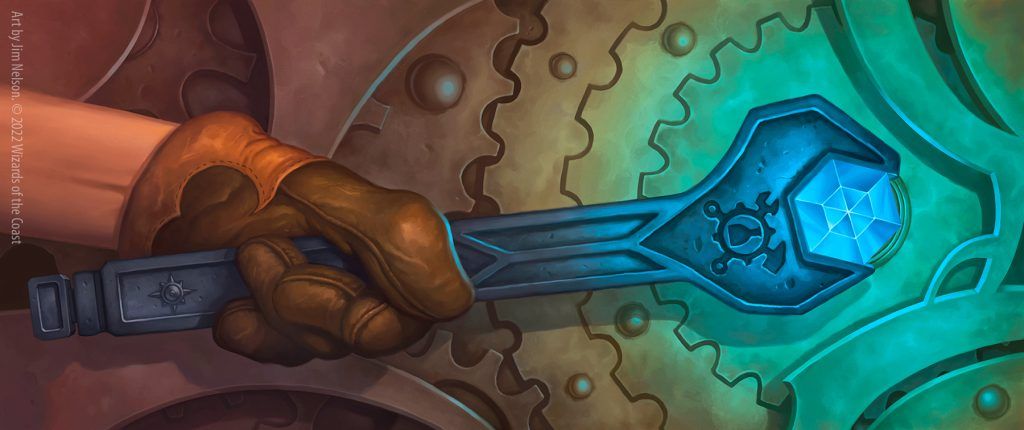
Alchemist's Talent | Illustration by Milivoj Ceran
Class cards are enchantments that can be “levelled up” by paying an associated mana cost. Levelling up sometimes means another static ability is now in effect, and sometimes it triggers a triggered ability.
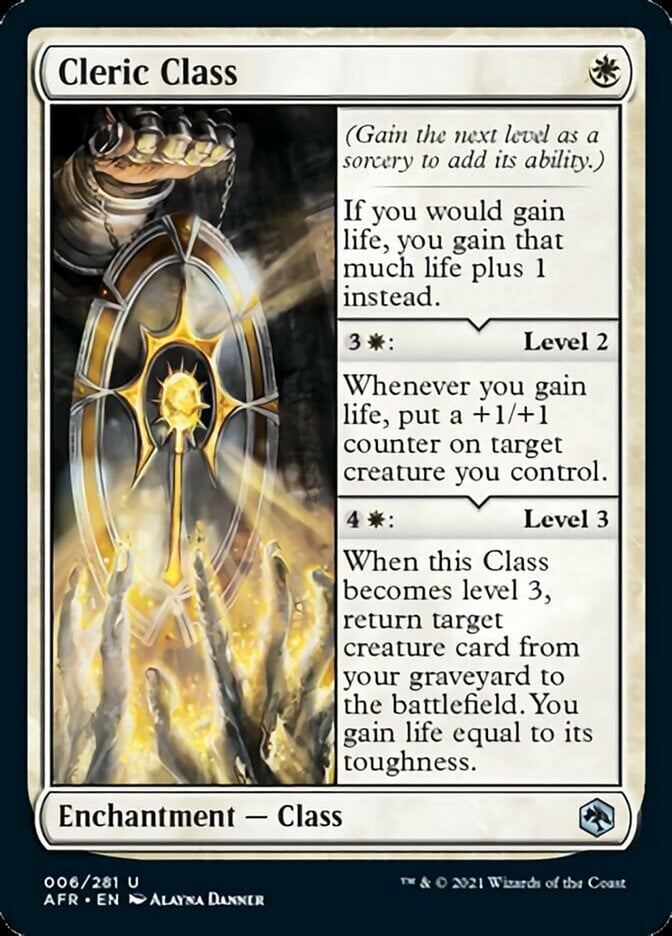
Take Cleric Class for example. When it enters the battlefield only the first level is active. When upgraded to level 2 by paying there’s a passive ability that triggers whenever you gain life. Paying to level up to the final ability reanimates a creature from your graveyard. You can only activate each level once, and only in numerical order.
It’s also worth noting that all of the previous levels are still active when a particular level of the class is activated.
Class cards were introduced in Forgotten Realms as an analogue to the character classes used in D&D. They’re like a cross between sagas and the “level up” creatures which were mainly seen in Rise of the Eldrazi. They were later reintroduced in Bloomburrow as simple “occupations “talents” like fisher, builder, blacksmith, and the like, then again in Teenage Mutant Ninja Turtles to add depth to some of the main characters from that franchise.
A Note on Alchemy Rebalanced Class Cards

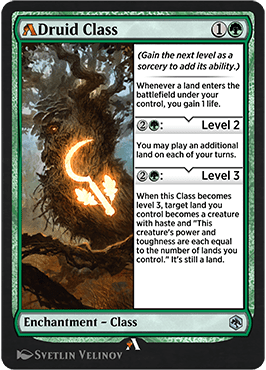

Three classes have rebalanced, digital-only versions on MTG Arena: Wizard Class, Sorcerer Class, and Druid Class. The main change is that their level 3 mana costs were reduced from 5 mana to 3 to be more viable in MTGA formats like Historic, Alchemy, and Brawl. For the purposes of this list, we’re referencing the cards as printed in paper.
#32. Monk Class
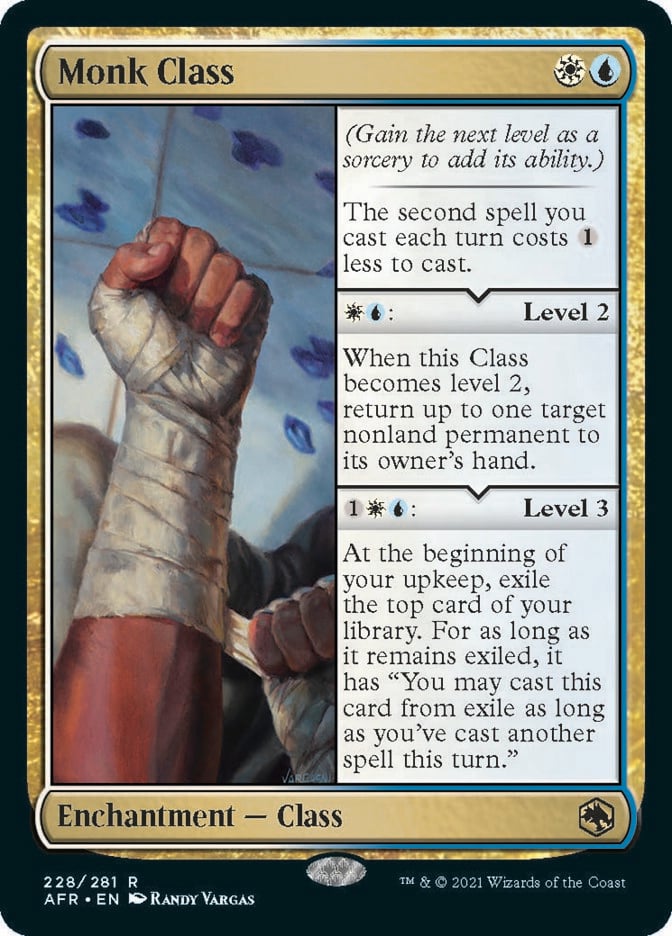
There was a cycle of five 2-color class cards at rare in the original Forgotten Realms set, each in one of the enemy combos. Most were very specific to one play style and weren’t particularly exciting.
Monk Class is the first of these. It’s based around the idea that you want to cast two spells in a single turn, and could have been intended to be played with the black and white archetype from Kaldheim, despite being an Azorius card.
Unfortunately it’s difficult to build around and not particularly interesting or powerful once you tick all of these boxes. Sorry, monk fans!
#31. Fighter Class
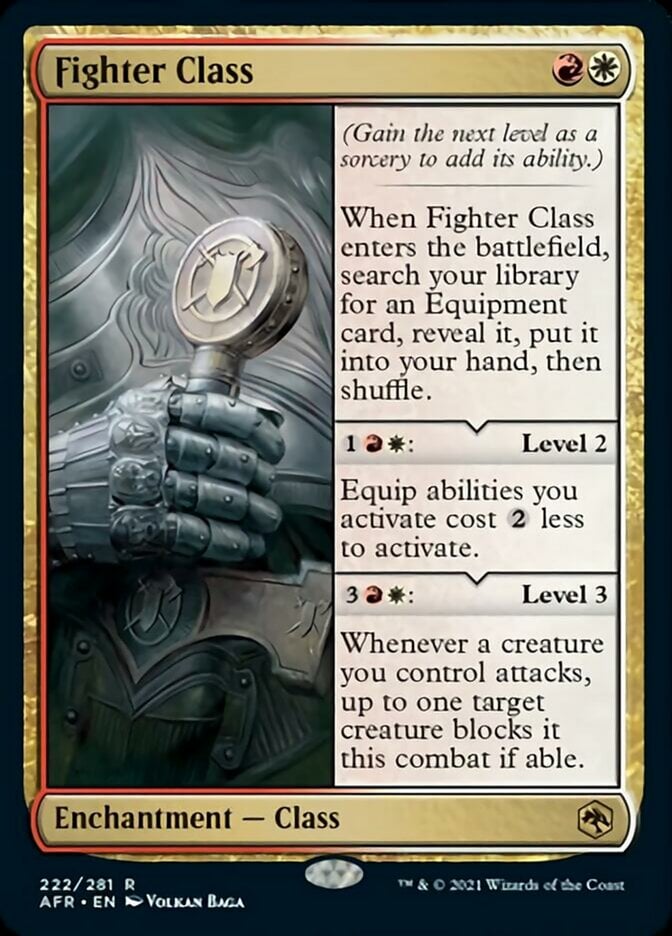
Fighter Class has some of the same issues as Monk Class, but it’s slightly better since equipment has a lot more support. It’s a 2-mana equipment tutor with some extra upside at its base. The second and third levels may be a bit expensive for a deck that likely wants to be aggressive, but you really can’t complain too much as an extra upside.
The second level in particular has some interesting uses. Reducing the cost of equipping things permanently is a fairly unique effect and has some particular interactions. Imagine only having to pay 3 mana total to unequip and re-equip Sunforger. That definitely has some synergies worth considering.
#30. Sorcerer Class
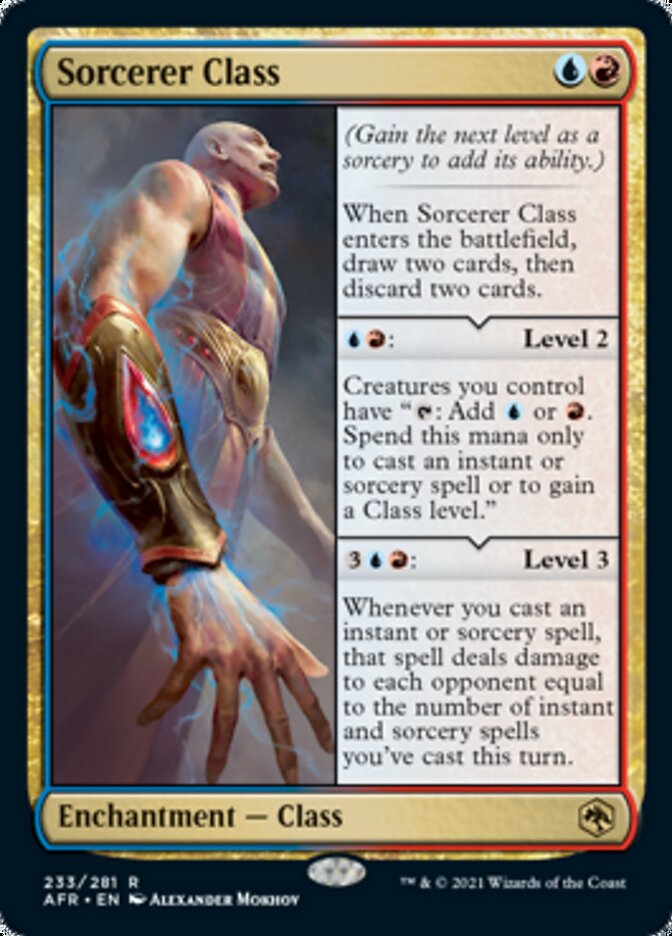
Sorcerer Class (unsurprisingly) cares about instants and sorceries. The abilities are quite an odd bunch, but they allow for some good synergies.
Paying 2 mana to loot two cards isn’t the worst rate in the world. The second level costs 2 mana but could easily pay for itself in the right deck. And while it might seem a bit at odds with a deck that doesn’t care about creature spells, there are plenty of Dragon Fodder-style spells that can make multiple tokens.
The final level is a real storm payoff and enabler. And you really can’t complain when you have a nice portion of gravy on top of some decent effects like this. It might be a specialized class, but as one of the strongest Izzet enchantments, it would fit really well in a spellslinger deck like Veyran, Voice of Duality.
#29. Alchemist’s Talent

Like Fisher's Talent, Alchemist's Talent is powerful, but it requires a lot of time and effort to be good. This red enchantment’s natural home is in a deck that already takes advantage of Treasure, like a Prosper, Tome-Bound Commander deck.
Four mana gets you two tapped Treasure tokens, which is a little worse than casting a Big Score. Going into the late game, you’ll get twice the mana from Treasures, and dome your opponents when you use them to cast spells.
#28. Fisher’s Talent

Fisher's Talent is an expensive but crazy powerful Simic card. It’s not without downside, as it makes you wait for a full turn after investing your mana. But from there, you get to draw an extra card on your upkeep, and if it’s a land, you get a free 1/1 fish. When you upgrade the class, these 1/1 tokens become 3/3s and later 8/8s. That’s powerful, but also a 10-mana investment, so look for this card if you’re the Simic () ramp deck that plays lots of land.
#27. Rogue Class
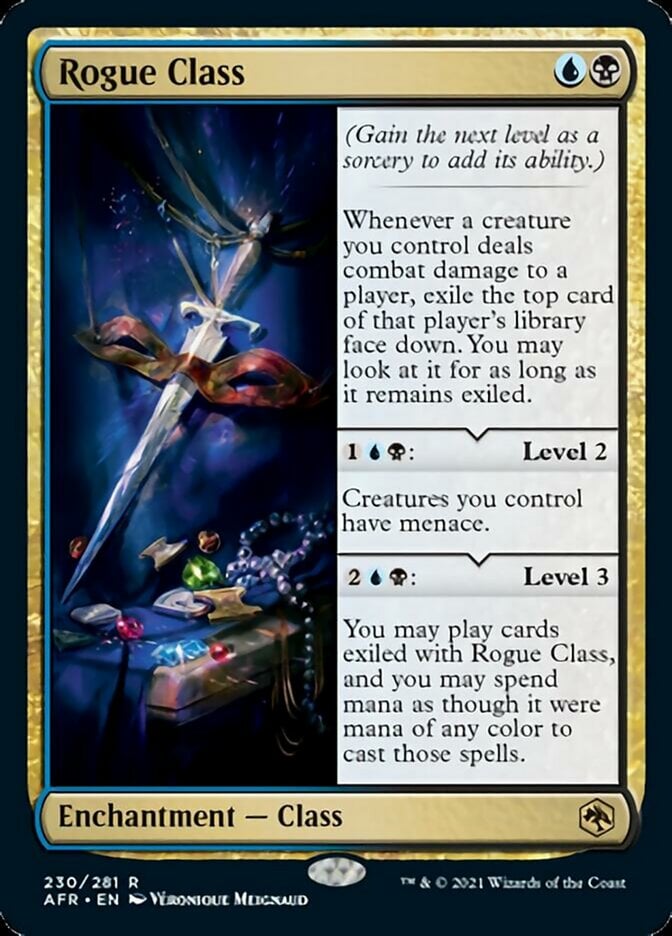
Rogue Class is fairly unusual in that you really need to level it all of the way up for it to start doing its thing. The first two abilities are really just enablers for that, but it’s pretty powerful once you’ve spent nine mana on it.
Not only that, but it scales in power with your opponents if you’re playing Commander since it’s a Gonti, Lord of Luxury effect and you’re playing their cards. It’s never going to be overpowered, and that can be a good thing.
You need some good evasive creatures to get the most out of this. That suggests rogues as the best bet with ninjas as a nice backup. You’ll be looking either for a commander that cares about hitting your opponent like Anowon, the Ruin Thief, or something that makes it likely that you’ll get to hit the opponent with multiple creatures like Oona, Queen of the Fae.
#26. Gossip’s Talent

Gossip's Talent is a saboteur’s dream card. First, you get to surveil when creatures enter, so you have a pseudo-Search for Azcanta on the battlefield. You’re also making small creatures unblockable, so think about all those ninjas and creatures that deal damage and draw cards, or even a ninja commander like Yuriko, the Tiger's Shadow. The last step is that you get to blink the creature that dealt damage. Better get that Mulldrifter in the red zone!
#25. Warlock Class
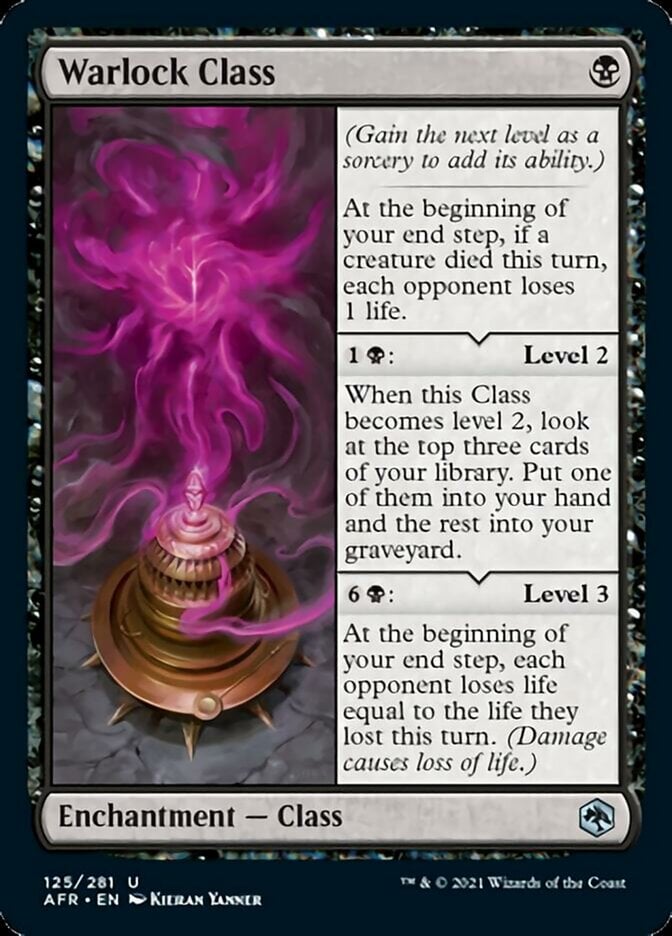
Warlock Class is a bit more generic than a lot of the cards we’ve looked at so far. The abilities don’t point in any particular direction, but it’s particularly useful in an aggro build.
The first ability is a very black one. Something dies and your opponents lose life. Not bad, but not really good enough by itself. But the second ability is pretty good, drawing the best card out of your top three and the rest go into your graveyard. That’s comparable to Ransack the Lab with a lot of extra upsides.
The last level is expensive but potentially devastating in the right build. It essentially doubles the amount of damage you can do, making it much easier than normal to kill your opponent through damage.
This is good in creature aggro as well as decks built around draining life. And while it may not be quite as powerful as the previous cards when they’re in just the right deck, it’s a lot more versatile.
#24. Gourmand’s Talent

Here’s a powerful nod to lifegain. Gourmand's Talent allows you to turn artifacts into food so you can get your lifegain payoffs going. Getting a free 3/3 once every turn if you gained life is strong, and that pushes you into gaining life on your opponent’s turn. Once you get into the final stage, lifegain nets you free +1/+1 counters on all creatures. This card is maxed when you have ways to sacrifice Food during their turns or when you have many lifelink creatures ready to attack or block.
#23. Druid Class
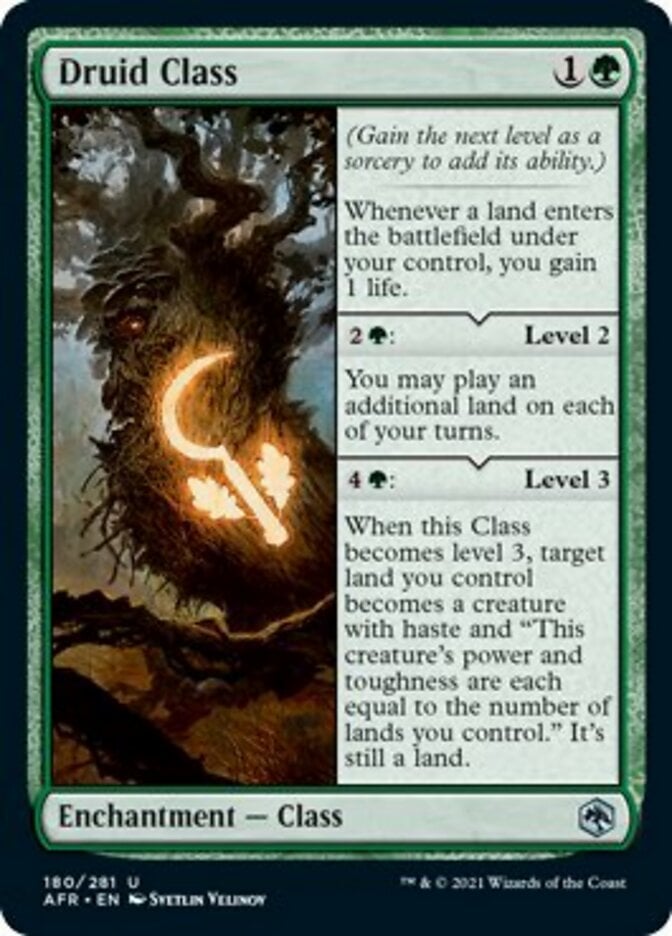
Druid Class is another card that can probably slip into any deck in its colors. It’s all about land synergies and gains you a bit of life to keep going as you level it up.
The problem here is that it’s just a bit lackluster. None of the abilities seem particularly interesting or unique and it doesn’t feel like any of them are really worth the mana investment. Maybe it should be lower on the list but the fact that it can go in pretty much any green deck just barely saves it.
#22. Wizard Class
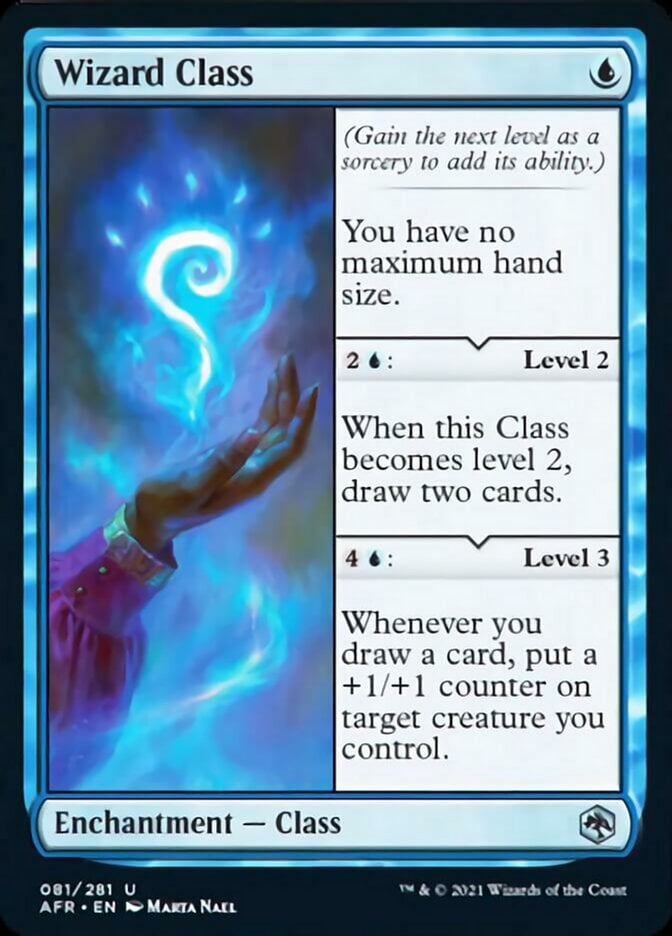
Drawing cards is what blue does, and that’s exactly what Wizard Class cares about. The first level allows you to have all of the cards you could ever want in your hand, and the second level is a Divination that draws a couple cards.
But the last ability is what we’re here for. You also get to put a counter on a creature whenever you draw a card? Not only does that sound like it goes amazingly in a tempo deck, it also has some infinite combos.
Either Benthic Biomancer or Fathom Mage will draw a card when you put a counter on them and trigger this again. Of course you’ll need a way to stop the loop before decking yourself here, but all you need to do is have another creature to put a counter on. At that point you have a huge number of ways to win. Any card with a janky 2-piece combo has my interest.
#21. Barbarian Class
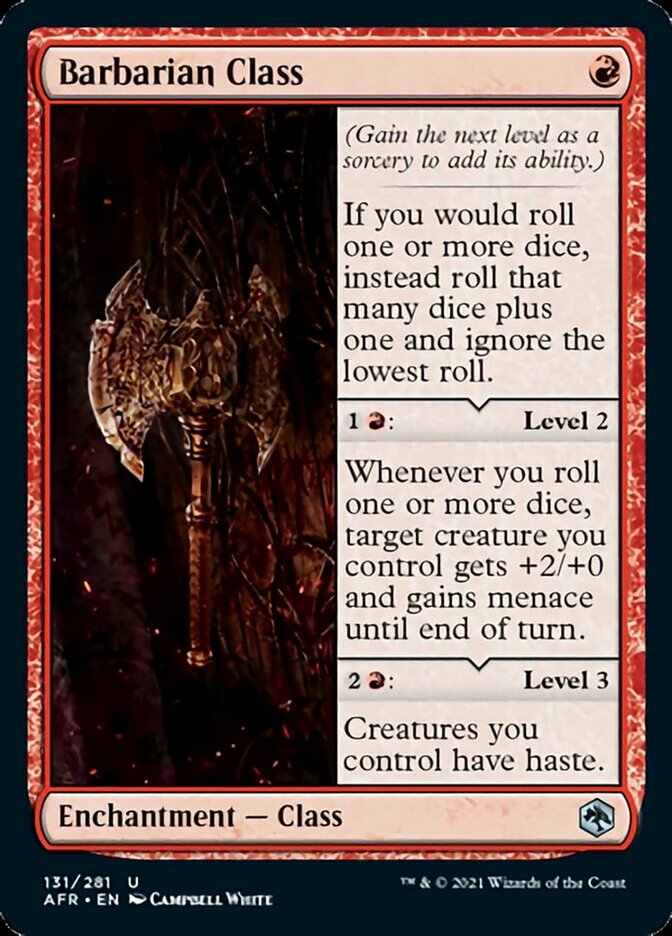
This is a particularly fun one. Clearly meant to be played along dice-rolling cards, Barbarian Class may be less versatile than Wizard Class and Warlock Class, but what it gives up in flexibility it more than makes up for in sheer fun! It’s actually a powerful combo piece before you even level it up at all.
Delina, Wild Mage has the chance to go almost infinite with this. Well, to be honest, it has the chance to do that by itself, but this card makes it much more likely. You can target another creature to create a copy when Delina attacks. You roll a d20 when you do. If that result is 15 or more, you get to try again.
With Barbarian Class out you have two chances at this. While it’s not as effective as copying Pixie Guide, it’s a useful piece nonetheless. And it helps with the shenanigans even more once it’s levelled up.
#20. Hunter’s Talent

Hunter's Talent offers you a bite effect at the base rate, and from there you can build something better. This green enchantment is an interesting way to add removal to your green big creature decks, and late into the game, you get a Garruk's Uprising effect.
#19. Blacksmith’s Talent

Blacksmith's Talent gets better if your deck is into expensive equipment. At first, you’ll get a +1/+1 equipment token, which is underwhelming unless you have equipment synergies. By upgrading this red card, you get to equip expensive equipment at will, or for Mirrodin! cards. I’d play this class with a Boros () equipment commander due to all the synergies involved.
#18. Fortune Teller’s Talent

Fortune Teller's Talent gives you a quick reward for just 1 mana, and to maximize this blue enchantment, you should be casting many cards from exile. Think of Vega, the Watcher decks in EDH, or decks built around the Doctor Who paradox mechanic or the foretell mechanic. And although conditional, getting to play cards from the top of your library is a powerful engine, especially with the cost reduction.
#17. Paladin Class
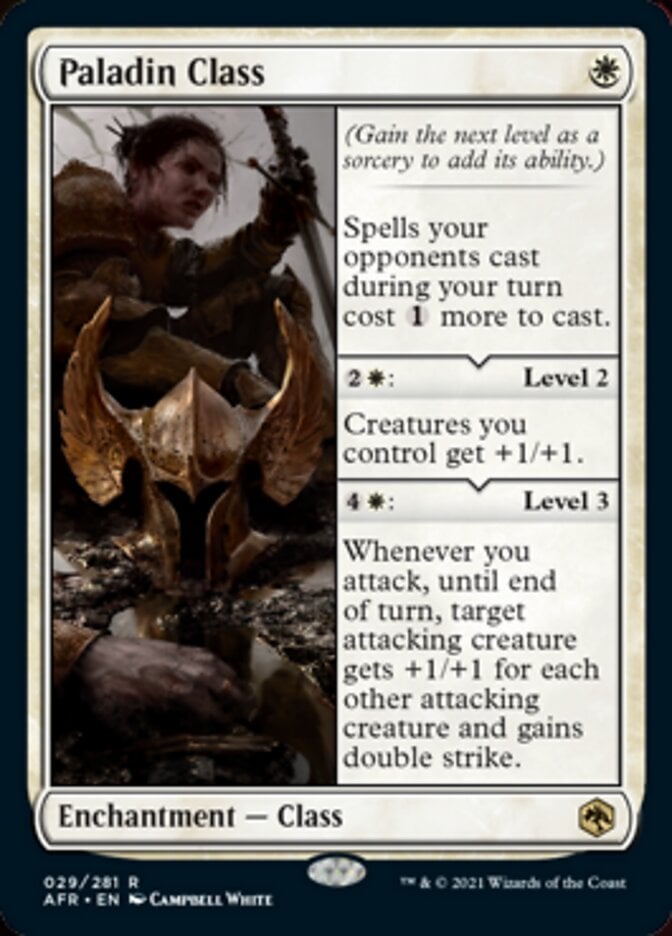
Paladin Class has an odd mix of abilities, but they all somehow work together. It’s pretty much exactly what a white weenie deck wants apart from creating a body. But the first ability helps protect what you’re doing, mimicking Thalia, Guardian of Thraben’s effect.
The second level is an anthem, and while not bad for 3 extra mana, it isn’t breaking the world in two. But the last ability has the potential to hit for a big amount, especially when you target a flier. You can win quite easily from commander damage too if you pair it with a Voltron commander.
#16. Does Machines
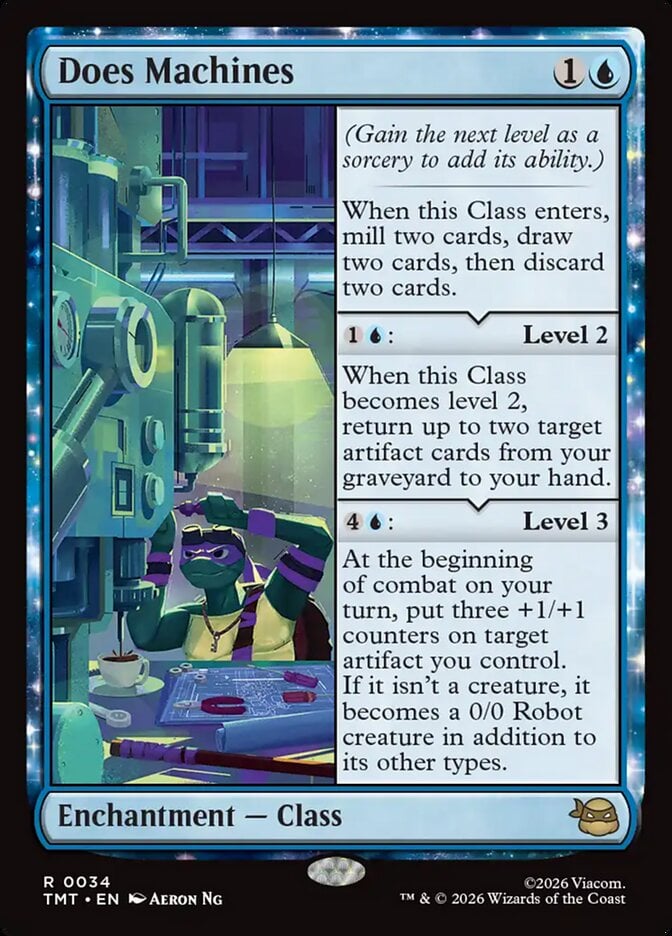
Does Machines indeed does an excellent job of filling your graveyard for threshold and lessons, but to get the most of it, you should be playing artifacts. You can retrieve two artifacts you’ve discarded before or lost on level 2. If you’re playing this just for the graveyard-filling capabilities, you’re underutilizing this card. Late game, this card will give you a steady stream of 3/3 artifact tokens.
#15. Scavenger’s Talent

One of the best aspects of Scavenger's Talent is that you can get to the last level with 6 mana total. This black enchantment‘s abilities feed into one another: Your creatures die and you make Food, and if you sacrifice three permanents, you mill six cards and get to reanimate something. And just casting this great sacrifice payoff for 1 mana means that your creatures all gain you some life back while also feeding the forage mechanic.
#14. Artificer Class
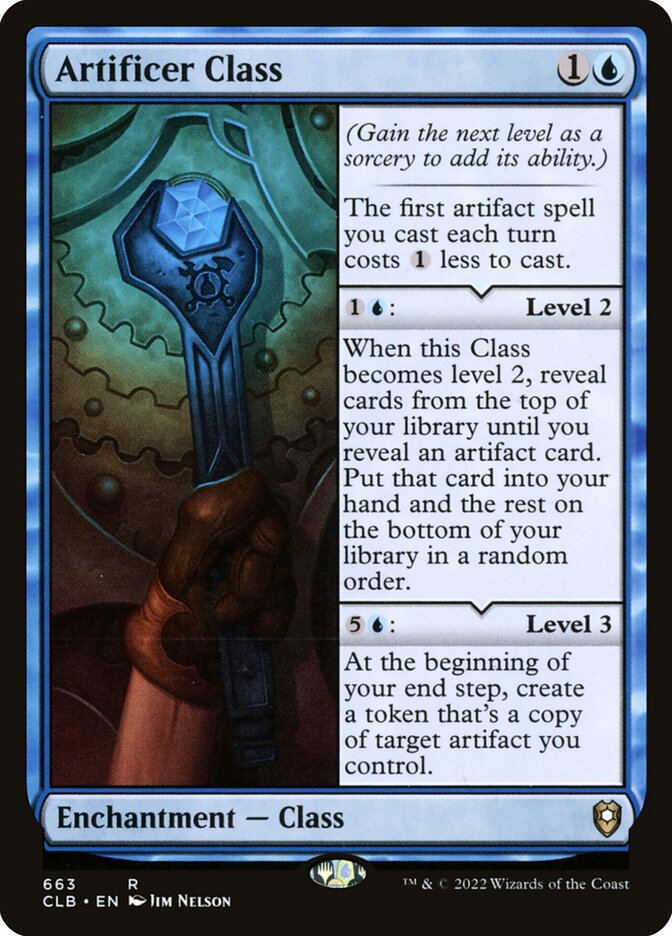
The only AFR class that didn’t come from the main set, Artificer Class was printed in Battle for Baldur’s Gate. True to its name, this card cares about artifacts.
The first ability is definitely a bit tame, only discounting one spell per turn. The second ability is pretty interesting if you’re being particularly sneaky and only have a single artifact in your deck since you can guarantee you’ll get that card.
The final ability has some spice to it, too. Copying your most powerful artifact on your end step every turn is great in a deck that cares about it. Six mana may be a lot, but artifact decks often have ways to create a lot of it pretty easily. Not to mention that enchantments are generally fairly difficult to remove from the battlefield, so it’s going to be somewhat protected once you get it to level 3.
#13. Bard Class
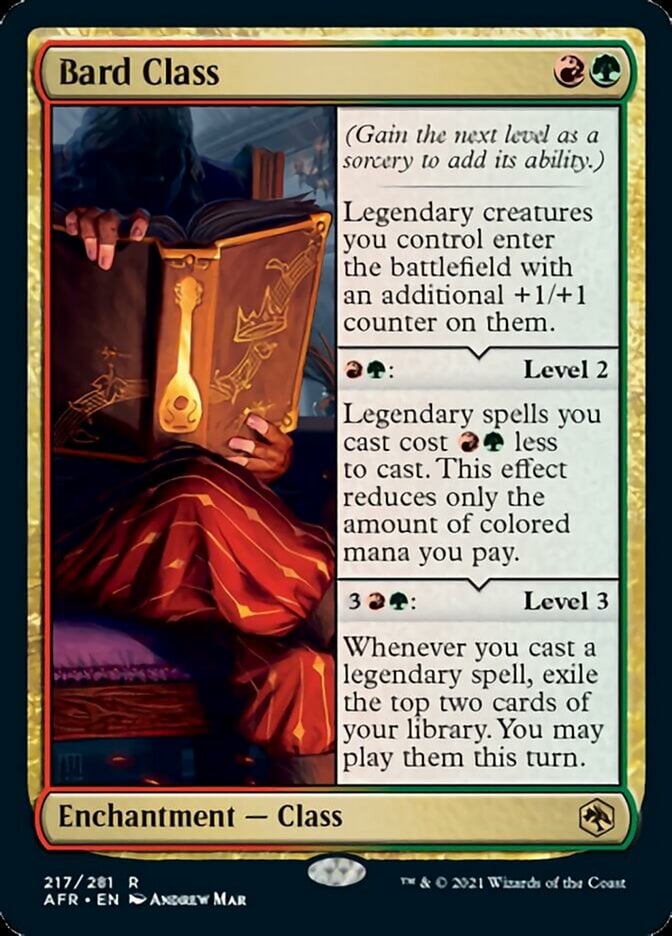
Remember how I was down on these very specific 2-color class cards? Well, I have a bit of a soft spot for Bard Class.
The combos with this card are pretty fun. Any legends that cost , , or are free once you get the second level activated, and anything else is discounted heavily. The last level lets you “storm off” and keep casting legends that you exile from the top. Combining this with something like Birgi, God of Storytelling can keep your mana topped up to keep the party going.
#12. Cool but Rude

Cool but Rude can complement Monument to Endurance strategies very well, and those are all over the place in formats like Standard. It’s also a cheap class to level up, and the final level is a Gamble that synergizes with what you’re doing. Better in aggressive decks.
#11. Party Dude
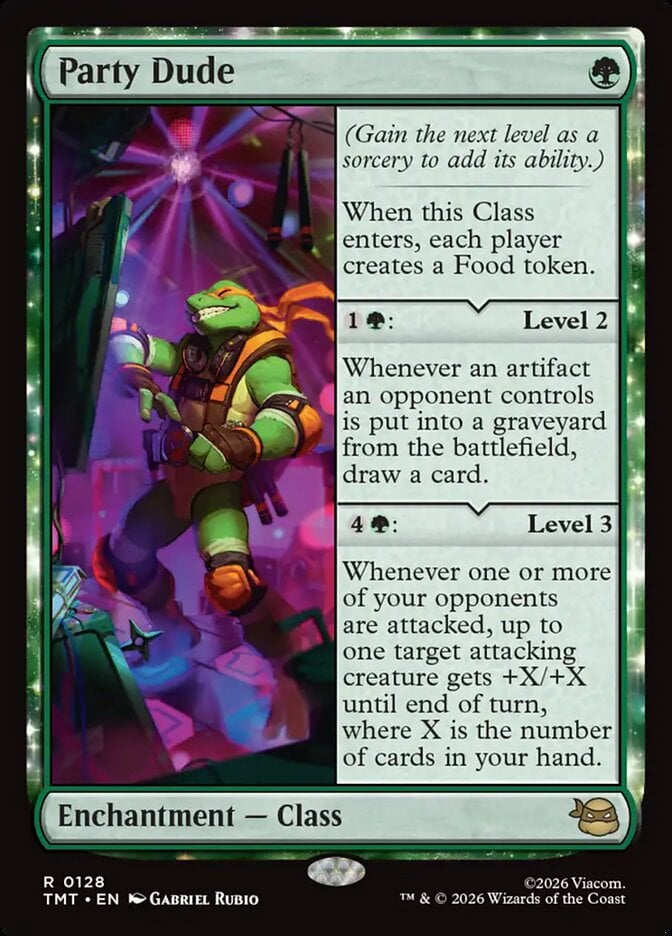
I like that Party Dude also gives your opponents a Food, but if they sacrifice it, you get to draw a card. This is a metagame-dependent card, but look, if your opponents are keen on ramping via Treasure or cracking lots of Clues/Food, you get to leech on that. Very strong Commander card and a nice green draw engine, but not that good in 1v1.
#10. Cleric Class
You’ll likely have come up against lifegain decks if you’ve played any Constructed games on Arena. Love them or hate them, they’re popular and often effective. Cleric Class fits fantastically into decks built around this kind of effect, whether it’s mono-white with Heliod, Sun-Crowned as your powerhouse or splashing another color like green with Trelasarra, Moon Dancer.
This class’s first ability is actually pretty good for a single mana, increasing the amount of life you gain. And when you have lots of way to gain 1 life it basically doubles how much life you’re netting.
The second ability can make anything into an Ajani's Pridemate, which is what these decks want. The final ability, while not game-breaking, is a good way to come back from a board wipe, which is where a lot of these decks are weakest.
#9. Artist’s Talent

Artist's Talent might as well be called spellslinger’s talent. Getting to discard and draw every time you cast a noncreature spell is nice fuel, ditching excess lands or cards you don’t intend on casting and churning through your deck. You’ll also grow your graveyard fast for mechanics like delve and threshold. It doesn’t stop there, making your spells cheaper to cast and dealing extra damage. This card can power your UR deck all by itself, and it doesn’t require that high of a mana investment.
#8. Leader’s Talent
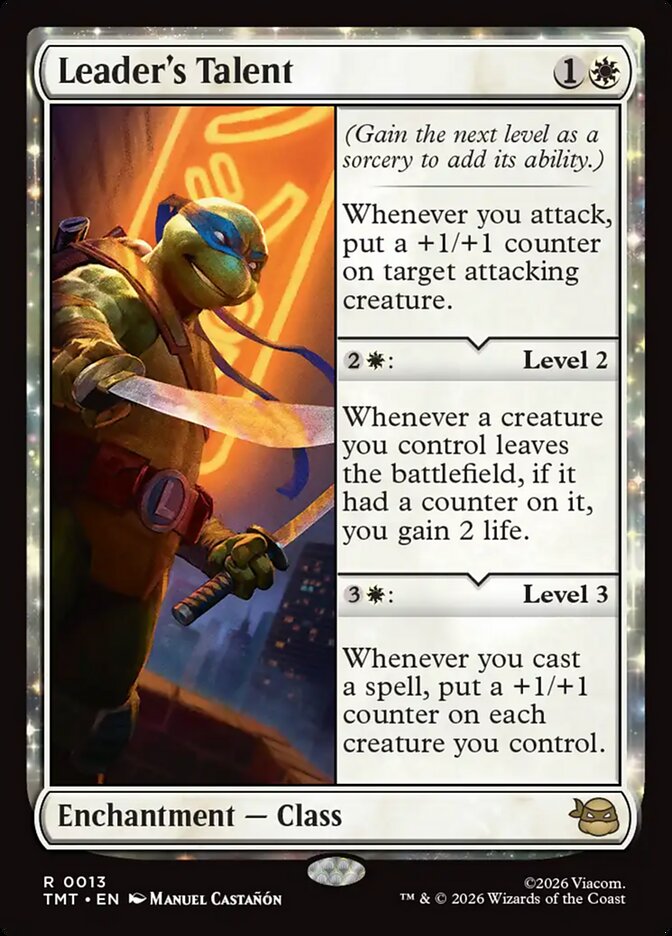
Leader's Talent looks like those cards that do a lot of different things all over the place, and none of them is really good. I’m evaluating this just on the first ability. Curving a 1-drop into this card, attacking, and getting a +1/+1 counter is a good plan, especially with fliers. Unlike Ranger Class that creates its own creature, this can flop if you don’t have a board.
#7. Builder’s Talent

Builder's Talent has a place in Standard, buying you some time with a 0/4 wall, and if you manage to loot away some expensive enchantments or planeswalkers, you can reanimate them. This talent sees some play with Omniscience in Standard.
#6. Bandit’s Talent

Bandit's Talent’s been a key piece in discard decks, making your opponent discard a card and profiting if they have one or few cards in hand. It also provides a wincon for discard decks, because it’s very common for that strategy to have lots of ways to discard cards but no plan for advancing the board.
#5. Ninja Teen
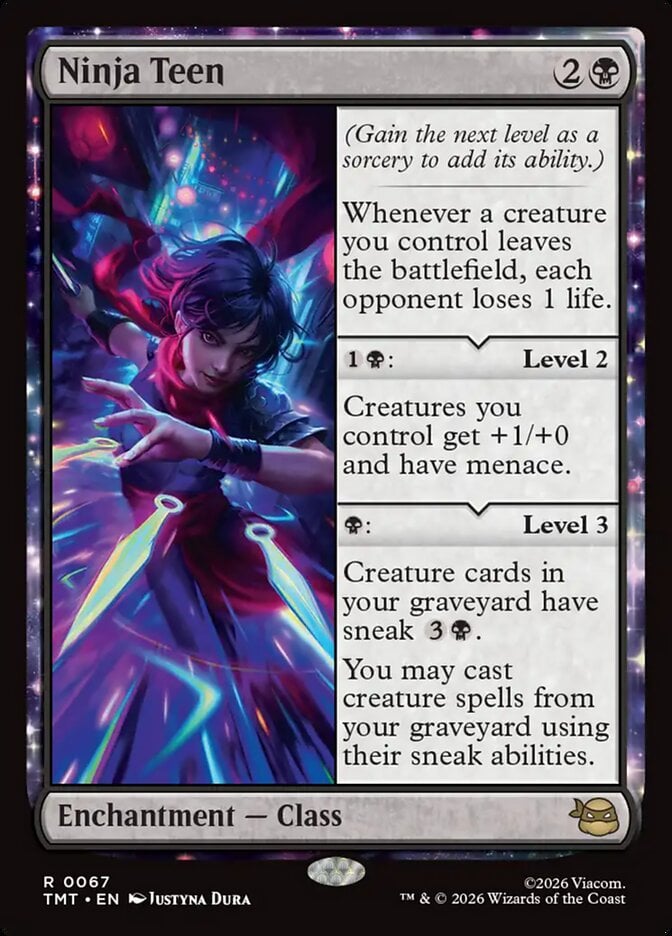
You’ll need to spend some mana on this class, but it delivers in the long run. Ninja Teen is a payoff for a lot of different stuff, including ninjutsu and sneak, creature sacrifice, mobilize, and much more. If you continue to level this up, you’ll get a strong attack bonus with +1/+0 and menace, not to mention inevitability when you can sneak creatures straight from your graveyard.
#4. Caretaker’s Talent

Caretaker's Talent pays off token decks handsomely, being able to “populate” and draw you cards consistently. Plus, it’s hard to interact with these effects, especially in best-of-one matches, so it snowballs very quickly.
#3. Innkeeper’s Talent

Once Innkeeper's Talent is fully charged, it acts like a Doubling Season, and many planeswalkers can win you the game from there, like Vraska, Betrayal's Sting. Unlike Doubling Season, you can get value right away just by getting a +1/+1 counter every turn or putting ward 1 on your permanents with any kind of counters on them.
#2. Stormchaser’s Talent

I like cards that give you a quick return, and with Stormchaser's Talent, we have a 1/1 prowess creature for only 1 mana. Good start, indeed. Later, a 4-mana investment gives you an Archaeomancer-like effect, so you can get whatever you need back. I think of it like a creature with kicker, although one you can invest the mana into later.
#1. Ranger Class
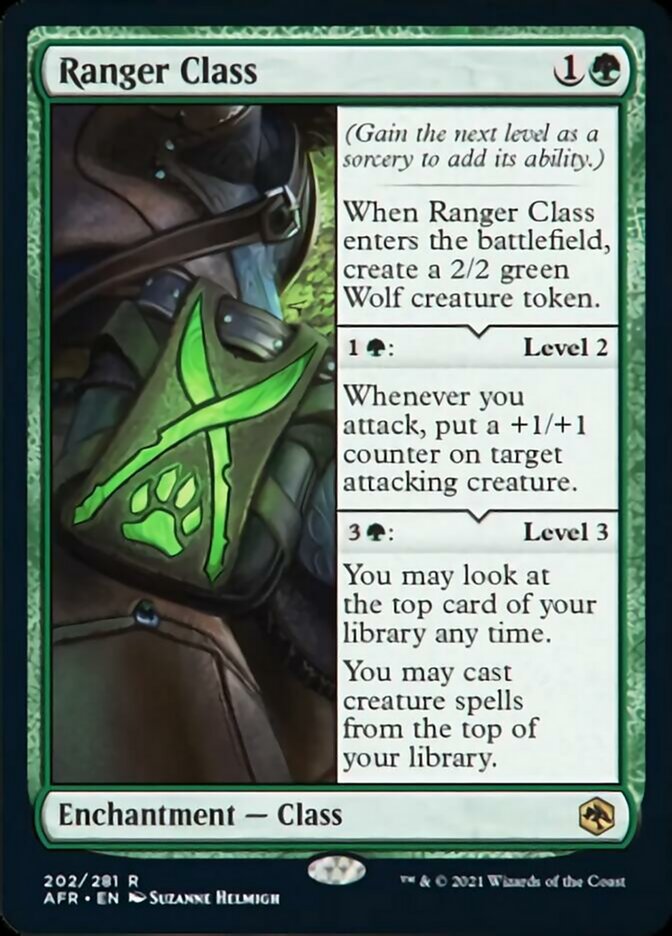
So what makes Ranger Class the top card on this list? It may be influenced by the time this card absolutely dominated in Standard, but it definitely gets you some good value.
It’s a rare instance of feeling like every mode on this card is worth the mana in isolation. A 2-mana 2/2 wolf may just be okay, but it can quickly get out of hand combined with the second ability. And the card advantage you can get in a creature-heavy deck if you manage to level it up all the way is incredible.
Can You Play the Same Class Twice?
Class cards aren’t legendary so there’s nothing stopping you from playing more than one of the same class card at a time.
Do Class Cards Stack?
The class card abilities generally do stack. For example, if you have two Druid Classes in play you’ll gain 2 life whenever a land comes into play, not just 1.
Can You Proliferate Classes?
No, despite being very similar to sagas, classes don’t actually use counters to represent their levels. So proliferating a class enchantment won’t usually do anything, and won’t level it up even if it somehow has counters on it.
Do Class Enchantments Use Level Counters?
They don’t. Class enchantments start at level 1, and they simply gain levels. You can use pieces like dice or other means to indicate which level your class actually is at a given point. But they aren’t counters or level counters, and as such, they can’t be manipulated or proliferated. Cards like sagas, which are very similar graphically, use lore counters, but that’s an entirely different matter.
Is Levelling Up a Class Enchantment an Activated Ability?
It is. To gain levels for a class enchantment, you need to pay the required mana at sorcery speed. That’s the definition of an activated ability. Levelling up uses the stack and can be interacted with by stifle effects.
Class Dismissed

Monk Class | Illustration by Randy Vargas
Looking through the list it feels like there’s a class card for almost every occasion. They’re generally good mana sinks, even if the abilities attached to them don’t always match the costs involved.
Classes have proven themselves popular for WotC to reuse their designs, like they did in Bloomburrow and TMNT, and I suspect that we’ll see more of them in future Magic sets.
What are your thoughts on classes? Which one is your favorite, both in D&D and in Magic? Let me know in the comments down below or join the discussion over in the Draftsim Discord.
And remember, stay classy!
Follow Draftsim for awesome articles and set updates:










3 Comments
Are there any DND classes they haven’t made yet? Because that’s what’s next.
Putting fighter class at second to last is bonkers but so is being a standard player.
Yeah I gotta bump up Fighter Class next time we update this.
Add Comment