
Last updated on April 24, 2026
Quandrix, the Proof | Illustration by Lucas Graciano
The first day of school is always exciting and terrifying. New friends, new teachers, new things to learn and so many possibilities of who you can become. This is true everywhere. But at Strixhaven, there’s an acute possibility that you could be turned into a toad in the process.
That’s what made Strixhaven such an amazing place when we were first introduced to it back in 2021. And now, five years later, we get to go back, fresh-faced and ready for more spells, more wizardry, and more mayhem. This time around, there are quite a few new mechanics that take the place of the old ones, but each of the five colleges still have that same school spirit.
That said, there’s a lot of new stuff to cover before the test, so use this as a study guide, because you’re going to need it if you don’t want to be incinerated by your professor.
Major Mechanics

Sanar, Unfinished Genius | Illustration by Justin Gerard
Prismari: Opus


Prismari () is the school of the arts at Strixhaven, and its students often find themselves obsessed with creating a grand spectacle. It’s therefore only fitting that their new mechanic, opus, conjures this same feeling of grandiosity that their school and its students are so famous for.
Opus is an ability word you’ll find printed on creatures, like Molten-Core Maestro, and it denotes an ability that has two parts. Firstly, it triggers when you cast an instant or sorcery, and secondly, the effect is bigger and/or better if you spent 5 or more mana to cast that spell.
It’s important to note that opus only cares about the amount of mana spent to cast the spell; it doesn’t care about the spell’s mana value.
Lorehold: Flashback


Lorehold () students are historians, through and through. They uncover the secrets of the past and use what they learn of antiquity to cast powerful spells. And what better way to encapsulate this reverence for history than with a blast from the past: flashback!
Flashback is a mechanic you’ll find on instants and sorceries that debuted way back in Odyssey block about 25 years ago, and it has popped up here and there throughout Magic’s history. It’s a fairly straightforward mechanic. Cards with flashback have a flashback cost, and they can be cast from the graveyard for this cost. Normal timing restrictions apply, and when a spell you cast with flashback resolves, it goes to exile rather than back to the graveyard.
Quandrix: Increment


Quandrix () students love numbers more than anyone, and they’re adept at finding even the most unintuitive solutions to complex equations. Thankfully for us, their new mechanic, increment, is fairly easy to calculate.
Increment is a keyword ability that you’ll find printed on creatures. If you remember evolve from the Return to Ravnica block, this is very similar. Whenever you cast a spell, if the amount of mana spent to cast it is greater than the power or toughness of the creature with increment, you put a +1/+1 counter on it.
One thing to be aware of when playing Secrets of Strixhaven is that the specific wording of increment means that the game checks twice to see if your creature gets a counter. It checks the first time when you cast a spell to see if the ability even triggers; if the amount of mana you spent to cast it was greater than the creature’s power or toughness, then it triggers. Then, it checks again as the ability resolves to see if the creature’s power or toughness is still less than the mana value of the spell.
Silverquill: Repartee


The students of Silverquill () are lexically beyond reproach, poignantly eviscerating their adversaries with verbal tact. The Silverquill mechanic, repartee, is evocative of this signature sharp wit.
Repartee is an ability word that triggers whenever you cast an instant or sorcery spell thattargets a creature. Each repartee ability does something different, but they all trigger this way. There are a few things distinct about repartee that are good to be aware of. Firstly, it only triggers from casting instants or sorceries; auras and other targeting spells don’t trigger it. Secondly, it triggers when you target any creature, so it doesn’t matter who controls it. Finally, each repartee ability won’t trigger additional times if a spell has multiple targets.
Witherbloom: Infusion


To the students of Witherbloom (), the cycle of life and death isn’t some grand mystery, it’s the topic of their 8:00 AM lecture. And when you’re playing a Witherbloom deck at the Secrets of Strixhaven prerelease, you’ll see that you gaining life and your opponent dying is no mystery either.
The Witherbloom mechanic is infusion, an ability word thatchecks whether you’ve gained life this turn. If you have, that’s great, you get a bonus! That’s about all there is to it. It can be any amount of life, and infusion still works even if you gain life then lose life in the same turn. It doesn’t matter whether your life total increased or decreased during your turn, just that you gained life at some point prior to the resolution of the spell or ability with infusion.
Set-Wide Mechanics
Prepared


While each of the colleges has its own thing going on mechanically, there are also some things that everyone gets to do.
Prepare is a mechanic that has two main parts.
The first part is the most visually obvious, the creature cards with a spell that takes up the right half of the text box. Its formatting might remind you of adventure spells from Eldraine, or more recently, omens from Tarkir: Dragonstorm, but it functions quite a bit differently. You can’t cast the spells in the right half of the text box like a regular spell, because they aren’t like regular spells.
When you play a creature with this formatting, it usually has something in the other half of its textbox that refers in some way to being “prepared”. Either it enters prepared, or you can do some action or meet some condition to prepare it. This designation of being prepared is the second part of the mechanic.
This is the important part. When a creature with one of these spells in the right half of its textbox is prepared, it means that you can cast that spell. If it has Lightning Bolt and it’s prepared, you can cast it. However, casting a prepared spell causes the creature to become unprepared. If you want to cast that spell again, you have to prepare the creature again somehow.
The way this works under the hood is that when you have a creature with a prepare spell in play and it’s prepared, you get a copy of that spell in exile, and when you cast the spell, it’s that copy in exile that you cast.
As for a creature being “prepared”, it’s a designation that a permanent can have that works in the same way as suspect in Murders of Karlov Manor. This designation remains until it leaves the battlefield or it loses it, and in the case of prepared, it can lose its designation by casting its spell or by certain effects that outright say that a creature becomes unprepared like Biblioplex Tomekeeper. However, changing control of a prepared permanent doesn’t change anything about its designation, so if your opponent somehow steals your prepared Emeritus of Ideation, they can cast Ancestral Recall.
Paradigm

Paradigm is another new mechanic that isn’t specific to a certain college, but it only appears on five cards in Secrets of Strixhaven. But it’s absolutely bonkers.
Paradigm does a few things, so we’ll walk through the steps. First, it exiles the spell as it resolves: You play a spell with paradigm, but it goes to exile instead of the graveyard. Pretty straightforward so far. Then, if this is the first time you’ve resolved a spell with that specific name in this game, you get to cast a copy of the exiled spell at the beginning of each of your first main phases, every single turn, for the rest of the game. Also of note is that you don’t have to cast the copy if you don’t want to; it’s a choice, and choosing not to cast the copy doesn’t prevent you from copying it on your next turn.
Additionally, every spell with paradigm in this set also has the lesson subtype, but there aren’t any cards that care about lessons in Secrets of Strixhaven, so for the purposes of Limited, it’s essentially flavor text.
Converge


For the last of the set-wide mechanics in Secrets of Strixhaven, we have an oldy but a goodie: converge.
Converge first appeared back in Battle for Zendikar, and it’s a fairly simple mechanic. It’s an ability word that cares about the number of different colors of mana spent to cast a spell. There are five colors of mana in Magic, so the output will be somewhere from 0-5. If there are any additional casting costs, mana spent on those also counts towards this calculation, but this only counts actual additional costs, which will be worded as such. Paying for a ward ability or paying mana so a Quench doesn’t counter it aren’t additional costs of spells, so any mana you spend on those doesn’t count towards converge.
Conversely, if you somehow cast a spell for free, the number of colors of mana spent to cast it is obviously zero. Also, if you copy a spell, the number of colors of mana is also zero because you didn’t spend mana to cast the copy.
Book

Books! You know what a book is. And now Magic does, too! Book is an artifact subtype that appears on Diary of Dreams; Wizards will likely use it on other books going forward, and they’ll apply it retroactively to some cards to be announced at a future date. As of this time, it doesn’t seem like the book type carries any special rules with it.
Hybrid Mana


This is something we’ve been seeing a lot more recently, but it’s always good to have a refresher. You’ll see hybrid mana symbols on some cards, and it just means that you can pay either type of mana in the hybrid symbol to pay for that cost. For example, Practiced Scrollsmith costs 1 red mana (), 1 hybrid red/white mana (), and 1 white mana (). You pay for the normal symbols as usual, and for the hybrid symbol, you get to choose red or white, whichever you want.
Cameo Mechanics
There are a handful of returning mechanics in Secrets of Strixhaven that only appear on a single card, including each of the five elder dragons. You might not see these cards in every game, but it’s good to study when your instructor is an enormous ancient dragon with high standards. They’d hate to be disappointed.
Storm

Prismari, the Inspiration gives your instants and sorceries storm. When you cast a spell with storm, you copy it for each spell cast before it this turn. This includes your opponents’ spells. Additionally, if you cast a spell with storm that has one or more targets, you may choose new targets for the copies you make. However, if you’re casting a modal spell with storm, something with the wording “choose one”, like Prismari Charm, the mode you chose is the same on all the copies.
Miracle

Lorehold, the Historian gives miracle 2 to instants and sorceries in your hand. Miracle, introduced in Avacyn Restored, is a one-of-a-kind mechanic that allows you to cast a spell for its miracle cost as you draw it if it’s the first card you’ve drawn in a turn. The important thing with miracle is that you have to cast it right away when you draw it if you want to cast it, and you get to ignore regular timing restrictions.
The other important thing with miracle is actually tracking it. If you play online, the computer handles everything for you like usual, but if you’re playing in paper, it’s important to differentiate which card you’ve just drawn from the rest of your hand, as it can be otherwise difficult to tell what you’ve just drawn. This likely results in a judge being called and you not being able to cast the spell for its miracle cost because you can’t prove that you just drew it this turn.
Cascade

Quandrix, the Proof has cascade, and it also gives cascade to instant and sorcery spells you cast from your hand. The is a mechanic originally from Alara Reborn that functions a lot like discover from The Lost Caverns of Ixalan. When you cast a spell with cascade, the cascade ability triggers and you exile cards from the top of your library until you exile a nonland card with lesser mana value. You cast that spell and put the rest of the cards exiled this way on the bottom of your library in a random order. Because cascade triggers when you cast the spell, this means that the spell you find resolves first.
Just be aware that because this is a cast trigger, if you have any other abilities that trigger from casting a spell, like increment, you can put them on to the stack in whichever order you want.
Casualty

Silverquill, the Disputant gives casualty 1 to each instant and sorcery spell you cast. Casualty is an ability that lets you pay an optional additional cost of sacrificing a creature with a certain amount of power, in this case 1 or more. When you cast a spell with casualty and you pay this cost, you copy it, and you may choose new targets for the copies. Just like with storm, if you’re casting a modal spell like Silverquill Charm and you copy it, you choose the same mode for the copy.
Affinity for Creatures

Witherbloom, the Balancer hasaffinity for creatures, and it gives your instants and sorceries affinity for creatures as well. This just means that it costs 1 less to cast for each creature you control. That’s it. You’ve likely seen a few cards more recently being printed with different versions of affinity, most commonly affinity for artifacts on cards like Memory Guardian, but it’s a mechanic that has been around since the original Mirrodin block which came out over 20 years ago.
Grandeur
Page, Loose Leaf has the grandeur ability word, a mechanic that first appeared in Future Sight on a cycle of legendary creatures; you may be familiar with Korlash, Heir to Blackblade. Grandeur lets you discard a card with the same name to get some effect, which is nice on a legendary creature because it means you don’t get punished for having multiple copies in your deck.
Commander Mechanics
For you Commander majors out there, there will also be five preconstructed decks, each with a handful of new cards alongside reprints. Among the new cards, there are some returning mechanics that not everyone at your table will be familiar with, so here’s a quick rundown on what you’ll see.
Myriad
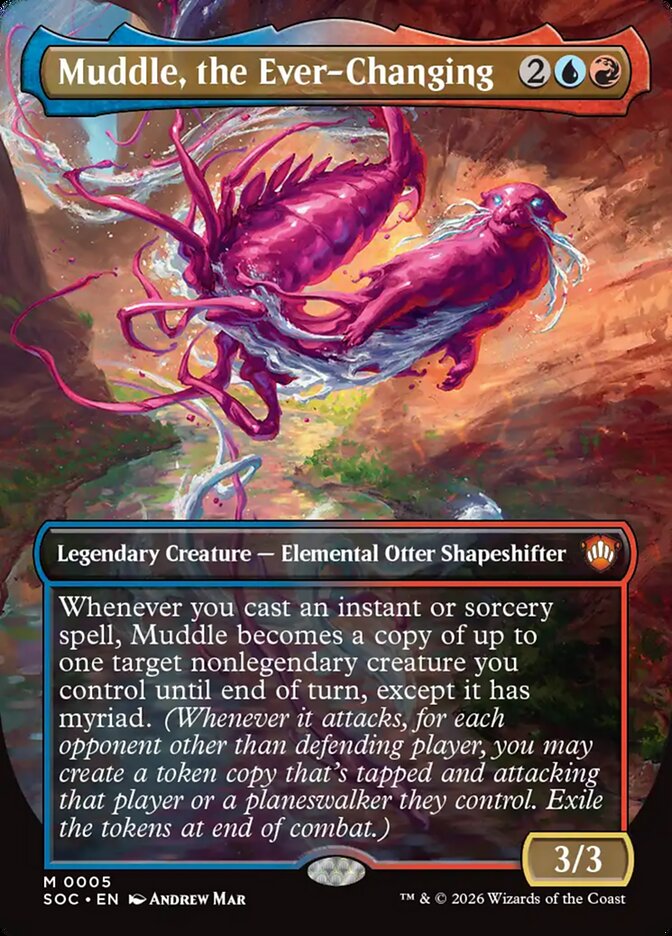
Myriad returns on Muddle, the Ever-Changing. Myriad is an ability that makes copies of the creature with myriad when it attacks, and those copies each enter tapped and attacking a different opponent (or planeswalker that opponent controls), and you exile the token copies at the end of combat.
Goad
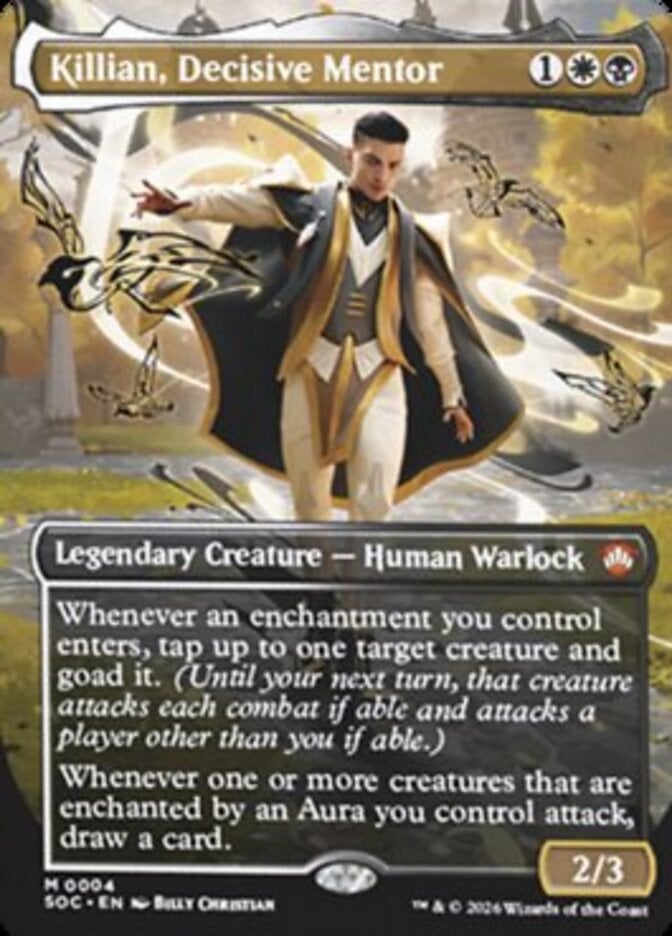
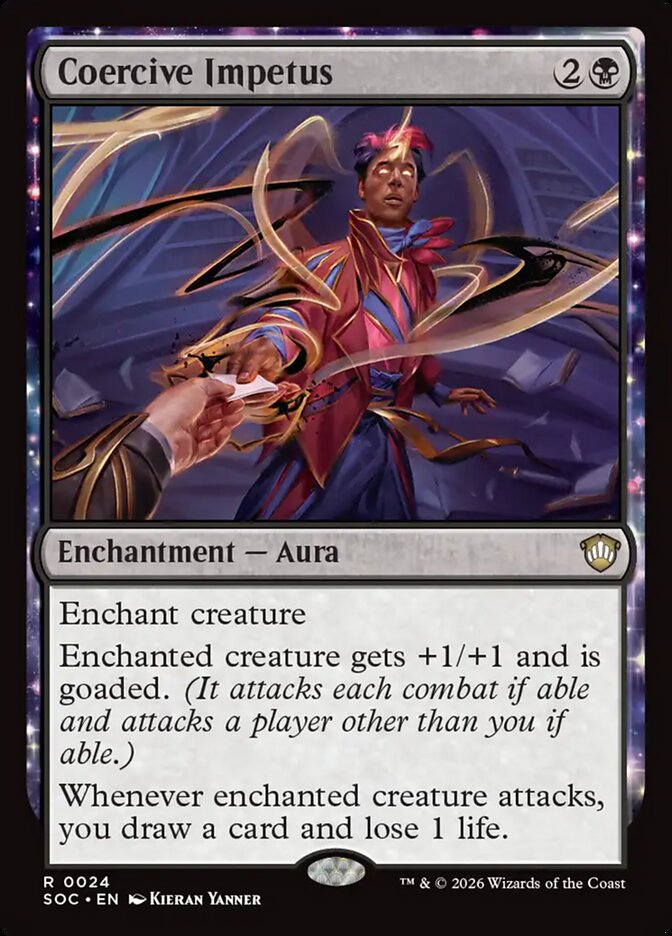
Goad also returns on a couple of cards from the Silverquill Influence deck. Goad is a keyword action that affects creatures. When a creature is goaded, until your next turn, it must attack if able, and it must attack a player other than you if able.
Replicate
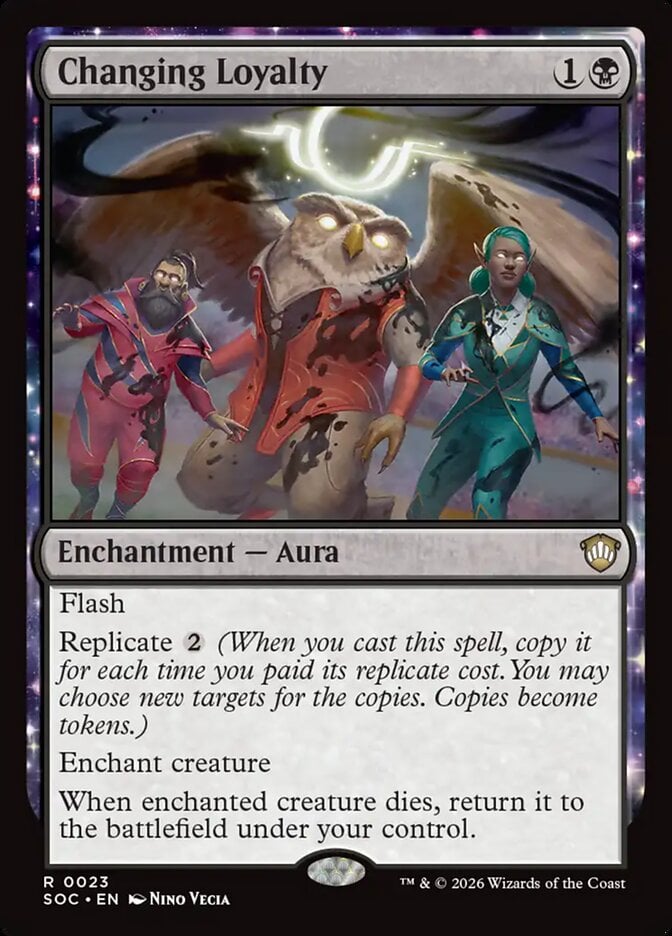
Replicate appears on Changing Loyalty. As you cast a spell with replicate, you can pay its corresponding replicate cost any number of times as an additional cost. If you do, you copy the spell for each time you paid this cost, and you may choose new targets for the copies. In the case of Changing Loyalty, it’s an aura, which means the copies of it become tokens as they enter, but this doesn’t count as “creating” a token for token doubling effects like Exalted Sunborn.
Gravestorm
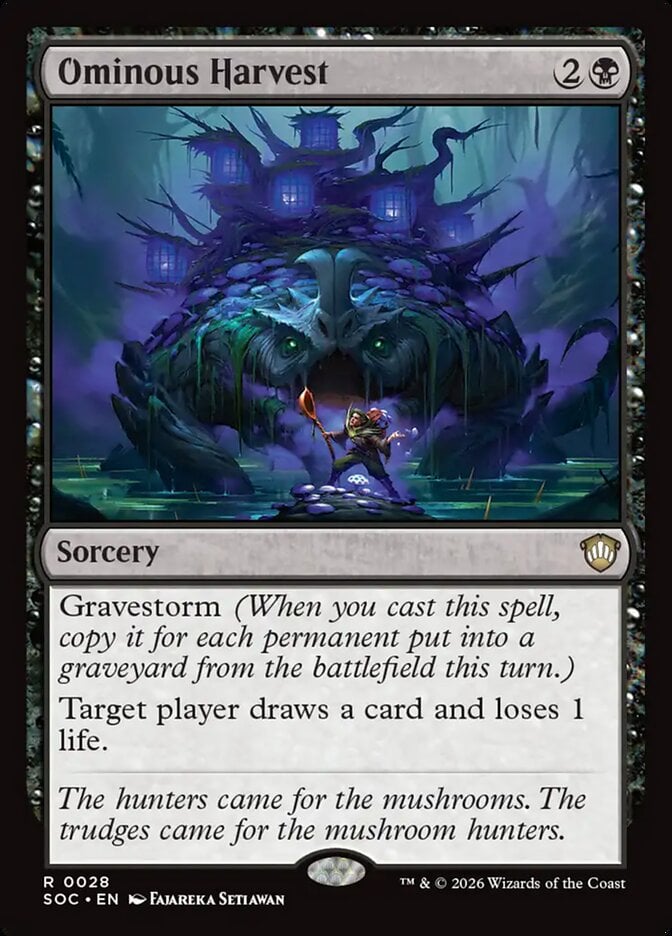
Gravestorm makes its third ever appearance on Ominous Harvest, previously appearing only on Bitter Ordeal and Follow the Bodies. Gravestorm is a keyword ability that copies the spell for each permanent put into a graveyard from the battlefield this turn. Notably, this counts all graveyards, not just your own. Tokens count towards this because the ability doesn’t specify that they have to be permanent cards, just permanents. Which tokens do in fact do, even though they cease to exist immediately afterwards.
Proliferate
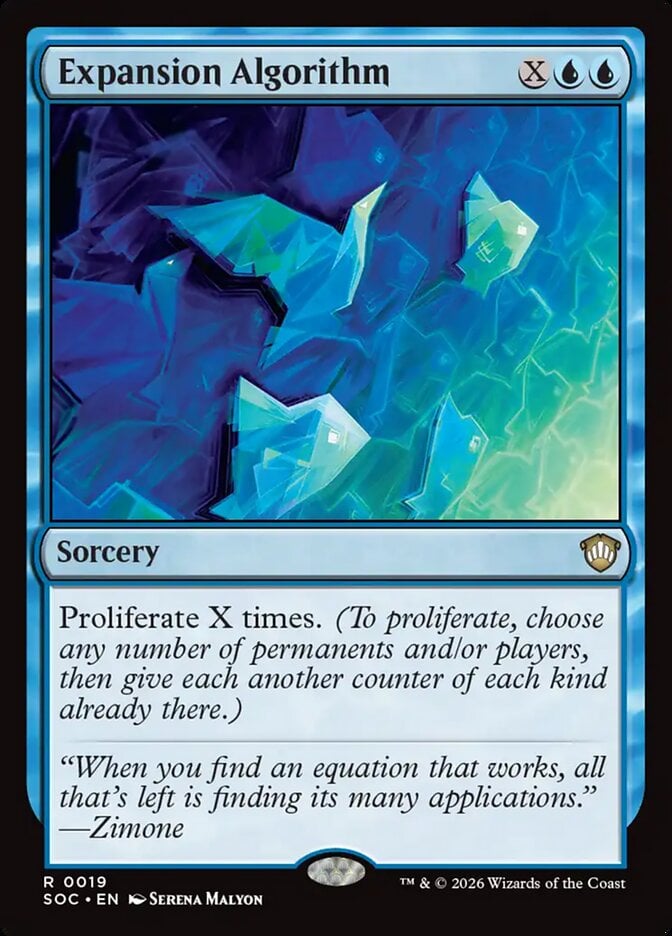
Proliferate is back on Expansion Algorithm. Proliferate is an action keyword that lets you choose any number of permanents and/or players and give them an additional counter of each kind already on that permanent or player. Proliferate notably doesn’t target, so you can still choose permanents and/or players with hexproof or shroud.
Devour
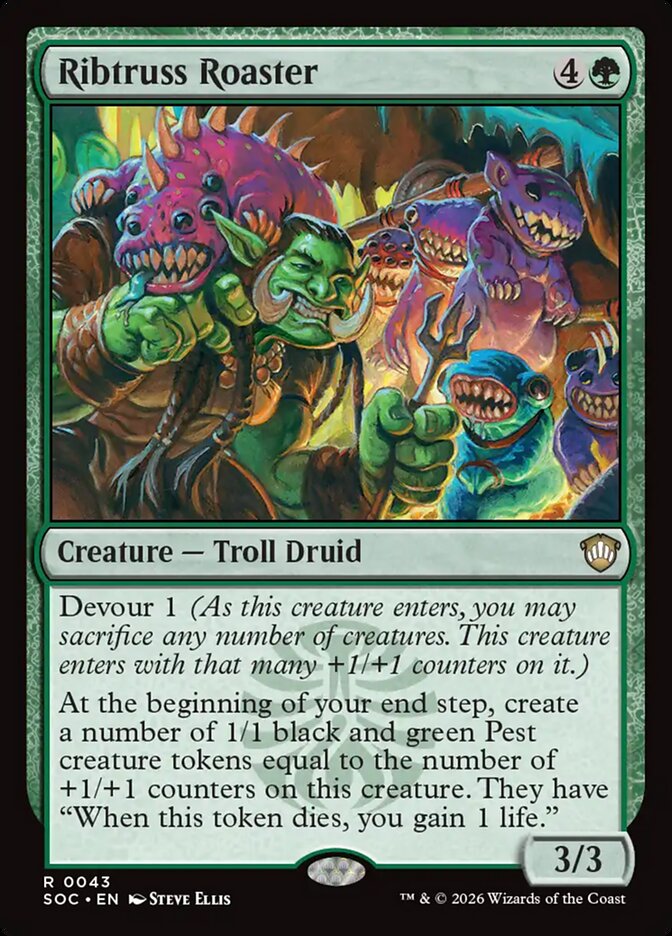
Devour returns on Ribtruss Roaster. Devour is a keyword ability that allows you to sacrifice any number of creatures as the creature with devour enters, and it enters with a number of counters on it equal to its devour number times the number of creatures sacrificed. Roaster only has devour 1, so it gets one counter per creature sacrificed.
Because of the wording of devour, you sacrifice creatures as it enters, not when it enters. This means that once the spell has resolved, your opponents can’t respond to you sacrificing creatures.
Council’s Dilemma
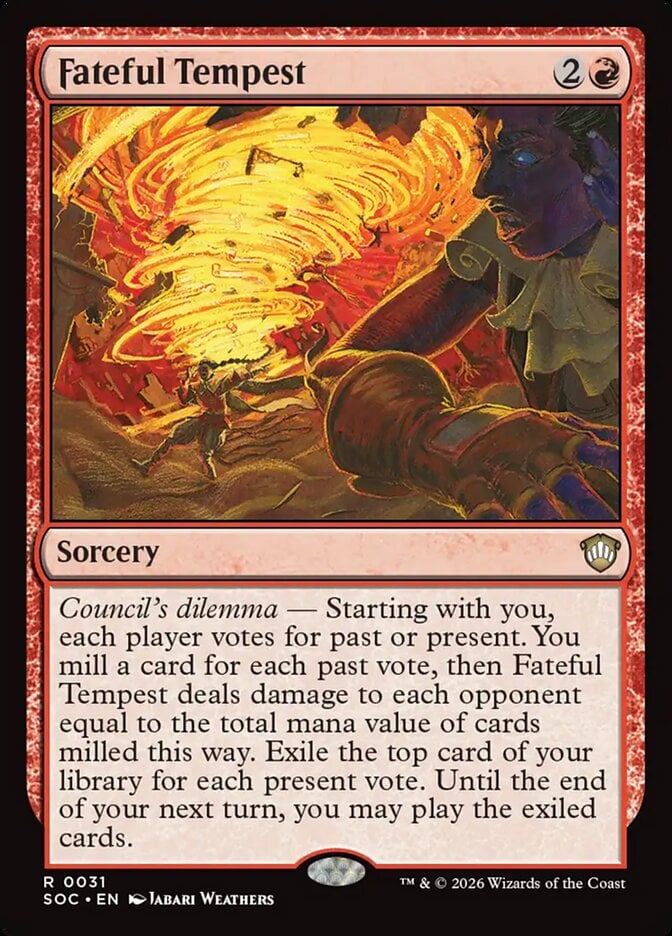
We also see the return of council’s dilemma on Fateful Tempest. This is a voting mechanic that presents players with two options, then everyone votes for one or the other in turn order, starting with you. Cards with council’s dilemma explain what happens for each, so there’s nothing you need to remember here. Just be sure to vote in the correct order.
Classes
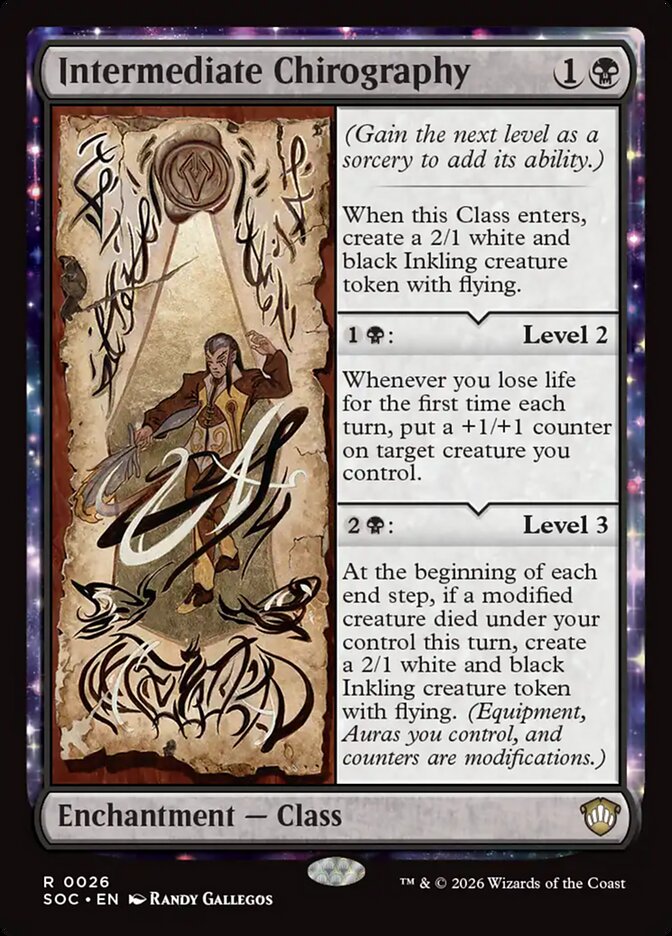
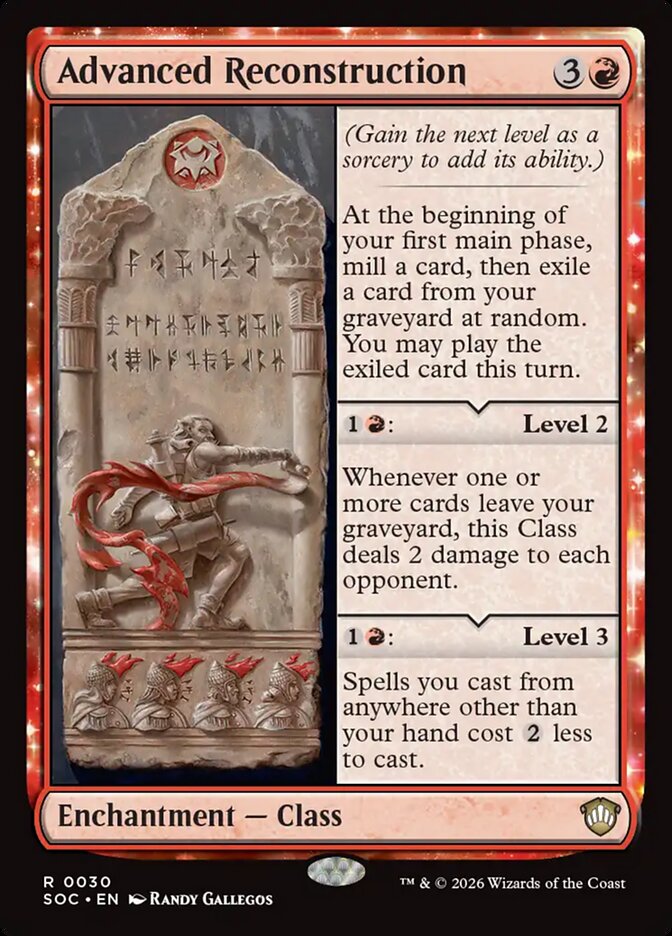
Finally, we have the return ofclasses, enchantments that have a textbox on the right half of the card that’s divided into different levels. You get level 1 just by having the enchantment in play, but the other levels aren’t active until you pay their corresponding costs, in order. You can only pay this cost at sorcery speed, which is during either one of your main phases while the stack is empty, and doing so gives you the next ability. After that, you have the option to pay the next cost down the line for the final ability.
Is Magecraft in Secrets of Strixhaven? How About Lesson and Learn?
No, magecraft doesn’t appear in Secrets of Strixhaven, nor does learn. There’s a cycle of mythic lessons with paradigm, though there isn’t any kind of lesson payoff or support in SOS.
Wrap Up

Abigale, Poet Laureate | Illustration by Olivier Bernard
It looks like a good year ahead of us at Strixhaven. Each of the colleges has its own mechanic that captures the special feeling of that school, and the prepare mechanic looks exciting. Paradigm is big and flashy, and each elder dragon gets to bring along something special on their card. Everything is about casting instants and sorceries, and this will likely make for a very cohesive experience playing Draft and Sealed. Despite this, we’re missing a few things we had last time on Arcavios. No more lesson/learn, or at least, not in a way that matters, and we’re also missing magecraft, even if opus does a pretty good impression of it.
Secrets of Strixhaven is set to have its Prerelease events starting April 17th, with the full set releasing on Arena on April 21st and in paper on April 24th, so make sure you’ve looked at the study guide.
Let us know how you’re feeling about the set in the comments below, and check out the Draftsim Discord for more MTG conversation! If you’re looking more from Draftsim, check out our daily newsletter and subscribe to The Daily Upkeep on YouTube.
Good luck on the test!
Follow Draftsim for awesome articles and set updates:










Add Comment