
Last updated on August 6, 2026
Through the Forest Gate | Illustration by Leon Tukker
Greetings planeswalkers! It’s time for a return journey to Middle-earth. You need not make the journey alone, however; this guide will be your faithful companion!
Read on to learn about everything you need for success in this set. I’ll cover The Hobbit’s mechanics, archetypes, best cards, rares, and more, plus I’ll throw in an example Sealed pool build for good measure.
Let’s set out!
Introduction
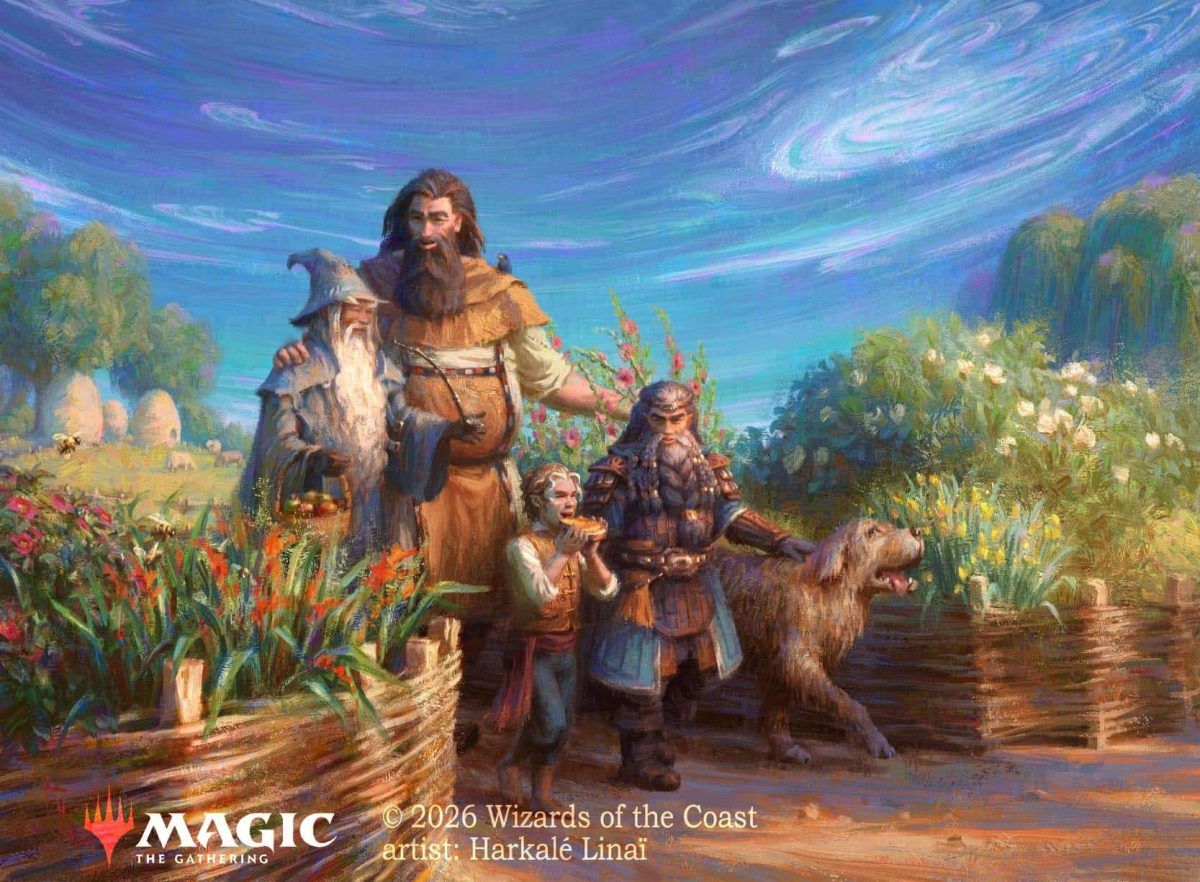
Beorn's Hospitality | Illustration by Harkalé Linaï
Like Spider-Man and Teenage Mutant Ninja Turtles (shudders), The Hobbit is a smaller set than average with only five primary archetypes. Most of the cards in this set seem fairly straightforward too, to the point that you could say this is kind of a “Core Set” in terms of mechanics/gameplay. The Hobbit should be an excellent fit for a newer Limited player while still having enough meat to satisfy the more experienced.
Mechanics
Storied (RW)
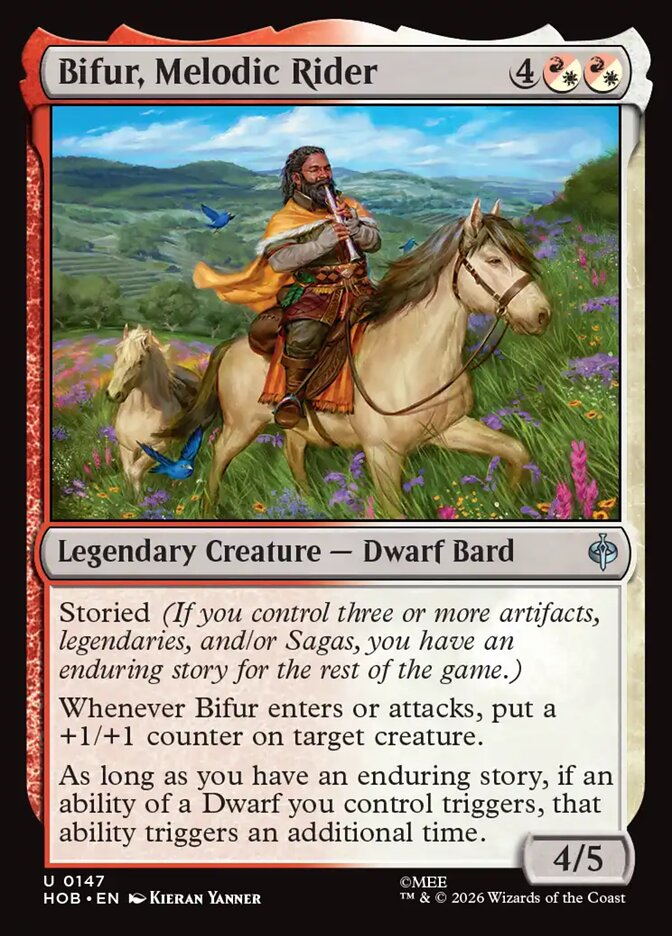
Storied is the first of two new mechanics, and it resembles the city’s blessing and ascend from Rivals of Ixalan. The official text for this one is: “If you control three or more artifacts, legendaries, and/or Sagas, you have an enduring story for the rest of the game.”
“The rest of the game” is a key phrase here, as like the city’s blessing, it’s impossible to lose your enduring story once you have it! This mechanic appears exclusively on nine legendary dwarves, each of which was a member of Bilbo’s party in the novel. Because they’re all legendary themselves, you’ll already be a third of the way towards completing your story when you play them.
Achieving an enduring story should be quite easy in RW Dwarves, but it’ll likely be trickier in other decks. This encourages you to play legendary dwarves together, alongside equipment cards (which many of them synergize with).
Recruit (WU)
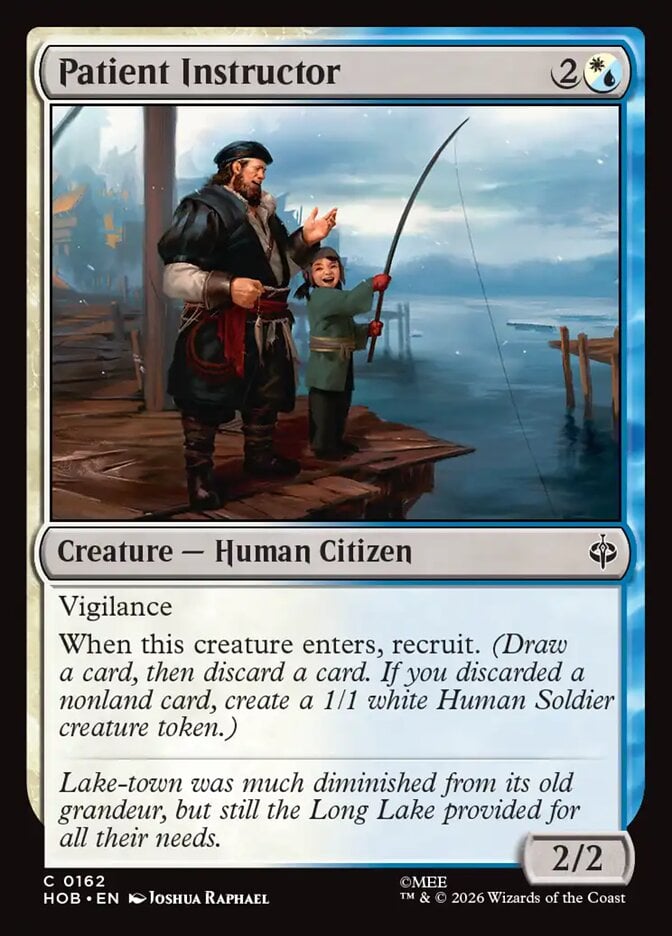
Recruit is the second new mechanic, and it greatly resembles connive (which was in the last set, Marvel Super Heroes). When you recruit, you draw a card and then discard a card. If the card you discarded this way was a nonland card, you’ll make a 1/1 Human Soldier creature token.
Recruit is a versatile smoothing mechanic with a number of uses. Discarding nonlands effectively leaves you up a card, in the form of a free 1/1. There are also several cards in the set that provide extra value when you discard them, like Moment of Glory, Plunder the Trollshaws, and Eagle's Rescue.
Every deck can make use of this mechanic, but it’s the primary focus of WU in this set.
Adventures (All Colors)
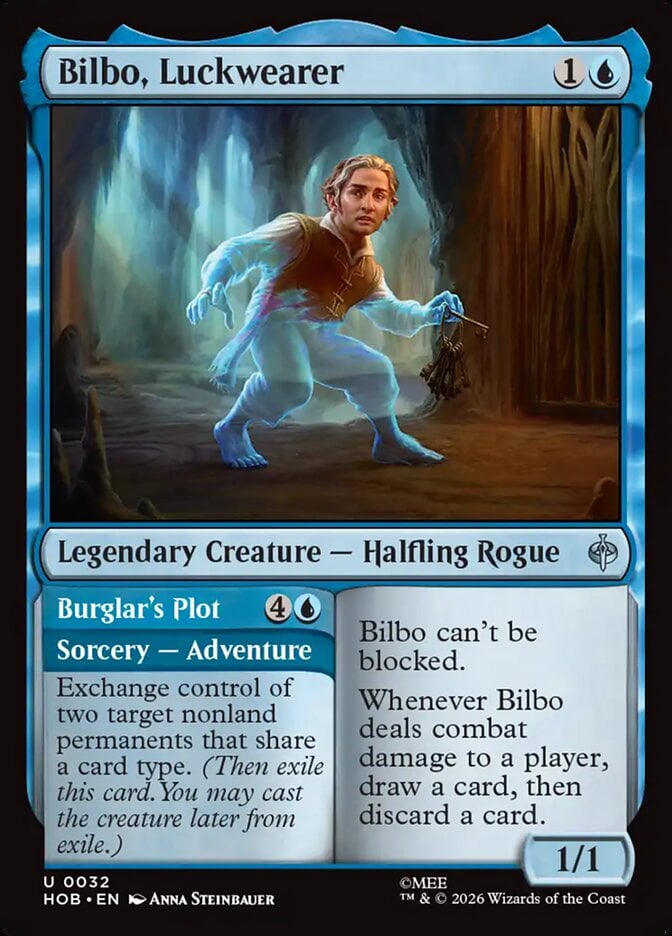
Adventures are a returning mechanic, and one of the set’s primary mana sinks. Each adventure card is a modal spell of sorts.
Let’s take Bilbo, Luckwearer for example. You can play Bilbo for either (Burglar’s Plot), or . If you play it as a sorcery, you’ll exile Bilbo when Burglar’s Plot resolves, and then have the opportunity to play it later from exile. But if you play Bilbo as a creature, you won’t be able to play Burglar’s Plot.
Adventures appear in all colors in The Hobbit, and each color has one common adventure. Quality among these varies from good (Bilbo Baggins, Burglar) to amazing (Gandalf, Goblins' Bane).
Amass Goblins (BR)
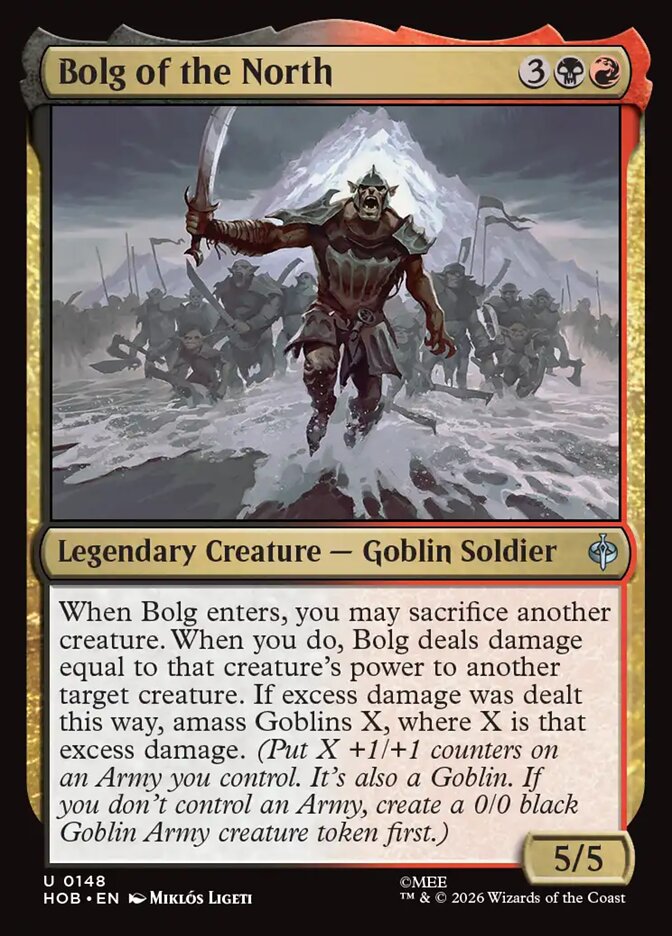
Amass is another returning mechanic, which also appeared in The Lord of the Rings: Tales of Middle-earth. When you amass, you’ll first check if you control an army creature. If you don’t, you’ll create a 0/0 black Goblin Army token, then put X counters on it (where X is the amass number). If you control an army already, you’ll simply put those counters on that army.
Amass is well represented in BR in The Hobbit, as there are a number of commons that grow your Goblin Army. Whether you want to trade off your army now or let it stick around and grow taller later will be a common decision point.
It’s also worth noting that the existence of amass has affected the design of some removal spells in The Hobbit. Enchanted River's Grasp, for instance, has the “remove all counters” clause to prevent it from locking you out of making future armies. Uneasy Partings has a “nontoken clause” that forces your opponent to always pay to target your army with it.
Ferocious (BG)
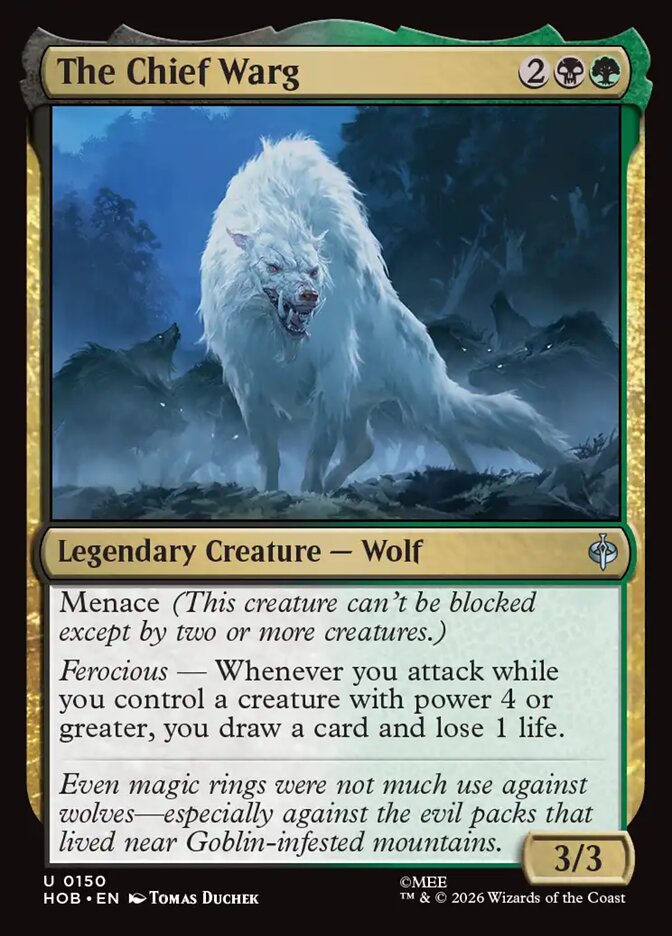
Ferocious is a simple mechanic that cares about whether you control a creature with 4+ power. If you do, you’ll have “ferocious”, which enables bonuses on cards like Nasty Little Rabbit and Ravening Warg. This is the primary mechanic for BG in The Hobbit, as you can see from The Chief Warg.
Landfall (GU)
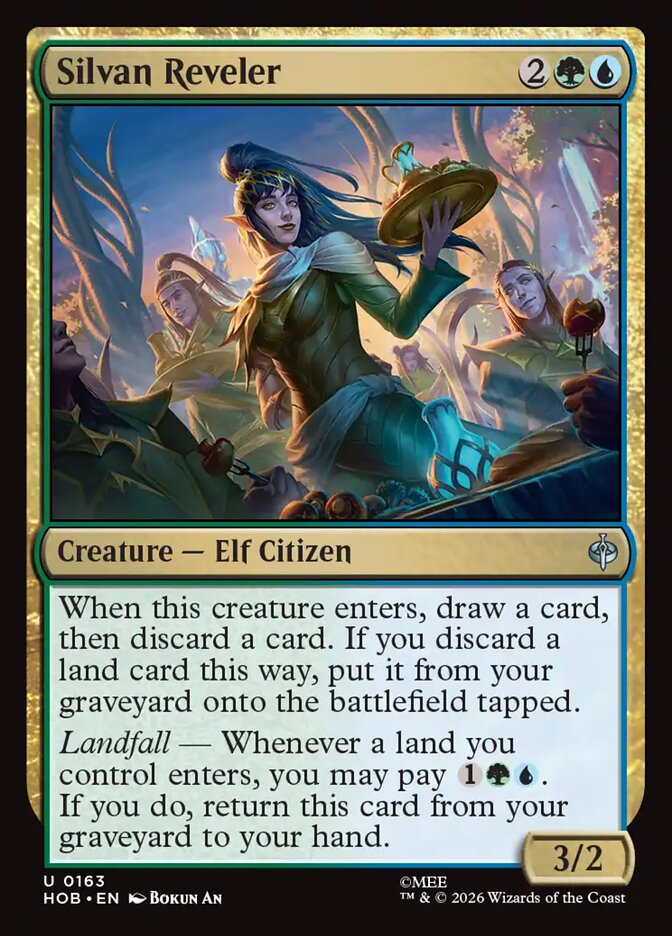
Landfall is our final returning mechanic, and it triggers whenever a land enters the battlefield under your control. It’s the primary mechanic of GU in this set, and it appears primarily on elf creatures. Lands that fetch other lands like Hobbit Hole and Elven Passage can net you two triggers at once.
Hone Counters
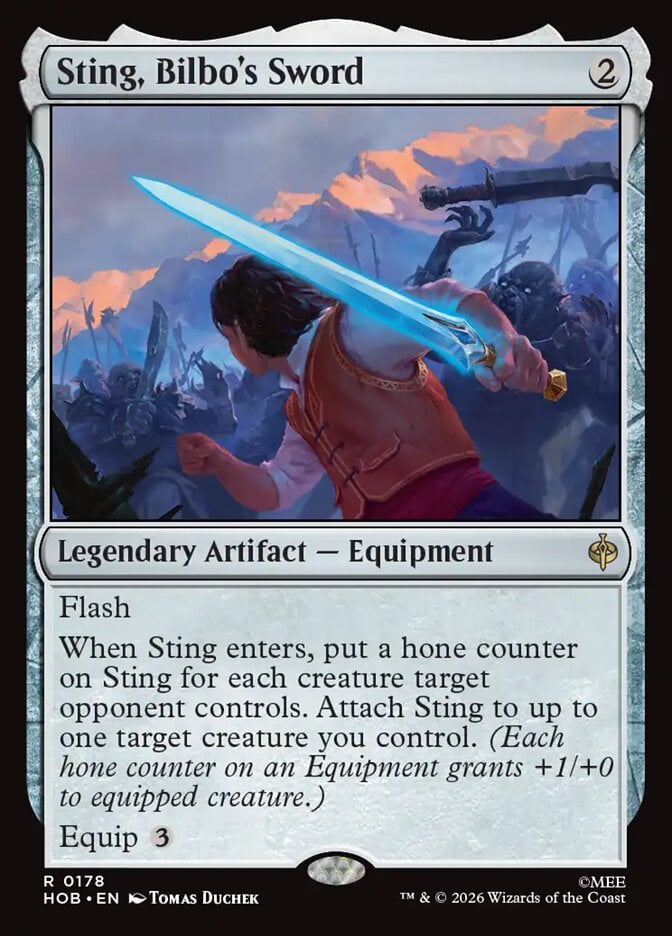
Hone counters are a new type of counter that you can put on equipment. A honed equipment will give +1/+0 to its equipped creature for each hone counter on it. There are only two cards in the set that make these (Dwalin, Weaponmaster and Sting, Bilbo's Sword), so don’t expect them to come up very often.
Legendary (All Colors)
It’s worth mentioning the constraints that “legendary” comes with. You can only control one copy of a legendary permanent with the same name; if you have two in play somehow, you’ll have to choose one to keep and put the other in the graveyard immediately.
As with all Universes Beyond sets, The Hobbit is jam-packed with legendaries. 55/193 cards in this set are legendary, including several common creatures like Beorn, Reluctant Host and Dori, Bearer of Friends. This means you may open pools with multiple copies of the same legendary. Here are some basic ground rules to handle this:
- If your legendary card is mediocre and unessential to your deck, it’s safer to play one copy of it.
- If the card is clearly above average, I’m happy to play two copies, but hesitant to play three or more.
- If the card is absurdly good (i.e., one of the “Bombs” I’ve listed), I’m not cutting any.
- Having any cards with the “storied” mechanic makes legendary creatures more valuable.
One interesting thing about The Hobbit is that it seems designed with playing multiple copies of the same legendary in mind! Between the recruit mechanic, Bilbo, Luckwearer, and Key to the Side-Door, there are many ways to loot excess legends for value. Keep this in mind if you have ‘em, as I’d happily play 3+ copies of a good legend like Bilbo Baggins, Burglar if I could loot the extras reliably.
Archetypes
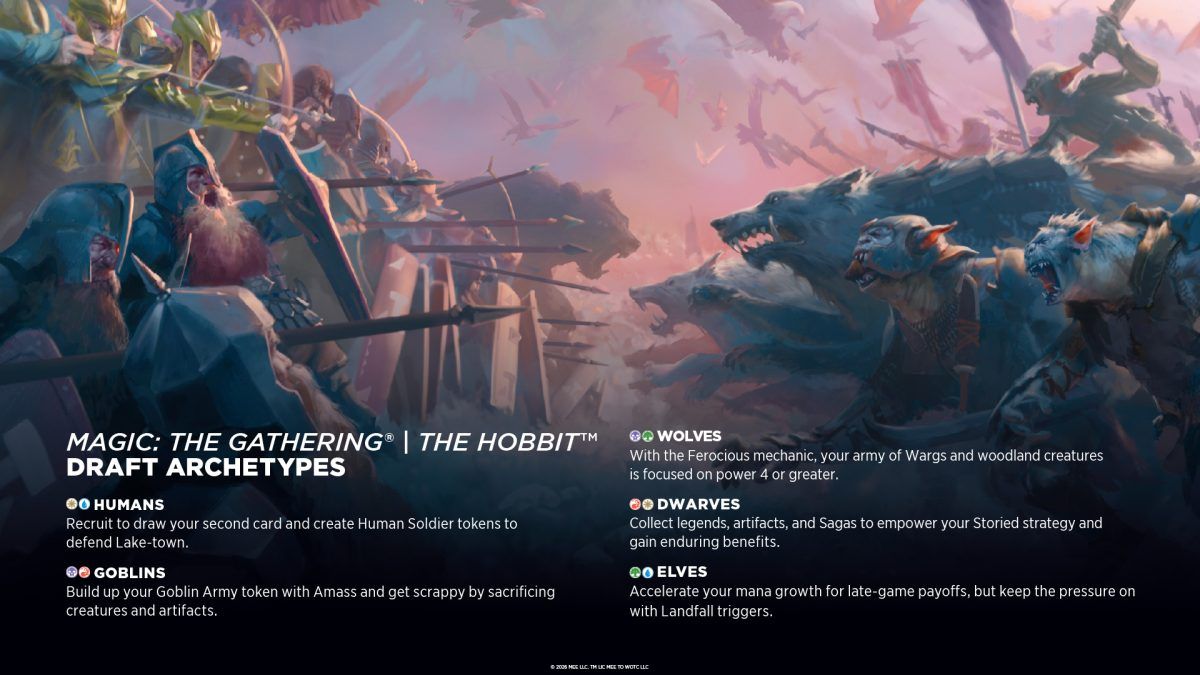
The Hobbit has five primary archetypes. Each of these focuses on a specific mechanic and creature type and is tied to a 2-color pair. Despite the emphasis on creature types, there aren’t actually that many payoffs for humans, wolves, or goblins. Dwarves and elves, on the other hand, have several cards that reward you for playing lots of them.
WU Recruit Humans
Recruit is the most flexible mechanic in the set, and it gives WU a great deal of control over its draws. The two primary ways to play WU will be as a go-wide deck or a control deck of sorts. Effects that care about you drawing your second card like Lakeshore Apothecary will play well here either way.
BR Amass Goblins
BR has two main themes in this set: amass and sacrifice. You can make the themes overlap by sacrificing a small army as fodder, which will come up with cards like Goblin-town Flunkies. Stir Up Trouble, Snowslope Hunter, and Bolg of the North. Other than that, expect BR to play out like a standard aggro deck with a bit more removal than other archetypes.
BG Ferocious Wolves
BG is arguably the most straightforward archetype. Play some payoffs, get ferocious, and turn your opponent into puppy chow. Here are a couple of practical ways to achieve ferocious:
- Play a creature with 4+ base power, like Ordinary Bear.
- Activate an ability like Desolation Prowler’s.
- Equip a creature with something like Crude Bent Blade.
- Amass a large enough Goblin Army.
- Cast a pump spell like Reverent Howl.
RW Storied Dwarves
RW is one of the more synergistic archetypes in The Hobbit. Playing lots of legendary dwarves makes getting an enduring story easy, which powers up your dwarves with cards like Bifur, Melodic Rider. This archetype is also encouraged to lean into equipment synergies, since many dwarf cards care about (or even create) equipment. Once you’re decently set up, your creatures should be difficult to handle in combat.
GU Landfall Elves
Elves is the most durdly archetype in The Hobbit, and probably the most tribe-focused, too. Direct elf payoffs like Woodland Weavemaster and Thranduil, Sindarin Liege reward you for playing as many elves as possible. Elves have quite a bit of card advantage as well, through cards like Silvan Reveler, Wood Elves, and Boughside Wanderers.
One potential issue with this deck is it lacks much removal (Quarrel, Enchanted River's Grasp, and Troll Negotiations are some of the only ones I can see), which leaves it vulnerable to bomb creatures.
Set Overview
So what are we to make of The Hobbit? I’d recommend that you approach this as a Core Set of sorts. Most cards will obviously fit into one of the five archetype “boxes”, but it’s still good to know how to mix and match them.
Mechanical/Archetype Overlap
- None of the primary mechanics in The Hobbit have any direct overlap, so you’re mostly encouraged to find your “thing” and lean into it.
- Despite this, recruit and landfall work subtly well together, as recruit will incentivize you to discard spells over lands (increasing the odds you have landfall triggers).
- There are cards like Goblin Plate Mail and Dwarven Provisioner that fit either archetype for their colors; Plate Mail is an equipment that you can free-equip with certain dwarves, while Provisioner helps WU to go wide more effectively.
- Some commons may work together in unofficial color pairs, which may come up when you open lots of powerful rares in unsupported colors. Lake-town Lookout for instance is an excellent fodder creature to play with Stir Up Trouble, and Grixis colors () will do the best job of leveraging spellslinger cards like Bilbo, Thief in the Night and Most Decrepit Old Bird.
Cycles
One way to get to know a new set is to examine each of its cycles. Here are The Hobbit’s.
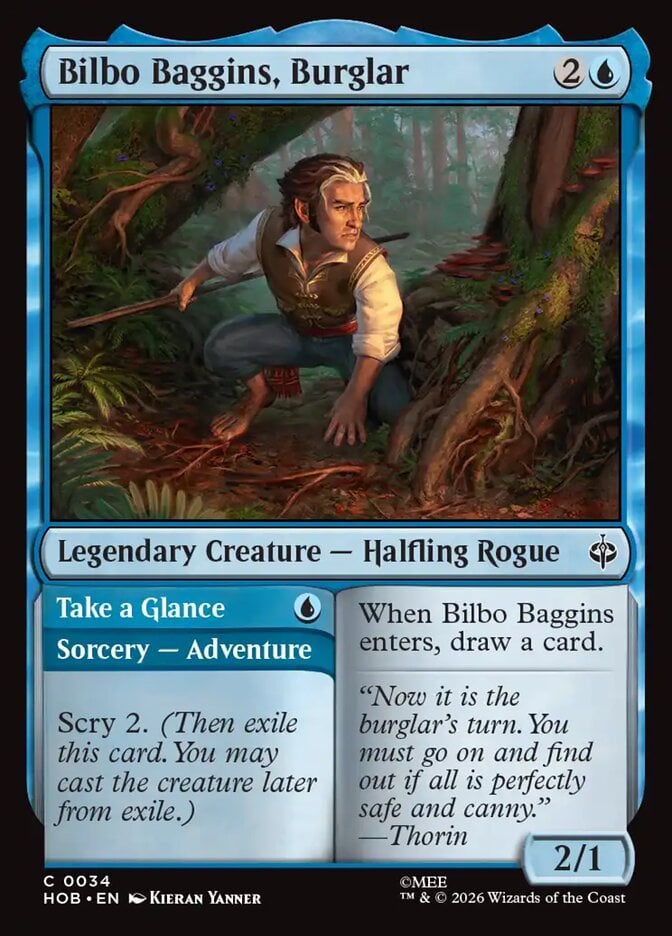
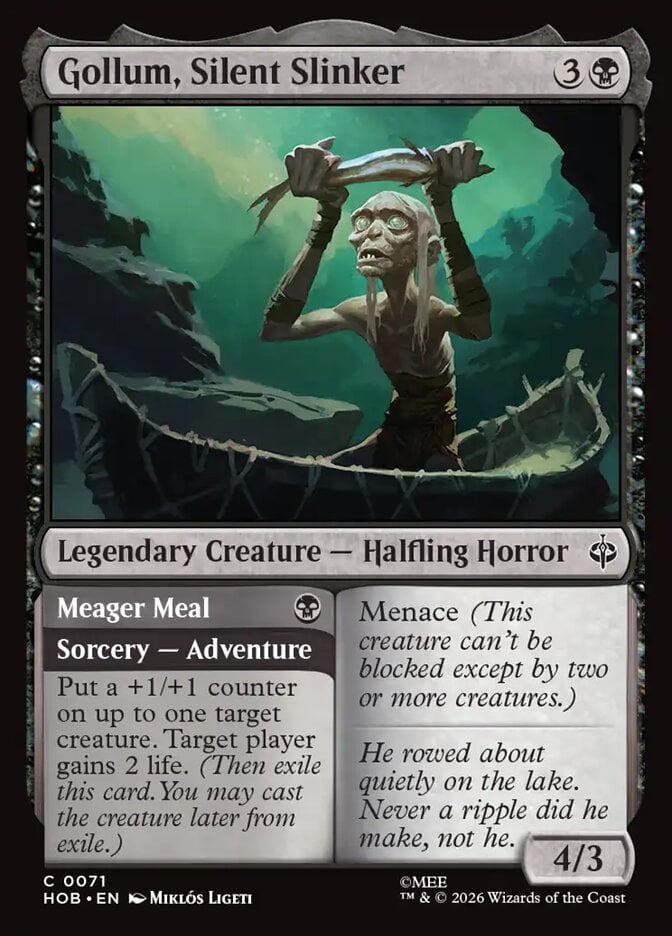
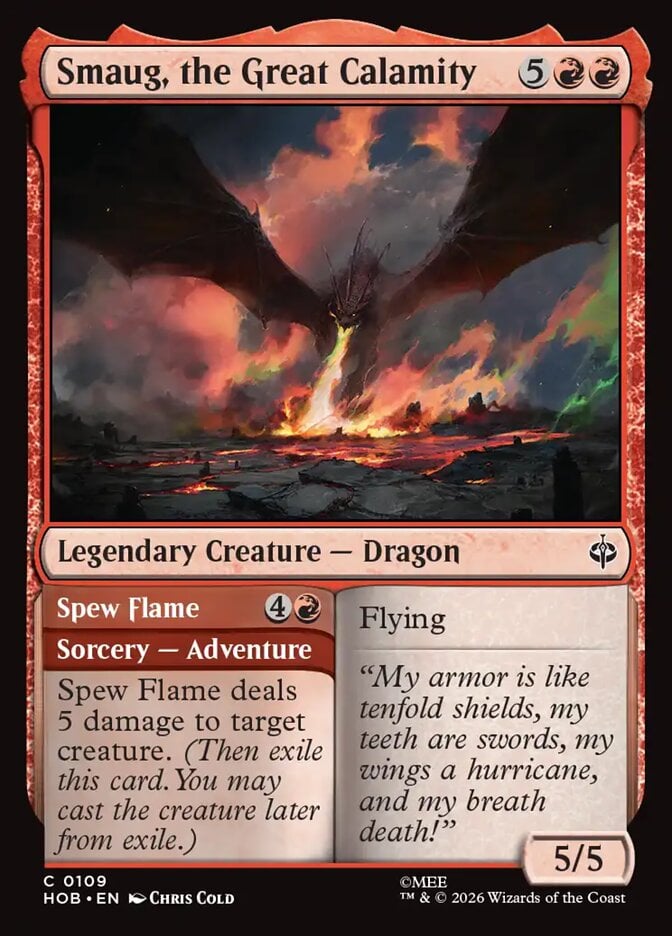
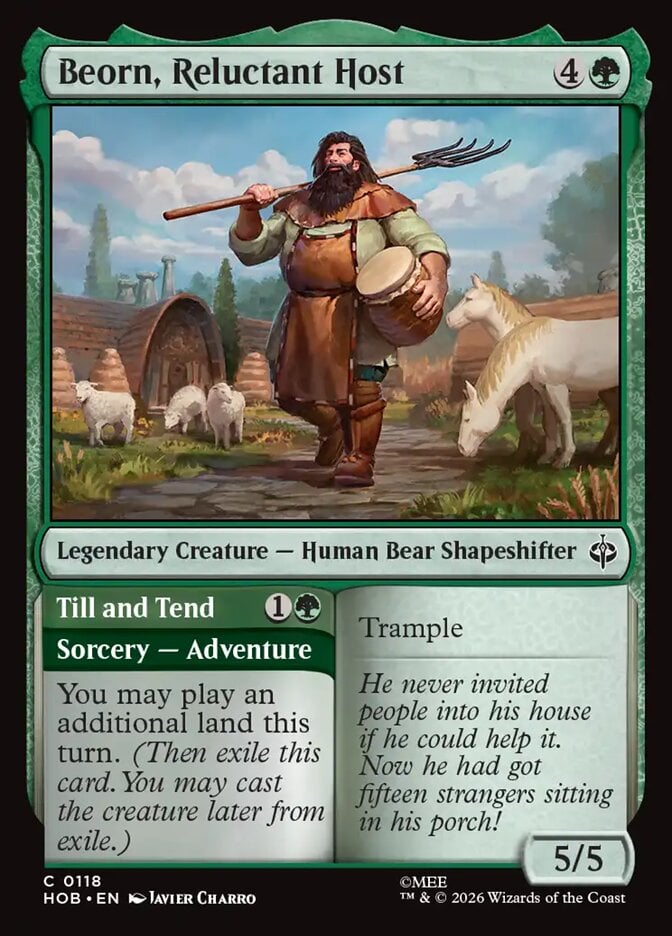
Common Adventure Creatures
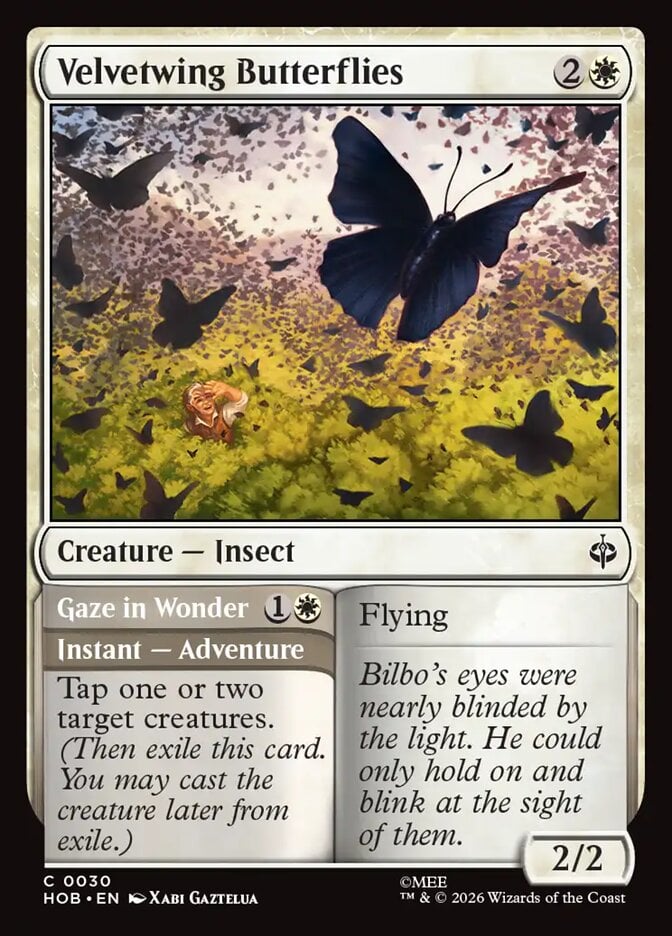
- Velvetwing Butterflies
- Bilbo Baggins, Burglar
- Gollum, Silent Slinker
- Smaug, the Great Calamity
- Beorn, Reluctant Host
Each of these is solid on its own and has some play in the context of what each archetype is doing. Velvetwing Butterflies helps tap down attackers for dwarves later, Bilbo Baggins, Burglar triggers “draw second” cards, Gollum, Silent Slinker has 4+ power for ferocious, and Beorn, Reluctant Host can ramp towards big green creatures or even enable double landfall sometimes. Smaug, the Great Calamity is the strongest card pound for pound, but it’s quite expensive and lacks overt synergy.
Common Hybrids
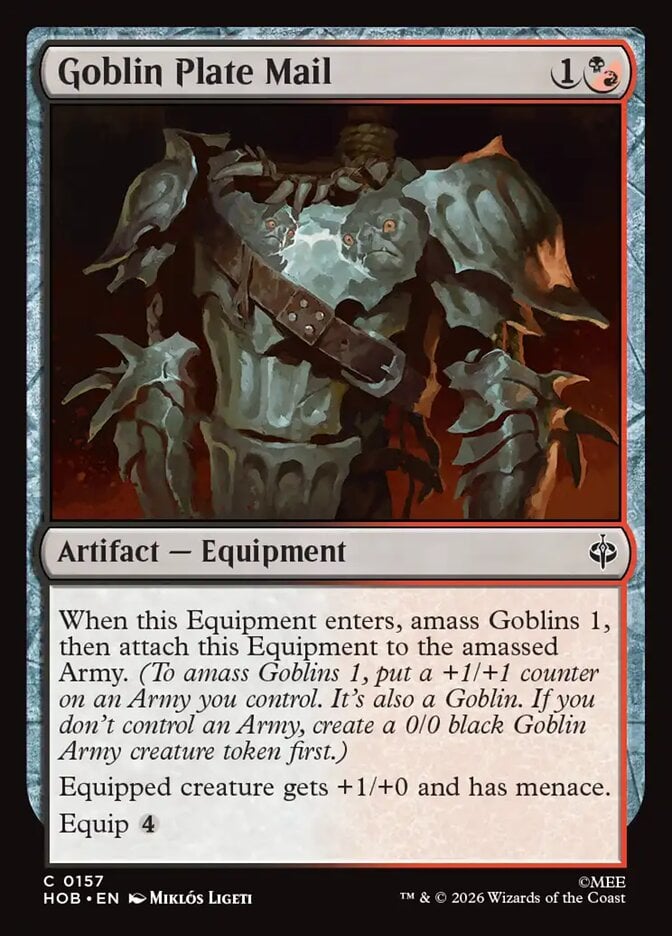
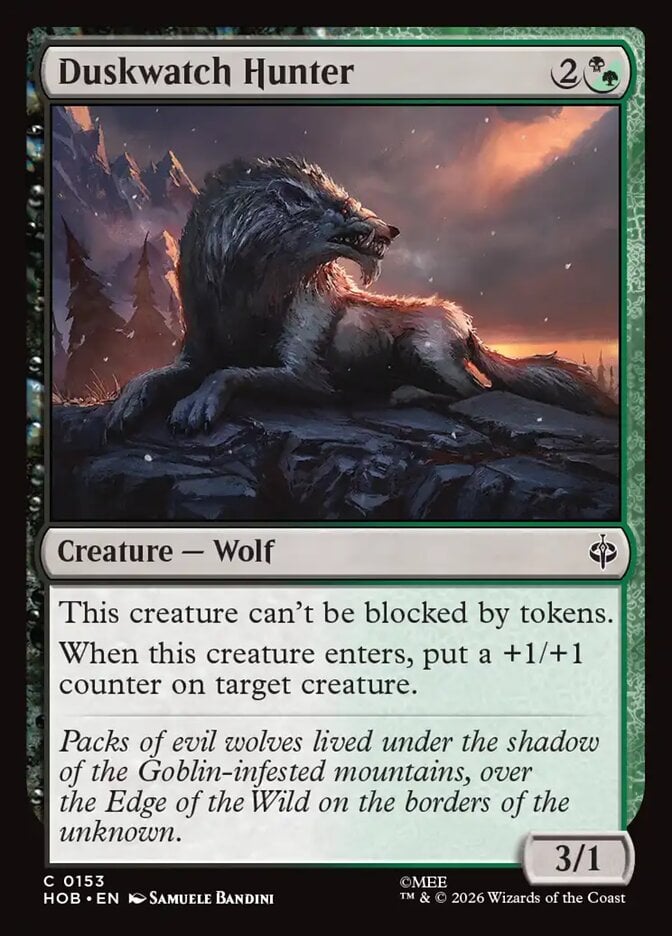
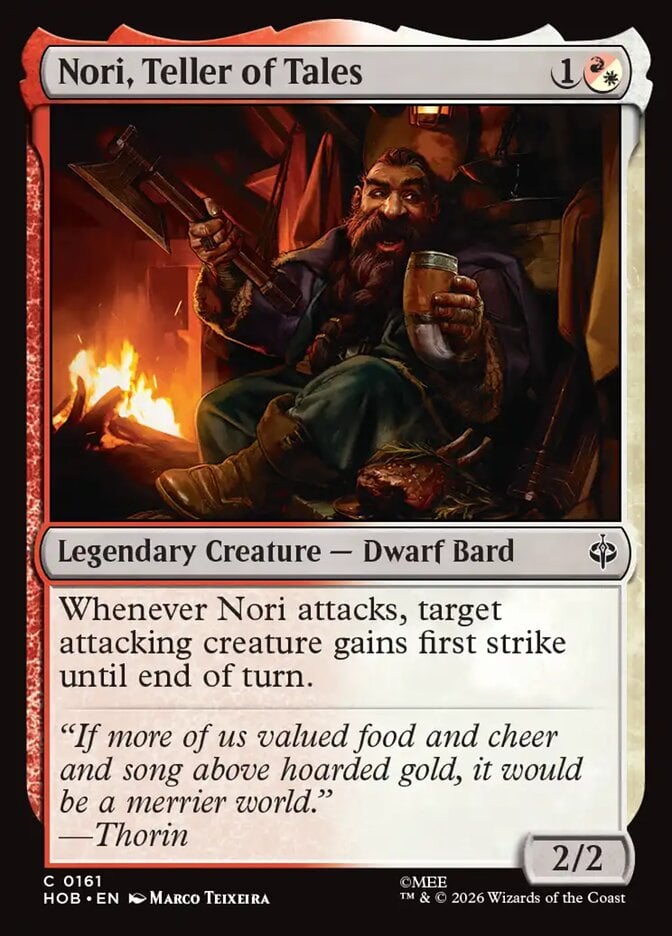
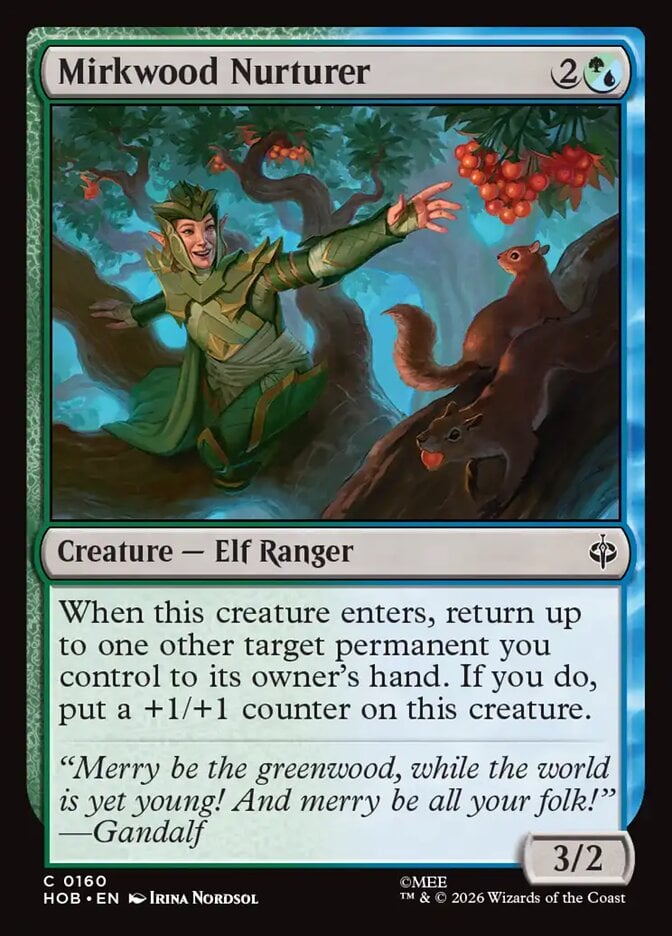
These play best in their respective archetypes, but they’re workable in other color pairs if need be. Mirkwood Nurturer is my favorite of the bunch, since it combos with Wood Elves and can enable more landfall in a pinch.
Common Duals
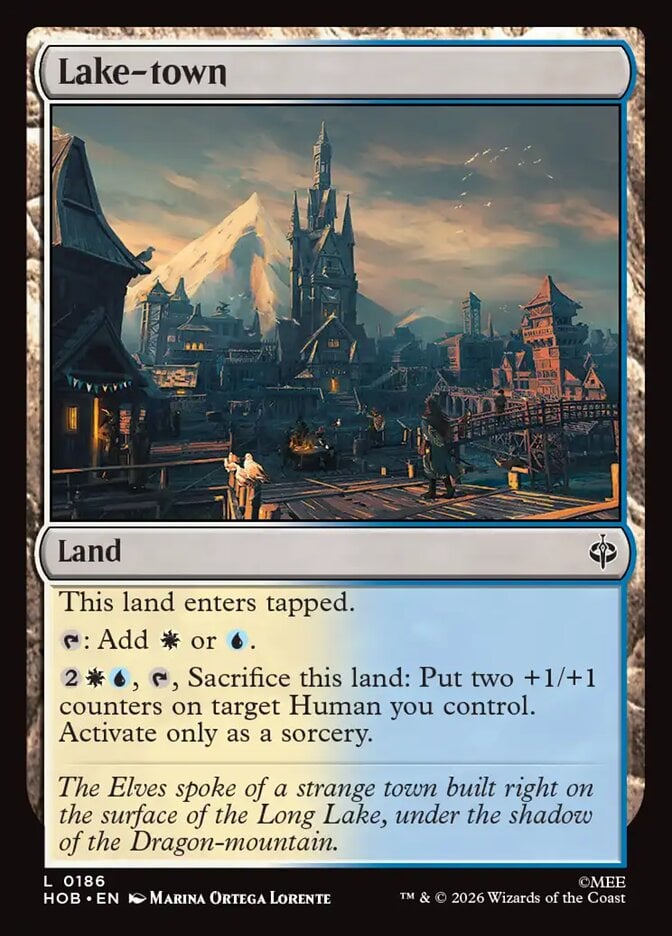
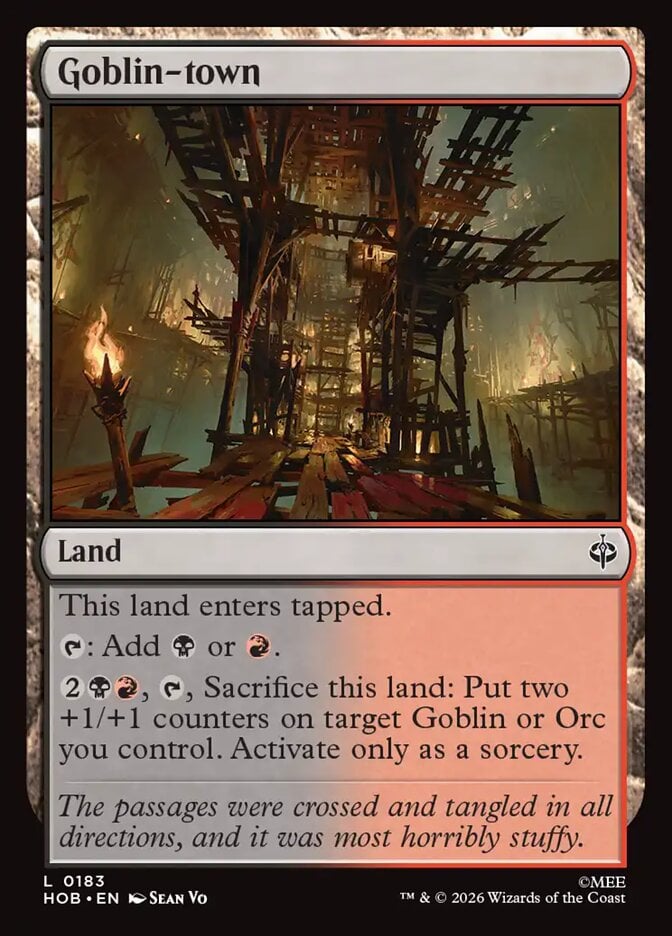
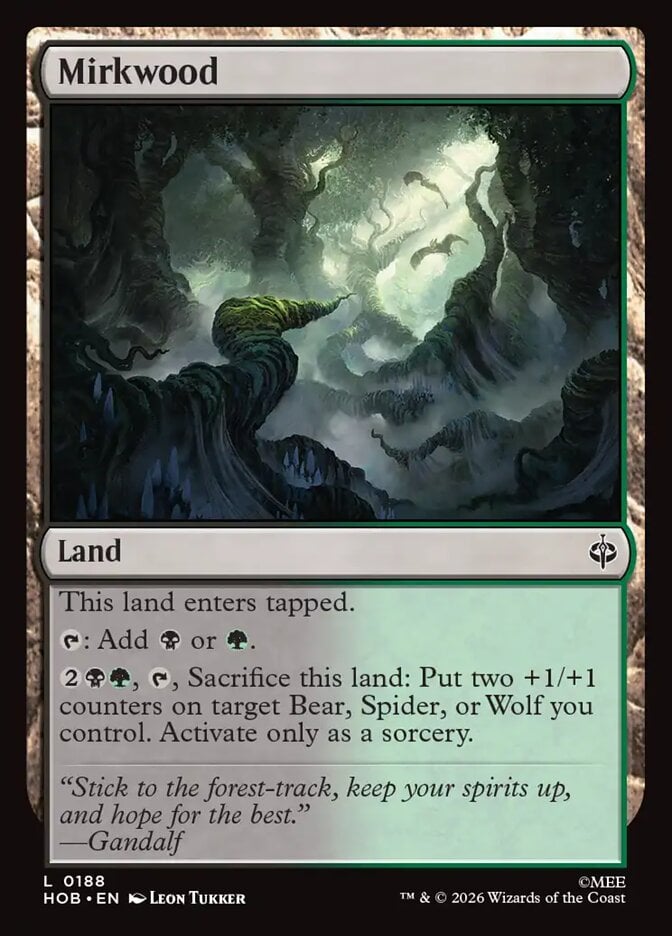
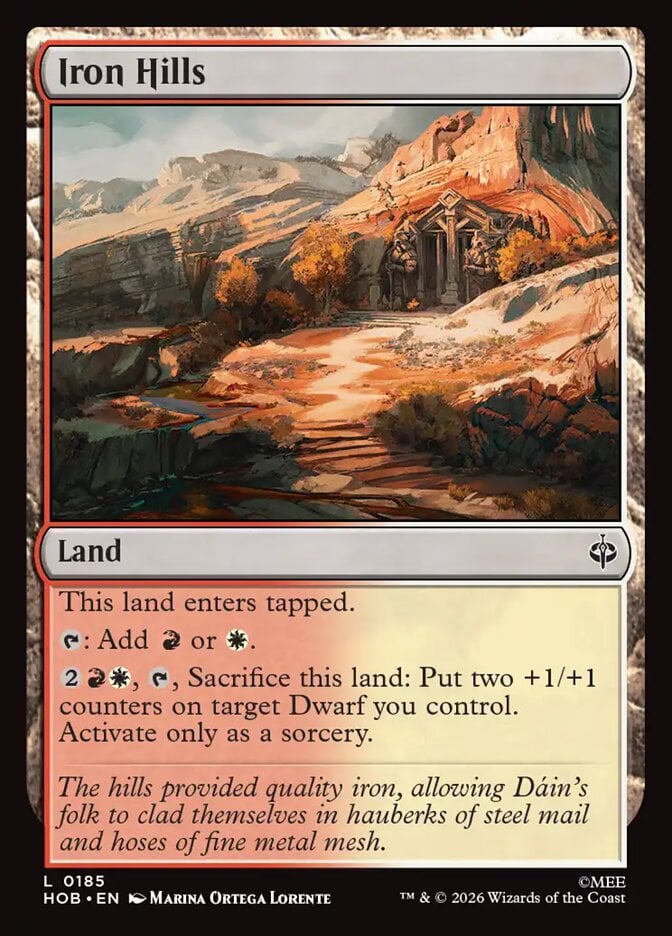
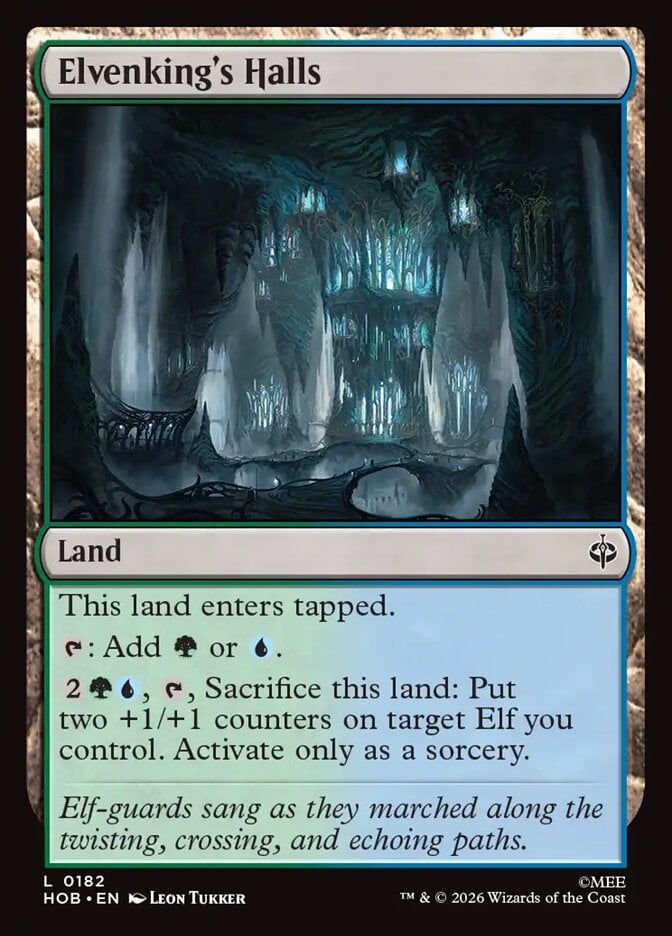
Reliable mana fixing with an in-built sink for late game. The pump abilities here can only target the native creature types for these color pairs (except for Mirkwood, which can conveniently target other forms of wildlife).
Uncommon Sagas
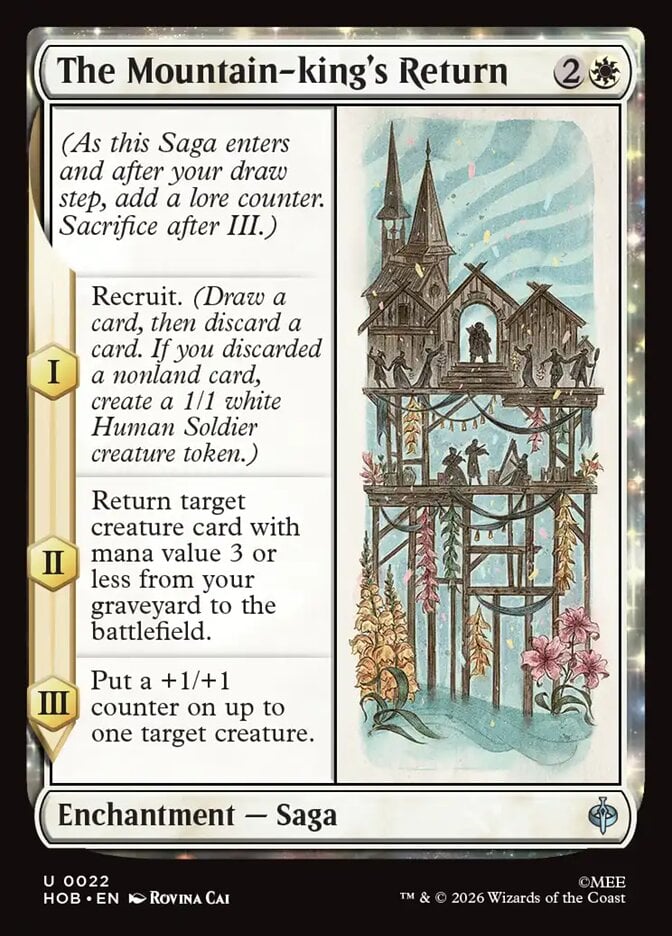
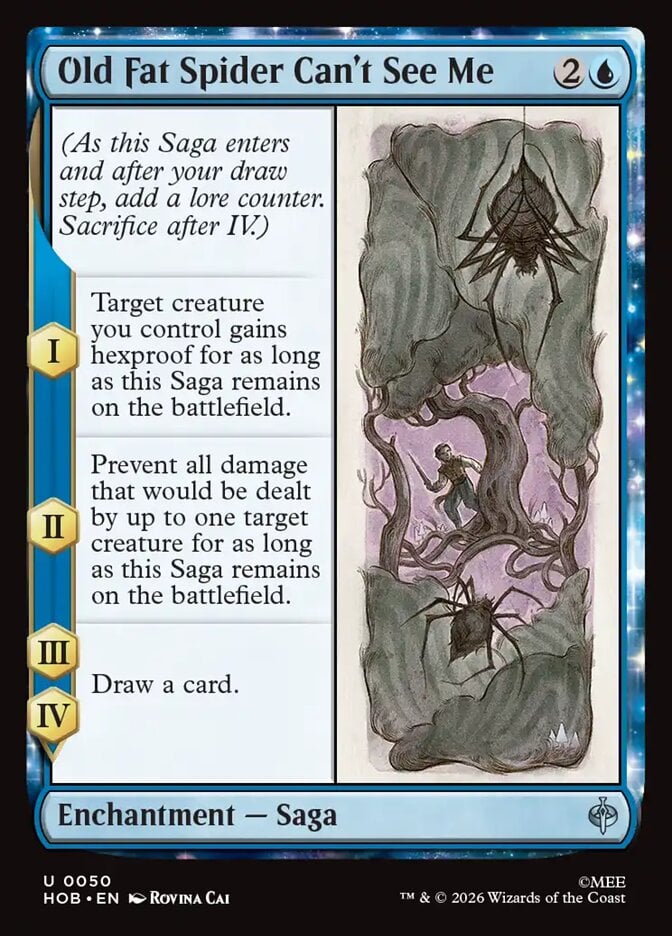
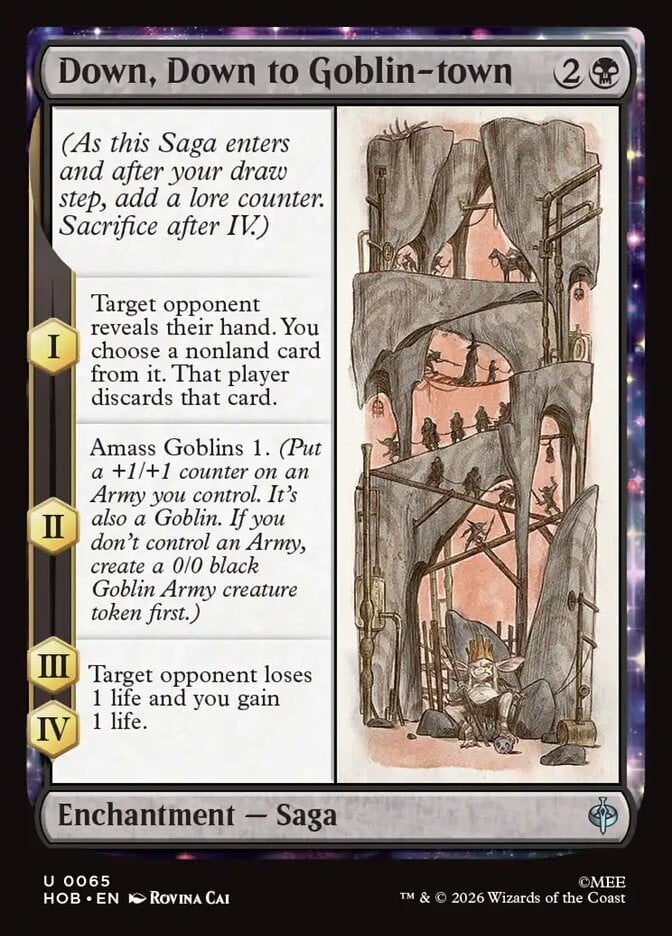
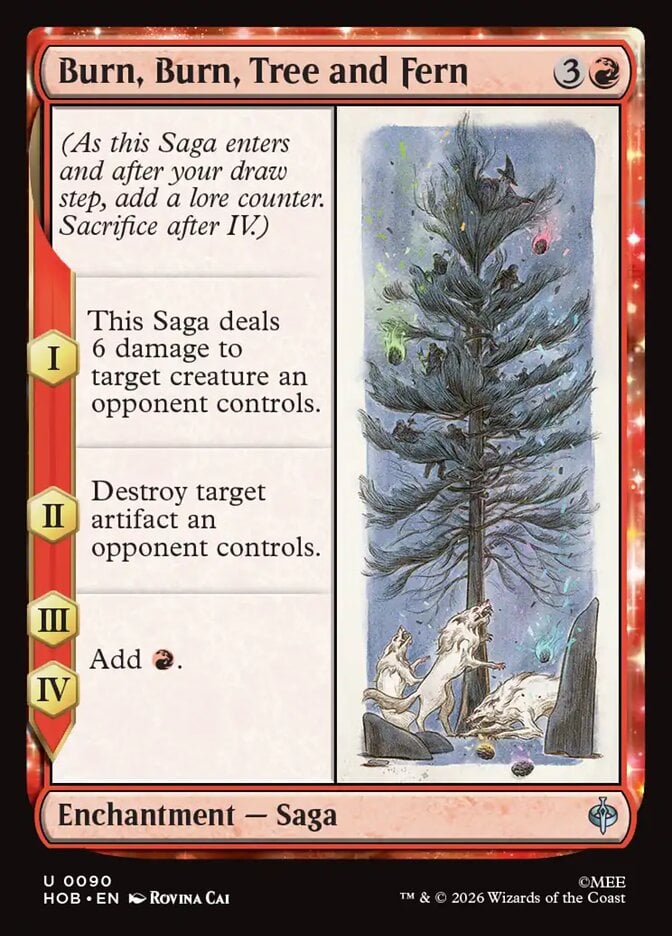
- The Mountain-king's Return
- Old Fat Spider Can't See Me
- Down, Down to Goblin-town
- Burn, Burn, Tree and Fern
Green is noticeably absent from this cycle of uncommon sagas, all of which look pretty good in Limited to me. Each of these can be a 2-for-1 in the right circumstances. Burn, Burn, Tree and Fern and The Mountain-king's Return would be my choices for the best of the cycle, with Old Fat Spider Can't See Me as the worst (since you don’t get its Divination until three turns later).
Uncommon Signposts
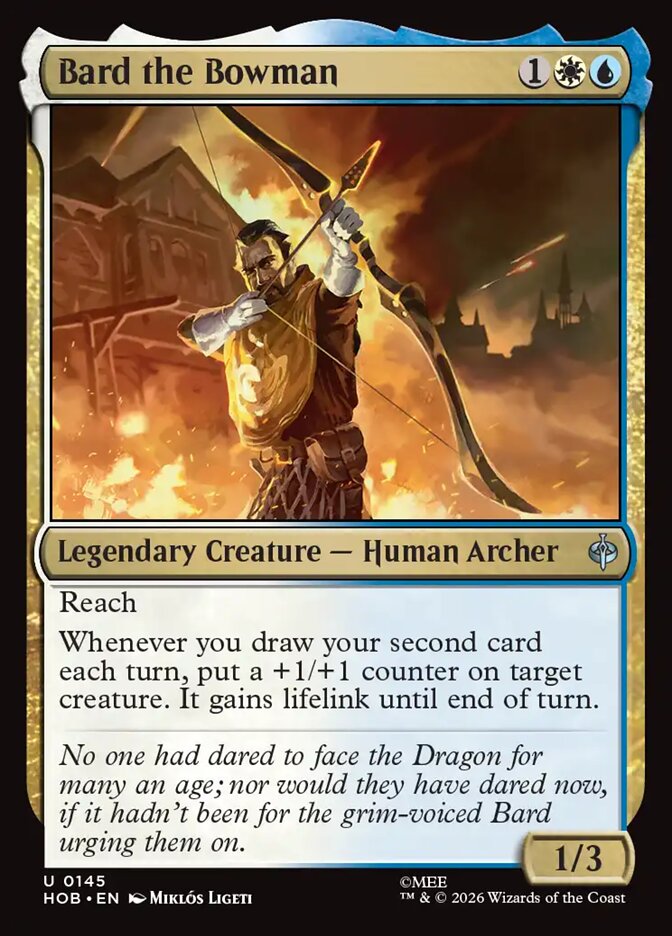
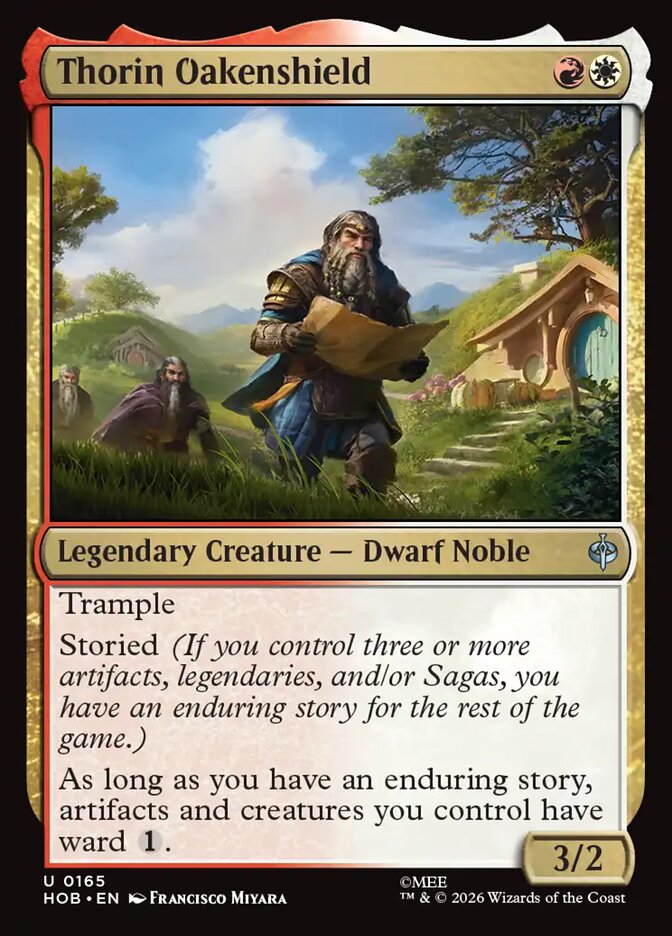
These are your standard signpost uncommons for each official archetype. They each provide a great reason to “do the thing” the color pair wants you to do.
Uncommon Hybrids
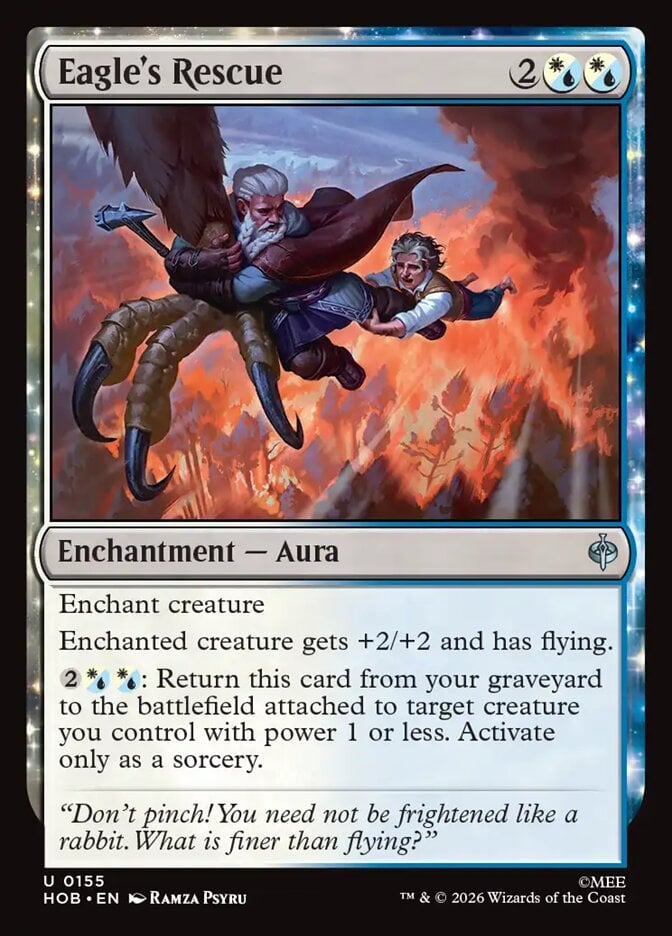
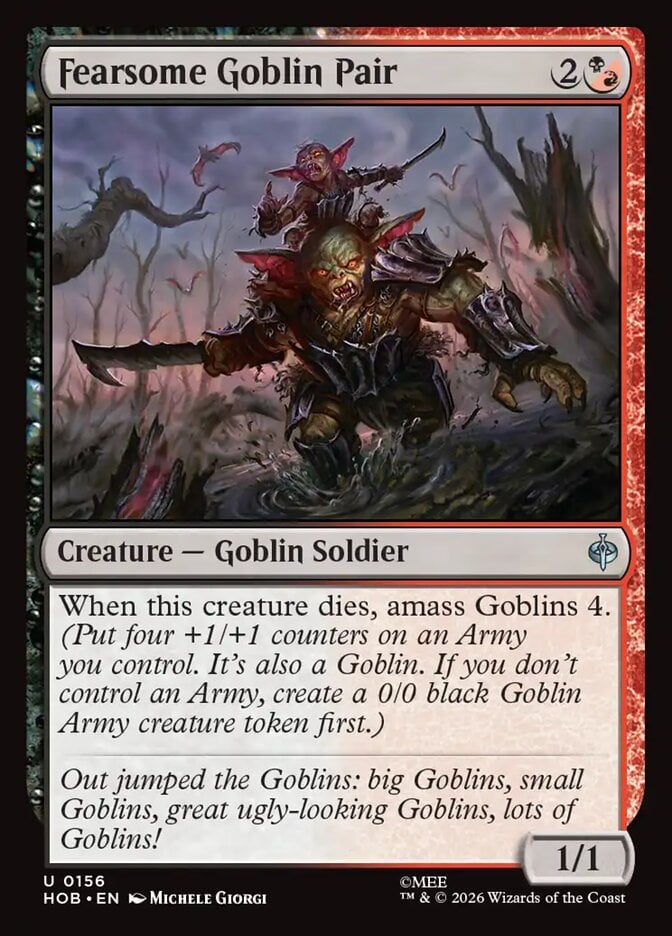
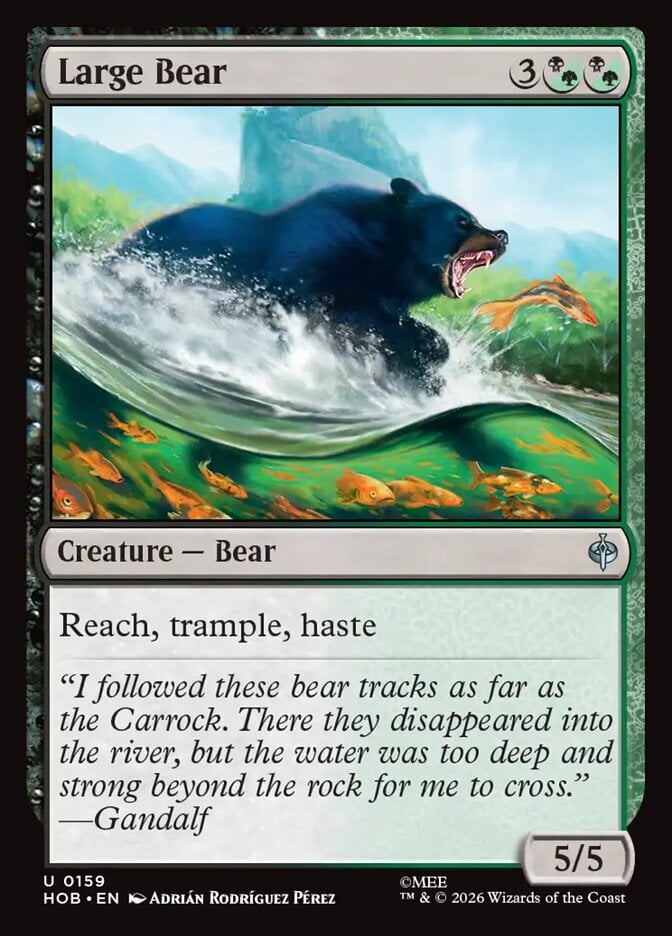
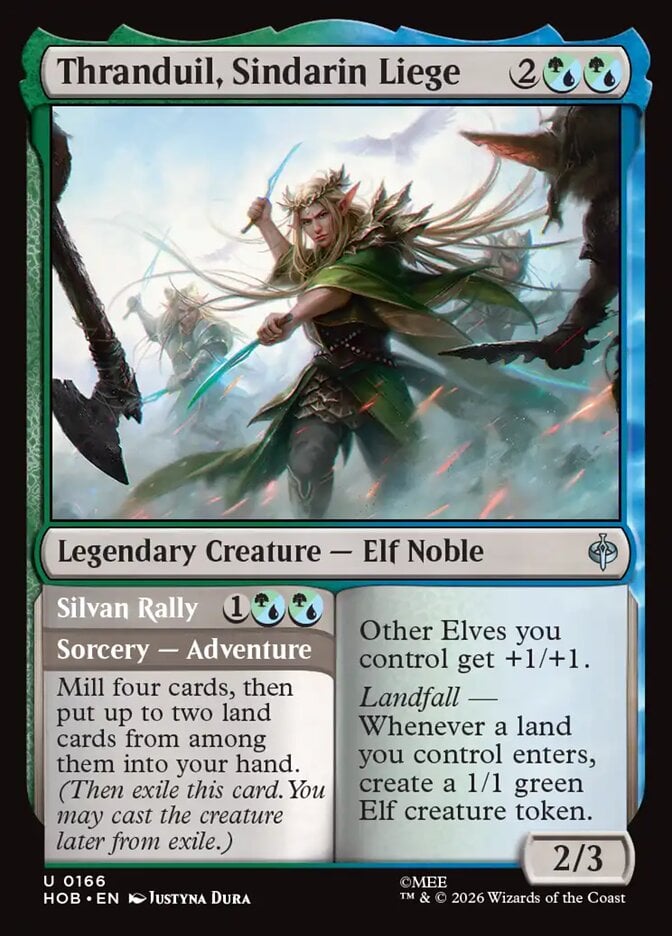
This cycle is more flexible cost-wise, but mechanically these will perform much better in their actual color pairs. Except for Large Bear, I suppose, which is a well,a large bear, and therefore of interest to any deck with Swamps and/or Forests.
Rare Sagas
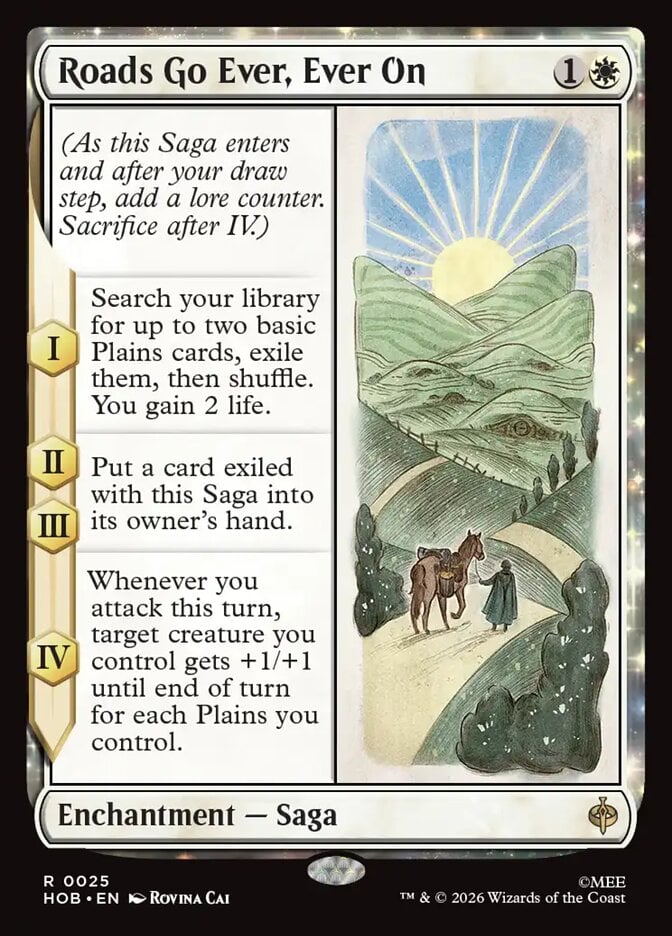
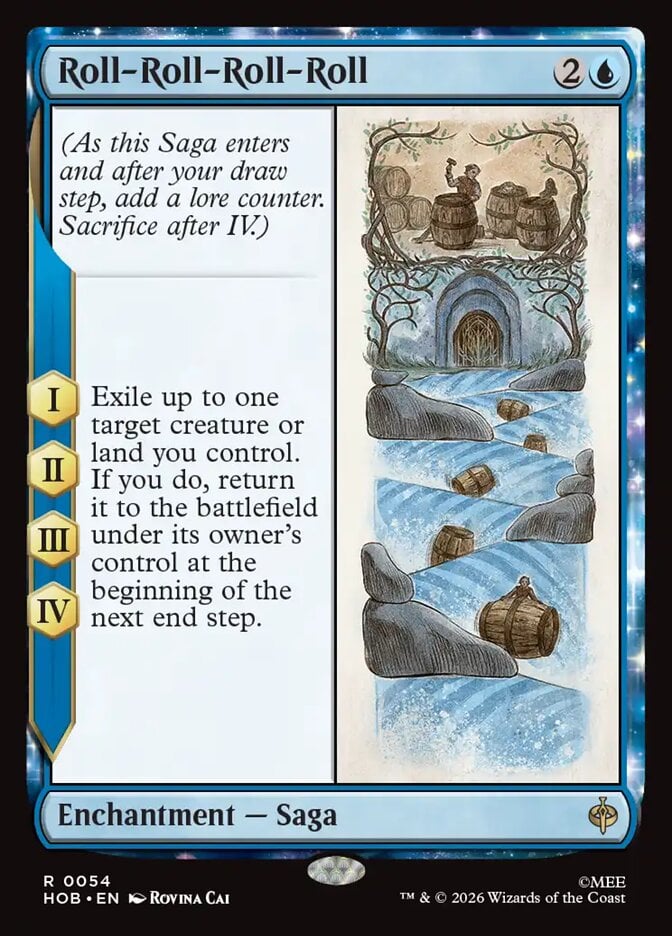
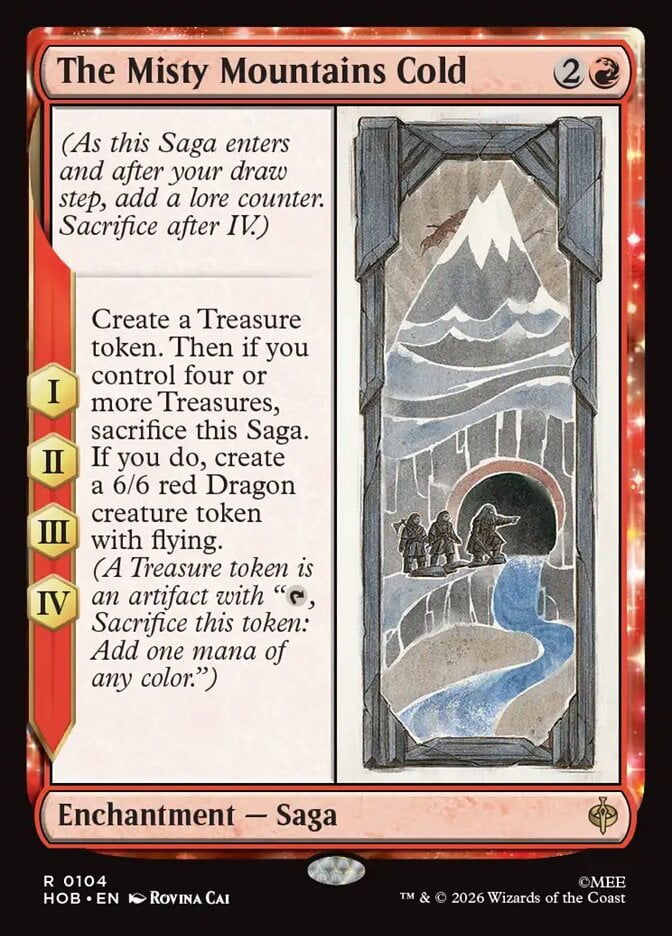
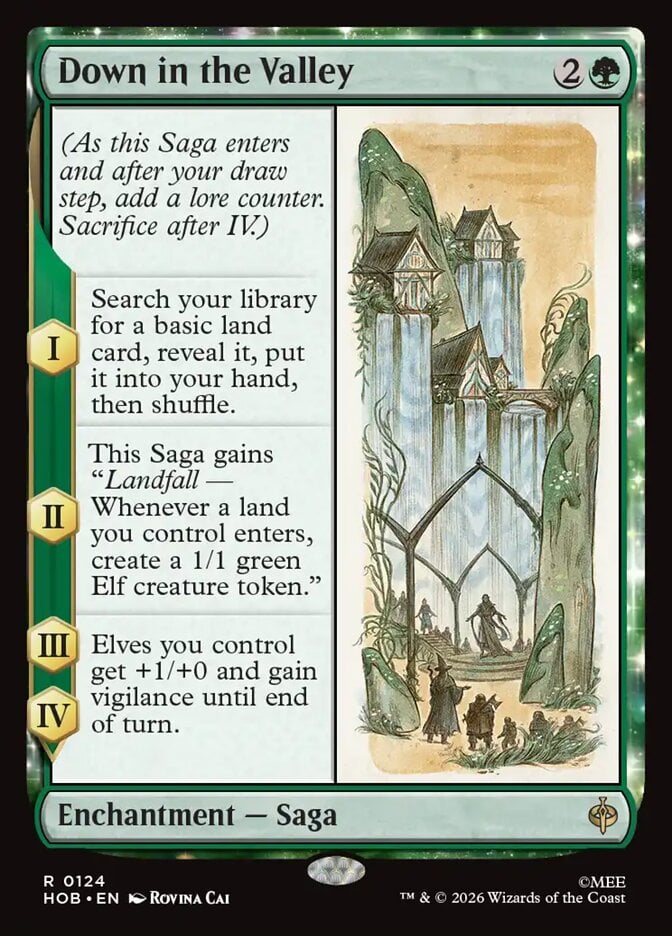
Black is now the absent color from this rare cycle of sagas. None of these appear especially busted in Limited, although I’m never cutting Roads Go Ever, Ever On or Down in the Valley from my decks either.
Rare Companies
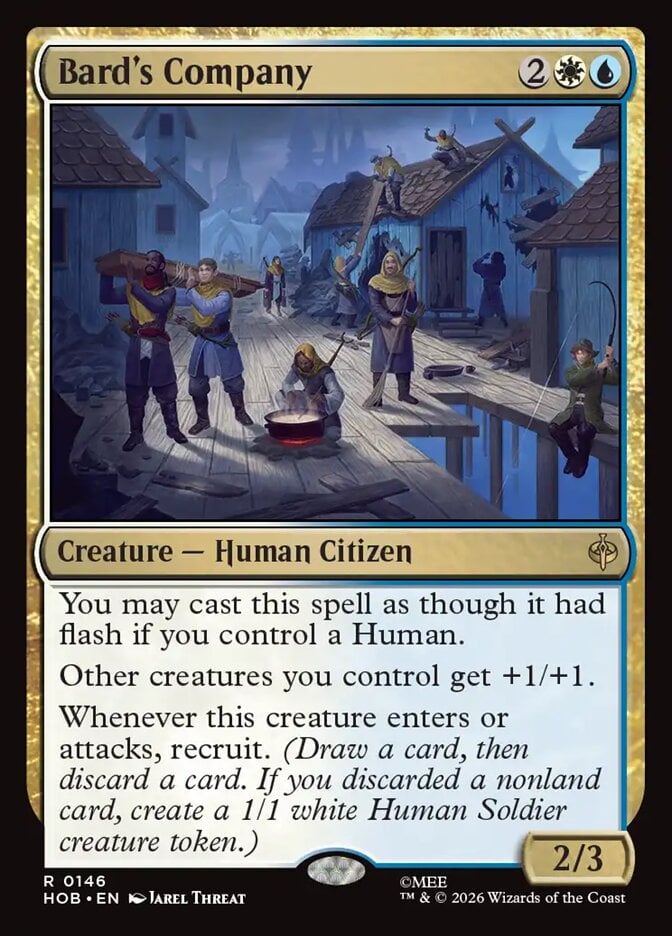
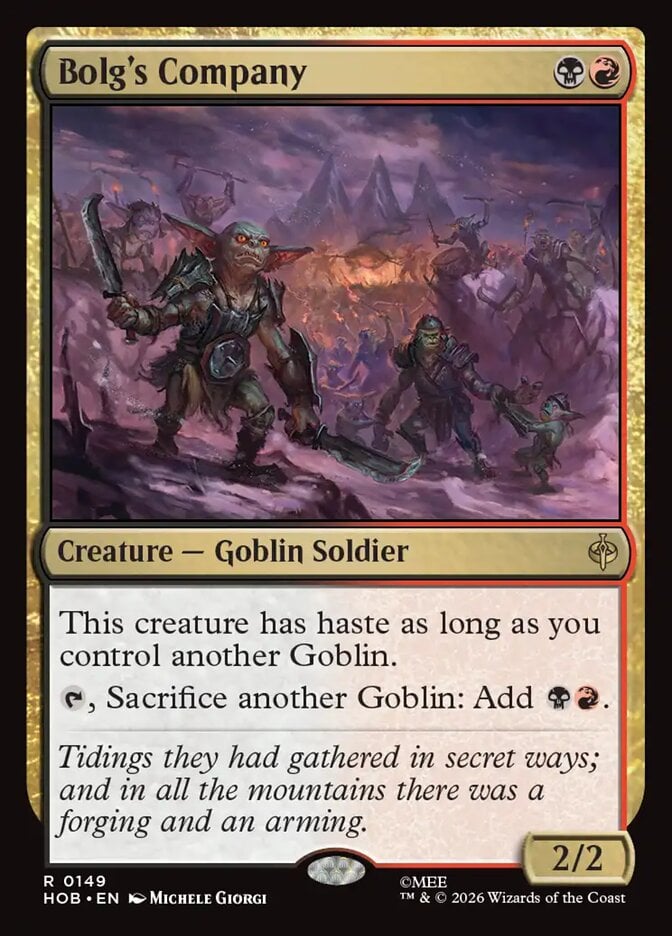
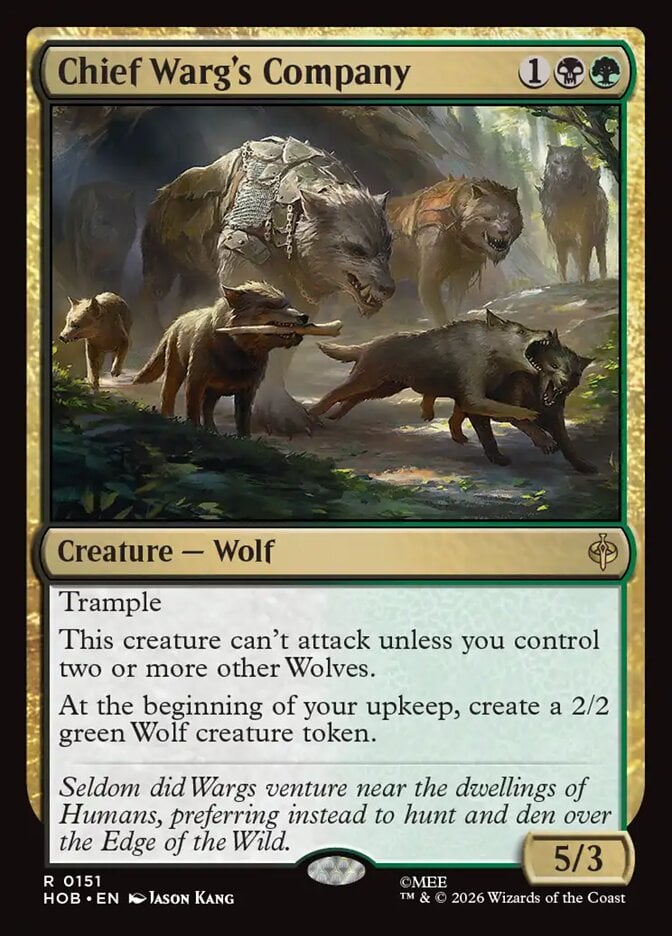
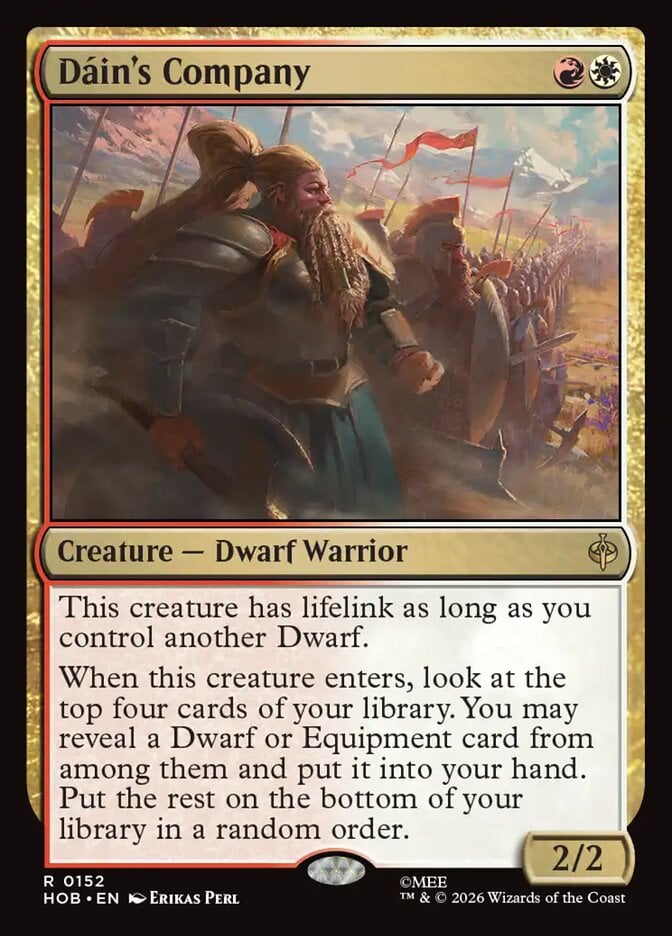
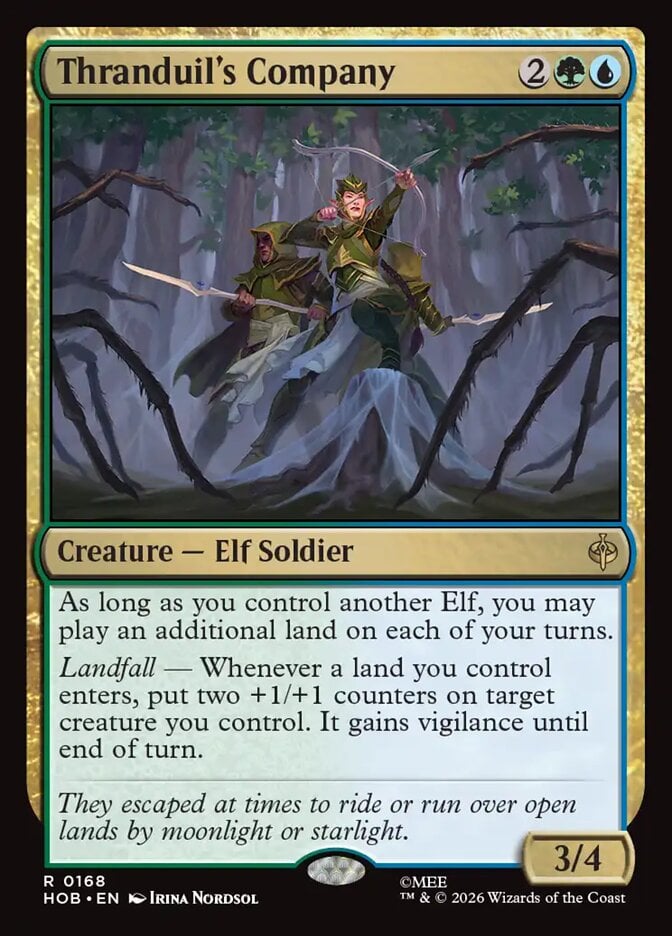
Think of these as souped-up signpost uncommons, for the most part. Bard's Company, Chief Warg's Company and Thranduil's Company are all bomb rares, and Dáin's Company is excellent, too.
Color Analysis
Here we can contrast each color by examining what it has to offer at the common rarity.
White is woefully lacking in common removal in The Hobbit, with only Magnificent End available. This is a departure from other small sets; it had two common removal spells in TMNT, and two in Spider-Man. Magnificent End is fine, but a slight downgrade from Grounded for Life. The rest of the color focuses on a mix of recruit and dwarf creatures, which curve from mana value 1 to 5.
Blue has one of the set’s best commons in Bilbo Baggins, Burglar, which is giving me major Hero in Training vibes. It has a nice mix of other spells, too, including some solid interaction, card draw, and passable creatures. Gandalf, Wandering Wizard is the biggest creature blue has, as otherwise its creatures are really small.
Black has two removal spells (three if you count Crude Bent Blade), and lots of small creatures. Stony-Voiced Goblins, Reverent Howl, and Rage into the Valley give black numerous 2-for-1s at common, which help it to grind out games.
Red was an awful color in Marvel Super Heroes, but it thankfully looks better in The Hobbit. Pinecone Strike and Smaug, the Great Calamity are its common removal spells, both of which seem pretty good. Smaug will play well in more controlling decks as a finisher that comes after your slightly over-costed removal spell. Gundabad Opportunist is similar to Crimson Operative, which was one of red’s few decent commons in Marvel Super Heroes.
Green mostly consists of big idiots and Quarrel, which is its only common removal spell. Despite the amount of fat green has, there’s no common mana dork; your only options for ramping are Beorn, Reluctant Host and Wood Elves. Green’s creatures have a significant sizing advantage on other colors, and Boughside Wanderers manages this while also being a reliable 2-for-1.
Evasion
The Hobbit is lower on evasive creatures than most sets. There are only 12 creatures with flying total (most of which are uncommons or rares), compared to 20~ in Spider-Man and 17 in TMNT. The few common fliers this set has don’t hit especially hard either, other than Long Lake Nuisance (which is fragile) and the expensive Smaug, the Great Calamity.
This means you’ll likely encounter many board stalls in this set. Unblockability from cards like Bilbo, Luckwearer, Elvenking's Harper, and Key to the Side-Door will shine in those, as will ways to draw cards and spend excess lands.
Mana Fixing and Splashing
Splashing will be less common in The Hobbit than it was in Marvel Super Heroes. There are no common landcyclers in this set, and no Undercover Skrull type dork either. If you have some bomb or removal spell you want to splash, here are your options.
Dori, Bearer of Friends
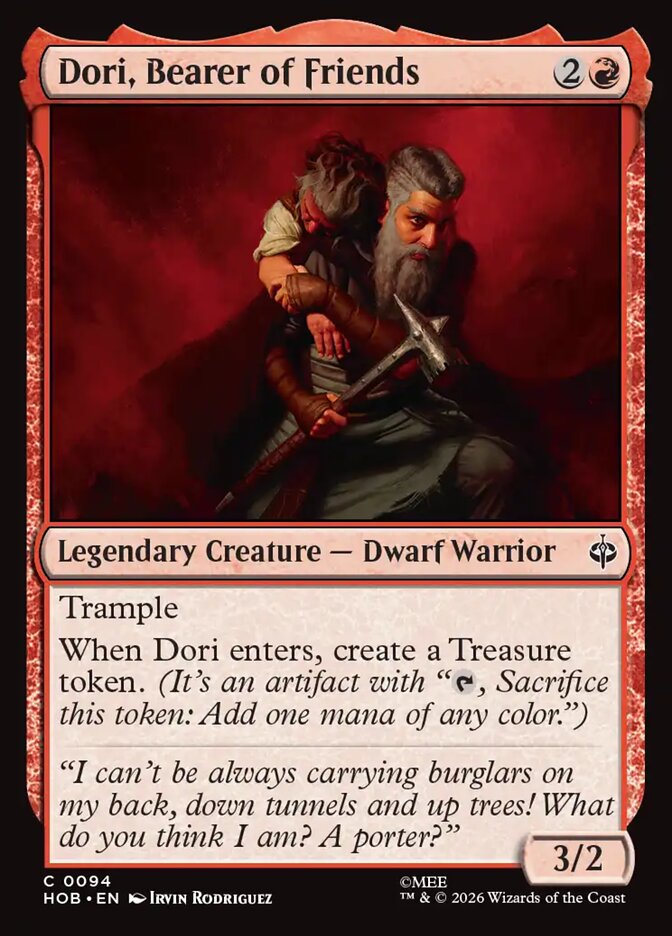
Dori, Bearer of Friends is an efficient creature that is more or less a legendary Plundering Pirate. Treasure tokens encourage you to keep your splashes as minimal as possible, but they’re an acceptable way to splash a bomb or two.
Giant’s Boulder + Old Thrush + Long-Bodied Grey Dog
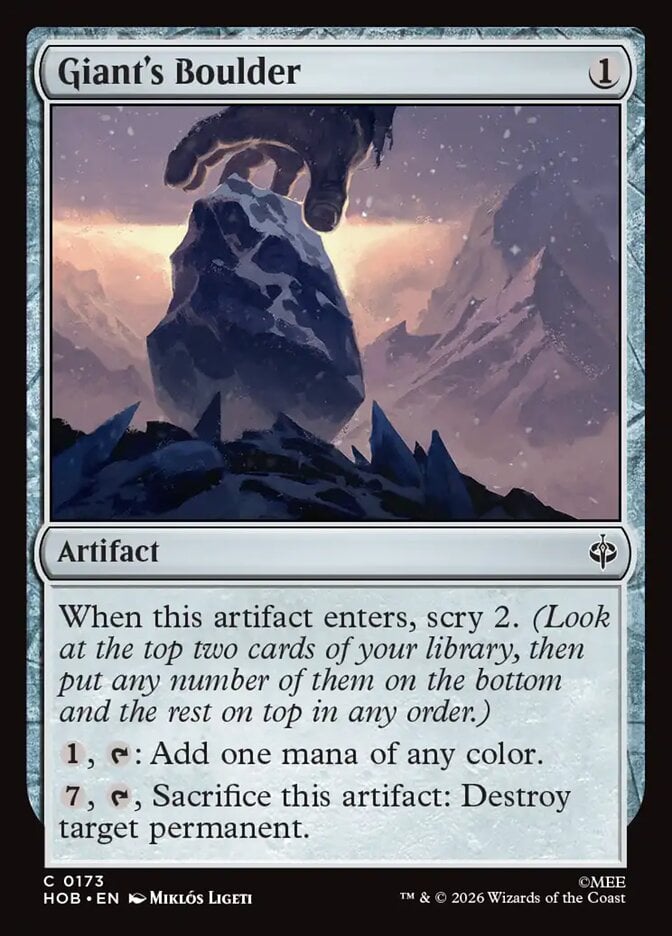
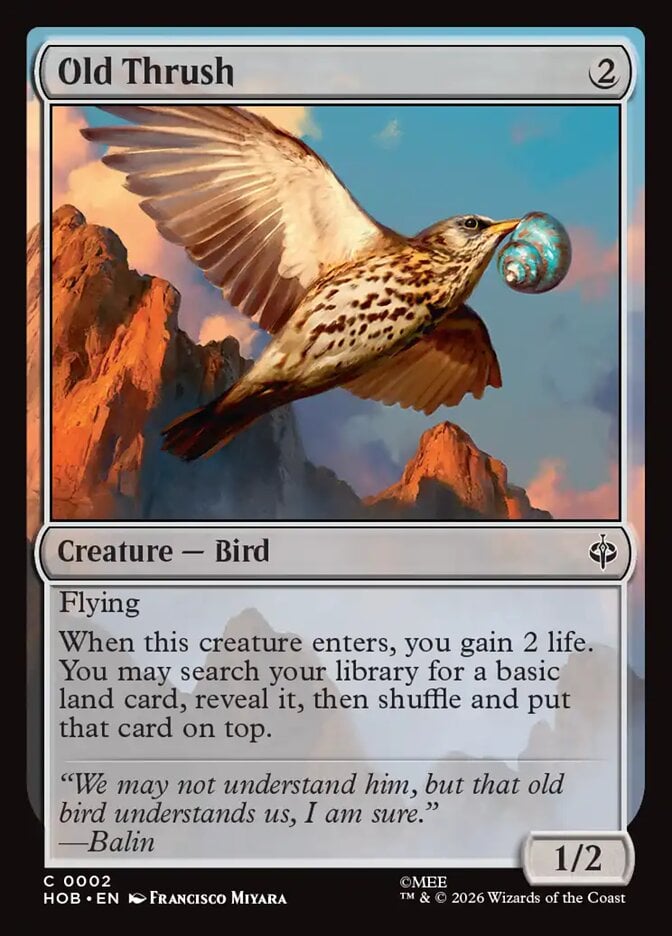
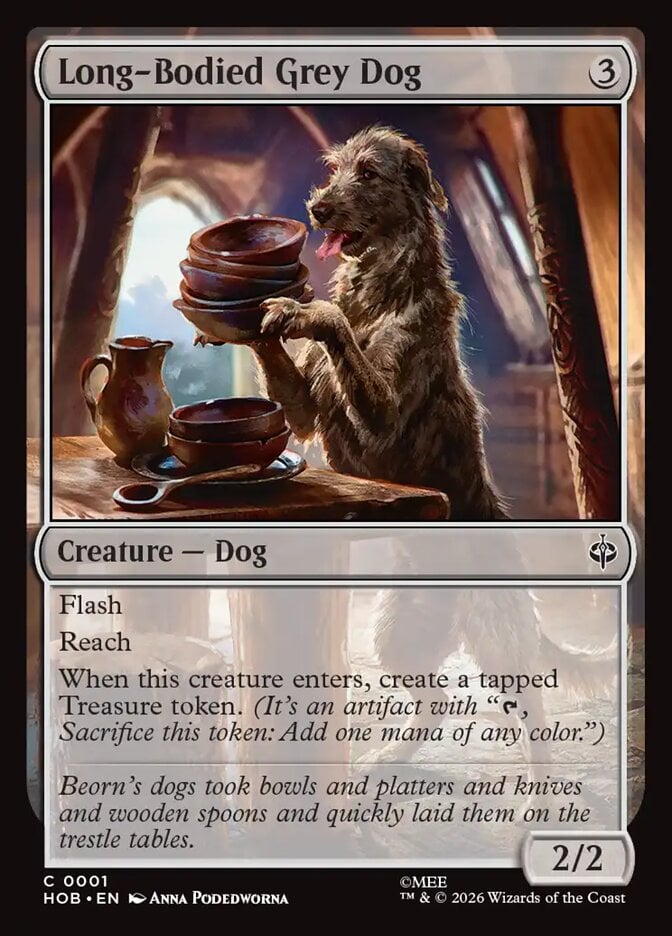
All three of these cards are below rate, so I’d hope not to play these unless I had to. Each fills a different role on the curve; Giant's Boulder is an early smoother/late hard removal, while Old Thrush and Long-Bodied Grey Dog help to shore up your 2- or 3-drop slot.
Common Duals
These are great, and they’ll make me much more likely to splash if I have them in the right colors for whatever bomb/removal spell I opened.
Hobbit Hole
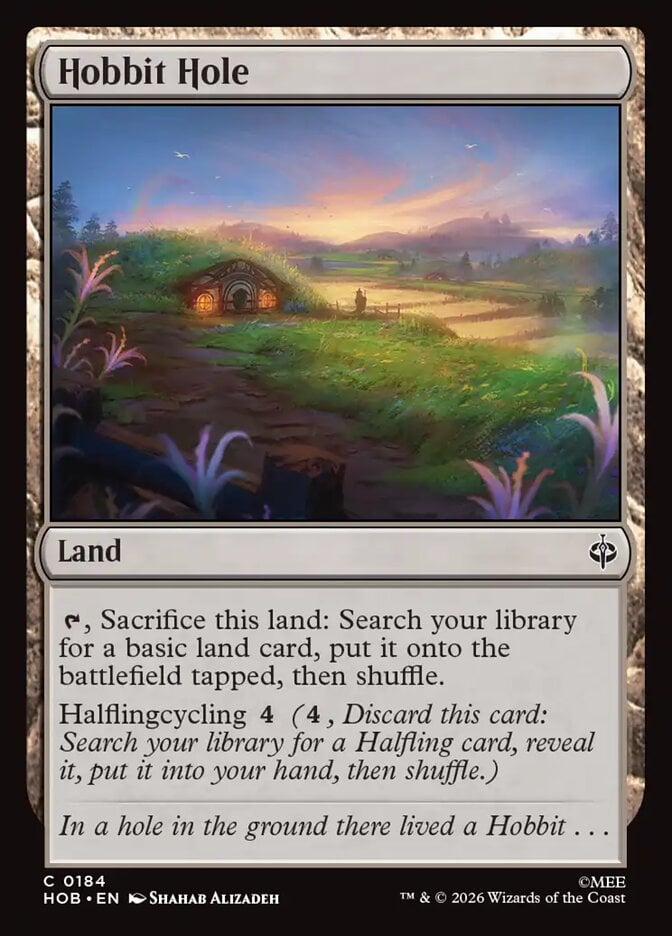
Serviceable fixing for any deck, and “halflingcycling” lets your Hobbit Hole grab Bilbo Baggins, Burglar if you flood out, too.
Thrór’s Map
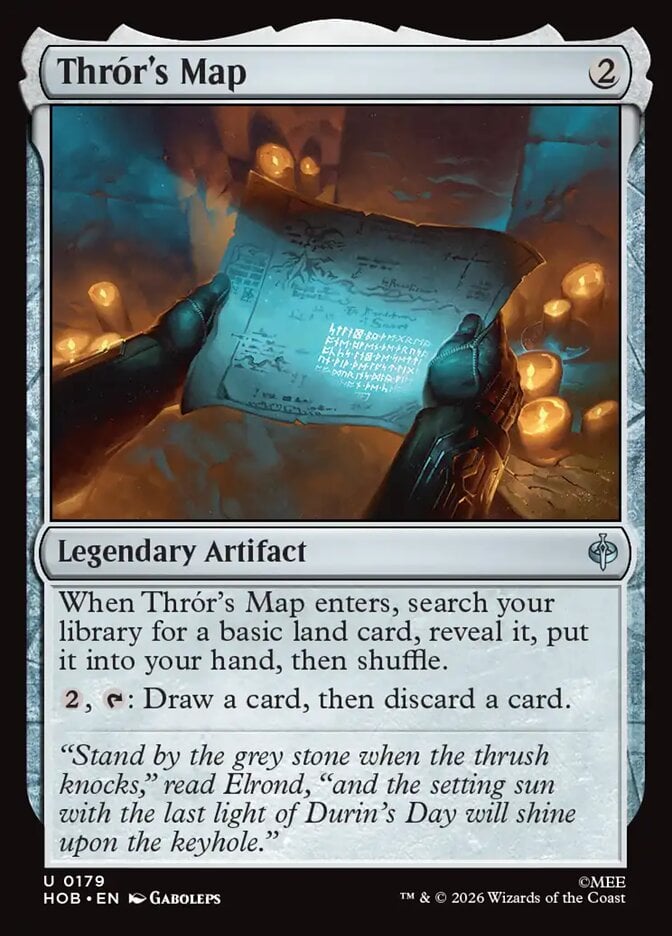
I’d recommend playing Thrór's Map in every deck, regardless of whether you’re splashing. Two mana to replace itself with a land is a serviceable rate, as we’ve all experienced with cards like Borough Backup and Aang's Journey, and getting a free looter afterwards is awesome.
Troop of Ponies
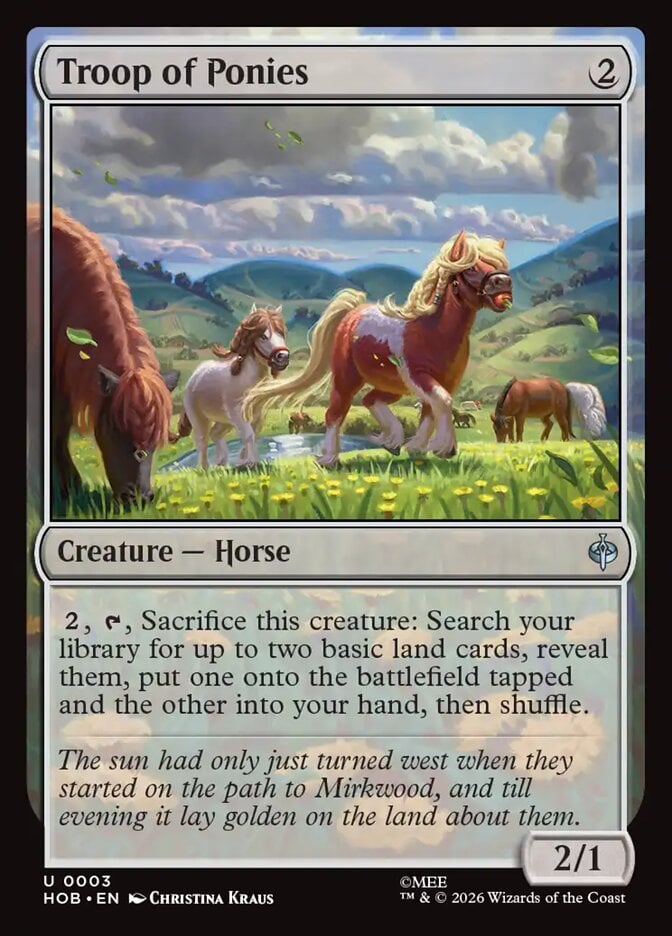
A nice upgrade to Burnished Hart, as Troop of Ponies only costs 2 mana both to cast and to use. It’s less of a must-play than Map, but it should still make the cut in most of your Sealed pools (and you’ll definitely want it if you’re splashing).
What to Splash
There isn’t all that much fixing in The Hobbit. Most splashes in this format will come from common duals/Hobbit Hole, or that trio of underpowered colorless cards that I’d prefer not to play. Here are most of the cards I’d consider splashing (which consist largely of bombs and removal spells, since those scale well late game). If you aren’t splashing for these, then you probably shouldn’t splash in the first place:
- Gandalf, Goblins' Bane
- Thorin, Mountain-king
- Great Gilded Boat
- Riddles in the Dark
- Part in Friendship
- Bard's Company
- Smaug, Wicked Worm
- Chief Warg's Company
- Tom, Bert, and William
- Thranduil's Company
- Celebrate the Mountain-king
- Stone by Sunlight
- Burn, Burn, Tree and Fern
- Misty Mountains Raider
- Magnificent End
- Enchanted River's Grasp
- Pinecone Strike
- Quarrel
Top Commons
It’s once again time to try and guess each color’s best commons! I’ll pick four cards from each. Look for these as you’re sorting out your colors, because they’re some of the best cards each color has to offer at this rarity.
White
#1. Dwarven Shortsword
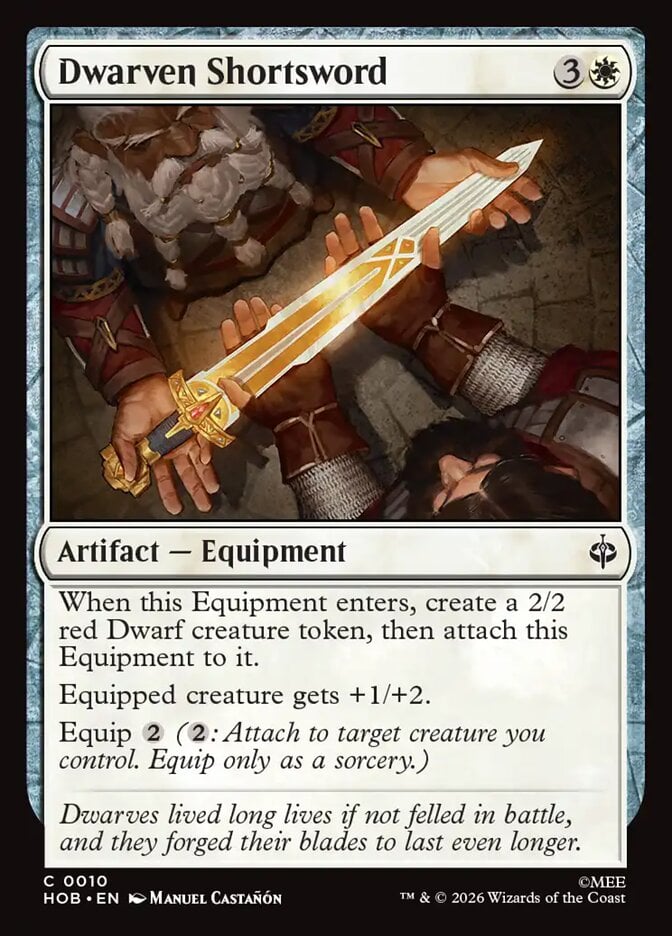
U.S.Agent, John Walker was a card I almost never cut, and Dwarven Shortsword is just short of that power level despite the dip in rarity. It’s helpful for getting storied and turning on equipment synergies, too.
#2. Magnificent End
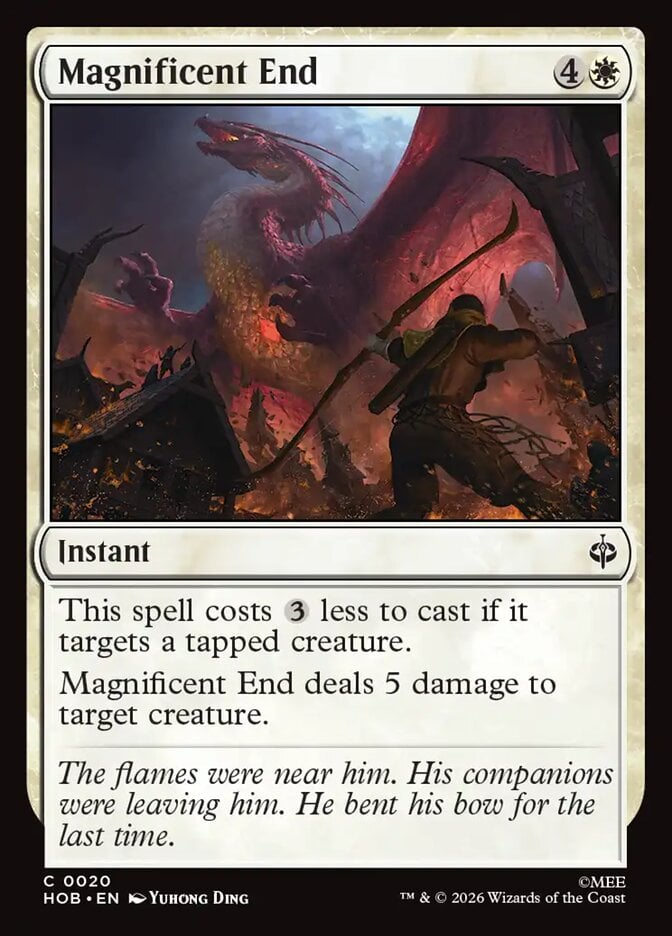
Five damage catches almost everything in The Hobbit, besides Old Fat Spider, Wilderland Scrounger, and a handful of giant rares. If white had a Web Up in this set, I’d probably put this lower, but removal is important for answering ferocious wolves, Goblin Army tokens, and fliers.
#3. Ori, Keeper of Songs
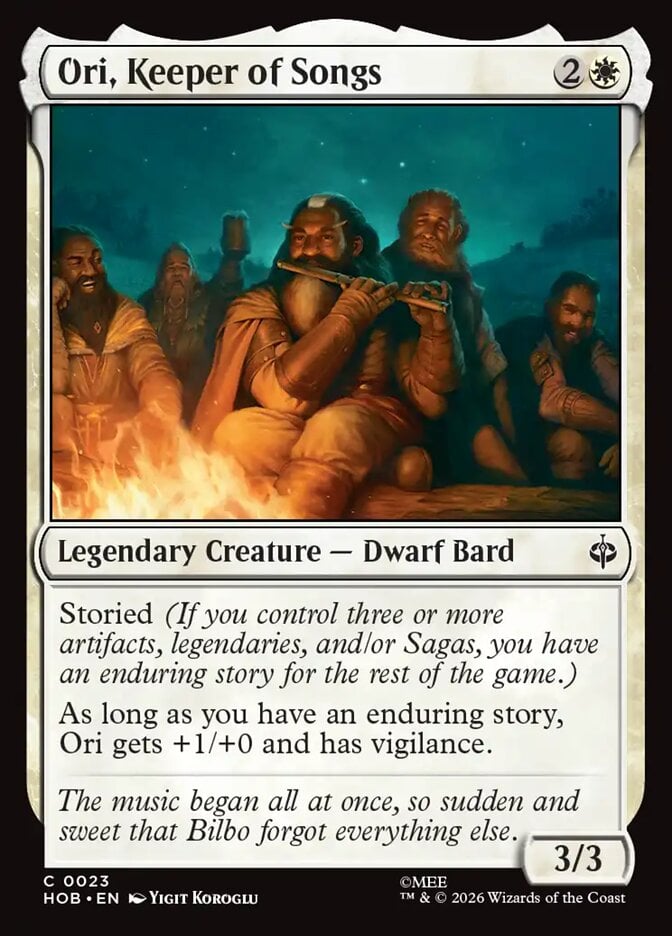
Ori, Keeper of Songs has strong stats for its cost if you can gain an enduring story, which you could do as early as turn 4 with a good curve.
#4. Velvetwing Butterflies
Ardenvale Tactician was white’s best common in Throne of Eldraine, although it had +0/+1 on Velvetwing Butterflies. Still, the combination of evasion and utility this offers is a valuable one.
Blue
#1. Bilbo Baggins, Burglar
Bilbo Baggins, Burglar is an awesome creature that fits into every blue deck, and a major draw to this color. Take a Glance makes your early game extremely consistent, and it makes Bilbo a much more exciting top-deck.
#2. Enchanted River’s Grasp
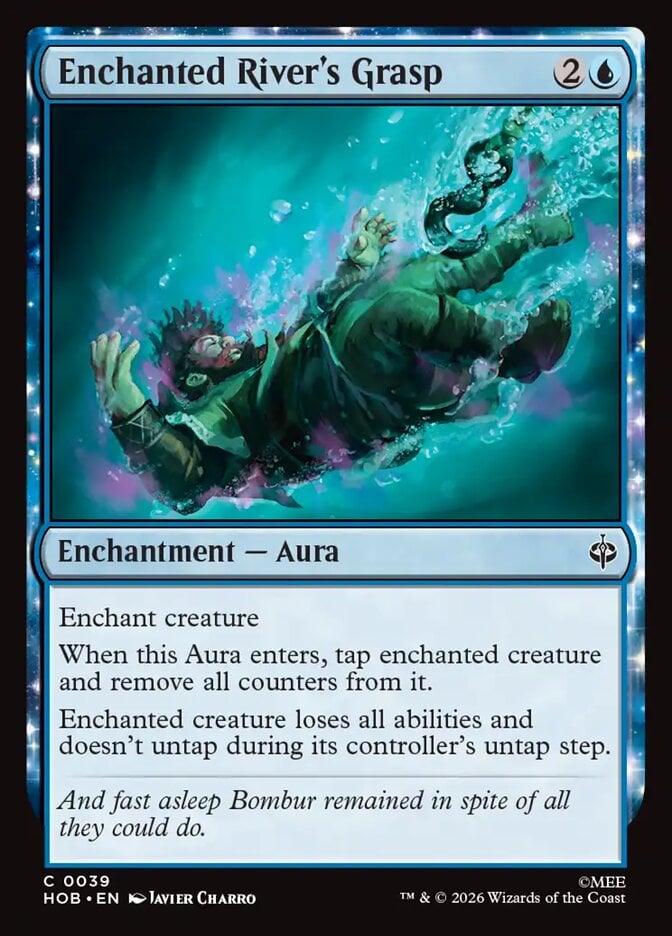
There’s no flicker in HOB other than Lake-town Mariners and Roll-Roll-Roll-Roll, and enchantment removal is quite rare, too. That makes Enchanted River's Grasp effectively a blue Murder, and an ideal card for answering most bombs.
#3. Plunder the Trollshaws
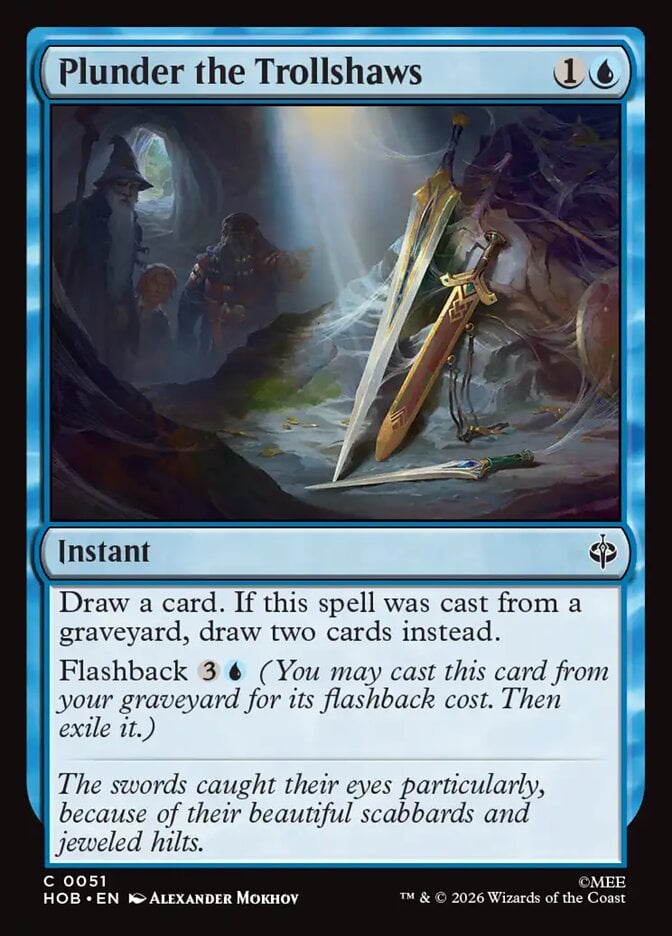
“Think Thrice” is an awesome card draw spell that will give you a definitive advantage in longer games. You can even recruit Plunder the Trollshaws for a bit of extra value sometimes.
#4. Uneasy Partings
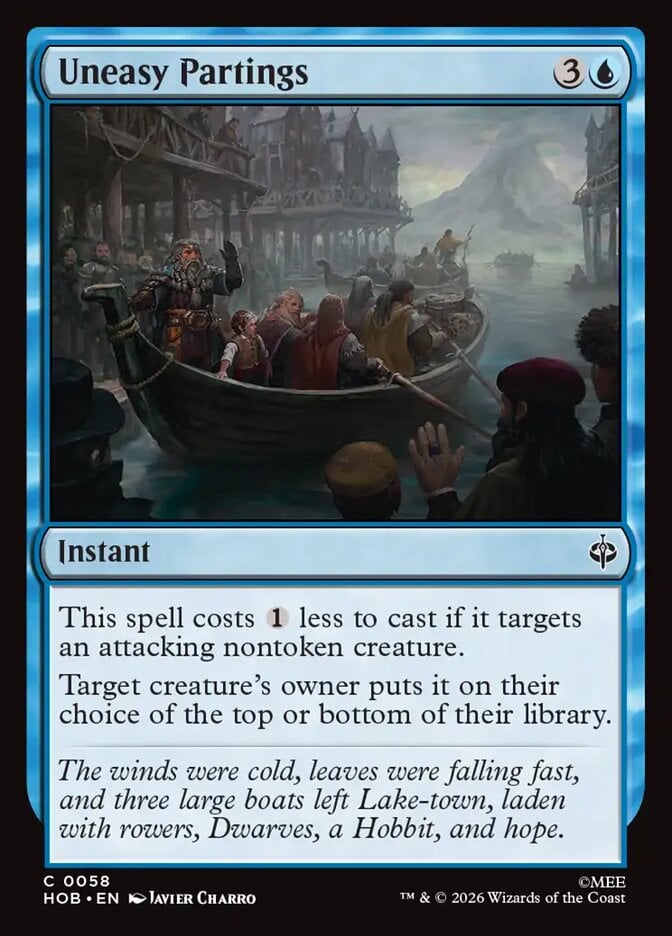
Dire Downdraft returns, albeit with a small restriction to prevent it from mopping up armies too easily. Uneasy Partings plays best defensively, but it’s still usable when you’re ahead, and it makes for nice “soft interaction”.
Black
#1. Bilbo’s Deadly Slice
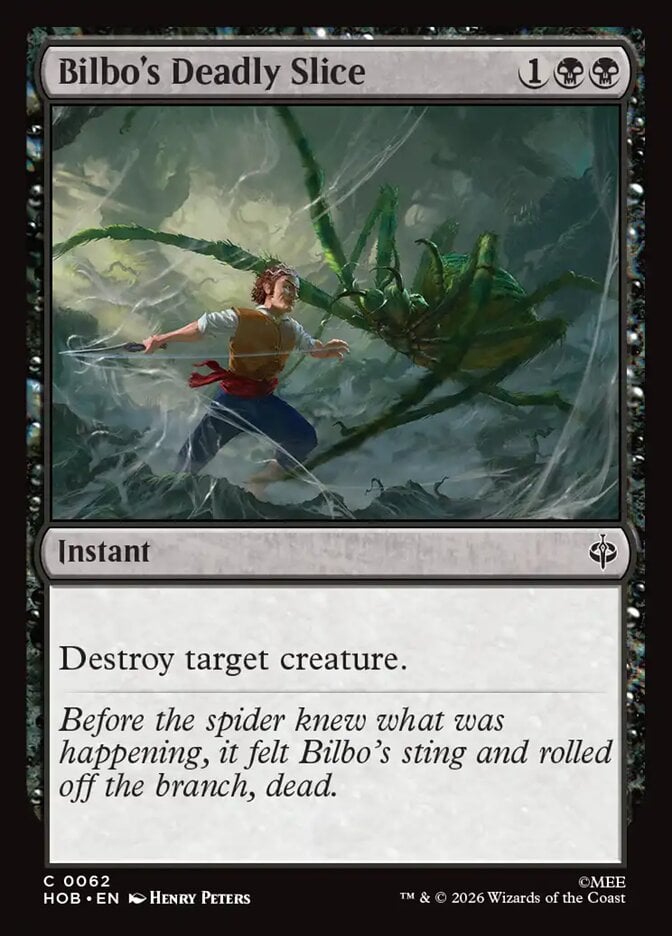
unfortunately keeps them from being splashed, but Murder is still good in 2026. I especially like Bilbo's Deadly Slice in a simple, focused set like The Hobbit.
#2. Rage into the Valley
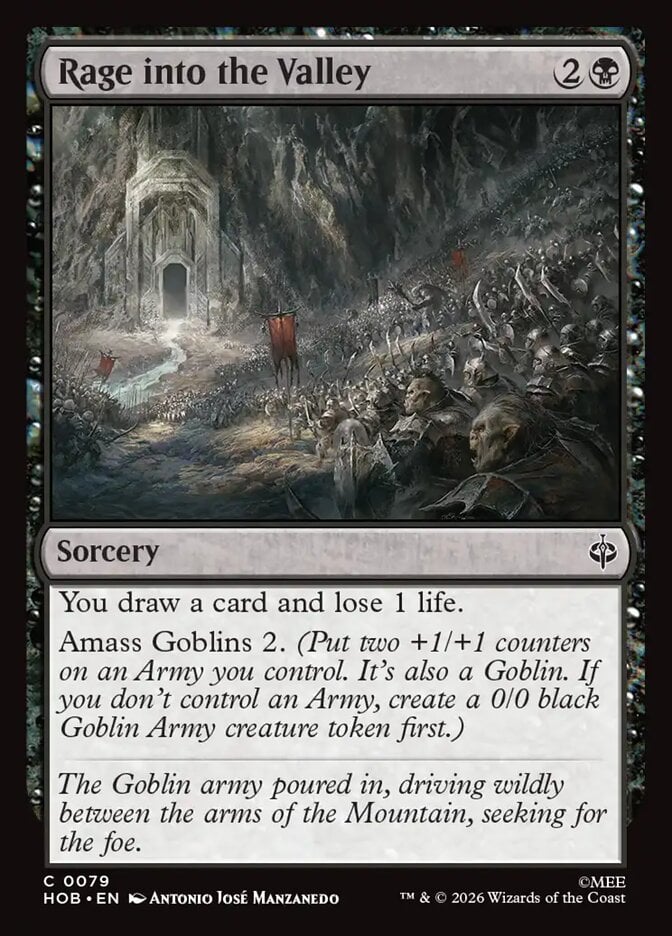
Think Phyrexian Rager, and you’ll immediately see the appeal. It’s debatable whether an army token is better or worse than a guaranteed 2/2 body (since Rage into the Valley will sometimes be a cantripping “aura” of sorts), but I’m happy either way.
#3. Stony-Voiced Goblins
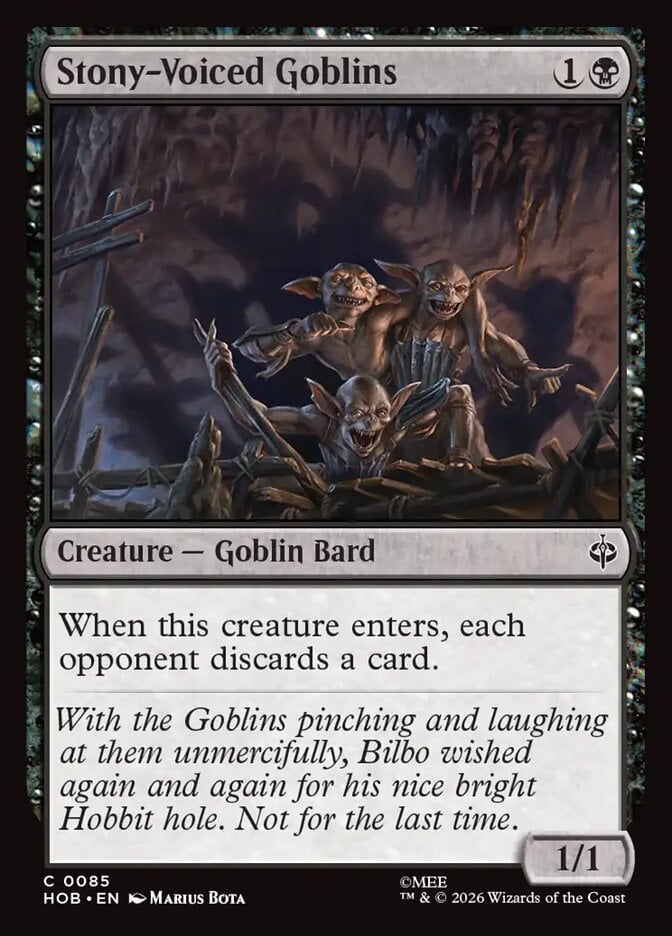
This kind of creature is good every time we see it, and there are plenty of ways to make use of Stony-Voiced Goblins’s 1/1 body in this set.
#4. Crude Bent Blade
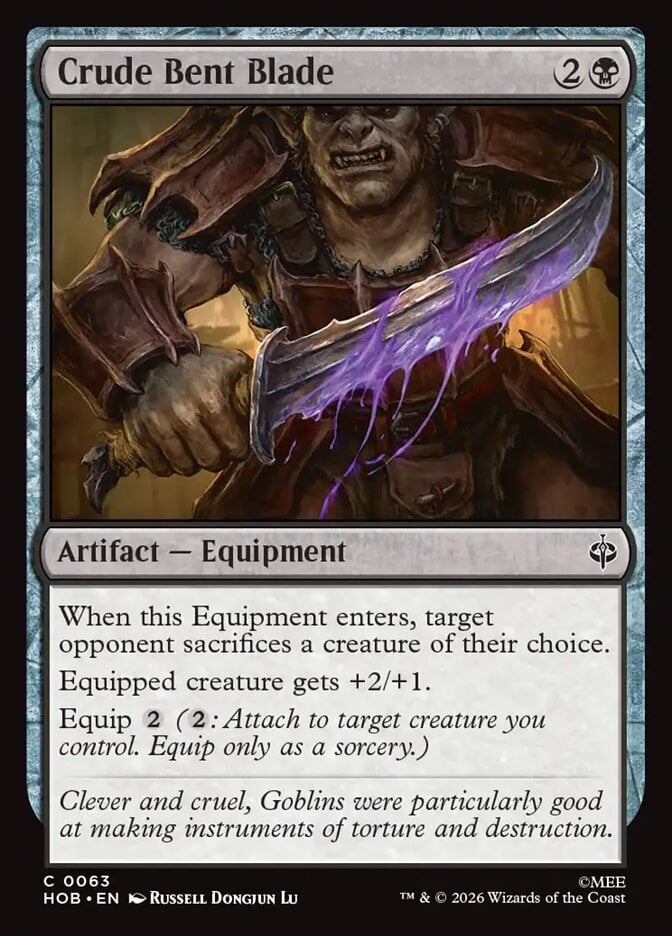
While The Hobbit does have some fodder options (recruit, goblins, and Wood Elves), Crude Bent Blade’s rate is strong when the edict trades for real cardboard.
Red
#1. Pinecone Strike
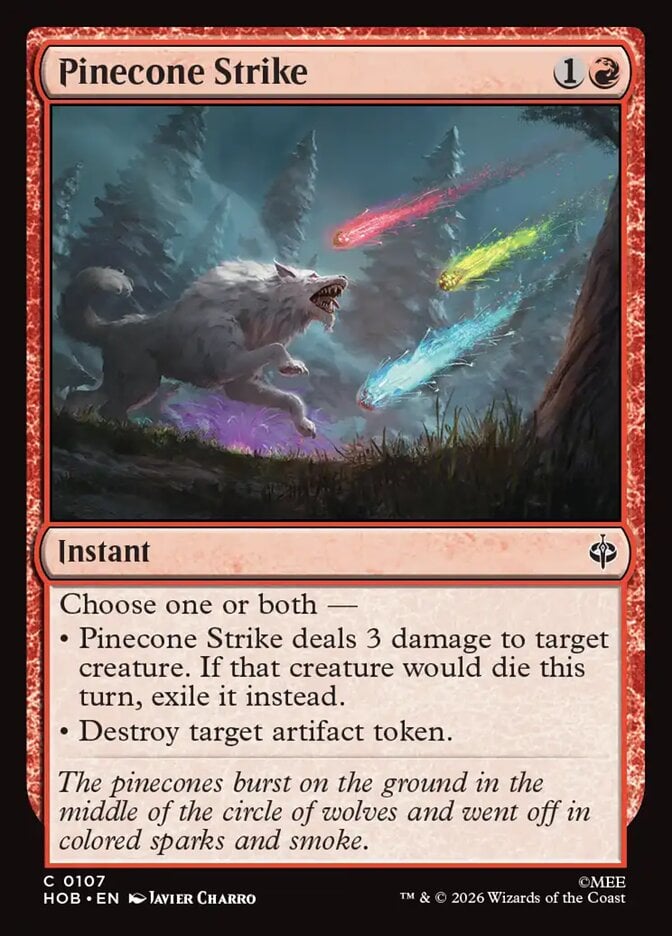
Pinecone Strike cleanly kills most creatures in this set, and it can even pick up free value against Axe tokens and Treasures. This kind of card is always either red’s best common, or at the very least near the top.
#2. Dori, Bearer of Friends
Dori, Bearer of Friends gets you two-thirds of the way towards an enduring story for just one card, and it’s a strong card on rate either way.
#3. Gundabad Opportunist
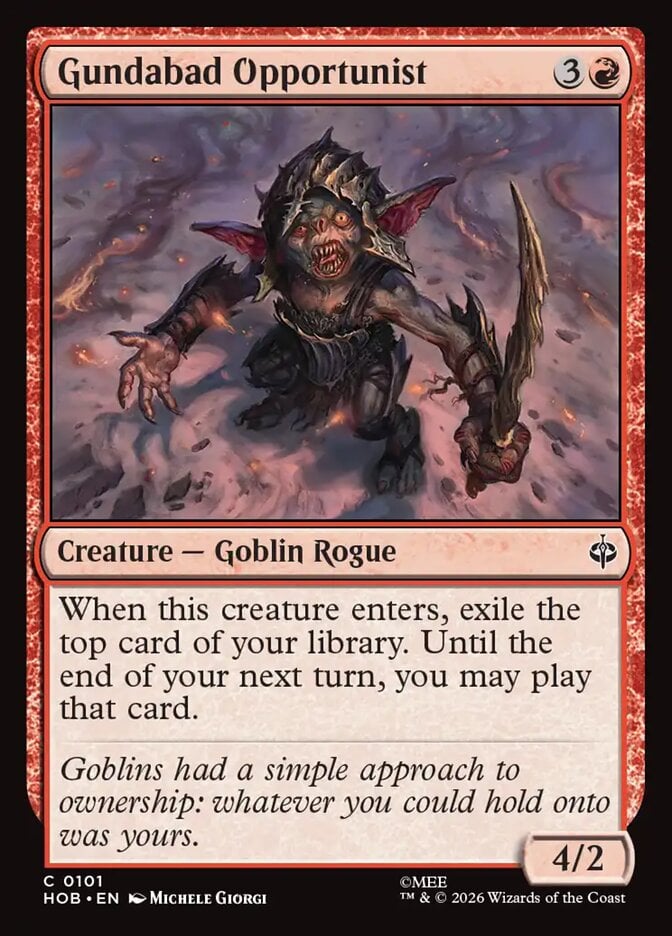
Generic value creatures like Gundabad Opportunist fit well into any red deck, regardless of whether you care about goblins.
#4. Óin the Brave
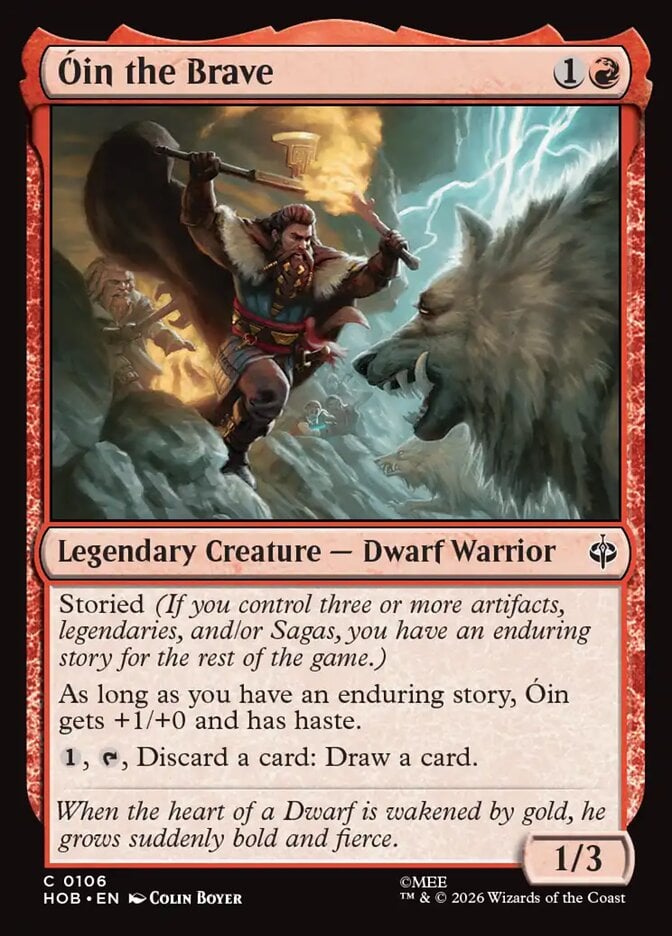
Óin the Brave is very efficient when you’re storied, and its rummaging ability gives it something useful to do in a board stall. I wouldn’t play this in BR Goblin decks (unlike Dori), but Óin’s great for what it wants to do.
Green
#1. Boughside Wanderers
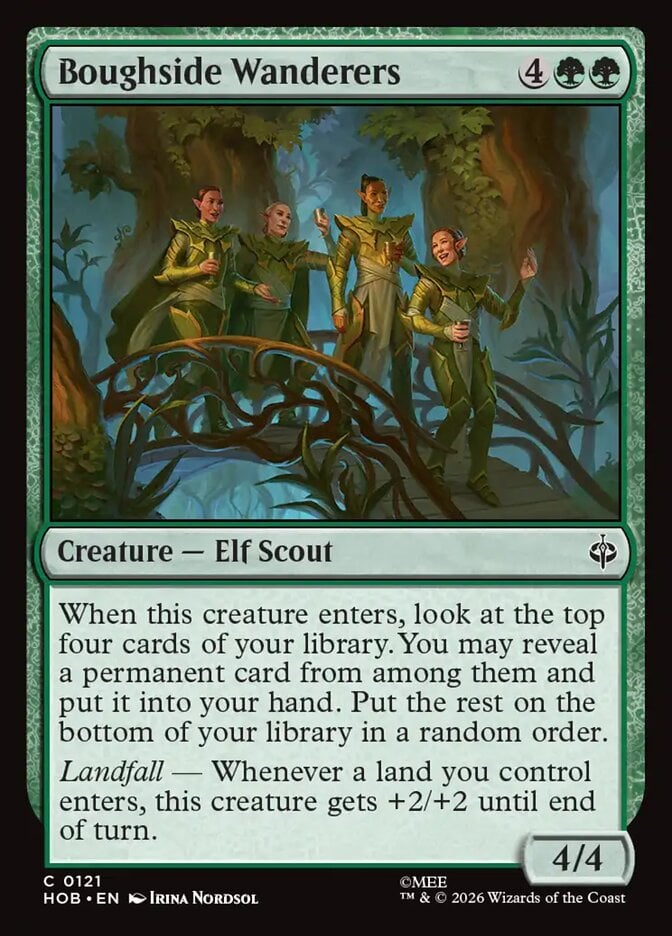
This will likely be green’s defining common, if the format isn’t somehow incredibly fast. You can actually chain multiple Boughside Wanderers into each other, and they hit hard enough that they’ll usually eat a removal spell (at +1 card advantage).
#2. Wood Elves
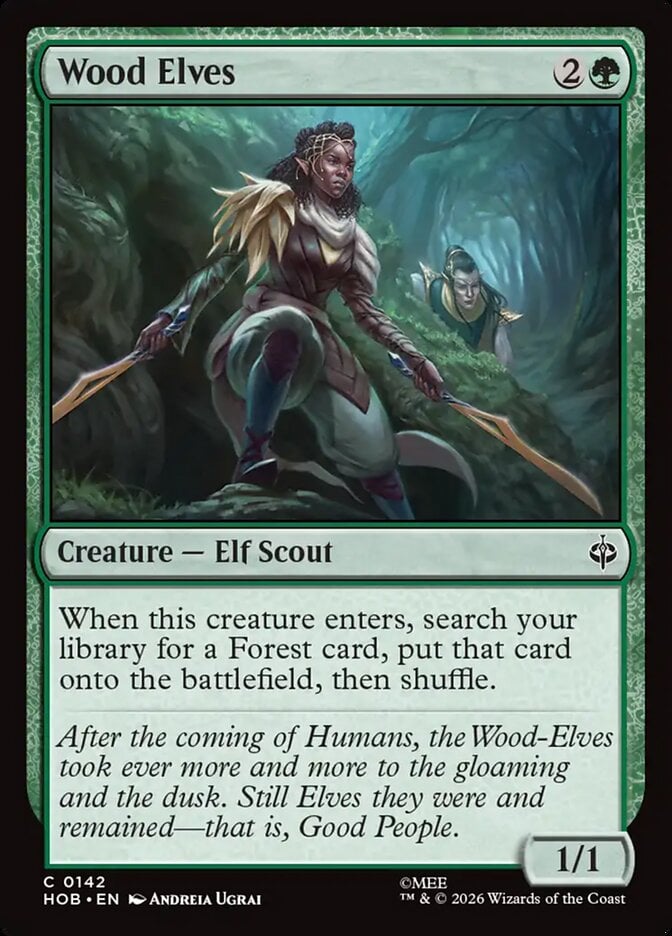
Wood Elves + Boughside Wanderers is green’s bread and butter in The Hobbit, as green has no other way to reach Wanderers earlier at common. It’s also synergistic with Mirkwood Nurturer and black sacrifice effects.
#3. Quarrel
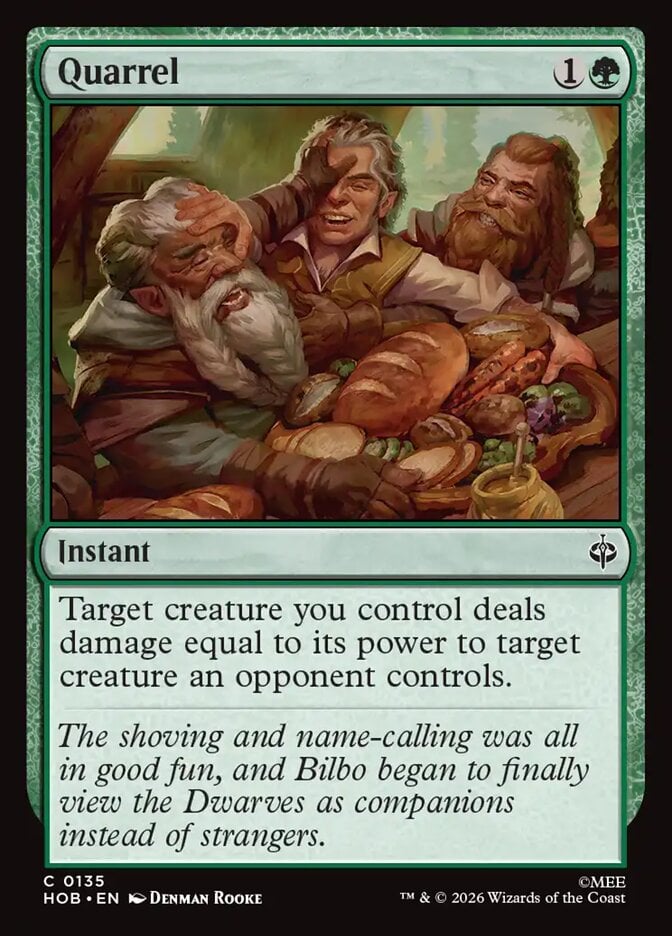
Quarrel is efficient and utterly alone, as green has no other removal besides Troll Negotiations. Green’s large creature sizing and cheap deathtouchers like Attercop are great for enabling this.
#4. Attercop
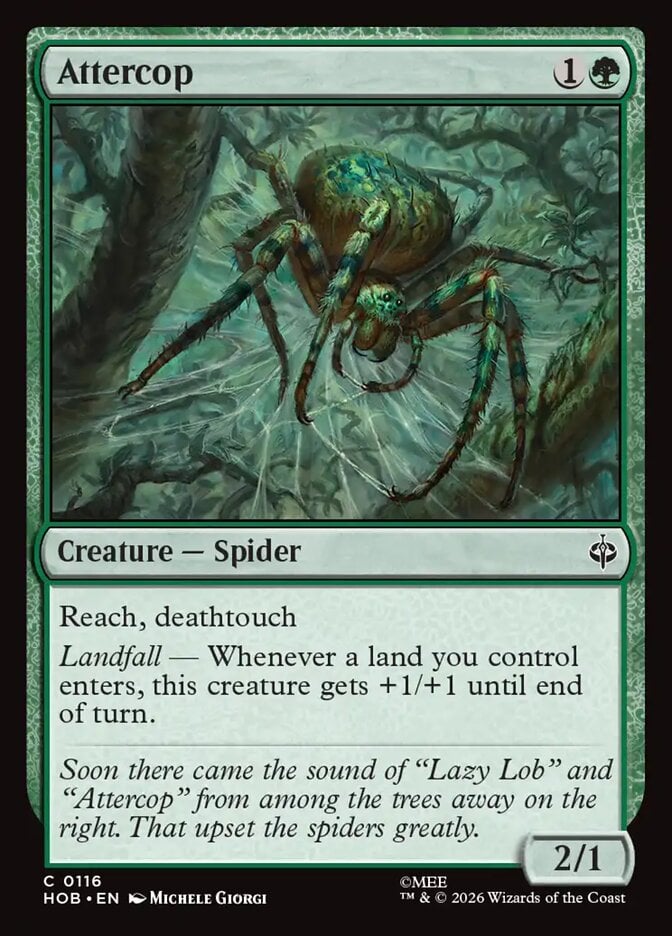
Speaking of Attercop, it trades well on defense and attacks decently with landfall, which is good value for a 2-drop. I love that +1/+1 pump keeps this from trading with recruit tokens.
Other
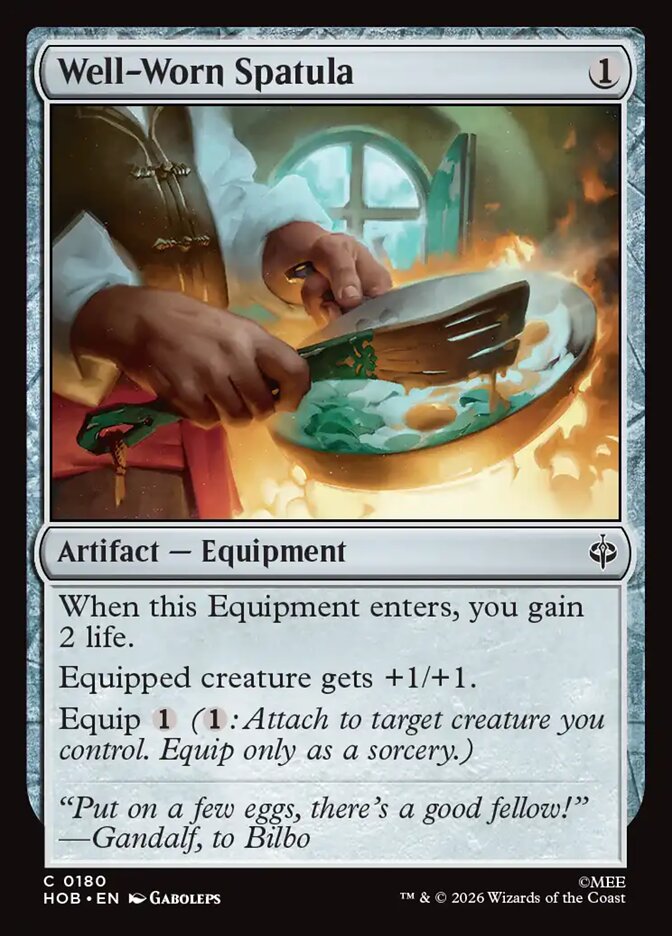
There are other commons too, as there’s a cycle of hybrid commons and several colorless cards. Well-Worn Spatula is the only colorless card I haven’t yet mentioned, and it’s a playable equipment if you have lots of cheap creatures and/or want to enable equipment payoffs.
As for the hybrid commons, they’re all above average cards, especially when compared to underwhelming 3-drops like Mirkwood Meditator and Great Fierce Bee.
Best Uncommons
For uncommons, I’ll choose sixteen particularly good ones rather than make a list for each color. These are all excellent cards that should have a strong influence on your deck.
#1. Celebrate the Mountain-king
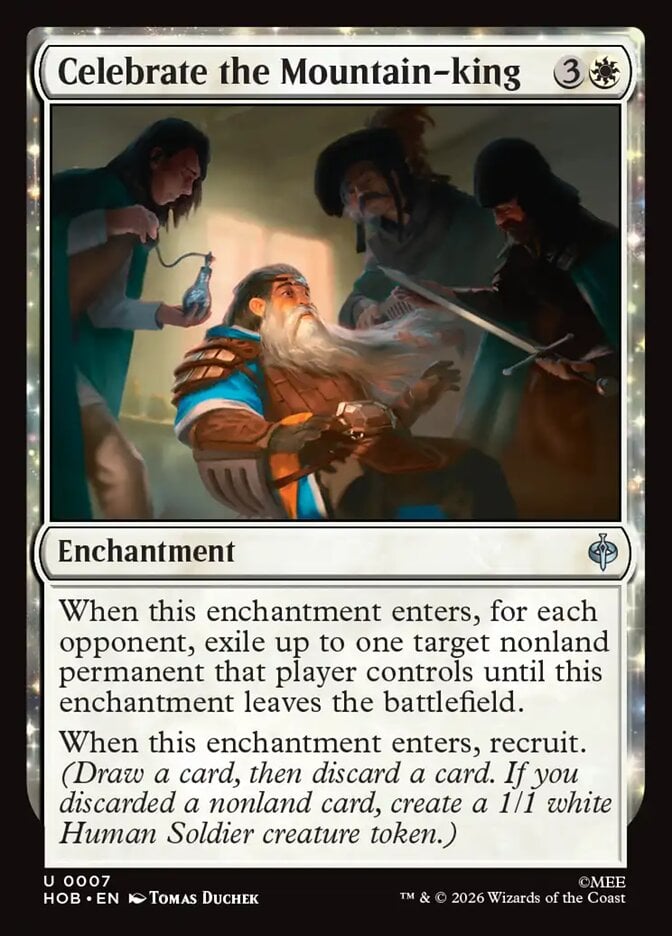
Four-mana Banishing Lights plus the set mechanic (i.e. Static Net, Lassoed by the Law) have a long history of being exceptional Limited cards, and Celebrate the Mountain-king isn’t going to break that streak.
#2. Iron Hills Blacksmith
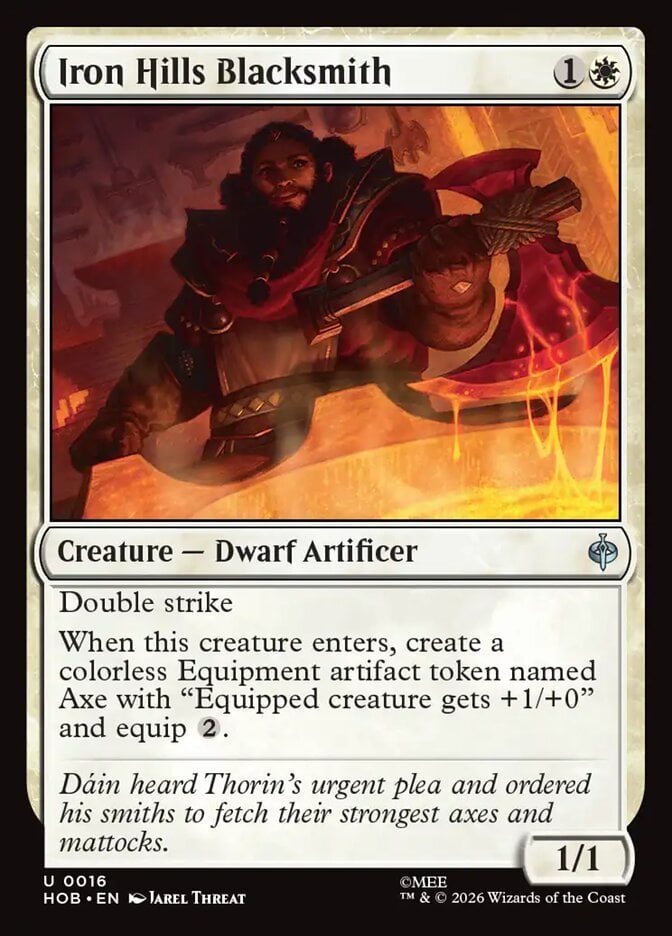
Fencing Ace rate is already fine, so getting an entire piece of cardboard on top of that (which Iron Hills Blacksmith can wear) is an awesome deal.
#3. Stone by Sunlight
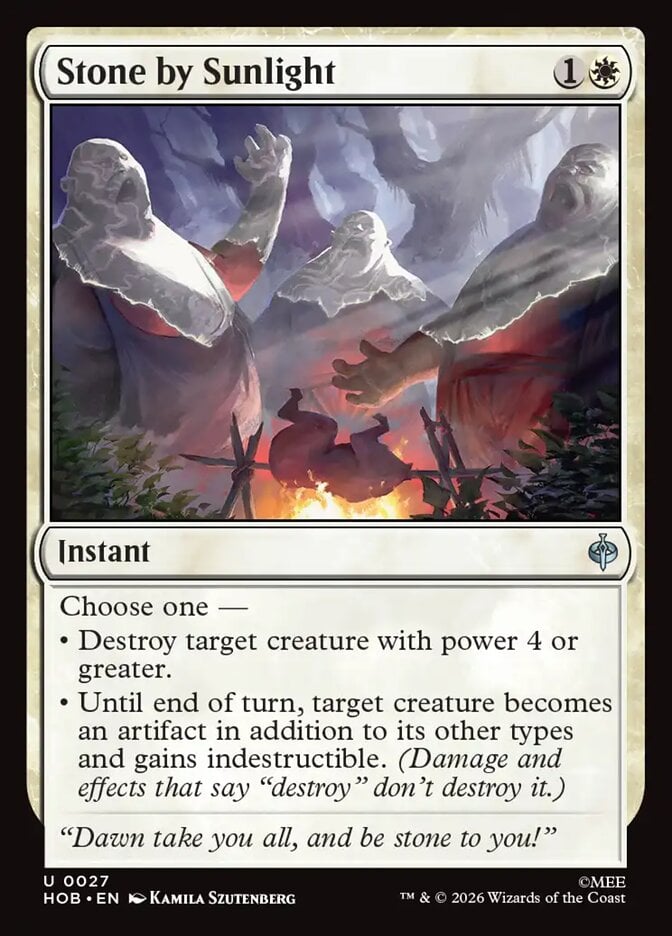
Valorous Stance is back in the form of Stone by Sunlight, and it remains an excellent Limited card.
#4. The Mountain-king’s Return
White’s commons looked mediocre, but it has a ton of excellent uncommons. Looting a 3-drop creature to The Mountain-king's Return is easy and highly effective, and it’ll leave you with that creature, a 1/1, and a +1/+1 counter on something (all for just 3 mana and one card).
#5. Bilbo, Luckwearer
Here’s a Merfolk Looter that gets to Shrewd Negotiations first if you top-deck it late game. Bilbo, Luckwearer is an incredible card.
#6. Desolation Prowler
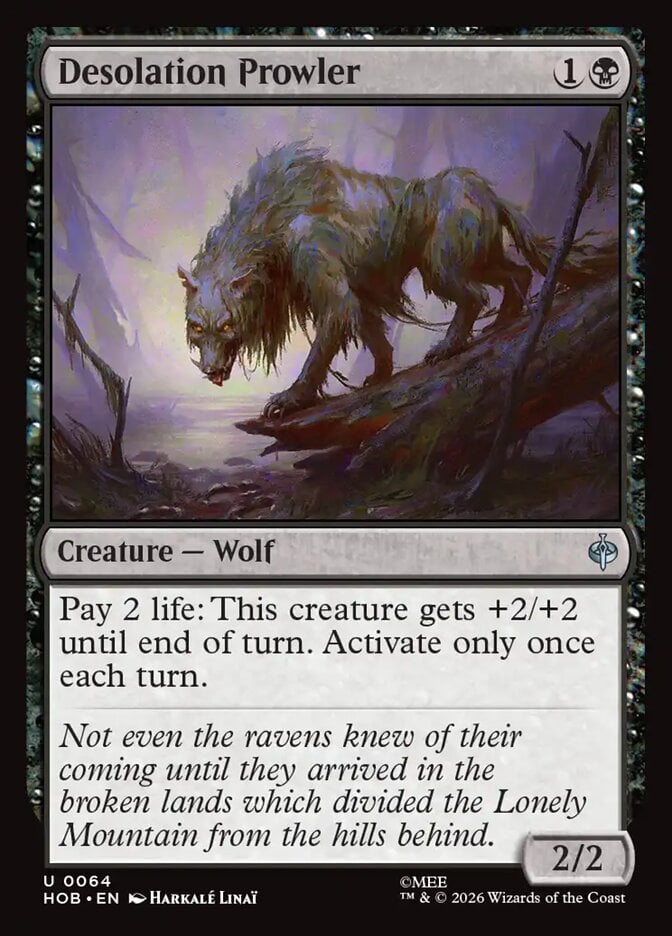
Putrid Leech has gone to the dogs! There are few better ways to enable ferocious, and the rate with Desolation Prowler is excellent even if you have no ferocious cards.
#7. Dreaded Bat-Cloud
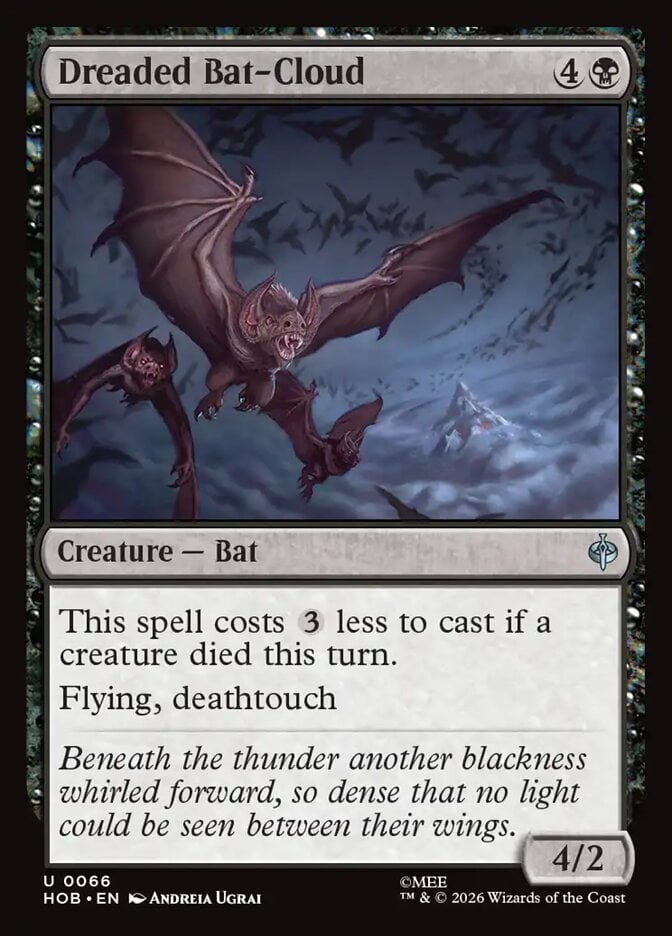
Speaking of excellent rates, trading off your 2-drop and playing Dreaded Bat-Cloud puts you monstrously ahead. You can sometimes accelerate it out with sacrifice outlets, too.
#8. Gathering of Darkness
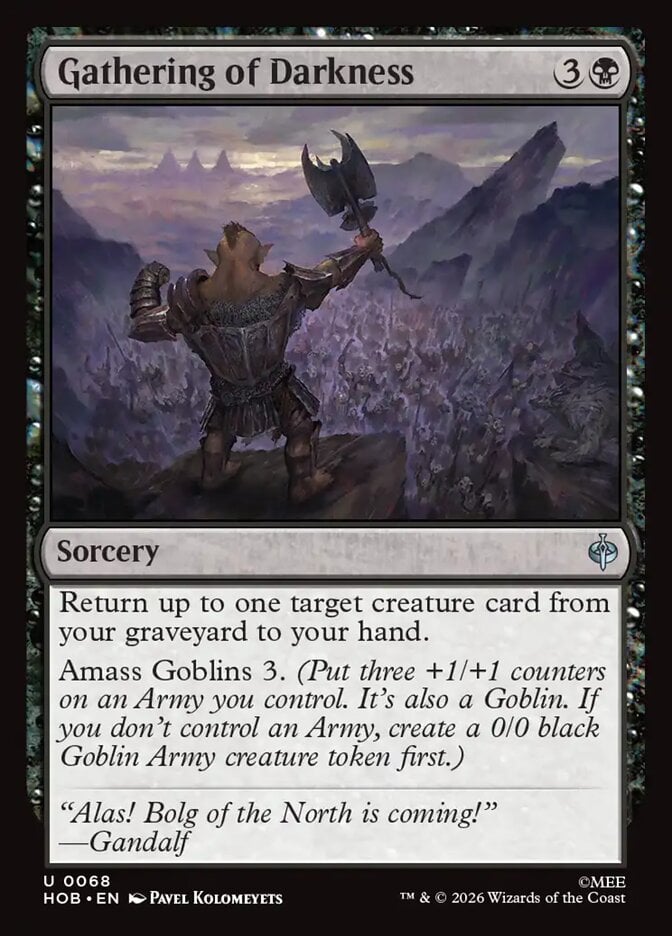
A strong Gravedigger variant. Gathering of Darkness gives you more stats than a normal gravedigger would for this cost.
#9. Gnashing of Teeth
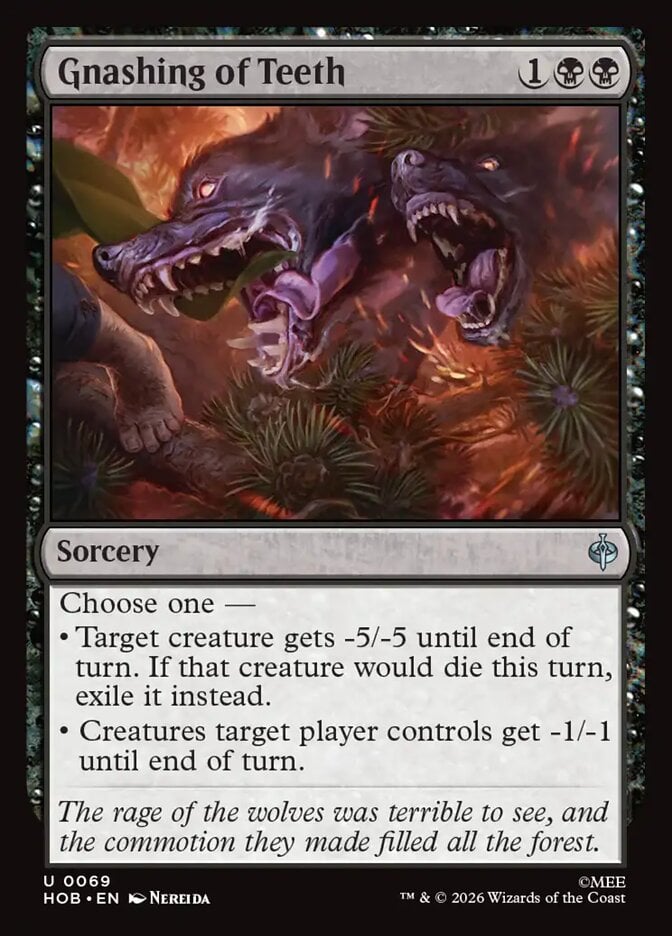
Efficient and versatile removal that answers most creatures in the set directly. Gnashing of Teeth also has the potential to clean up 1/1 tokens and Long Lake Nuisances.
#10. Burn, Burn, Tree and Fern
Burn, Burn, Tree and Fern would be good enough to play even as just a deal 6, and the other chapters of this red saga aren’t even that niche.
#11. Gandalf, Spark Starter
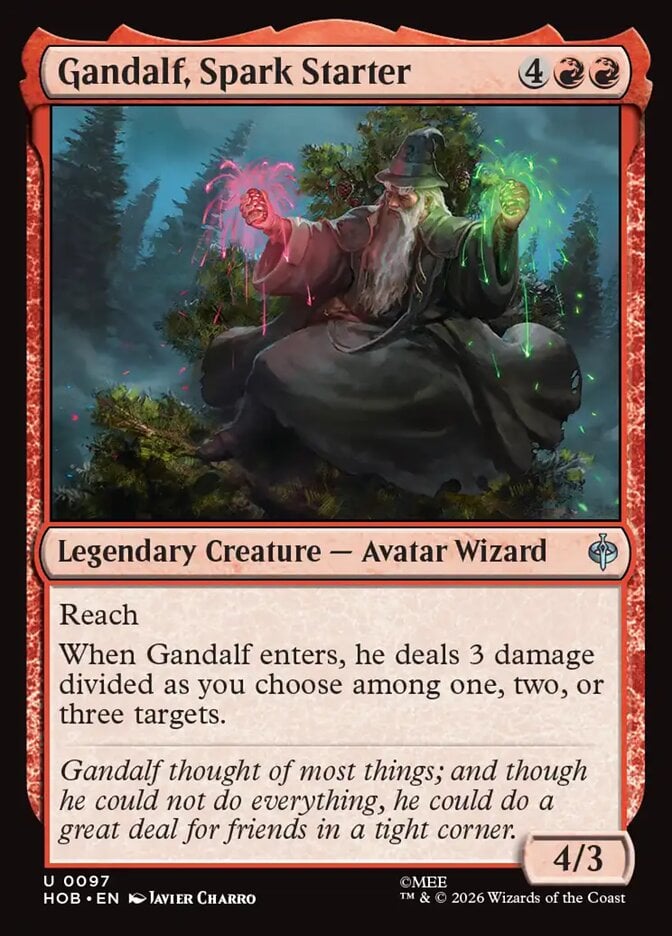
Flametongue Gandalf is one of the best uncommons in the set. Gandalf, Spark Starter has decent combat stats and an enters ability that can immediately take out a creature or two.
#12. Misty Mountains Raider
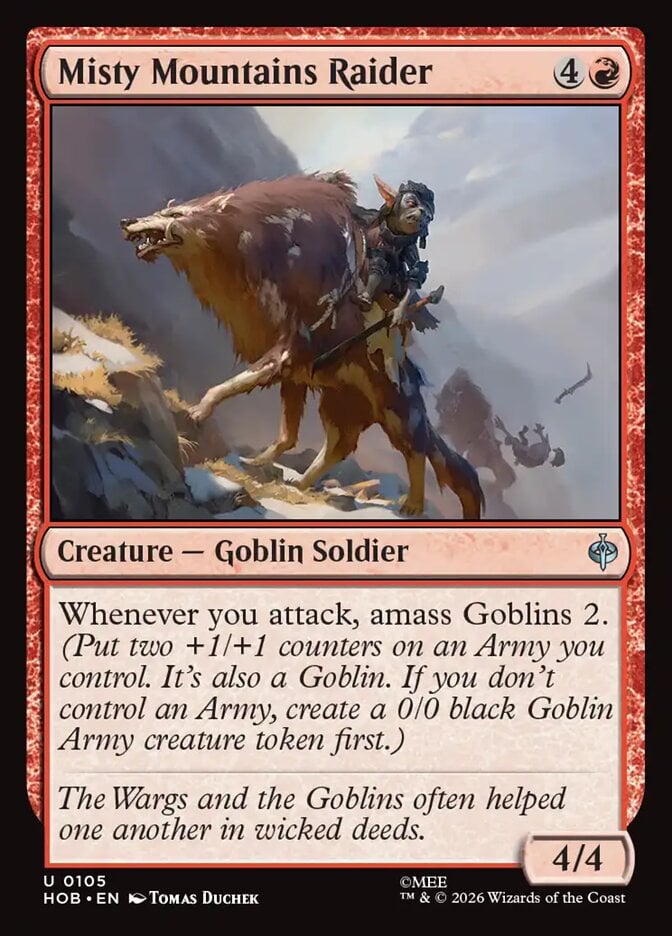
“Whenever you attack” is an exceedingly permissive line of text, and it lets Misty Mountains Raider get both immediate and continuous value. Throw in a reasonably sized body for its cost, and you’ve got a clear winner.
#13. Mirkwood Pathmaker
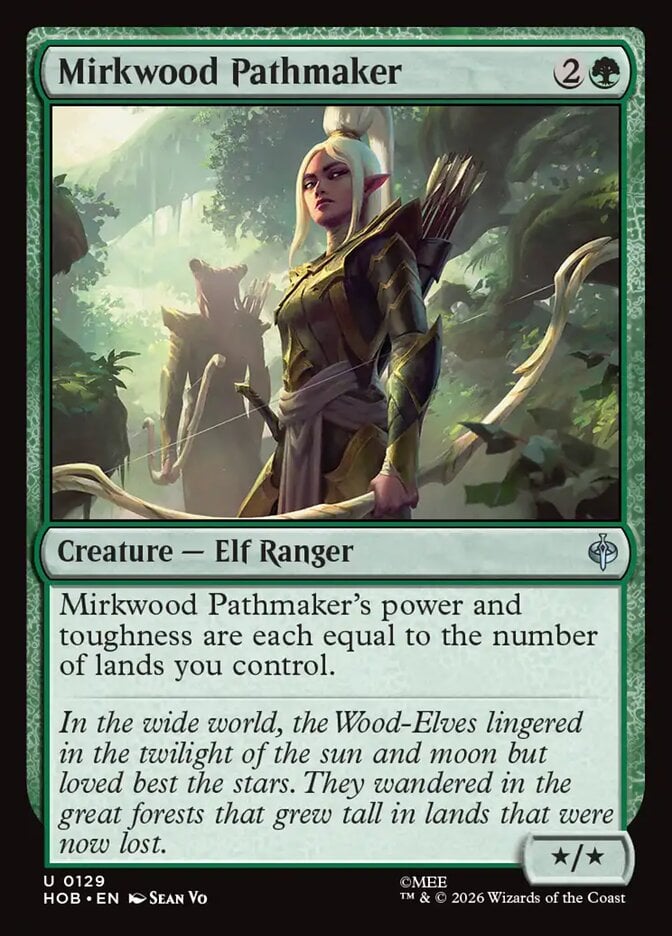
Mirkwood Pathmaker is very large for , since it starts as a 3/3 minimum and only grows from there. Elves are great at drawing cards too, so don’t be surprised when this is an 8/8 or bigger in a longer game.
#14. Old Fat Spider
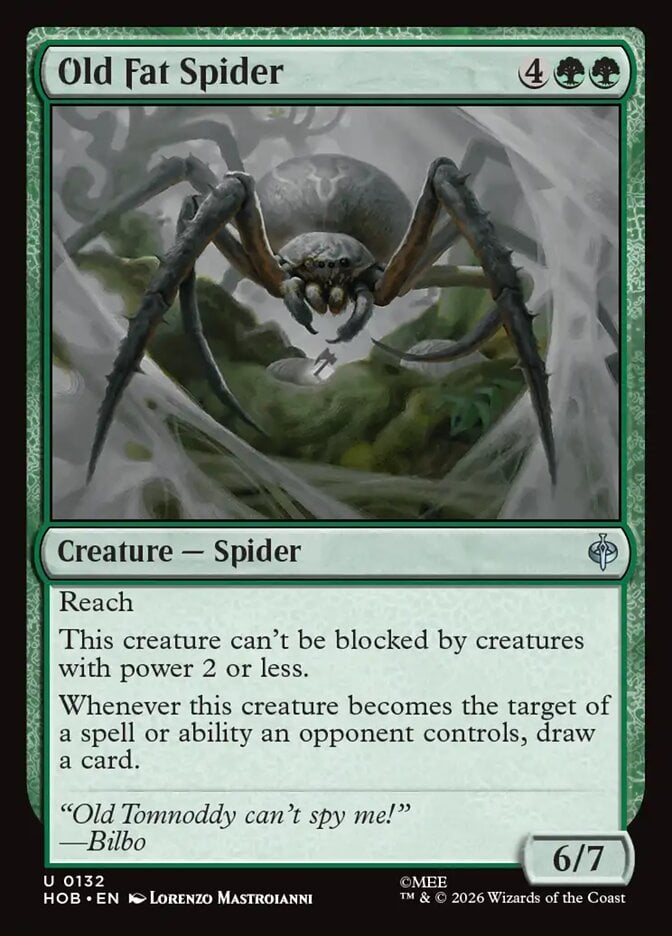
Funny name aside, this is a legitimately threatening piece of cardboard. Your opponent must 2-for-1 themselves to answer it directly, or somehow match this massive beast in combat. It even dodges its spider sibling (Attercop) due to that evasion clause!
#15. Troll Negotiations
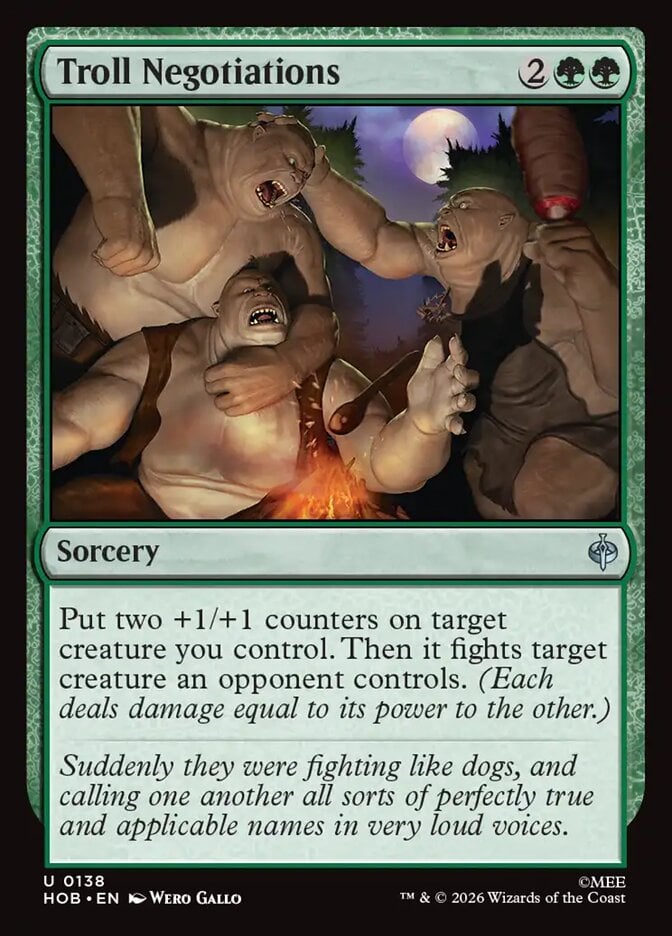
Hunt the Weak is much stronger when you throw an extra counter into the mix. Wait for your opponent to tap out first if you can, then kill their best creature with Troll Negotiations while creating a substantial threat of your own.
#16. Signpost Uncommons
All the signposts in The Hobbit are appealing cards, so don’t be afraid to let them guide your Sealed deck if you can’t decide on colors.
Rare Review
Terms
Bomb: This rating belongs only to the set’s very best cards. Do whatever you can to play/splash these if you open any!
Examples from the last set: Doctor Doom, Leader, Super-Genius, The Super Hero Civil War
Great: These cards fall a smidge short of true bomb status, but they should be among the best cards in your pool.
Examples from the last set: The Wondrous Wasp, Elektra, Daughter of the Hand, Cloak and Dagger, Entwined
Good: “Good” rares are, well, good! You’re usually happy to play these, but they’re unlikely to dominate games like “Great” or “Bomb” rares do.
Examples from the last set: Black Widow, Super Spy, Epic Fight, Captain America's Shield
Mediocre: I used to tag this rating as “Usually Unplayable”, but “Mediocre” should describe these cards better. Specific decks can get some use out of these, but they’re never bombs and most decks won’t be interested.
Examples from the last set: Ironheart, Clever Champion, Thunderbolts Conspiracy, Heroic Feast
Always Bad
These rares are just terrible in Limited, and they should never make your decks. Feel free to put them aside with your tokens/basics if you’re unfortunate enough to open one of them.
Examples from the last set: The Ten Rings, Armor Wars, Arc Reactor
Mythics
Gleaming Splendor (Always Bad)
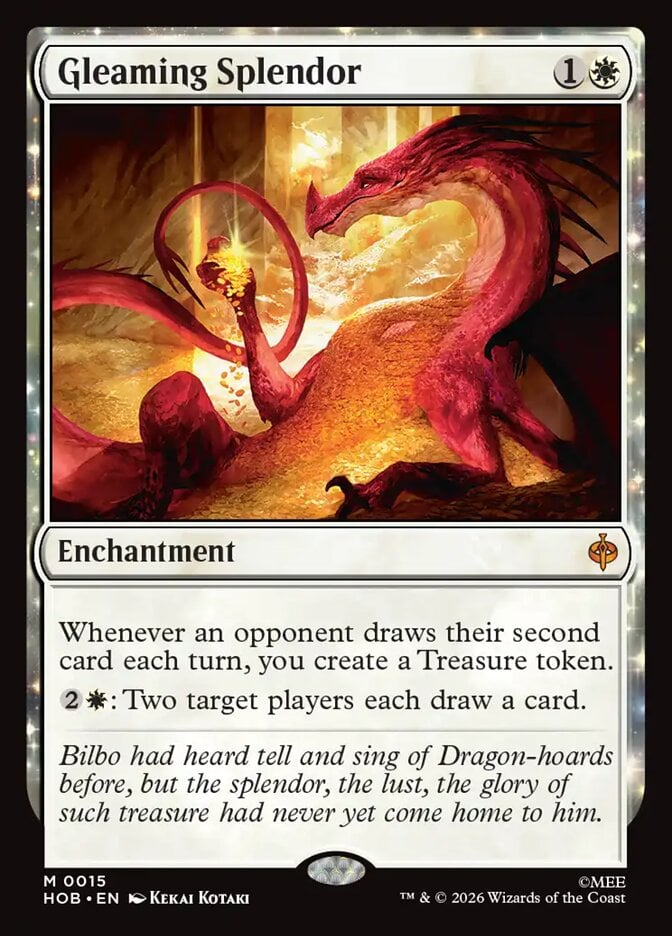
While Gleaming Splendor is likely to be a very exciting card for Commander, it’s 100% unplayable in Limited. You’ll be down a card and totally reliant on a single opponent to produce a handful of Treasures, which is an awful proposition.
The Queen of Dale (Great)
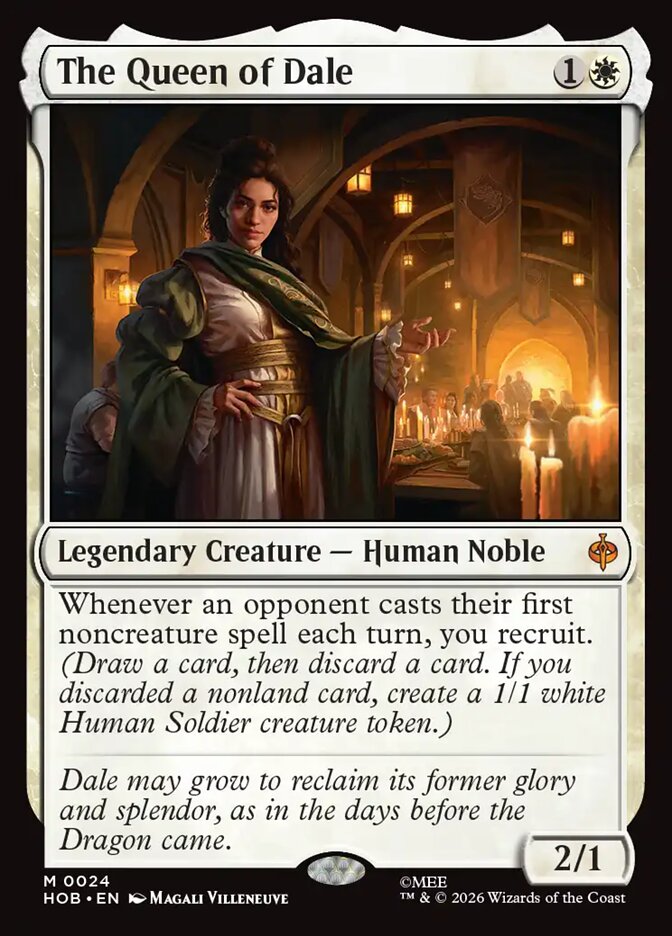
The Queen of Dale can net you a ton of recruit triggers if it sticks around, and this noble even trades up with removal (since you’ll always recruit at least once). That’s a lot of value for just 2 mana, so I’m always happy to play this one.
Bilbo, Thief in the Night (Great)
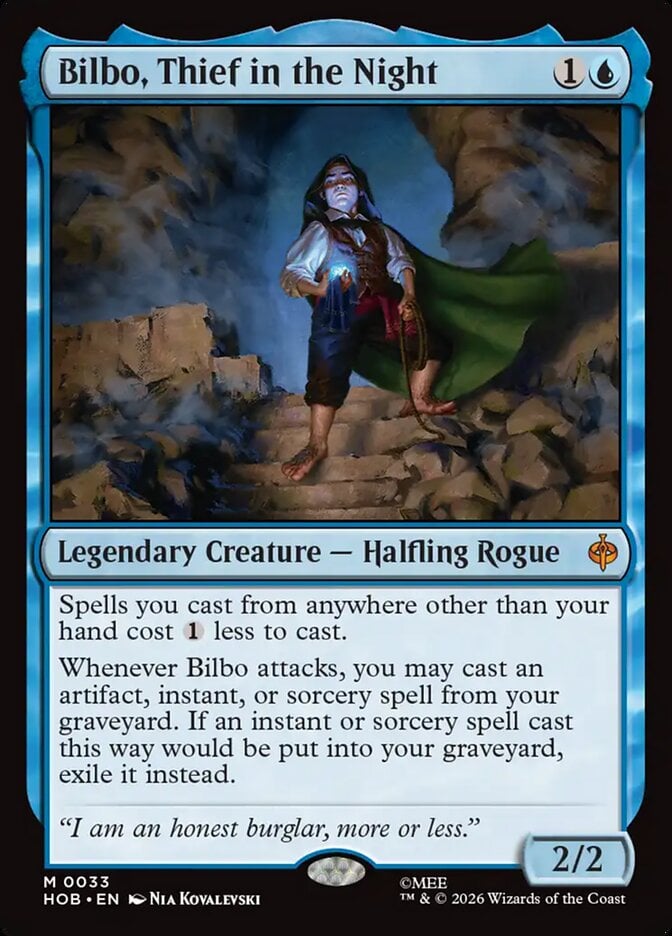
The Hobbit is somewhat lacking in instants and sorceries to flashback for Bilbo, Thief in the Night, but it’s a bear with upside at worst. Confusticate and Bebother, Uneasy Partings, Quarrel, and Stone by Sunlight are some of the better pairings available for Bilbo. You could try to play it in unofficial colors like Izzet () or Grixis (), since it’s excellent with removal spells like Pinecone Strike and Bilbo's Deadly Slice.
Don’t forget that it discounts other flashback costs (i.e., Plunder the Trollshaws) and exile-based draw like Gundabad Opportunist.
Elrond, Moon-Reader (Good)
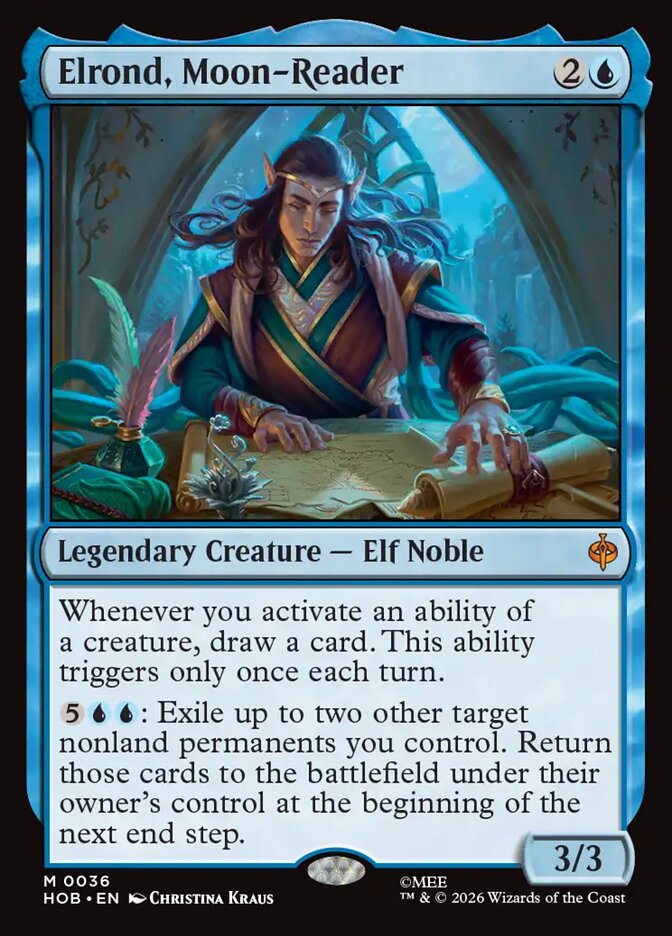
Most of the creatures that you could pair with Elrond, Moon-Reader are really expensive (i.e., Elvenking's Harper, Guardian of the Halls), so it’s mostly a 3/3 for with solid upside late game. I’m never cutting it, but I wouldn’t build around the effect much.
Fateful Discovery (Always Bad)
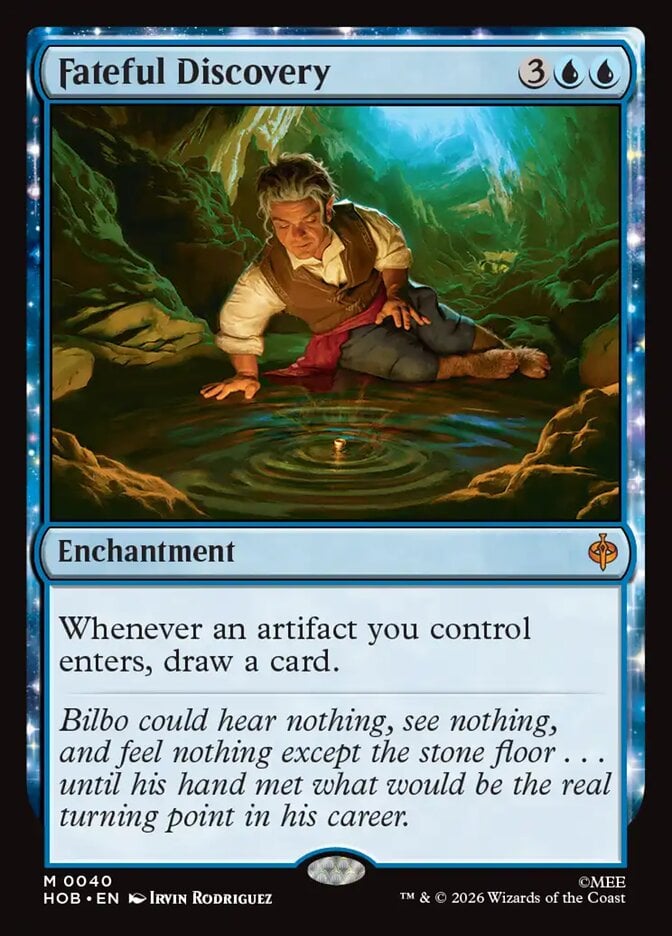
There are sets in which Fateful Discovery would probably be playable, but The Hobbit has a low artifact count and few ways to make artifact tokens. Neither of its blue archetypes (WU Recruit and GU Landfall) care about artifacts either, so don’t bother.
Gollum, Riddle Master (Bomb)
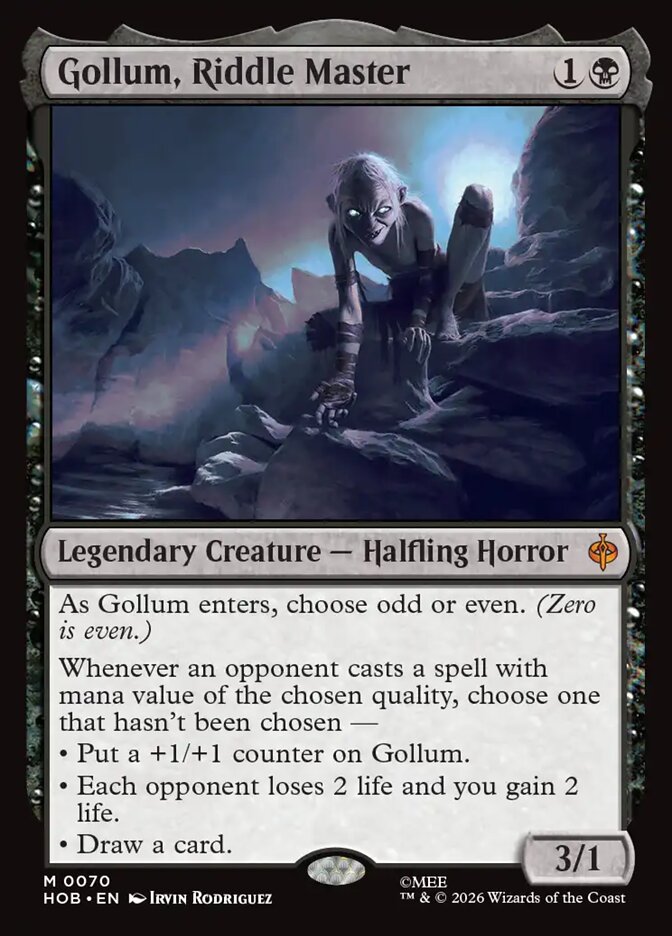
Gollum, Riddle Master is a really overpowered 2-drop, since you’re almost guaranteed to get the card back plus several bonuses later. I’d name “even” versus red decks to play around Pinecone Strike, but otherwise will just name whatever curve point your opponent is about to be in (i.e., “odd” if you play this turn 2 on the draw, or “even” if you play this turn 2 on the play).
Inside Information (Mediocre)
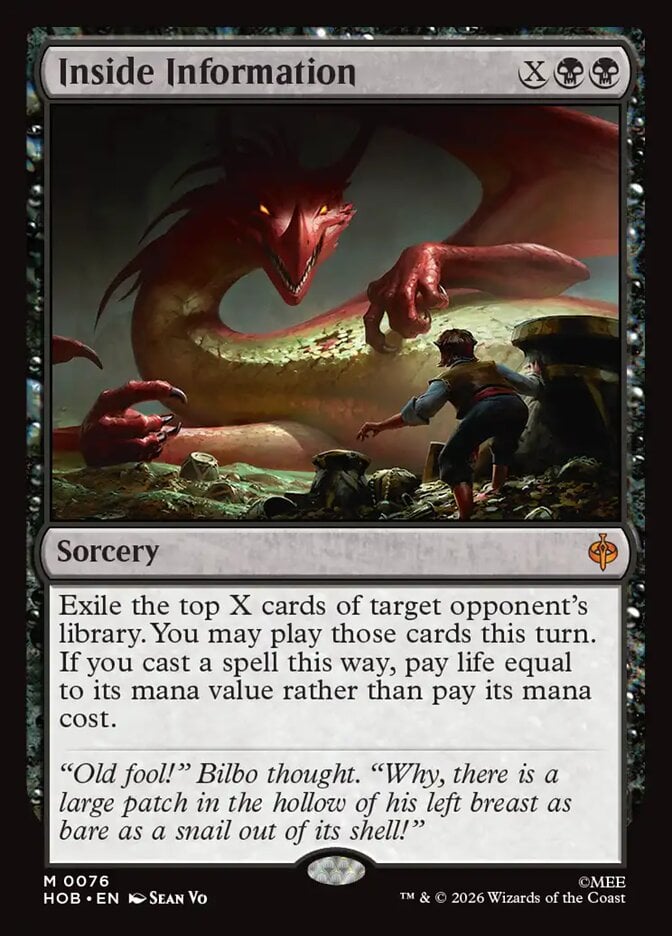
Inside Information is The Sentry, Golden Guardian of this set, because this is a card with immense variance to how it will play out. The basic sales pitch here is to cast this for X = 4+, hopefully with a significant chunk of life left over. You’ll then have the option to cast spells you exiled this way for life rather than mana, which could put you massively ahead if you hit some good stuff.
However, being forced to be at a high life total on turn 6 or later isn’t an easy task. The Hobbit has no common lifelink creatures, and it features several incidental life costs on black commons. If you stumble early, you’ll end up bleeding life trying to stabilize, which could make Inside Information more or less a blank when you’re finally ready to cast it.
As such, I’m not recommending that you play it, but I’ll definitely try it myself if I open it.
Gandalf, Goblins’ Bane (Bomb)
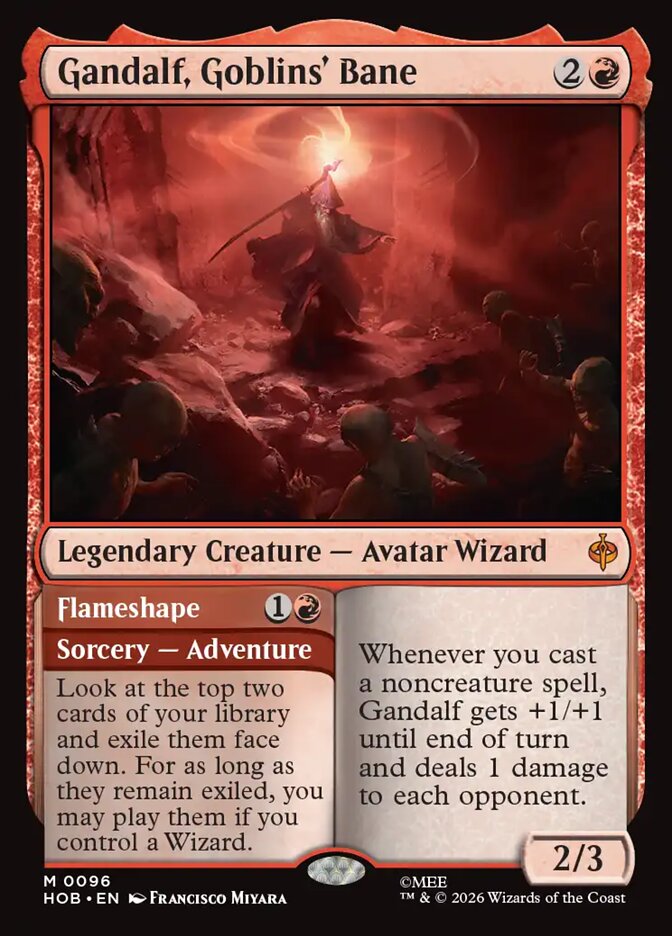
Gandalf, Goblins' Bane is a much simpler card, and just straight up excellent in Limited due to being a potential 3-for-1. Flameshape is a free Divination of sorts, as you’ll be able to play whatever you drew after playing Gandalf. You can use other wizards like Gandalf, Spark Starter and Gandalf, Wandering Wizard for an insurance policy (in case Goblins’ Bane is removed), but they’re hardly necessary.
Smaug the Magnificent (Bomb)
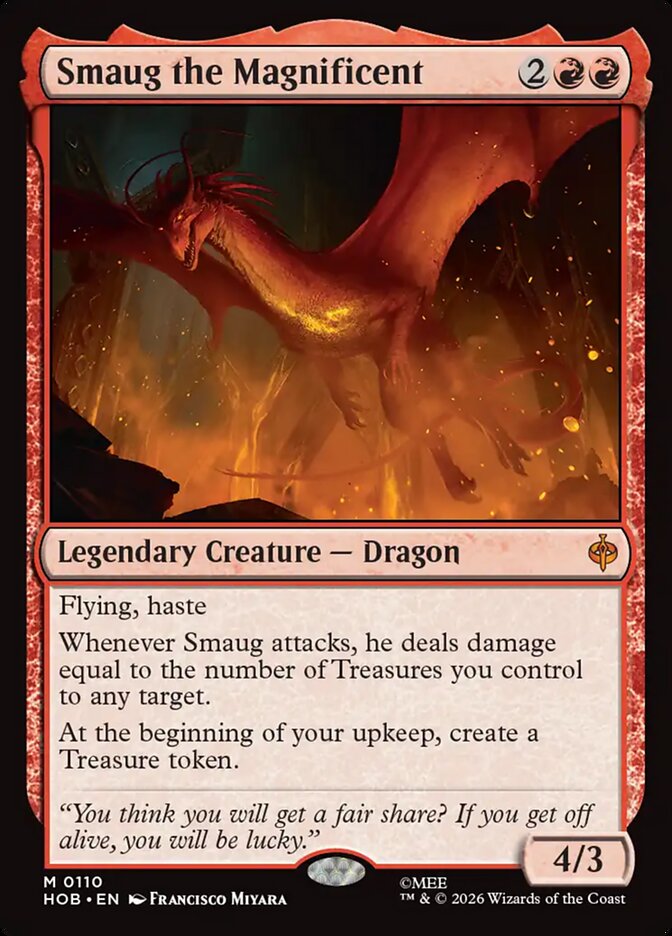
Smaug the Magnificent hits hard immediately (with evasion) and threatens to rapidly spiral out of control with Treasure powered pings. Other Treasure creators like Dori, Bearer of Friends and Long-Bodied Grey Dog can even setup Smaug to immediately kill an x/1 or x/2!
Thorin, Mountain-king (Bomb)
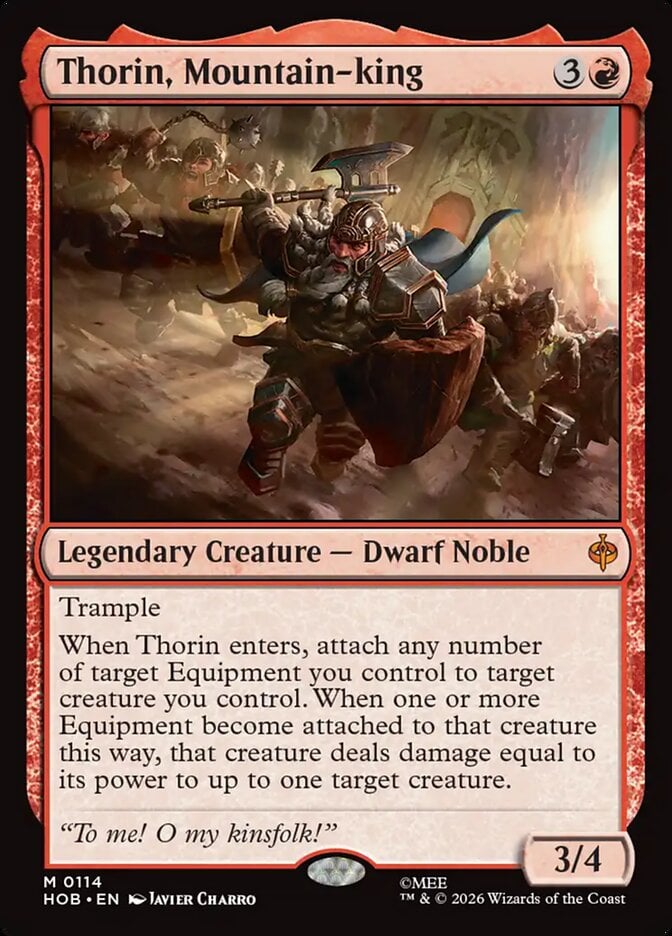
Flametongue Kavu is back, albeit with the minor restriction of requiring you to have an equipment lying around. That’s not difficult in The Hobbit, so I highly recommend playing some and running Thorin, Mountain-king (even if you have to splash it!).
Beorn the Fierce (Bomb)
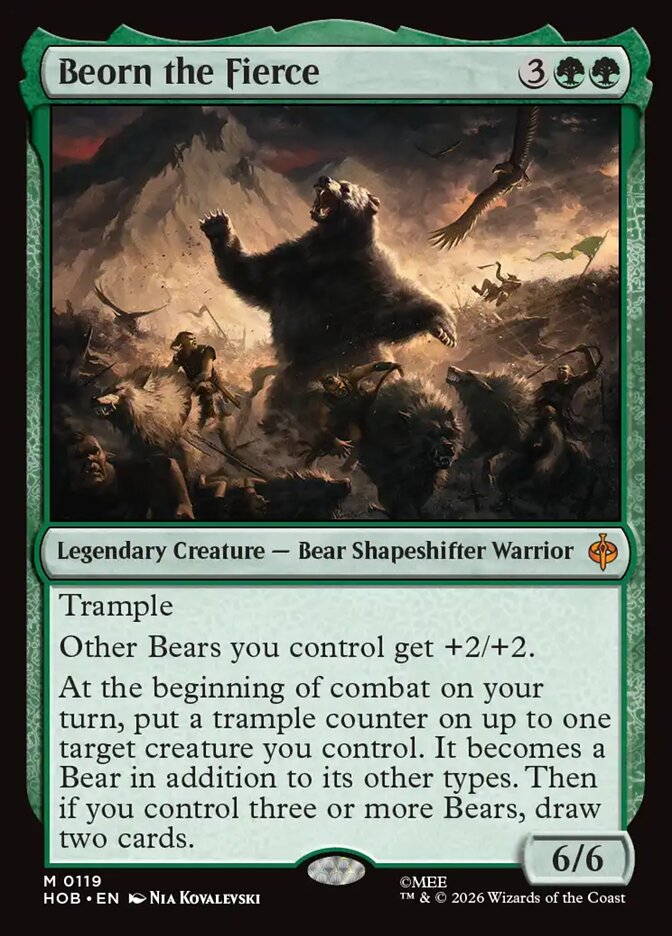
There are some actual bears to buff in this set, but if you don’t have any, fear not: Beorn the Fierce can just make you some anyways! Throw in the fact that it’s a 6/6 trampler for that draws extra cards if it sticks around, and you have a clear bomb rare.
Dancing from Dark to Dawn (Bomb)
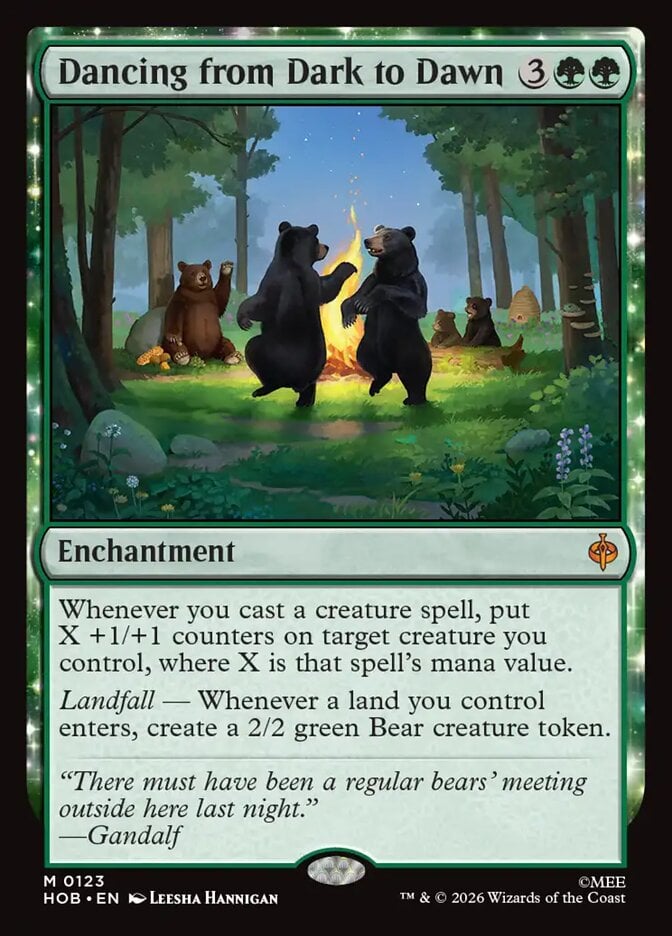
This dance is slow to start, but it’ll quickly result in a victory once you untap with it. Playing a land drop and then a Boughside Wanderers after playing Dancing from Dark to Dawn would leave you with a 2/2, a 4/4, the card from Boughside Wanderers, and six +1/+1 counters on one of your creatures!
Bard, King of Dale (Good)
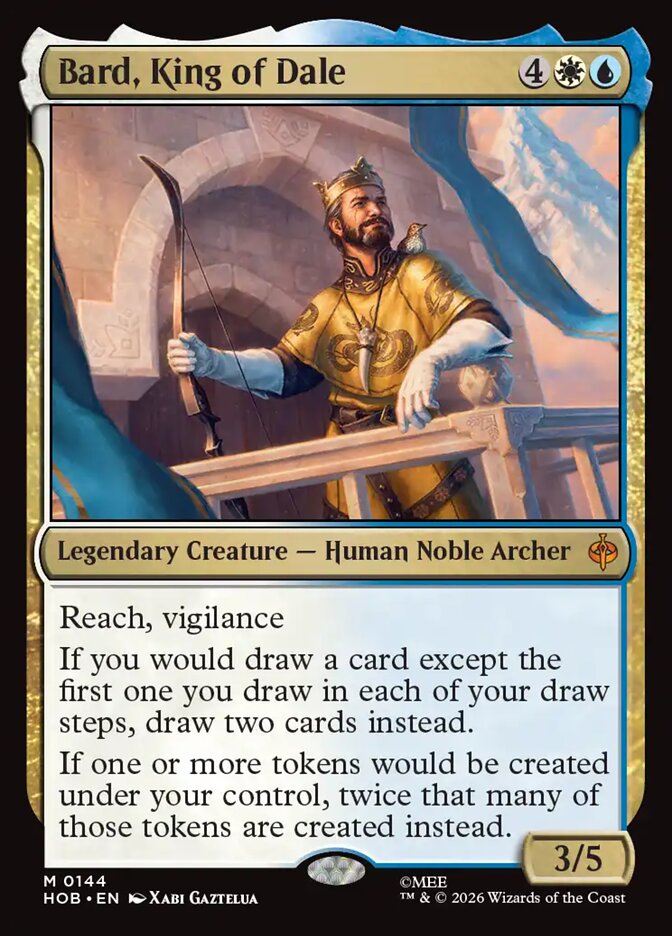
It’s neat that recruit plays off of both these abilities, but 6 mana is a ton for a creature with no inherent value or protection. Blue and black have the best answers to Bard, King of Dale (i.e., Confusticate and Bebother, Enchanted River's Grasp, Uneasy Partings, Bilbo's Deadly Slice, Stir Up Trouble), while other colors have only a handful of commons and uncommons that can actually remove Bard. I’m still going to play this in my WU decks either way, but it’ll temper my expectations relative to some of these other rares.
The Arkenstone (Bomb)
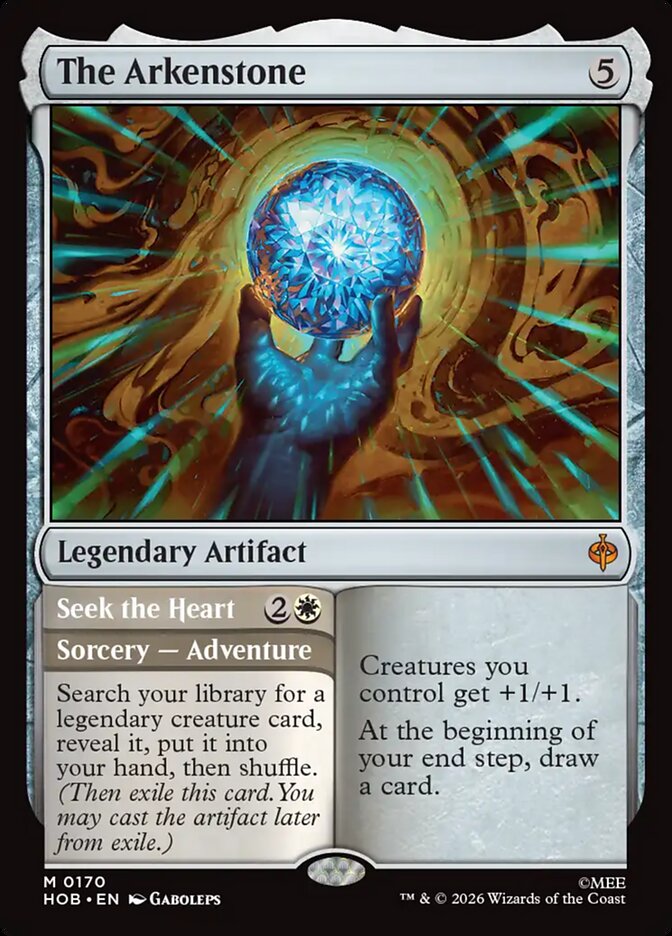
Now this is more like it! You don’t even need white mana for this, since The Arkenstone is already phenomenal as a 5-mana Glorious Anthem + Phyrexian Arena hybrid. Treat Seek the Heart as more of a cool bonus, and play this every time you open it.
Orcrist, Goblin-cleaver (Mediocre)
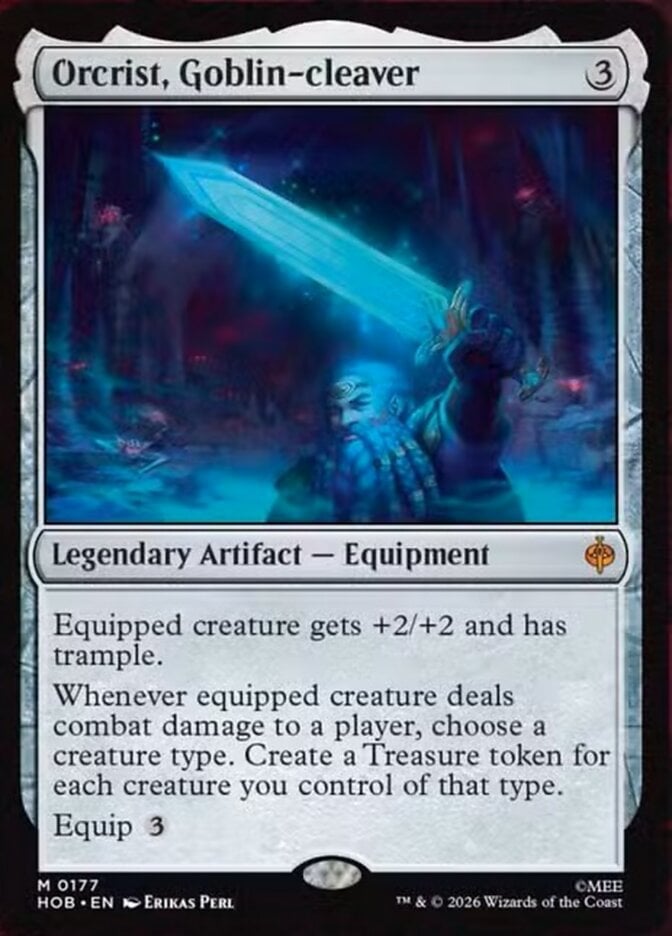
As sexy as Orcrist, Goblin-cleaver is for Commander, it’s significantly less exciting for Limited due to its hefty equip cost. I’d still consider playing it in dedicated Dwarf decks, because cards like Iron Hills Stalwart, Dwarven Mauler, and Kíli the Resourceful can help to mitigate its drawback.
Rares
An Unexpected Party (Bomb)
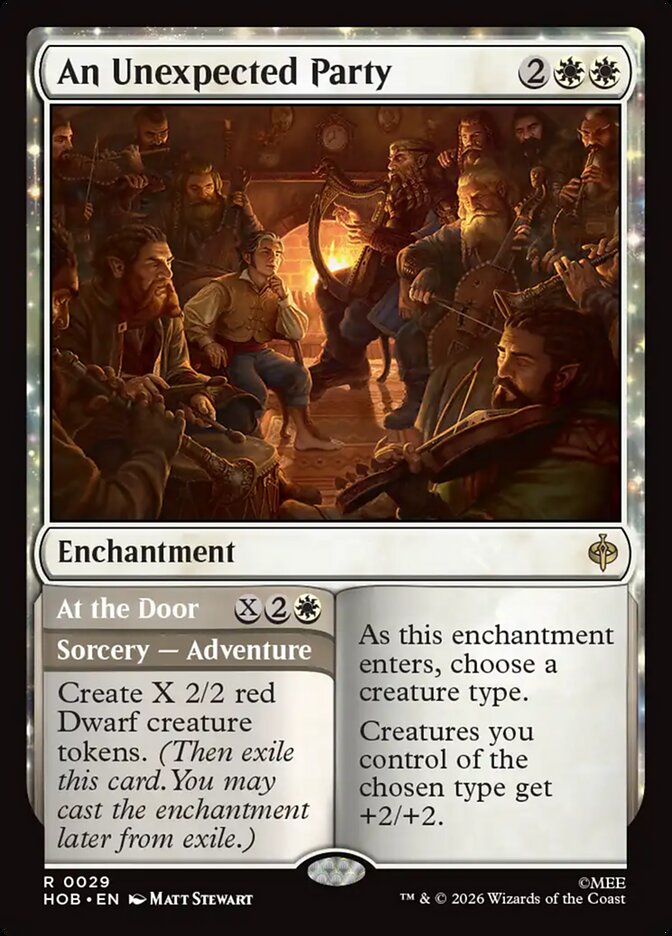
I’d already have been happy to play An Unexpected Party without the enchantment, but getting a free +2/+2 anthem afterwards is just ludicrous in Limited. You’ll usually name “dwarf” to boost the tokens you created, but having the option to name “human” for recruited tokens makes this even better.
Belladonna Took (Good)
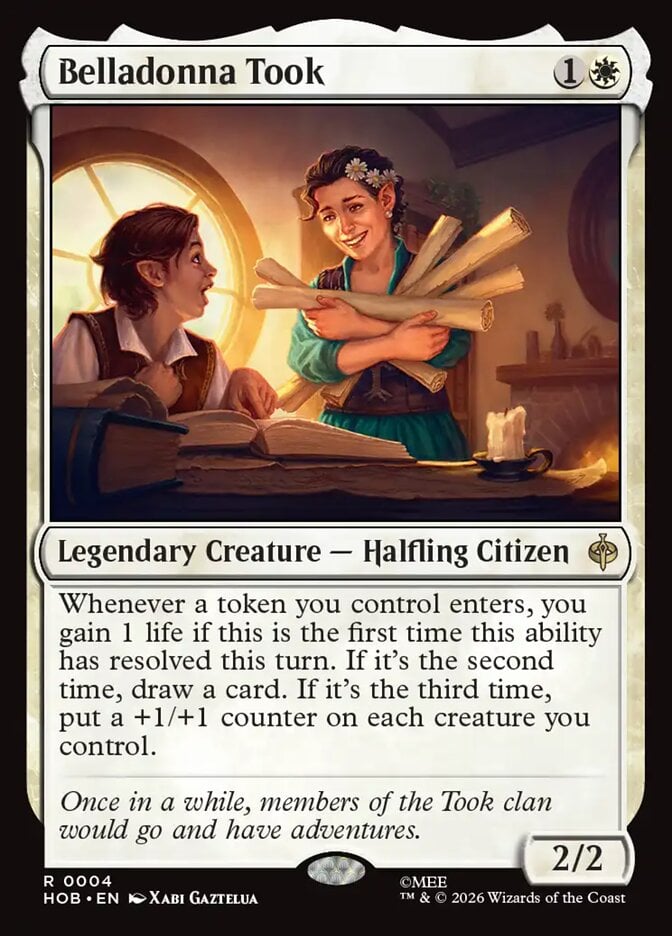
The Hobbit is a really poor set for this kind of effect, as there are no common or uncommons that make multiple tokens (and few token generators in general). You could try to recruit twice in one turn, but that seems tough to pull off. Belladonna Took is mostly just a 2/2 for 2 that occasionally gains you a bit of life, but that’s not completely awful.
Bilbo’s Gambit (Always Bad)
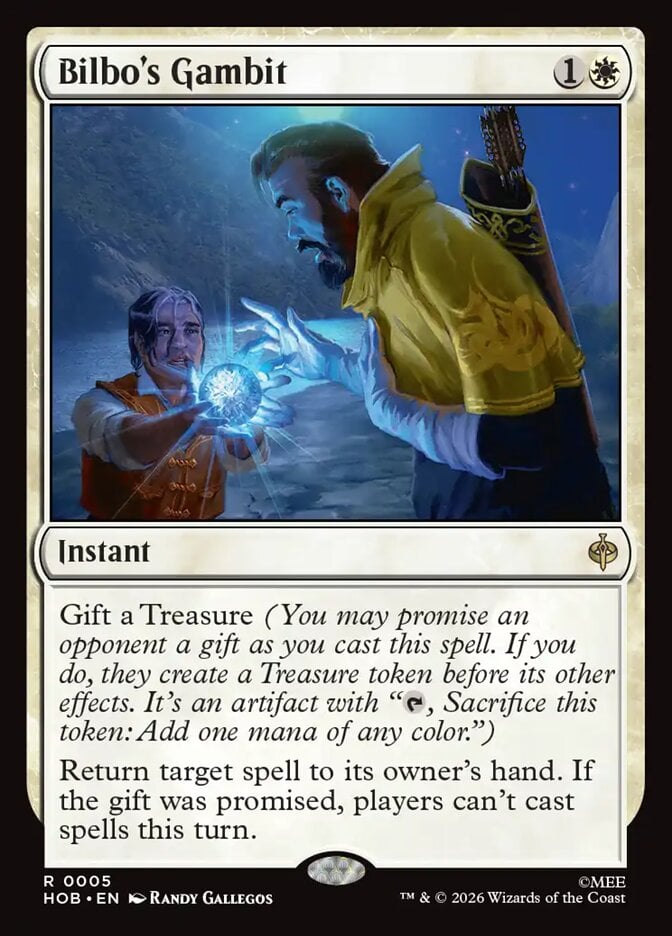
Reprieve is much worse in Limited when you take away the cantrip, and the extra Treasure upside here doesn’t change that. Think of it as a hyper conditional bounce spell, and stay far away from putting it into your Limited decks.
Fíli the Pathfinder (Bomb)
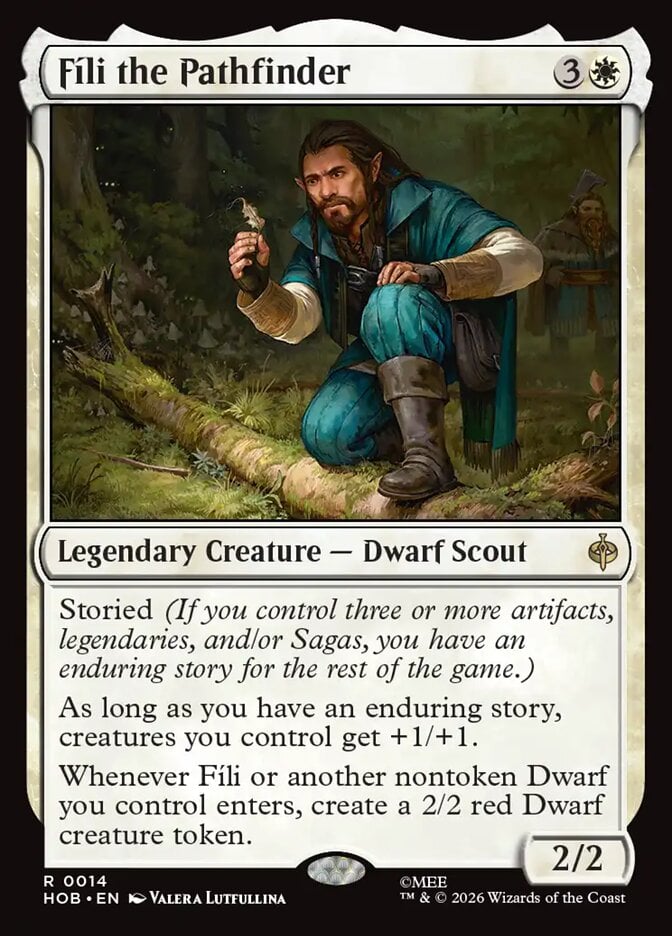
“Storied” has to be one of the easiest hoops to jump through I’ve ever seen in this game, and a storied Fíli the Pathfinder nets 6/6 worth of stats across two bodies for , with more to follow if it sticks around. Yeah, I’m always playing this, and I’ll actively try to include other dwarves when I do to get extra value.
Kíli the Resourceful (Great)
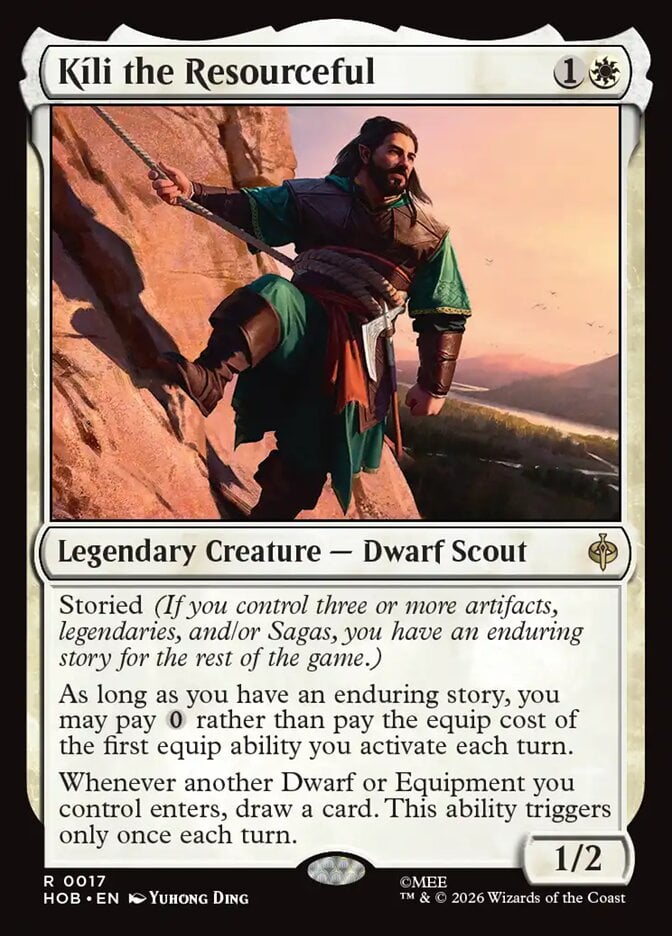
Kíli the Resourceful has a lower floor than Fíli, although both have the same simple demand (“more dwarves, please”). If you can provide other dwarves and/or equipment, Kíli could very well run away with the game, so I quite like this one.
Roads Go Ever, Ever On (Great)
Simple and clean value, with a healthy punch at Chapter IV for good measure. You don’t need to be mono-white or anything for this, just base white with 8+ Plains or so.
Settle the Wreckage (Great)
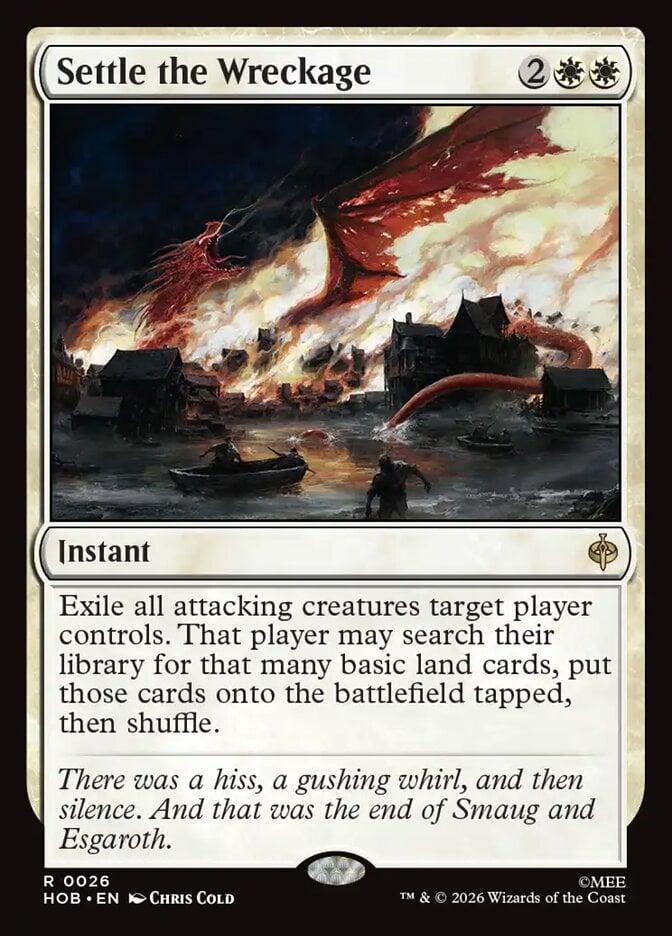
Settle the Wreckage require some cooperation from your opponent to be a blowout, and it’s a very good card to remember! I always like to play other instants with this when I can, as there’s no worse feeling than attacking into a Settle that you thought was just Plunder the Trollshaws.
If you’re ahead and your opponent is playing white, consider playing around this blind by avoiding pointless alpha strikes. Four mana is thankfully enough that you may sometimes be able to sniff this out, as there aren’t that many other instants in The Hobbit (especially in white).
The Eagles Are Coming! (Bomb)
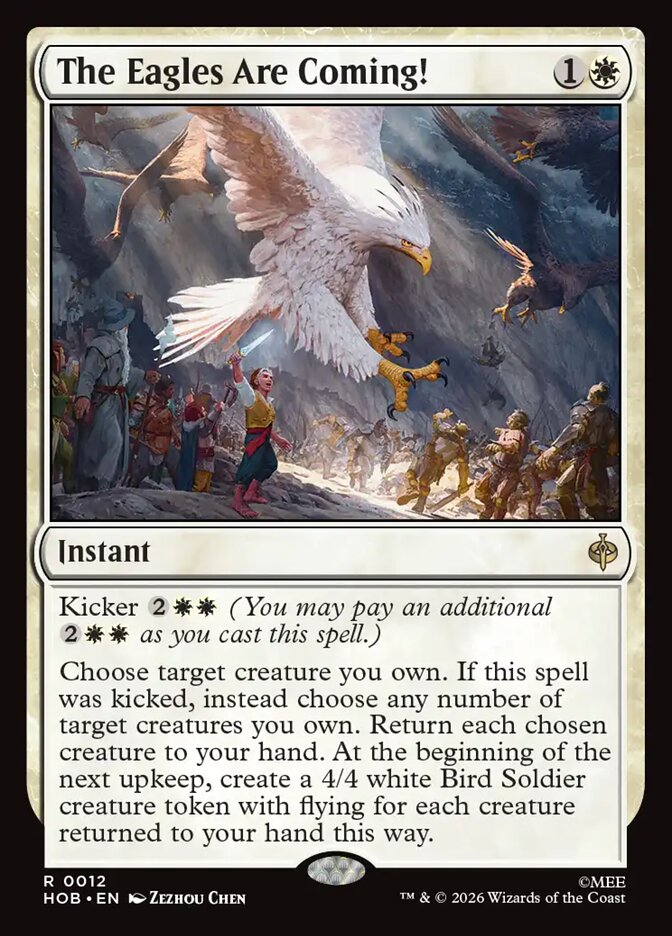
Every mode of this card seems really good to me. The most basic use case is just to cast it on something for a delayed 4/4 flier, while resetting a value creature like Bilbo Baggins, Burglar, Patient Instructor, and Goblin-town Flunkies. And if the game goes long, you can mass chump block and rebuy a ton of creatures while creating a massive fleet next turn.
Great Gilded Boat (Bomb)
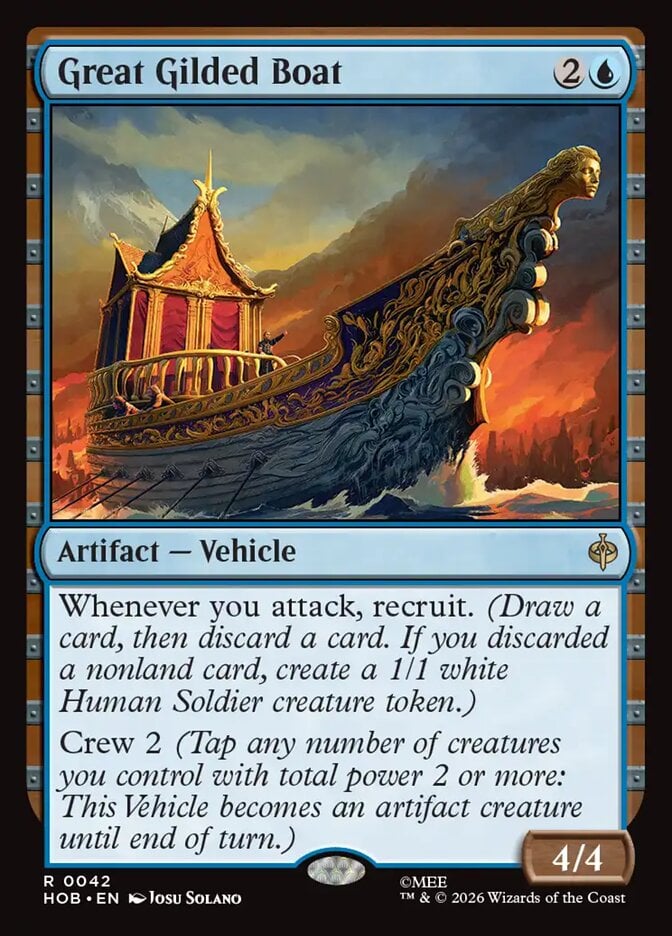
Great sizing for its cost, an affordable crew cost, and a recruit trigger that happens whenever you attack (not when “it attacks”) makes for a truly golden rare. There are almost no ways to directly answer artifacts either, other than Thorin's Last Stand and Burn, Burn, Tree and Fern. As a result, Great Gilded Boat acts with impunity unless your opponent has very specific cards.
Most Decrepit Old Bird (Good)
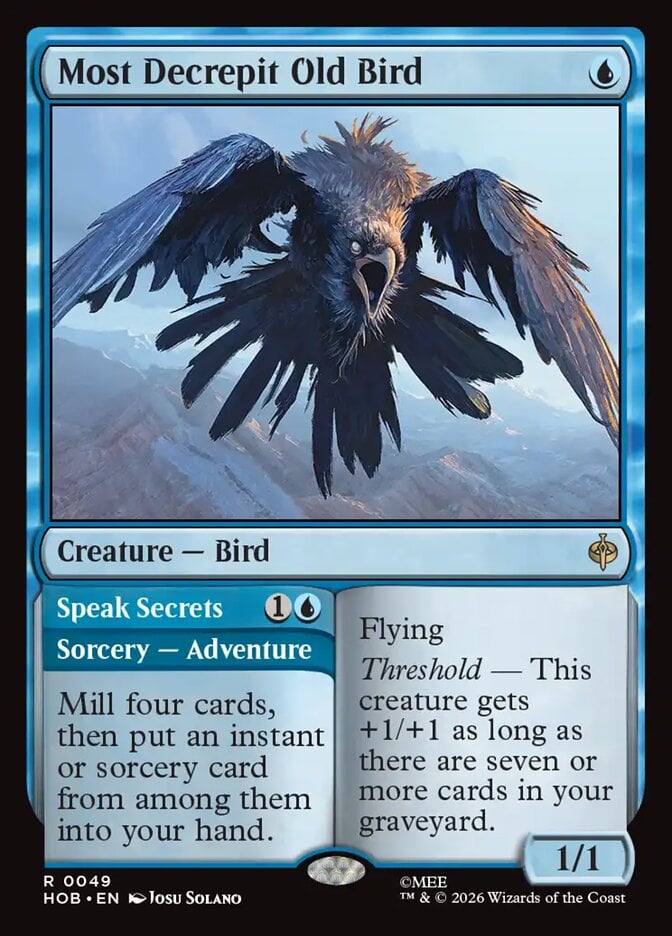
Whether “Good” or “Great” fits Most Decrepit Old Bird better depends on your instant and sorcery count. Having eight instants/sorceries would give you about a 60.7% chance to hit with this, so try to include more than that if you can.
Riddles in the Dark (Great)
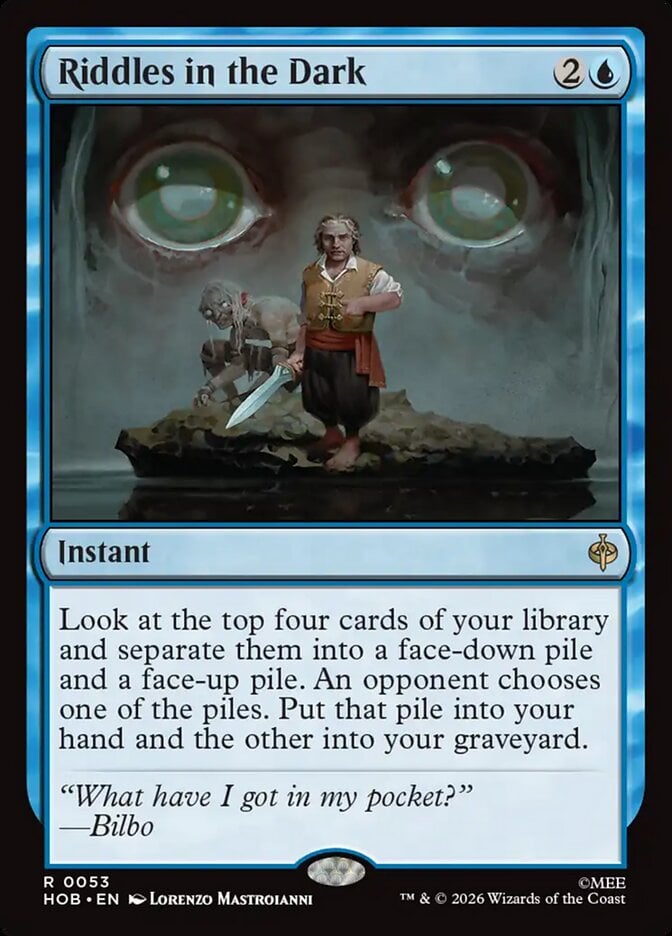
I love card draw minigames like this! You’ll make the piles with Riddles in the Dark, and your opponent must figure out whether you want the face up or face down pile more. There’s a ton of room for mind games here, so allow me to gush a bit about how to play it. There are three configurations of cards you may want to present, which include:
- A 2/2 split, two up/two down.
- A 3/1 split, three up/one down.
- A 1/3 split, one up/three down.
The goal of this minigame is to trick your opponent into giving you what you want, which will likely be circumstantial to the game state. If you hit three lands and an Enchanted River's Grasp and want the removal spell, there are two ways you could go about acquiring it.
- 3/1 with the lands face up, and the spell face down.
- 1/3 with the spell face up, and the others face down.
- 2/2 with the spell and a land face up, and the others face down.
If you’re in a top-deck situation, most opponents will snap and give you the lands if you 3/1 split. The 1/3 split is better, but it still suggests desperation for the spell which could “give away the game” so to speak. The 2/2 split puts out the strongest facade of strength, without losing you much value if your opponent calls your bluff (since you’ve already developed your mana in this spot). Therefore, I’d recommend splitting the cards 2/2 with removal/land face up.
I’ll write more about this one in the next guide, as I’m sure I could come up with plenty of other examples!
Roll-Roll-Roll-Roll (Mediocre)
This does nothing on its own, but Roll-Roll-Roll-Roll could produce a ton of value with “enters” creatures like Bilbo Baggins, Burglar, Wood Elves, and Patient Instructor. You can also blink lands to trigger landfall in a pinch, which gives this a little extra utility (although I’m never playing it without several good ETB creatures).
The Lord of the Eagles (Great)
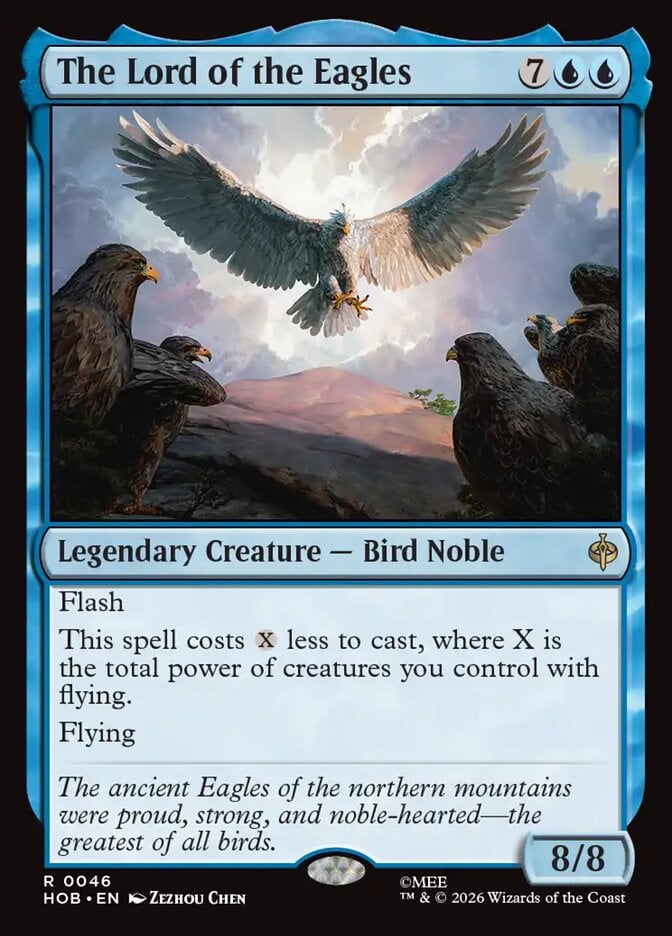
Flying is pretty scarce in The Hobbit, but I’d play every copy of Long Lake Nuisance and Velvetwing Butterflies I could to support this. The Lord of the Eagles ends the game in two or three evasive swings, and it should always eat a creature due to its absurdly large sizing.
Uncover the Moon-Letters (Mediocre)
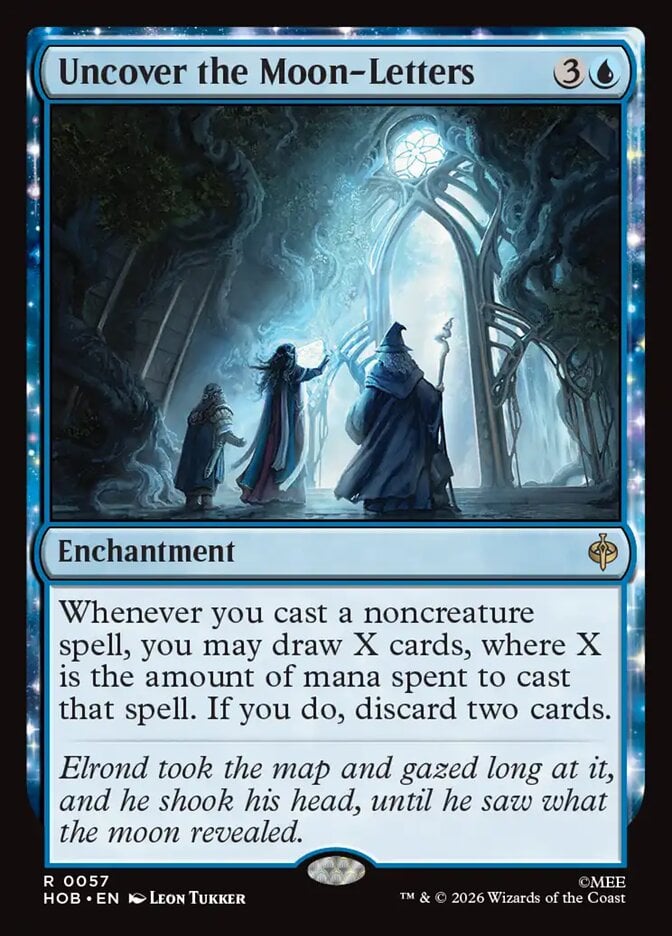
The Hobbit’s two official blue archetypes (WU Recruit and GU Landfall) aren’t likely to want to play this one. Uncover the Moon-Letters will do its best work in oddball Grixis decks, which may lean into the “instant and sorcery” subtheme found on this and some of the other blue cards.
Wizard’s Staff (Always Bad)
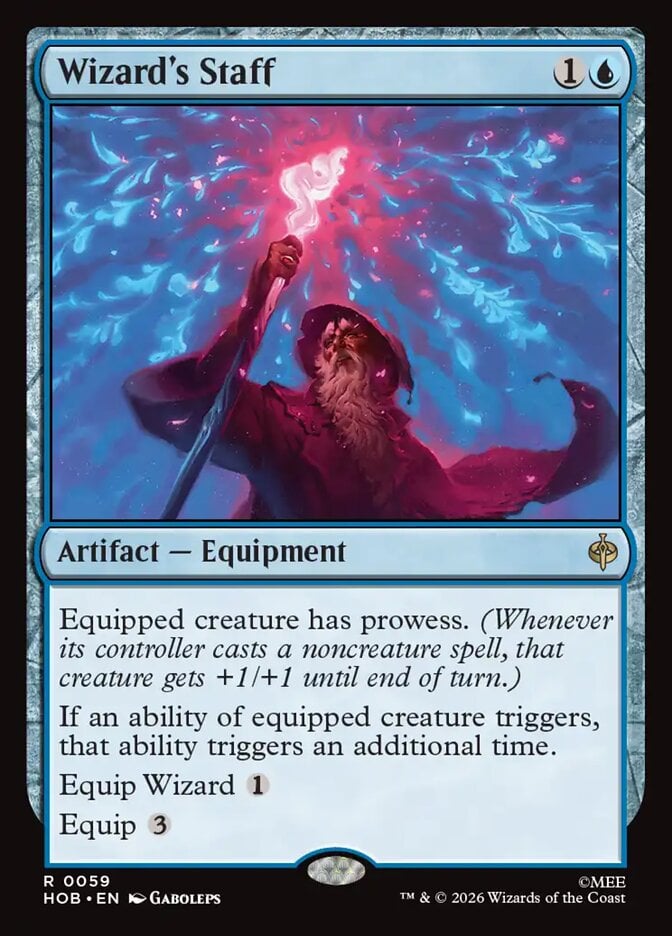
There are only four wizards in The Hobbit, and only one of them (Gandalf, Wandering Wizard) has an activated ability. Drawing six cards is a fun dream, but not worth playing junk like Wizard's Staff.
Along the Crooked Way (Good)
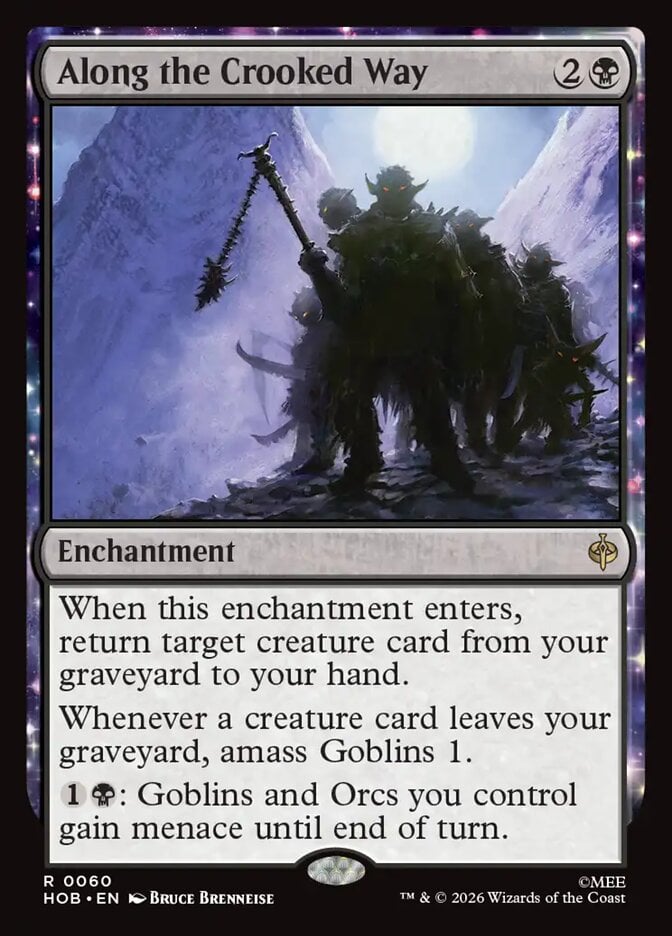
Along the Crooked Way’s baseline is essentially a 1/1 Gravedigger for , which sticks around to grant on-demand menace to your goblins and orcs. It’s very difficult to trigger amass again with this (the only ways I can see are Gathering of Darkness, Gollum the Abandoned, and Silvan Reveler), but it’s a solid playable in goblin decks either way.
Azog, Moria’s Ruin (Great)
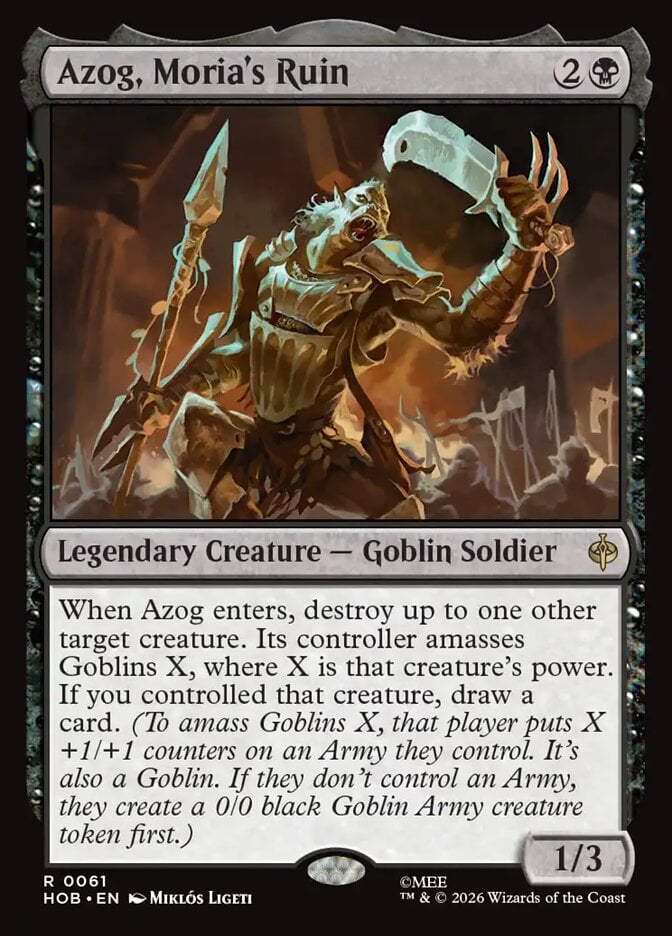
Azog, Moria's Ruin is a flexible creature that offers an emergency answer to certain bombs, and it can pick up value by off’ing your own army token and replacing it with a fresh one. I love the idea of killing off a Gundabad Opportunist with Azog, which is a cantripping creature with a lot of power (which would normally trade down).
Head of the Hunt (Bomb)
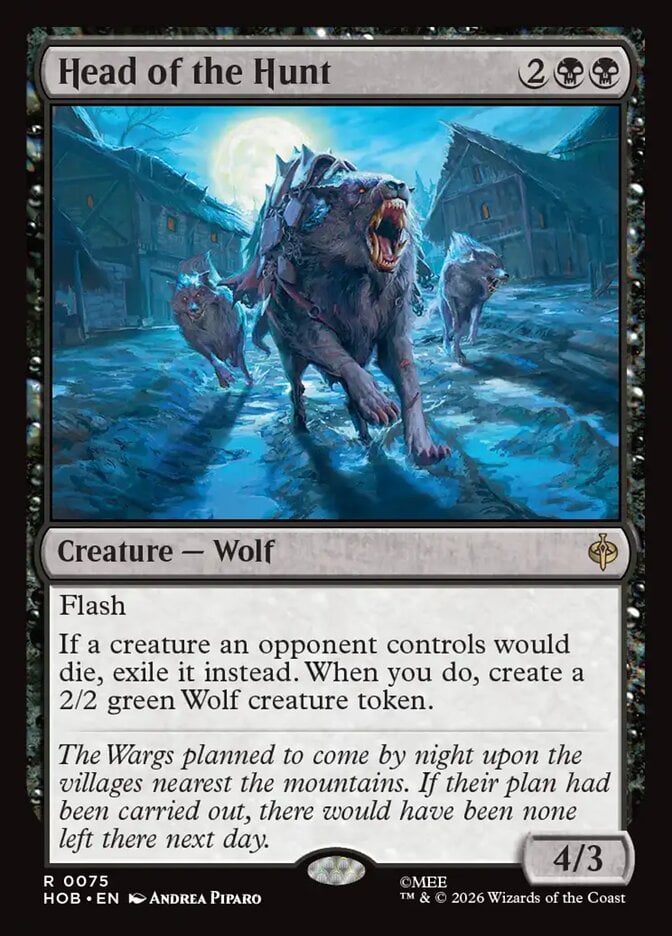
4/3 is a big enough body to eat cheap creatures safely, and combat will immediately become a losing proposition for your opponent when Head of the Hunt hits the table. I wouldn’t even risk this in combat most of the time, as it’s incredibly powerful to have in play.
Rhovanion Rampager (Bomb)
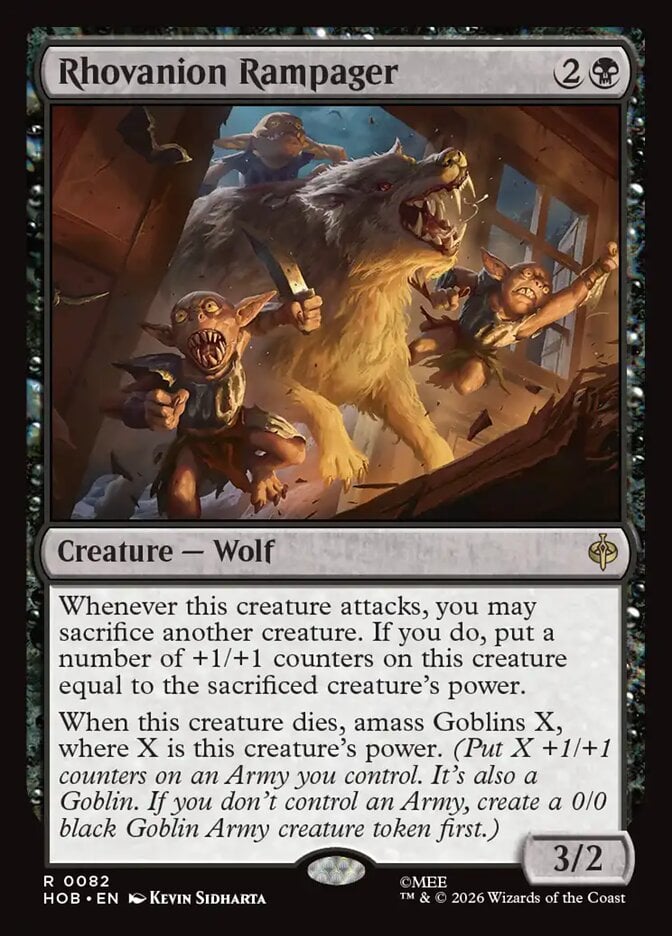
The Hobbit is definitely a sacrifice friendly set, with lots of fodder style creatures for this to munch on like Front Porch Sentries, Stony-Voiced Goblins, Goblin-town Flunkies, and Wood Elves. Rampager’s death trigger makes it a safe investment too, as you’ll get a massive army token later when it dies (or you sacrifice it to something else).
Supper for Spiders (Always Bad)
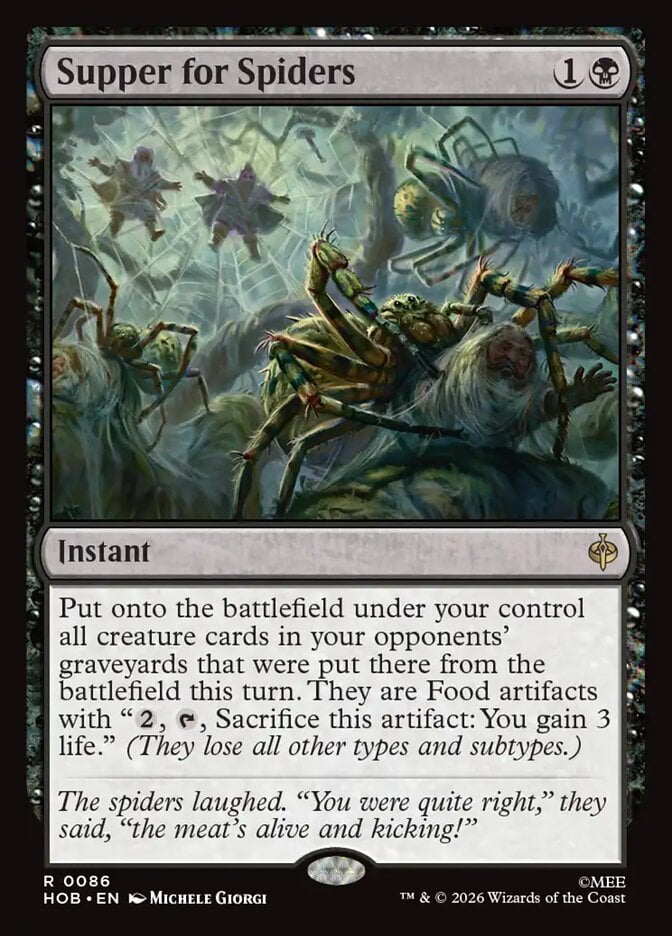
Supper for Spiders requires a ton of work for it to do anything because you’d need to combine it with a sweeper or massive combat step to bring back multiple things. And even if you do, there’s no guarantee whatever you get will have been worth the trouble, since they’re returning as Food tokens.
The Master of Lake-town (Great)
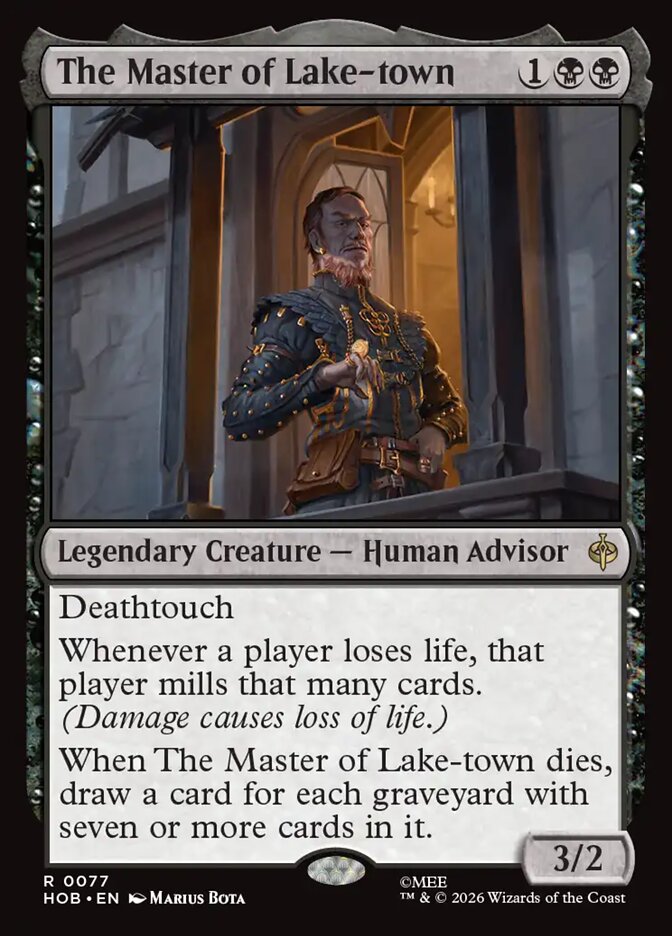
Letting The Master of Lake-town sit around for a bit should lead to both players having 7+ cards in their graveyard, and you can then trade this off for a free Divination. I don’t expect to deck my opponent out with this or anything, but a 3/2 deathtoucher is a fine baseline anyways.
The Sackville-Bagginses (Great)
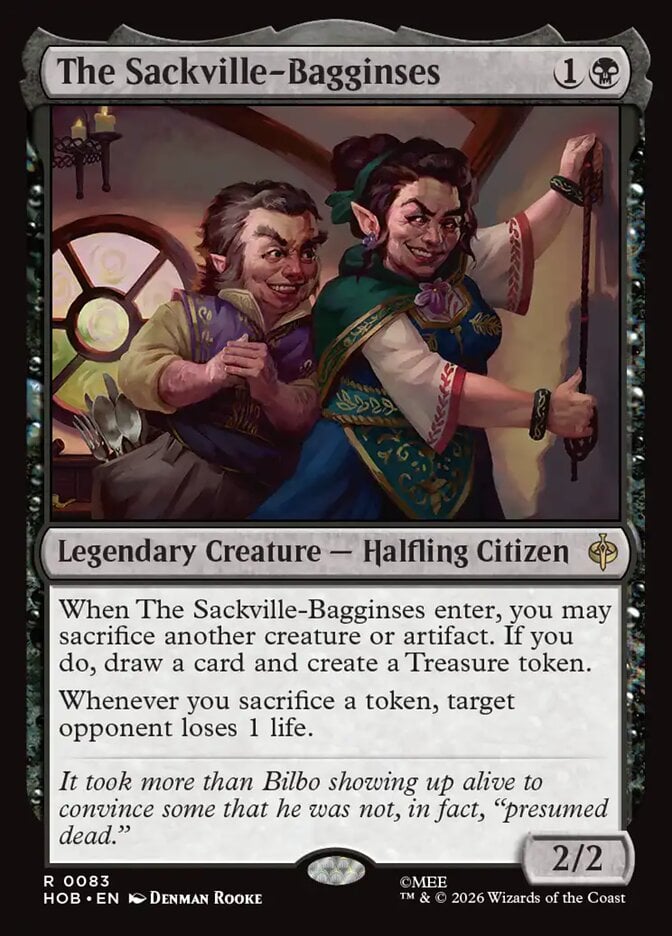
You can set up a nice 2-for-1 with The Sackville-Bagginses and many cheap “enters” creatures, or a Treasure token. Throw in the incidental burn this provides with armies and Treasure tokens, and you’ve got another excellent 2-drop.
Balin, Loremaster (Good)
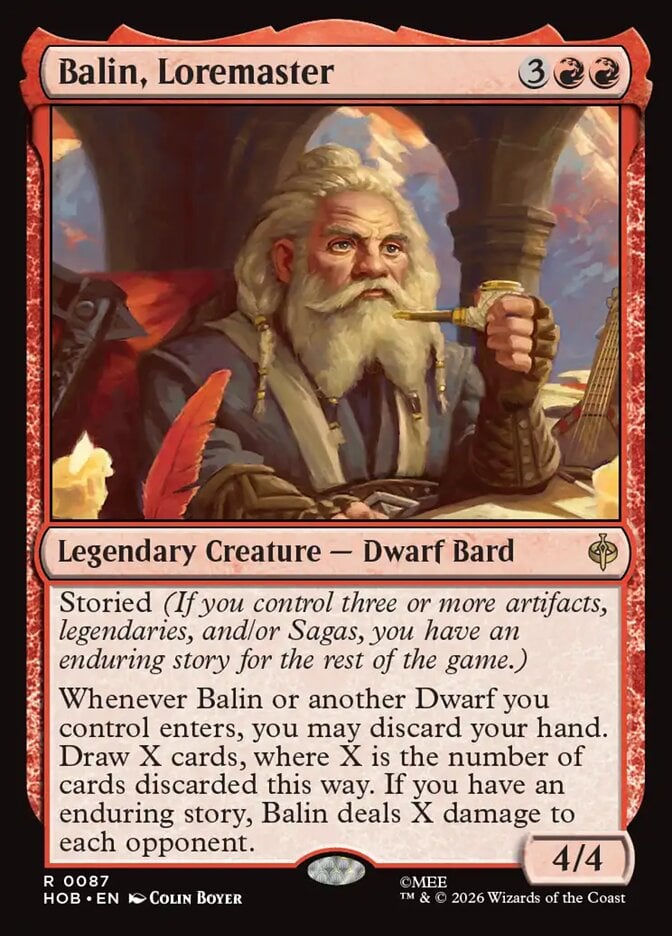
Balin, Loremaster is a bit undersized for a 5-drop, but it offers convenient rummaging with some free burn attached. RW Dwarf decks won’t have much to do with lands beyond land six or seven, and they’ll be happy to loot extras to Balin later on.
Dáin Ironfoot (Great)
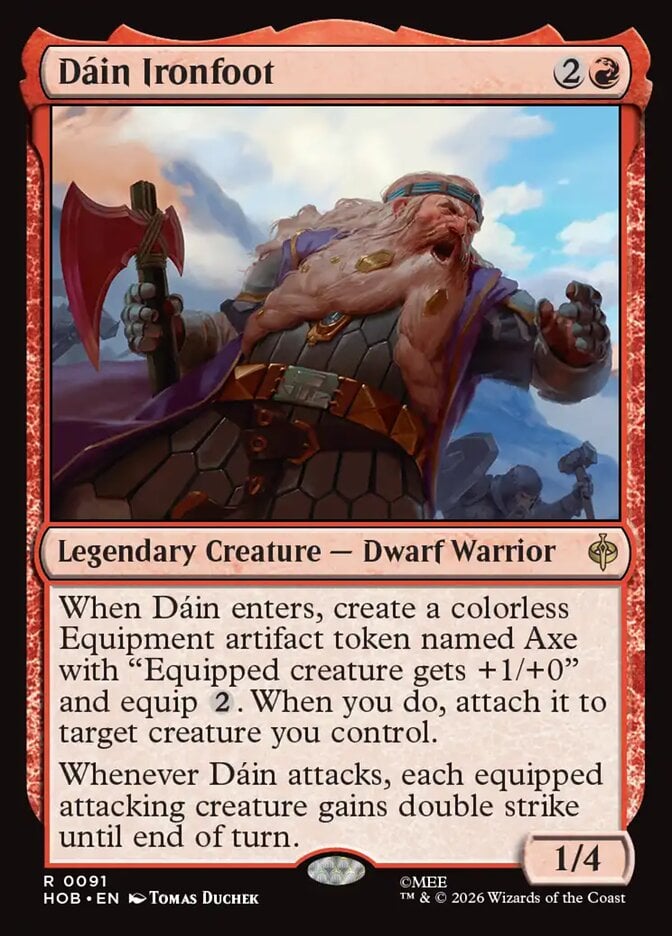
Dáin Ironfoot’s baseline is a 2/4 for that attacks with double strike, and the Axe it creates will stick around even if it’s removed. Dáin is strong on its own, and excellent with other dwarves and equipment synergy cards.
Desert Were-Worm (Mediocre)
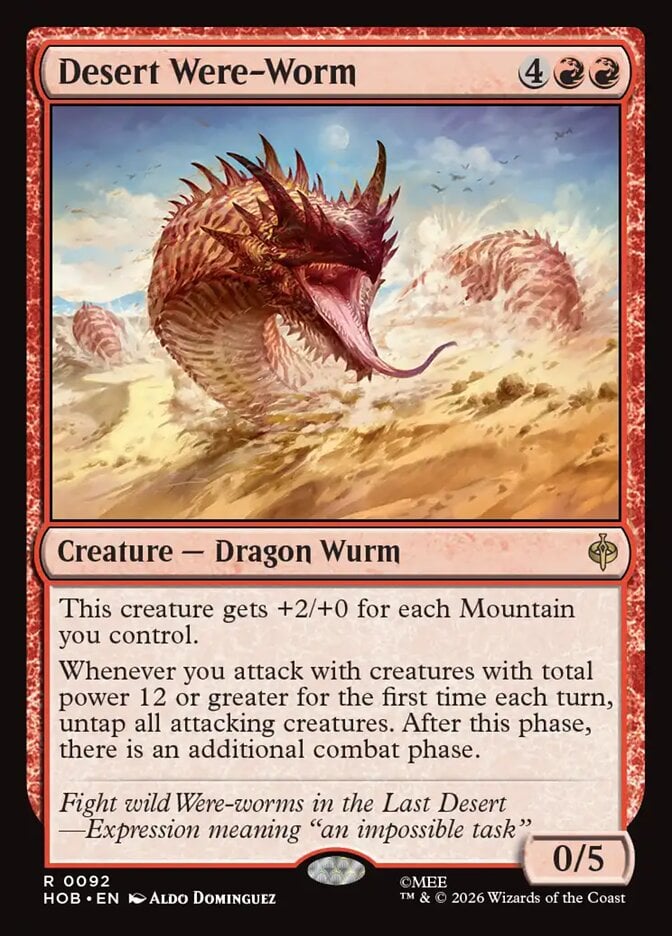
Desert Were-Worm will usually have between 4 and 8 power in the average red deck, so you should be able to access that extra combat most of the time (if you untap with it). It’s powerful, but expensive and vulnerable to several common removal spells.
Desolation of Smaug (Good)
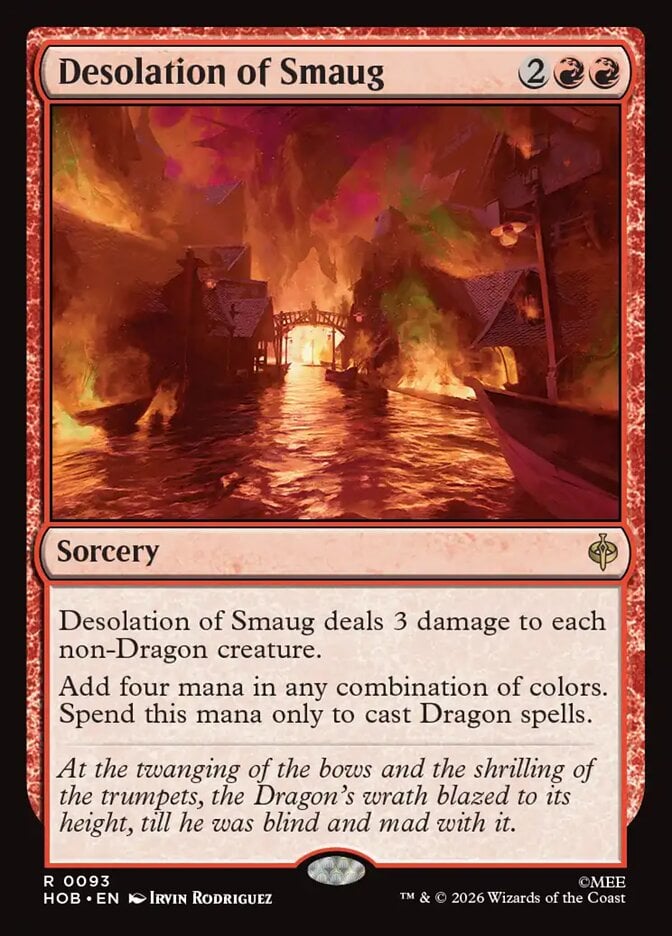
Desolation of Smaug is one of the only sweepers available in The Hobbit, and it does a great job of cleaning up dwarves and humans. It plays best in more controlling BR decks, especially after you’ve gotten your Goblin Army to 4+ toughness. The dragon bonus is fun, but it’ll only come up with Smaug, the Great Calamity and a handful of rares.
Getaway Barrel (Always Bad)
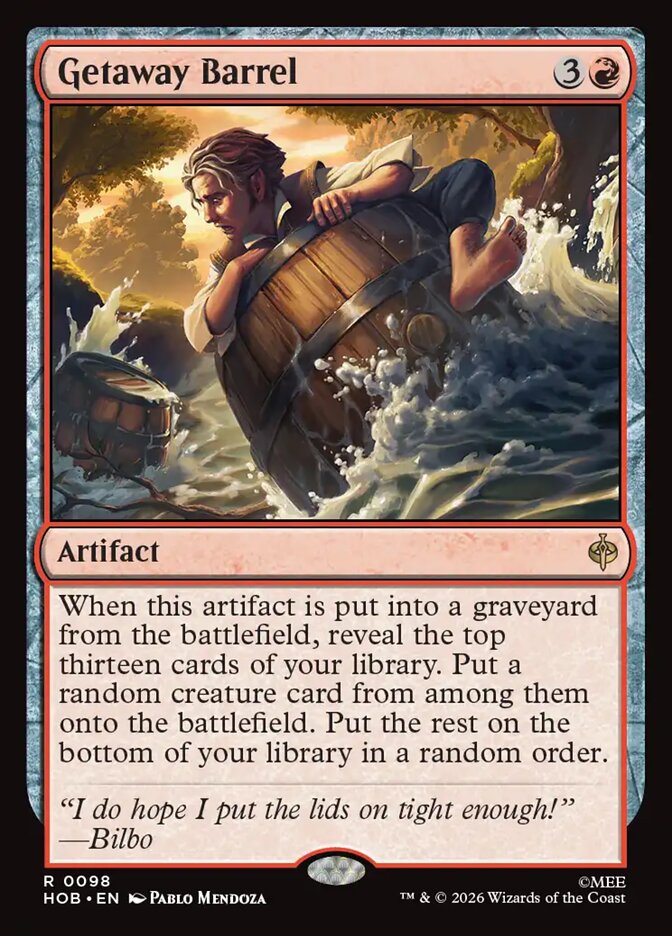
This hits a “random creature”, which means you’re putting in a decent amount of work to overpay for a random 2- or 3-drop. Leave the Getaway Barrel to Bilbo and stay away!
Last Light of Durin’s Day (Always Bad)
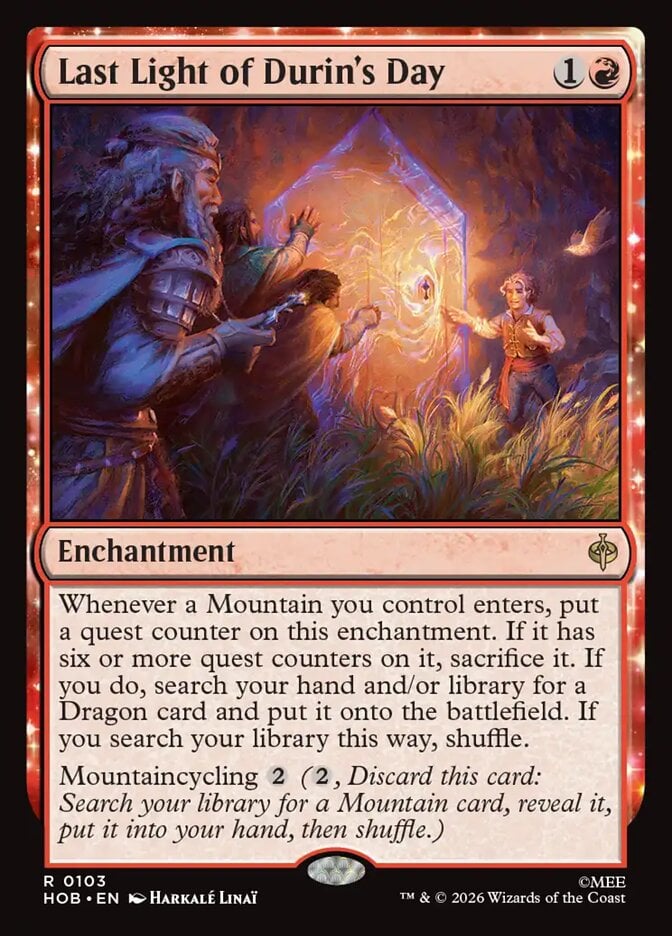
Last Light of Durin's Day is somehow even more unplayable than Getaway Barrel, as it requires being mono-red, make six land drops, and then have a dragon worth going through all of that trouble for. No thanks!
Stone-Giant of High Pass (Good)
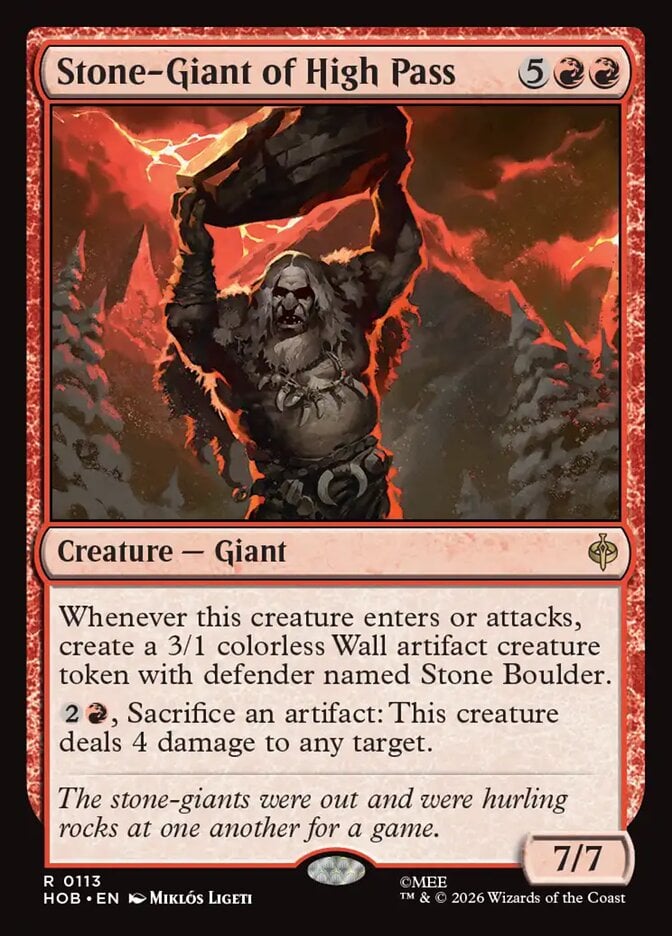
Seven mana is a ton, although untapping with this giant probably wins you the game. The 3/1 wall is an okay bonus if this immediately eats a removal spell at least. Try saving your Treasure from Dori, Bearer of Friends for Stone-Giant of High Pass if you can.
The Misty Mountains Cold (Good)
You’ll need to hoard your Treasure like an actual dragon to get the 6/6 token here, although it’s possible to speed up the clock with other Treasure makers like Dori, Bearer of Friends. The Misty Mountains Cold is a terrible top-deck, but it should be solid if you can play it on turn 3.
Bejeweled Warg (Great)
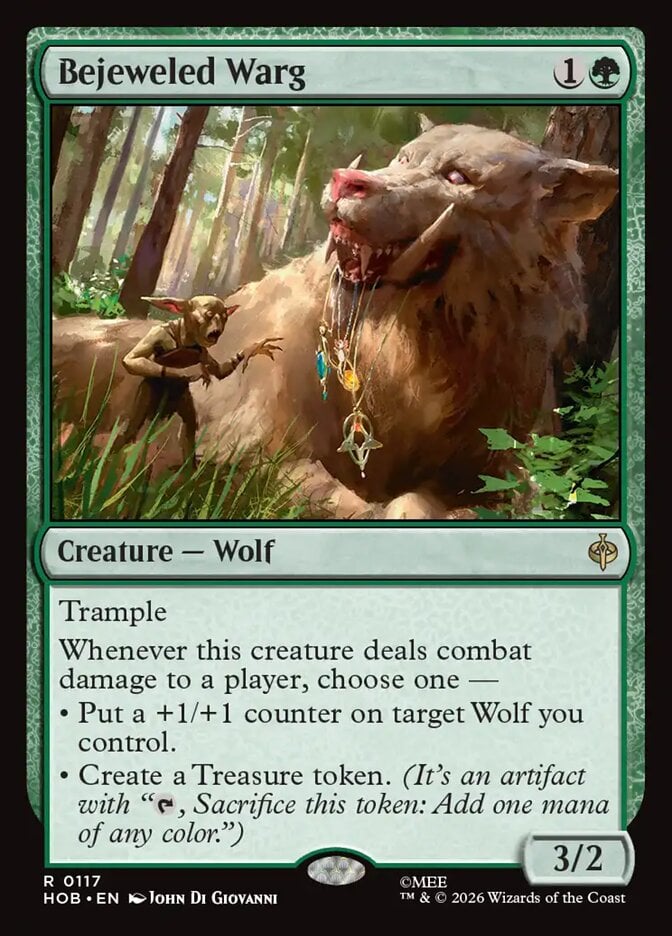
Trample lets you get value with this even when it trades with other 2-drops, and Bejeweled Warg will rapidly snowball out of control if it goes unanswered.
Cantankerous Keepers (Good)
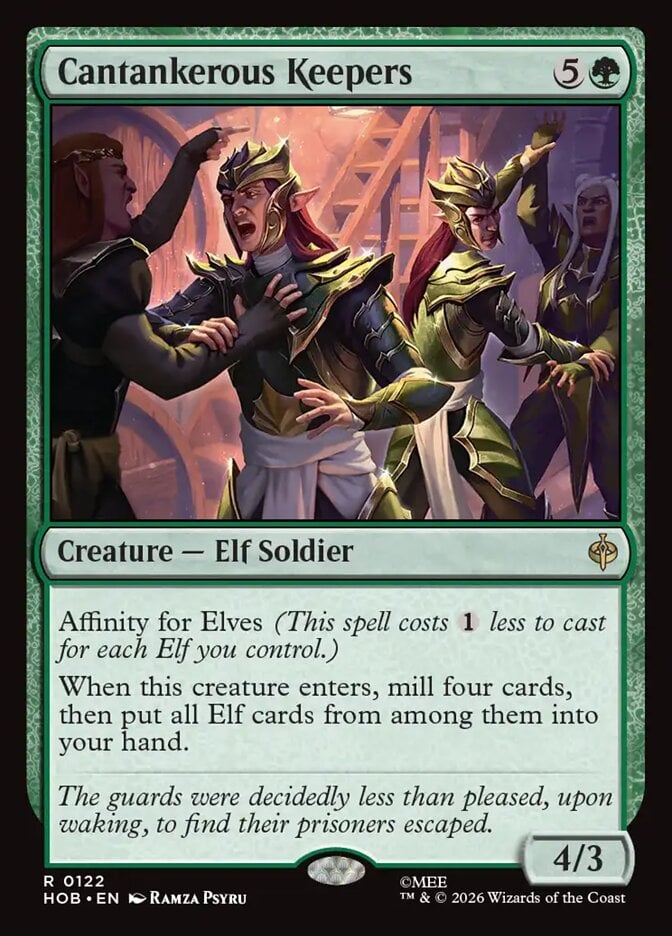
Most pools probably won’t have enough elves to want to play Cantankerous Keepers, although I’d be happy to do so if I had 10+ elves. This gives it a 70+% to draw at least one elf, with the potential for more if you get lucky.
Down in the Valley (Great)
Even with no other elves, you’re getting a basic and at least two 1/1 elf tokens from this (potentially more with cards like Hobbit Hole). That’s great value, and of course the card gets even better if you have actual elf synergies, like Cantankerous Keepers.
Gigantic Big Bear (Bomb)
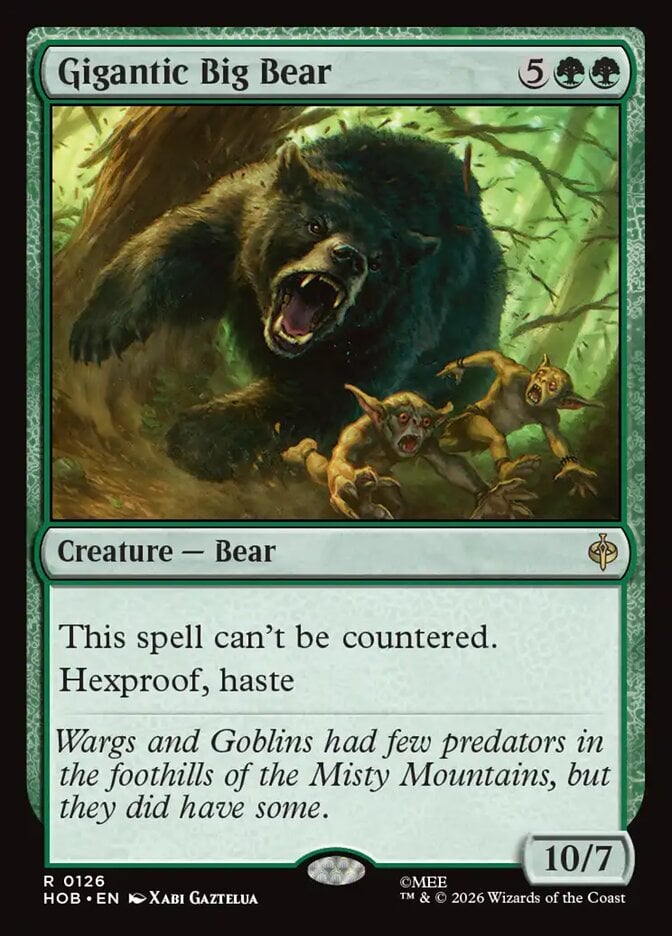
Gigantic Big Bear laughs at conventional removal and hits for a ton of damage out of nowhere, which makes it vastly superior to other fatties we’ve covered. It’s one of the best cards in the format to work towards with your Wood Elves and Boughside Wanderers.
Part in Friendship (Great)
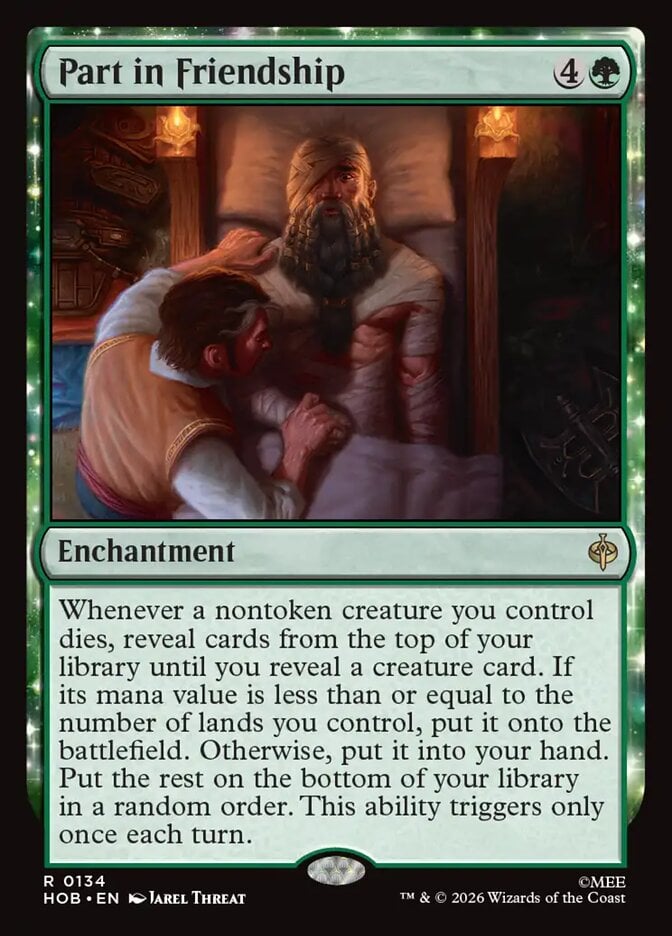
Combat becomes a terrible proposition once Part in Friendship is out, as creatures you trade off with immediately replace themselves or draw you a larger creature. You may be able to pair this with sacrifice cards for value too, so it plays best in BG (or as a splash in BR).
Radagast of Rhosgobel (Great)
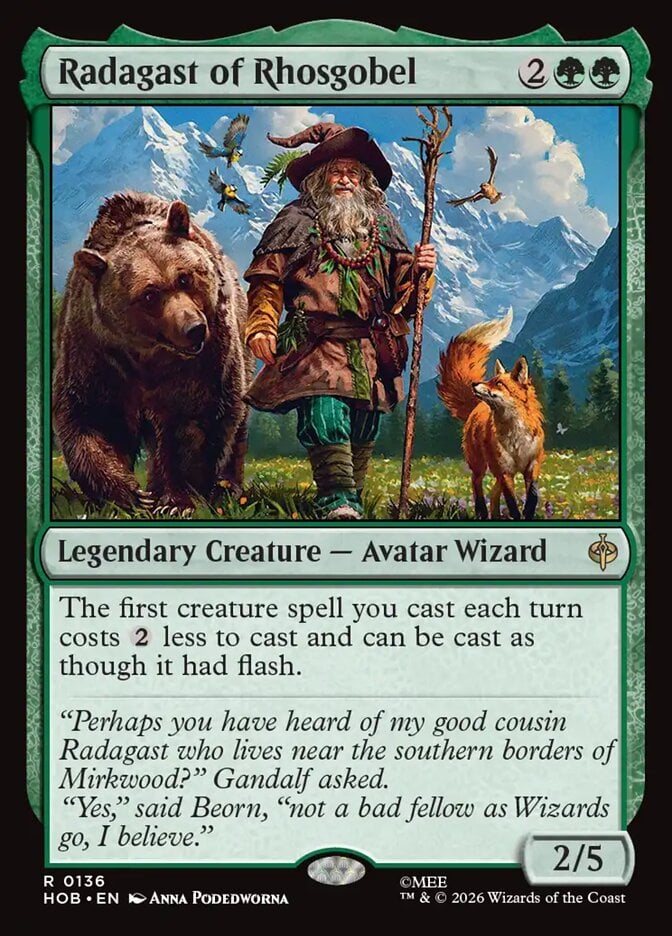
Radagast of Rhosgobel’s base stats are mediocre, but its cost reduction ability is very powerful with large green creatures. You can ambush blockers with under-costed fatties, or even double spell by using the cost reduction on your turn and your opponent’s turn.
The Notary Hobbits (Mediocre)
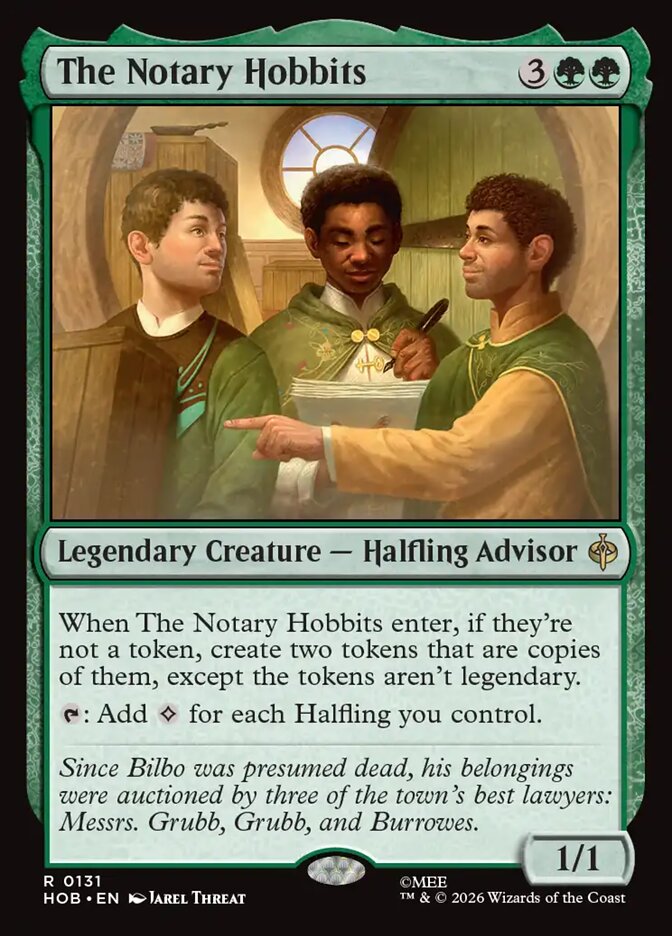
The stats here are abysmal for (even with three bodies), so you’ll want to have uses for all this extra mana. Boughside Wanderers is a great start, and I also like the idea of this plus common mana dumps like Guardian of the Halls and Gandalf, Wandering Wizard.
Through the Forest Gate (Mediocre)
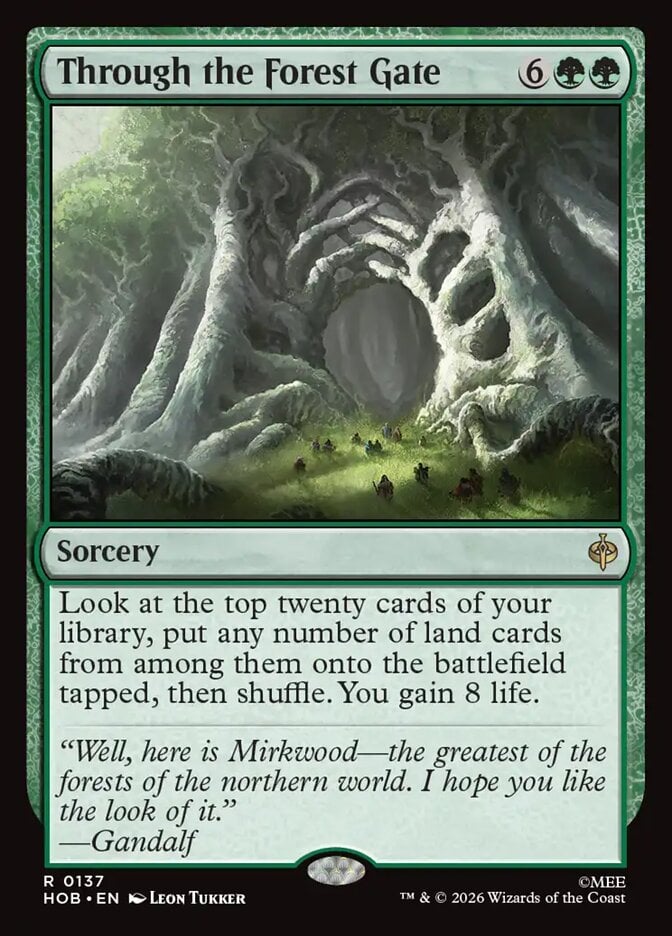
Cool Commander card, but unlikely to be worth the trouble in Limited unless this format is incredibly slow. I do like the life buffer and landfall synergy that Through the Forest Gate has, so I’m going to let this one dodge an “Always Bad” rating (which it was very close to receiving).
Bard’s Company (Bomb)
Having another human is easy in The Hobbit, so you’re looking at a 2/3 Glorious Anthem with a Titan-style recruit trigger. Bard's Company is clearly an awesome rare, and well worth splashing if you aren’t WU.
Bolg’s Company (Good)
You won’t always want to sacrifice for mana with Bolg's Company, but the worst this can be is a 2/2 for 2 anyways. Ramping up to Smaug, the Great Calamity by sacrificing a Goblin-town Flunkies or Stony-Voiced Goblins is a fine use of this card, for instance.
Smaug, Wicked Worm (Bomb)
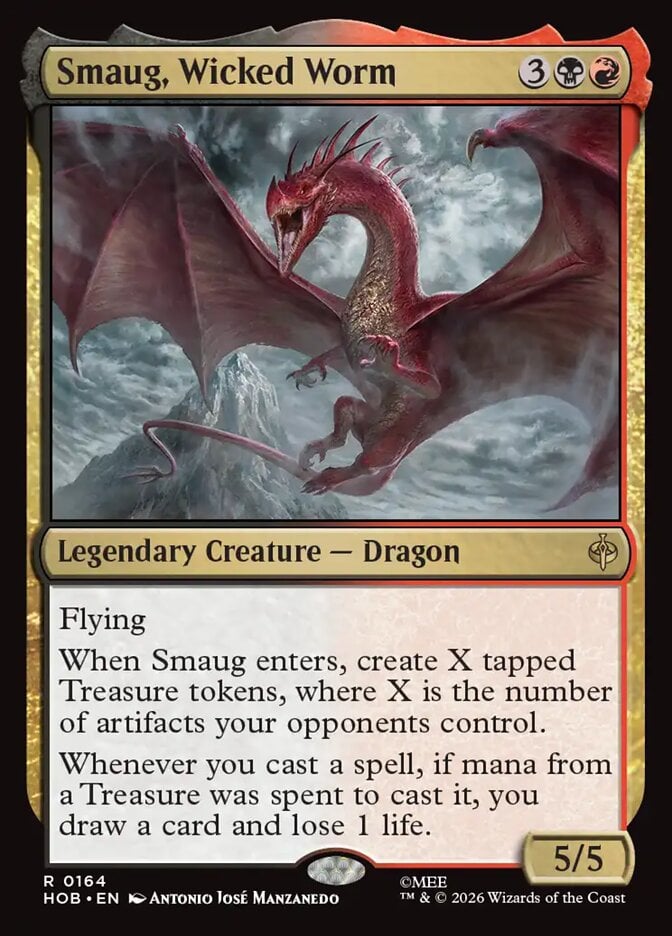
This Smaug is a 5/5 flier for at worst, and it should make somewhere between 0-2 Treasure tokens in most games (depending on your opponent’s deck/colors/draw). You can use your own Treasure tokens to supplement Smaug, Wicked Worm, at which point it becomes an actual bomb due to its combination of repeatable card advantage and giant flying beats.
The Great Goblin (Great)
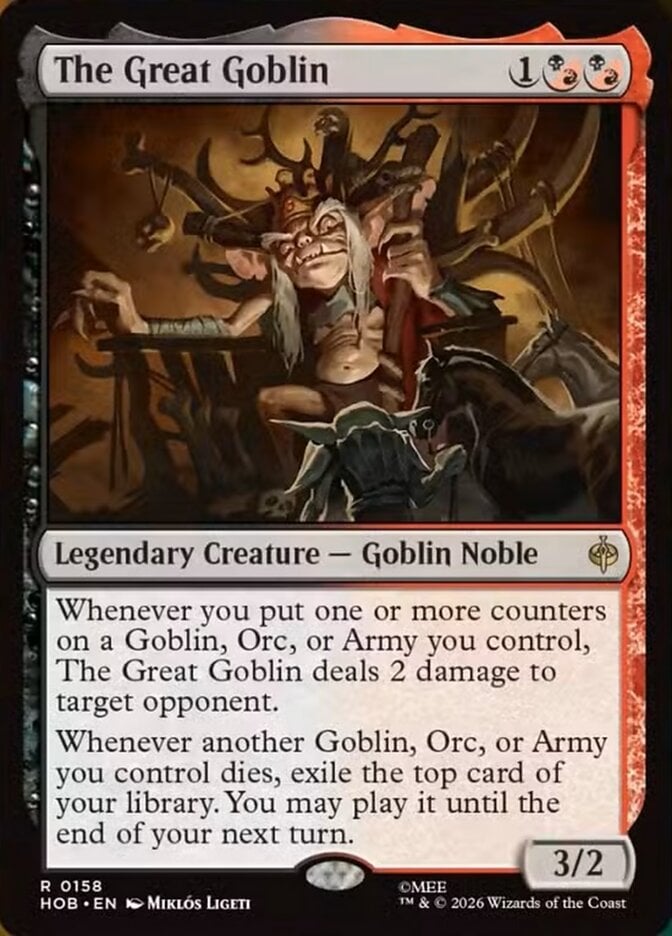
The Great Goblin enables some cool infinites in Constructed, but it plays out as a simple value creature here in the land of Limited. There are plenty goblins and armies in this set, so it shouldn’t be hard to get value if this sticks around.
Chief Warg’s Company (Bomb)
As you can see, most of the “Company” cycle are rather good in Limited! Chief Warg's Company only has to wait two turns to attack on its own, and it’s not hard to find other wolves in this set either. And if it doesn’t eat a removal spell, enjoy your free creature each turn!
Tom, Bert, and William (Great)
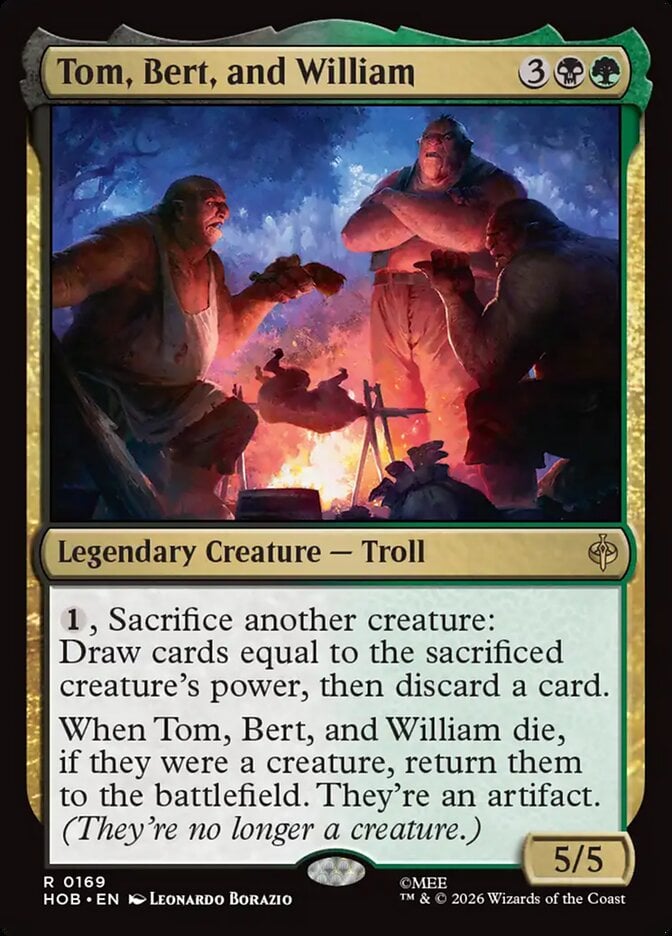
Having this chunky trio stick around as an artifact is a big win, because its activated ability offers a massive advantage in grindy games. Tom, Bert, and William is especially brutal versus Enchanted River's Grasp, provided it doesn’t get tagged by it.
Dáin’s Company (Great)
A cantripping Bishop's Soldier like Dáin's Company that digs for your best dwarves and equipment is an astounding deal for just , and one of the best reasons to be that color pair.
Dwalin, Weaponmaster (Great)
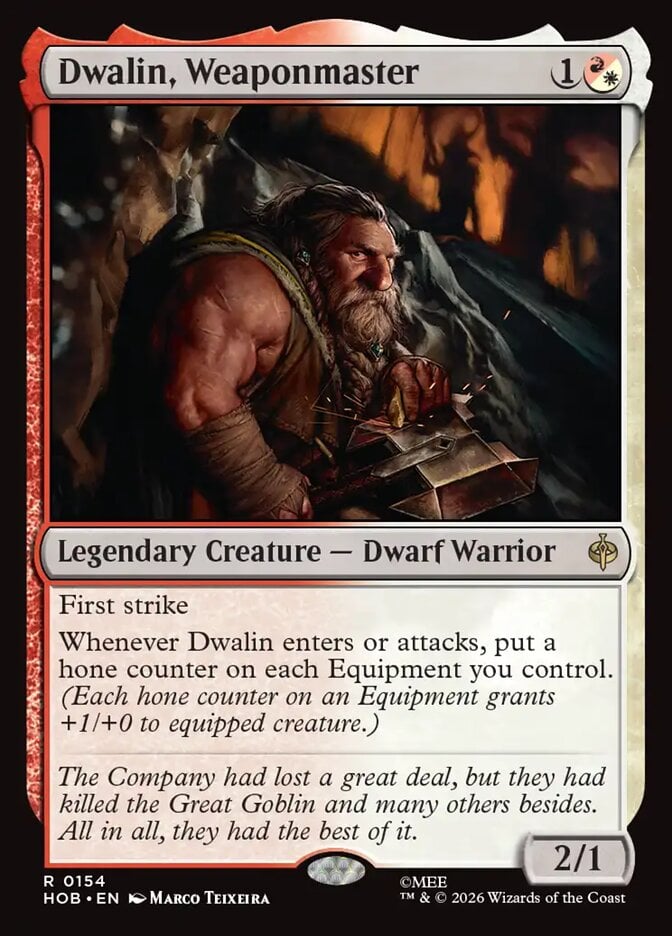
Dwalin, Weaponmaster gets to work on your weapons immediately, and it has nice combat stats for a 2-drop. I was surprised that this said “each” the first time I read it.
Thranduil’s Company (Bomb)
Two +1/+1 counters on landfall is nuts, and you can double trigger this the turn you play it if you have another elf! Hobbit Hole makes Thranduil's Company even more disgusting, so please splash/play this if you open it.
Thranduil, the Elvenking (Mediocre)
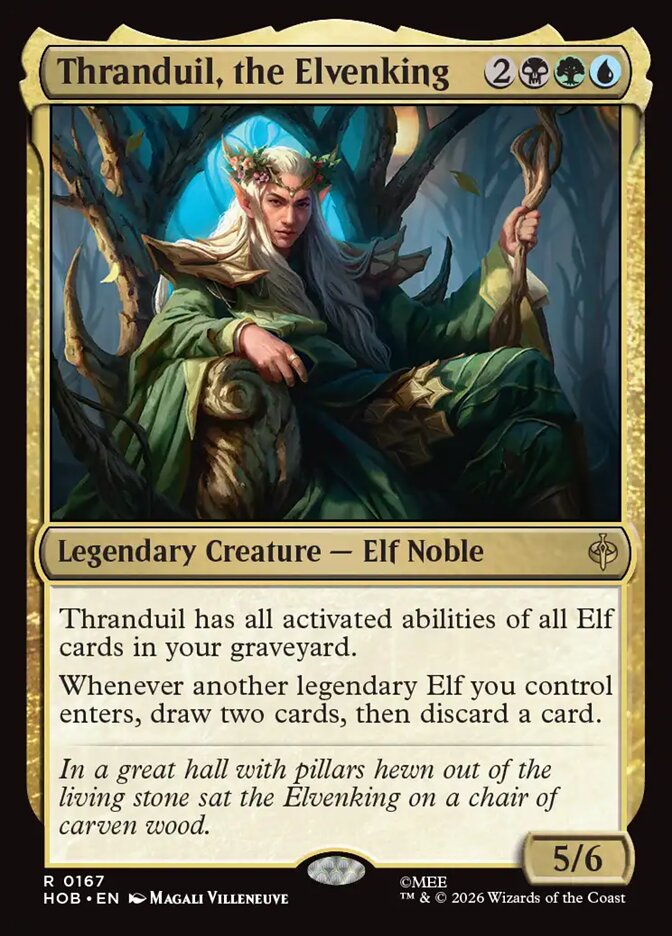
There are only four elves with activated abilities in HOB, none of which do much of note with Thranduil, the Elvenking. The free Catalog text on legendary elves is a bit more useful, and probably the main reason to actually play this card. I’m not likely to play Thranduil much, but I’d at least consider it if I had fixing and several other legendary elves.
Glamdring, Foe-hammer (Mediocre)
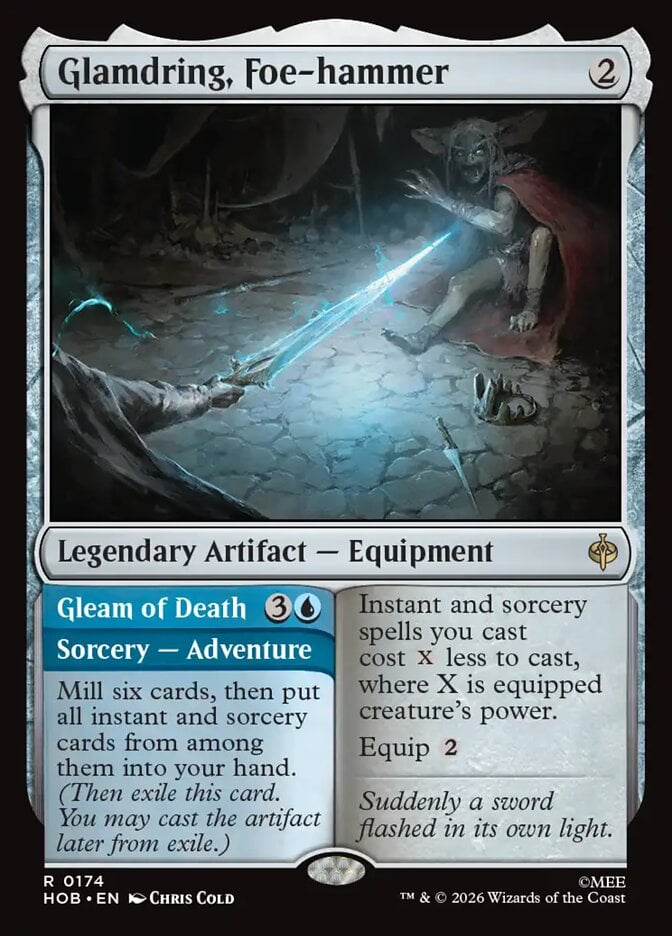
Glamdring, Foe-hammer requires a ton of instants and sorceries to be good, which is challenging in The Hobbit. Your best bet is to open this with other instant and sorcery payoffs, plus a ton of good spells in Grixis colors. If your pool doesn’t have all of that, don’t bother, as this is useless for the set’s primary archetypes.
My Precious (Great)
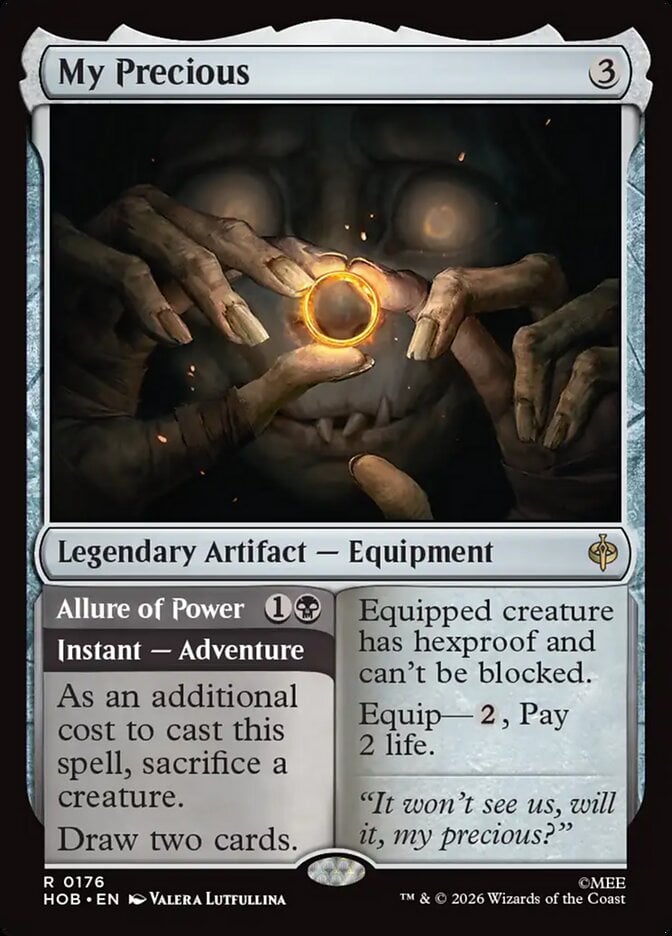
Allure of Power is a fairly priced Altar's Reap effect, which basically draws you My Precious for free to play later on. Hexproof and evasion more or less guarantee inevitability in a board stall, so I’d play this in every black deck and try to include fodder for it. If you aren’t playing black, this still offers a way to end board stalls, but it’d sit more in the “Mediocre” to “Good” range than Great.
Sting, Bilbo’s Sword (Mediocre)
Being forced to wait for your opponent to develop their board before Sting, Bilbo's Sword does anything really stings, and The Hobbit has more reliable equipment for you to play if needed.
The Lonely Mountain (Great)
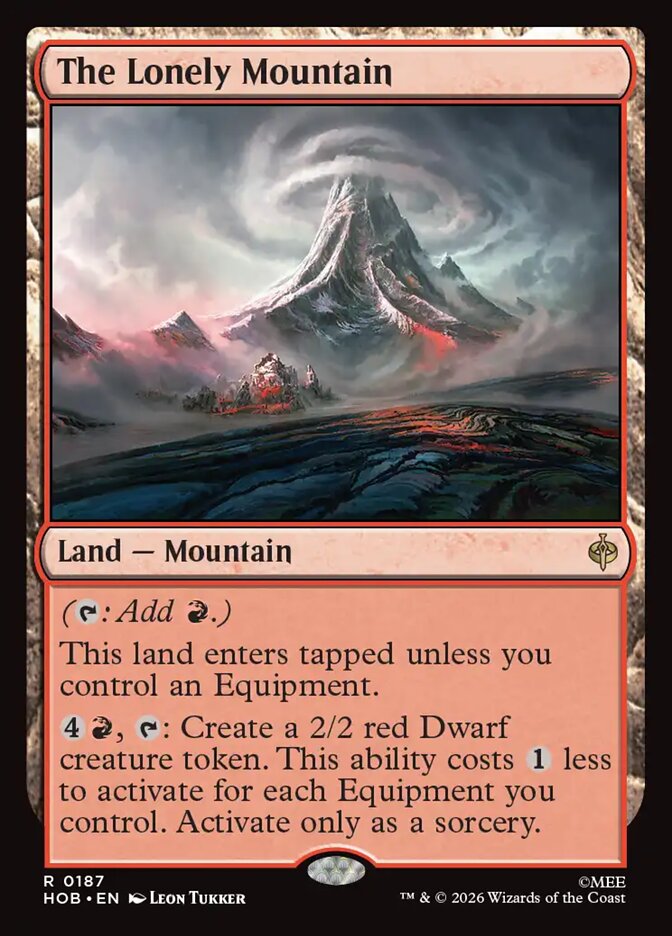
I love utility lands in Limited, as they do a great job at mitigating mana flood for a minimal deckbuilding cost. I’m always playing this (even with zero equipment), but I recognize how much better it is in RW Dwarves than other red decks.
Elven Passage (Good)
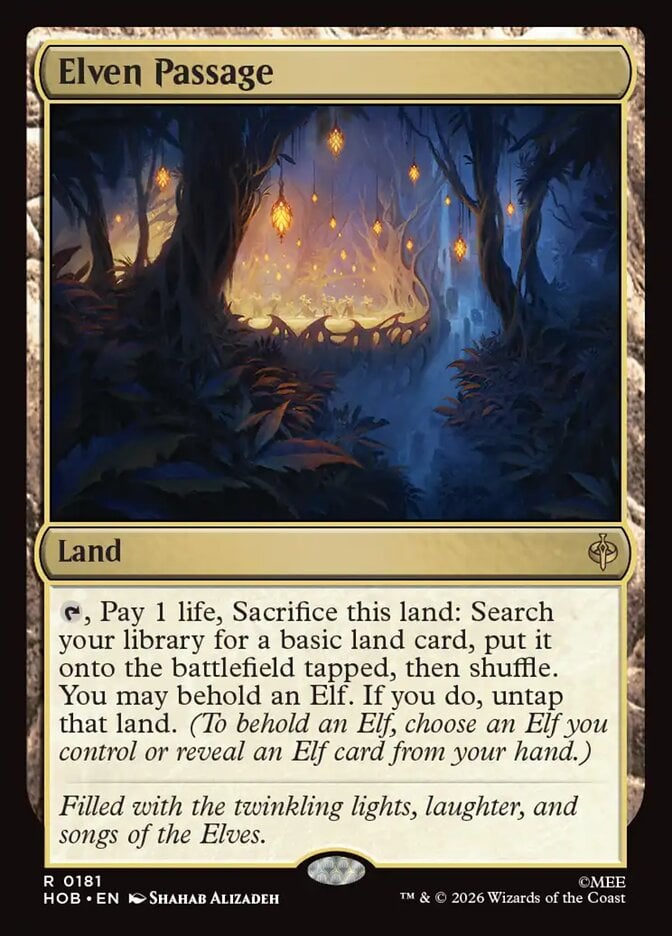
A nice upgrade to Hobbit Hole for your Elves decks, and a slightly worse version of that common if you don’t have any elves. Landfall synergies are obviously quite welcome with this one.
Final Scores
Here’s the breakdown of how each color scored, plus the set’s overall composition in terms of rare quality.
White (2 Mythics 8 Rares)
Bomb: 3 / Great: 4 / Good: 1 / Mediocre: 0 / Always Bad: 2
Blue (2 Mythics 7 Rares)
Bomb: 1 / Great: 4 / Good: 2 / Mediocre: 2 / Always Bad: 1
Black (2 Mythics 7 Rares)
Bomb: 3 / Great: 3 / Good: 1 / Mediocre: 1 / Always Bad: 1
Red (3 Mythics 8 Rares)
Bomb: 3 / Great: 1 / Good: 4 / Mediocre: 1 / Always Bad: 2
Green (2 Mythics 8 Rares)
Bomb: 3 / Great: 4 / Good: 1 / Mediocre: 2 / Always Bad: 0
All Cards (15 Mythics 53 Rares)
Bomb: 18 / Great: 22 / Good: 12 / Mediocre: 10 / Always Bad: 6
Analysis
The Hobbit seems like a rather Princely format from these ratings. Over a quarter of the rares in this set are bombs, and 57~% of them were rated “Great” or better. Most of these are well spread out between colors, although blue is definitely the least bomby of the bunch. If you don’t open terribly, expect your rares to have a major impact on how you build your pool.
Sealed Pool Example
And last but not least, we come to our example build. You can follow along using this pool here on sealedeck.tech. The pool was of course generated by Draftsim’s very own Sealed Pool Simulator!
Initial Highlights
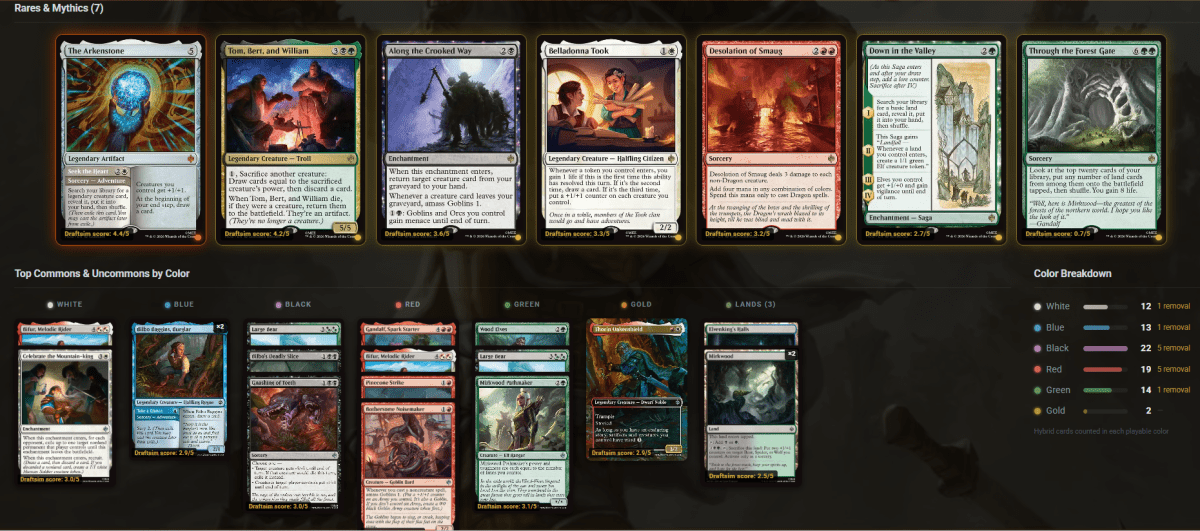
Our builder has a handy feature that shows off some of the highlights that I opened. I opened the following rares:
- The Arkenstone (bomb)
- Tom, Bert, and William (great)
- Along the Crooked Way (good)
- Belladonna Took (good)
- Desolation of Smaug (good)
- Down in the Valley (great)
- Through the Forest Gate (mediocre)
Pool View
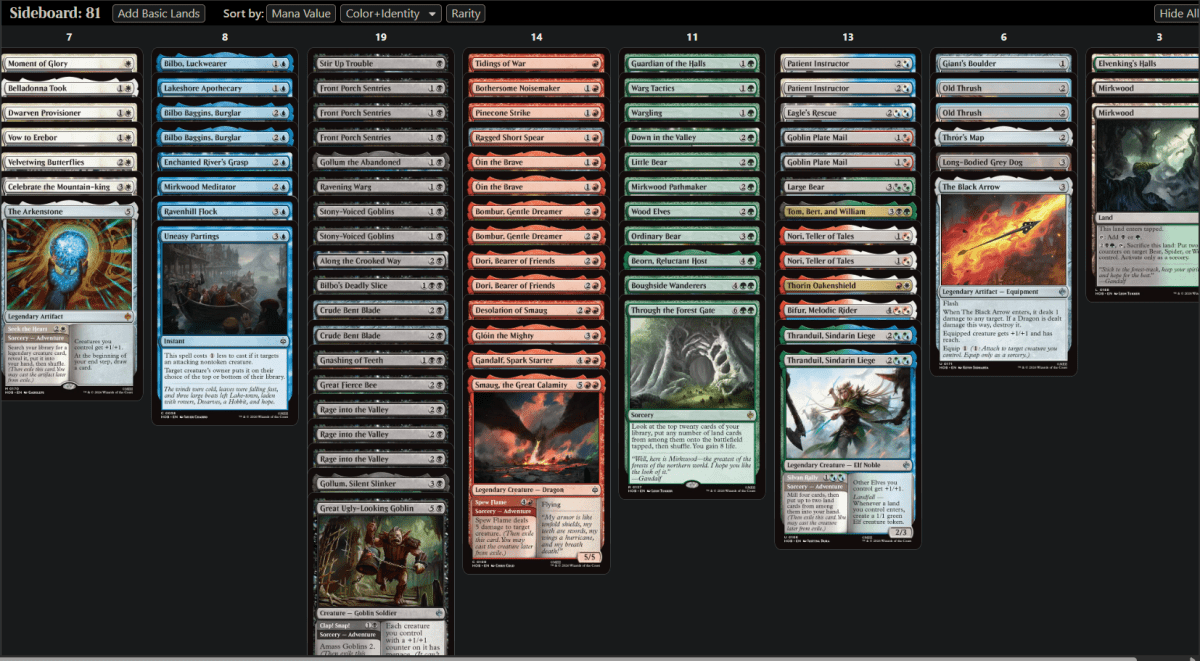
Black is by far my deepest color, and it has many removal spells. I could pair black with either green or red to play one of the set’s two officially supported archetypes. Clicking all of my playable black cards (and the strong rare I’ll want to splash) looks like this.
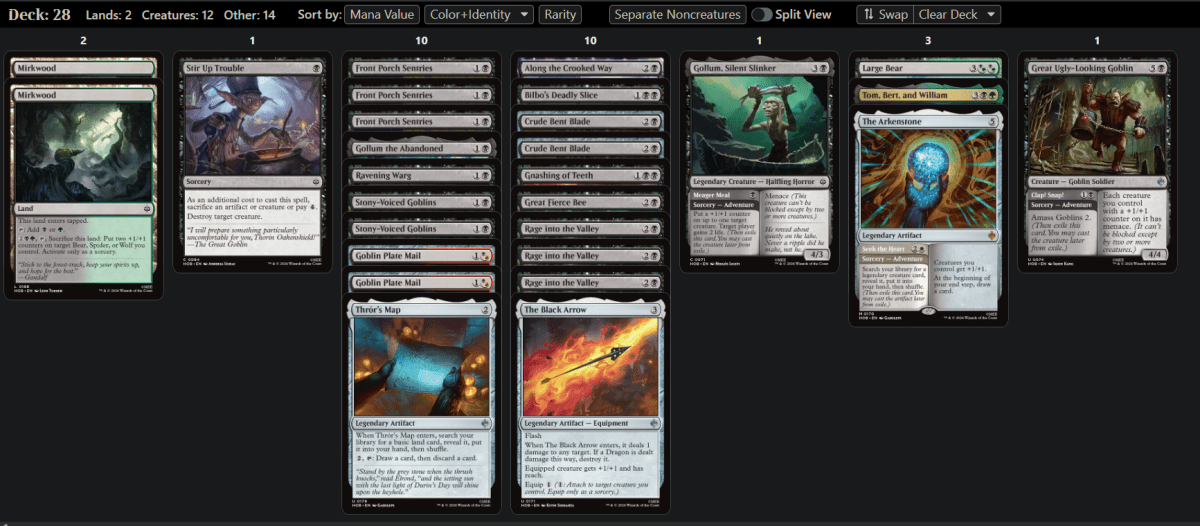
That’s too many cards of course, but it shows that black has my early game and removal covered. I’ll look to GB/BRg and see if my pool can provide some decent 4+ cost cards.
Adding a Second Color
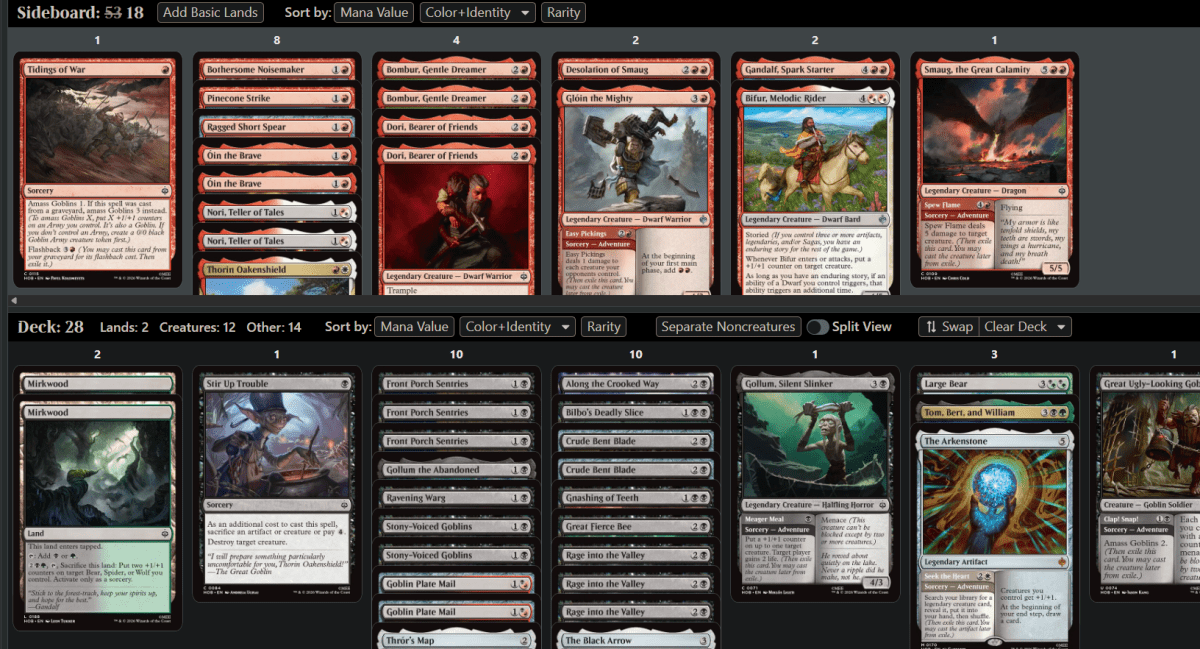
Red’s best offerings are Pinecone Strike, Dori, Bearer of Friends, Desolation of Smaug, and Gandalf, Spark Starter. Keep in mind that I can easily splash my Troll trio off the Mirkwoods, so I’m not worried about being base BG unless G is better than R.
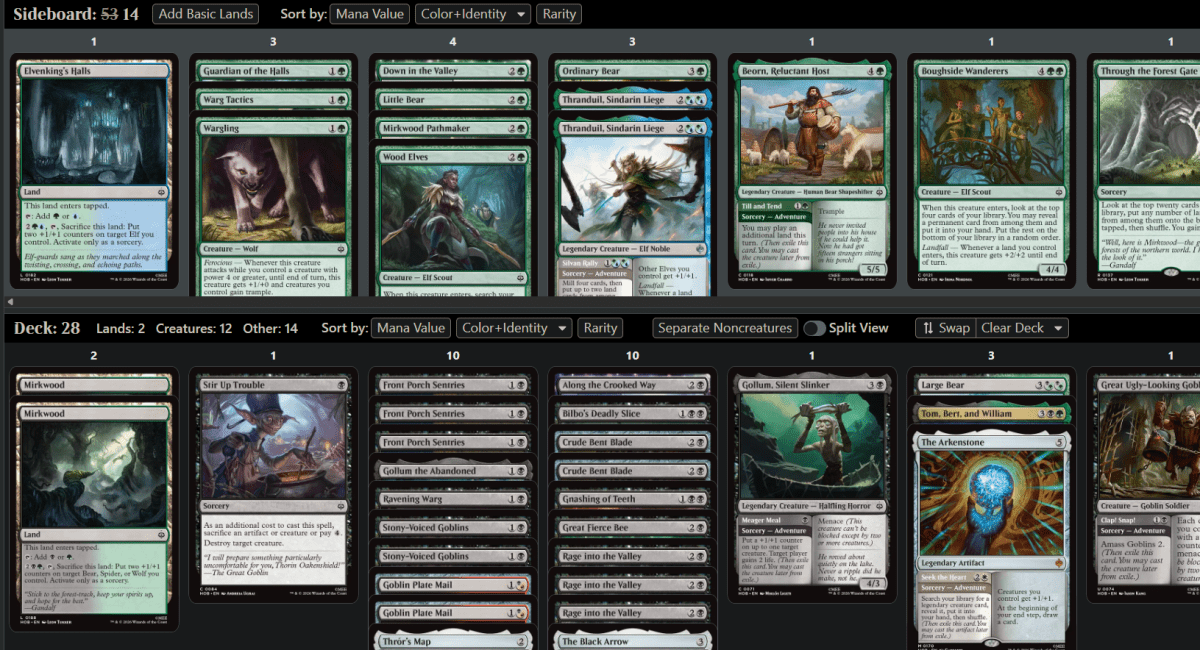
Green’s best offerings are Down in the Valley, Mirkwood Pathmaker, Wood Elves, and Boughside Wanderers. G versus R in this pool is very close, so let’s look at each build and decide.
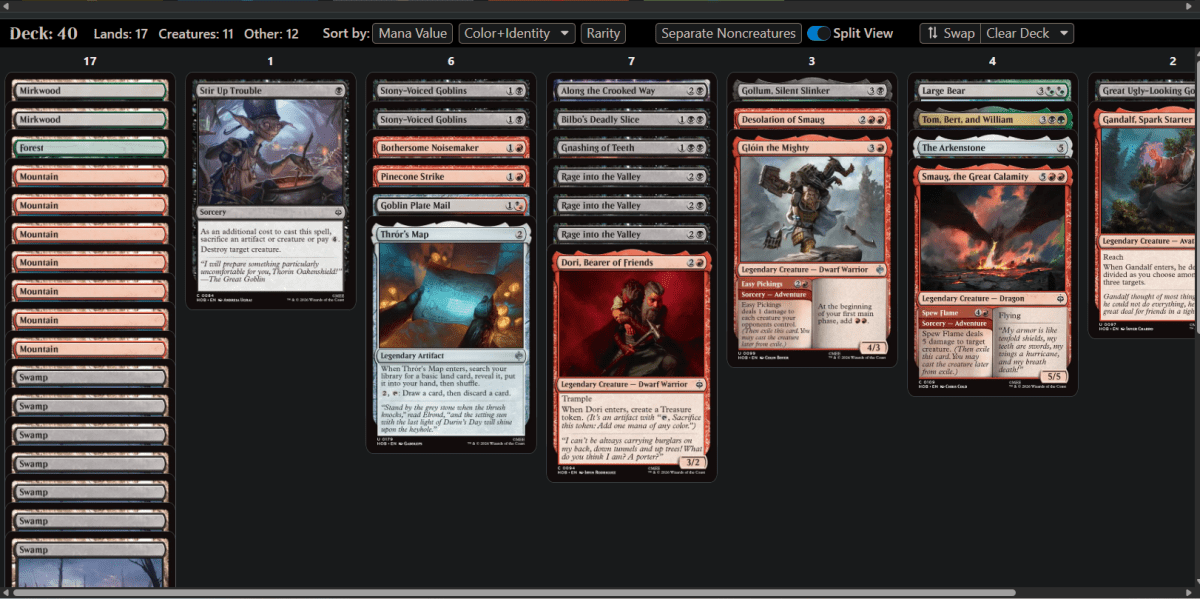
This is my first draft for what RBg should look like. I had to cut Crude Bent Blade and my other 2-drops to find slots for everything I wanted. The curve is a little top heavy, but the fundamentals here aren’t bad. Here’s GB.
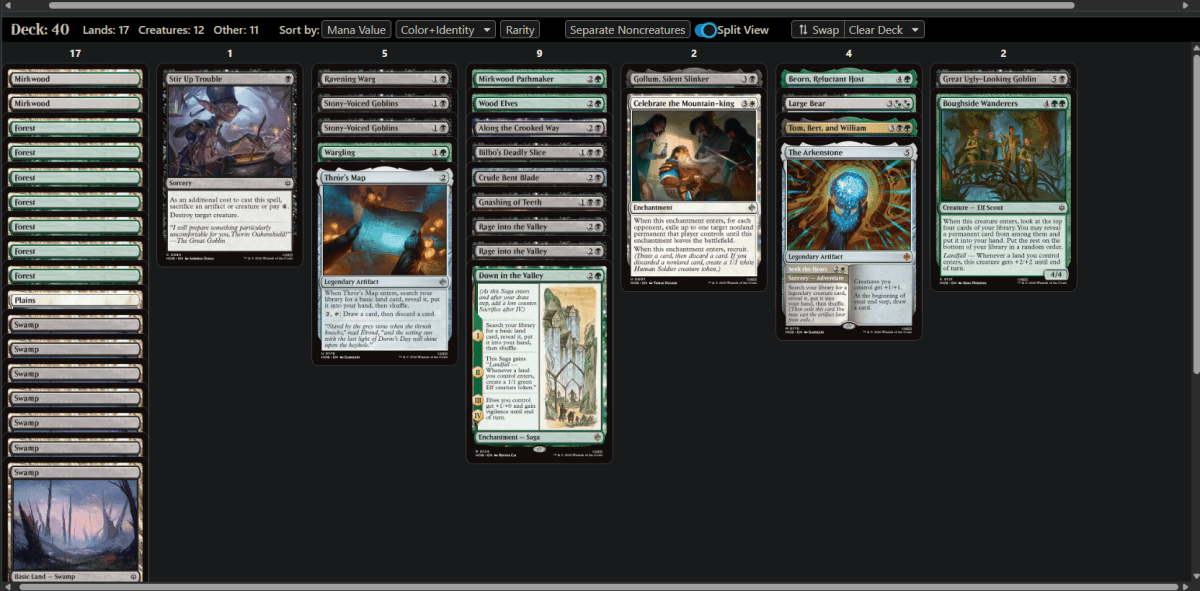
I actually added a small white splash to this one, for Celebrate the Mountain-king and The Arkenstone’s adventure mode (if convenient). Between 1 Plains, Down in the Valley, and Map, I have three sources of white mana. The rest of the deck looks similar curve wise to RBg (note that in both decks, I should’ve slotted Great Ugly-Looking Goblin as a 2-drop).
Final Decision
After mulling it over, I’d submit the Abzan list above to play in my Prerelease. I’m playing most of the best cards, have a reasonable amount of removal, lots of 2-for-1s, and a good curve. You can’t ask for much more in Sealed deck, so my only real regret is that I’m not actually playing with this pool this weekend!
Wrap Up
Hobbit Hole | Illustration by Shahab Alizadeh
And with that, you’ve reached the end of this “Hobbit-sized guide”. Well, not really of course, as this is yet another gigantic tome of mine. Regardless, I hope it serves you well, and prepares you to take home treasure from your Prerelease(s).
Which colors, cards, and archetypes are you hoping to find in your Hobbit Sealed pool? Do you think any of these cards will over- or underperform my initial impressions? Let me know in the comments below or over on the Draftsim Discord. For more Magic and Hobbit coverage, don’t forget to subscribe to our newsletter, The Daily Upkeep.
Good luck!
Follow Draftsim for awesome articles and set updates:










Add Comment