
Last updated on October 8, 2026
Dueling Coach | Illustration by Caio Monteiro
If you’re a new or returning Magic player interested in Arena but unsure where to start, Wizards has you covered with a game mode designed for new players: Starter Deck Duel!
The game mode comes with 10 decks to duke it out with fellow new players, or maybe experienced players interested in some casual fun. I’ve broken down everything you need to know about Starter Deck Duel, including how to pilot the decks.
What Is Starter Deck Duel?
Rivals' Duel | Illustration by Zoltan Boros & Gabor Szikszai
Starter Deck Duel (SDD) is a special event that lets players duke it out with their choice of 10 starter decks across various color combinations. Playing SDD is part of the tutorial for new players coming to Arena. You can play as much as you like, but you only receive rewards for your first three wins. The first two get you Individual Card Rewards, including a random card that’s at least rare, and the third is a mystery cosmetic.
Where Do I Find the Starter Deck Duel?
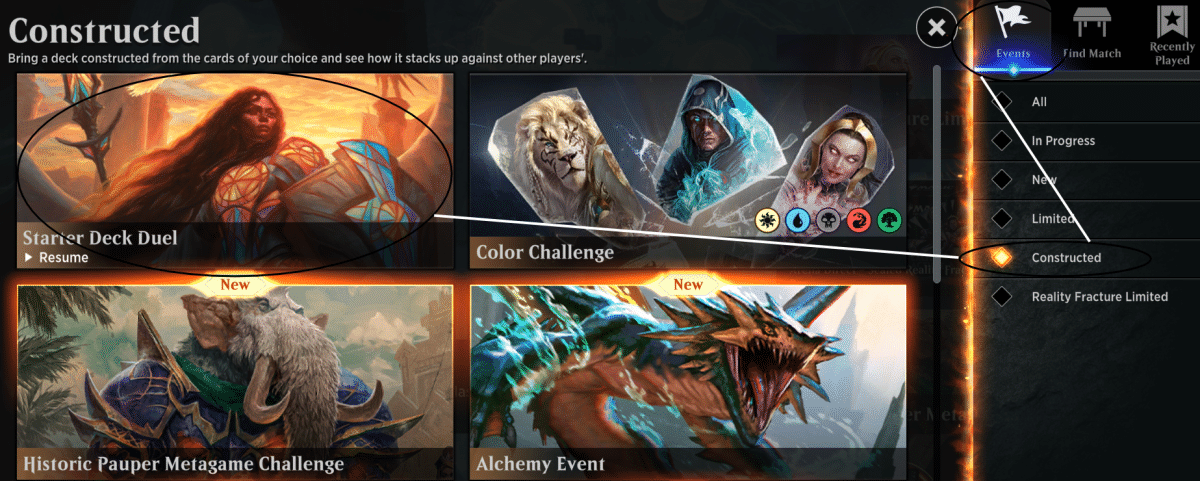
You can find the SDD by opening the Events page and filtering it to Events; if it doesn’t pop up right away, you can further filter the events pages by selecting the Constructed tab. It’ll be one of the few events left.
If you just completed the tutorial with Sparky, the SDD is even easier to find; it’s one of the first events Sparky unlocks after you complete the tutorial. If your account existed prior to when SDD was introduced, you can find it under the Events tab, as normal.
Who Is Starter Deck Duel For?
The Starter Deck Duel is best for new or returning Magic players who want casual games to learn or brush up on the rules. All the cards have simple interactions, so you can get the hang of the complex, multi-phase turns without worrying about super complex cards or play patterns.
Additionally, SDD gives experienced players who haven’t played on Arena a chance to familiarize themselves with the UI or a place to play fast, casual games before they’ve built a collection.
Why Play the Starter Deck Duel?
Playing the Starter Deck Duel is non-negotiable for new players; getting three wins is the second to last step before the end of the tutorial, when you unlock the Spark Rank and Sparky gifts you 600 gems.
If you haven’t completed the tutorial because your account was created before SDD was introduced, you can still play to claim your three rewards.
Experienced Magic players who skipped the tutorial because they know how to play the game might want to play SDD to familiarize themselves with the Arena client and interface before they play more competitive events.
The SDD can also be a great way to play some casual Magic. The event is completely free and often fires quickly—I’ve always found a match within 90 seconds—so you can play a ton of Magic with very little investment.
How Long Is Starter Deck Duel Available?
The Starter Deck Duel is always available, though Wizards may change the decks.
What are the Rewards of Starter Deck Duel?
The first two wins in Starter Deck Duel give you two individual cards, which are at least rare, and one card style.
The Starter Deck Duel Decks
Arcane Aerialists

Inspiring Overseer | Illustration by Irina Nordsol
Creature (27)
Healer's Hawk x2
Giada, Font of Hope
Youthful Valkyrie x2
Inspiring Overseer x2
Serra Angel x2
Spectral Sailor x2
Fog Bank x2
Curator of Destinies
Empyrean Eagle x3
Cloudblazer x2
Dazzling Angel x2
Aegis Turtle x2
Vanguard Seraph x2
High Fae Trickster
Lyra Dawnbringer
Instant (2)
Sorcery (2)
Artifact (2)
Enchantment (3)
Stasis Snare x3
Land (24)
Plains x8
Island x7
Azorius Guildgate x4
Tranquil Cove x4
Temple of Enlightenment
Arcane Aerialists is an aggressive blue-white, or Azorius () deck that swarms the board with flying creatures to dominate its opponent. Creatures with flying can only be blocked by creatures with flying or reach, so it’s a great aggressive mechanic.
It’s relatively simple to play this deck well: Keep a hand with 2-3 lands and some cheap creatures—ideally a 1-mana spell and a 2-mana spell, at least. You don’t want your first play to be on turn 3. Then cast them, and jam! Since your fliers have evasion, you probably don’t have to worry about much combat math unless you encounter a mirror match.
This deck has excellent card draw. With cards like Chart a Course, Inspiring Overseer, and Cloudblazer, you should have no trouble seeing plenty of cards to win the game, and that much card advantage helps to mitigate flood and screw.
This looks like one of the strongest decks due to its simplicity and card quality. It has a few duds, like Aegis Turtle and Fog Bank, but its simple game plan and deep card draw pool makes it a stellar option.
Cat Attack

Arahbo, the First Fang | Illustration by Simon Dominic
Creature (23)
Savannah Lions x3
Dawnwing Marshal x2
Helpful Hunter x4
Arahbo, the First Fang
Regal Caracal
Felidar Savior x2
Good-Fortune Unicorn x3
Leonin Vanguard x3
Wary Thespian x4
Instant (6)
Giant Growth x2
Claws Out x4
Sorcery (2)
Felling Blow x2
Enchantment (5)
Anthem of Champions
Banishing Light x2
Angelic Destiny
Unflinching Courage
Land (24)
Forest x6
Plains x9
Temple of Plenty
Blossoming Sands x4
Selesnya Guildgate x4
Cat Attack brings green and white together in a Selesnya () deck that attacks with a feline army. It goes wide with cheap creatures that it buffs with cat lords and Claws Out.
Similarly to Arcane Aerialists, look for opening hands with plenty of cheap plays so you can attack early and often. When you trade with your opponent, keep in mind your future plays: It might be bad to trade a Savannah Lions if you’re a turn away from casting Regal Caracal or Claws Out for a power buff that makes your creature survive combat.
This deck is a little disappointing. Good-Fortune Unicorn is a strange inclusion since it isn’t a cat and doesn’t really help you go wide, and its interaction suite is meager and expensive. You definitely have the potential for strong starts and can easily overwhelm your opponents if you draw your rares, but this one falls short of excellence.
Graveyard Gifts

Zombify | Illustration by Jason A. Engle
Creature (18)
Kiora, the Rising Tide
Gleaming Barrier x3
Brineborn Cutthroat x2
Arbiter of Woe x2
Abyssal Harvester
Crow of Dark Tidings x2
Dreadwing Scavenger x4
Billowing Shriekmass x2
Arcanis the Omnipotent
Instant (12)
Opt x4
Stab x4
Essence Scatter x2
Bake into a Pie x2
Sorcery (6)
Inspiration from Beyond x2
Rise of the Dark Realms
Zombify x3
Land (24)
Dimir Guildgate x4
Dismal Backwater x4
Temple of Deceit
Island x7
Swamp x8
Graveyard Gifts is a blue-black or Dimir () deck that uses the graveyard to fuel a midrange plan. Or maybe it’s control? Though there’s also the reanimation thing….
This deck is a mess. There’s almost a good midrange deck here, with cheap interaction to fill the graveyard for Kiora, the Rising Tide and Dreadwing Scavenger, and the latter is an exceptional threat due to its power and card filtration. Then the curve keeps going into Avatar of Woe despite a lack of good sacrifice fodder, and it wedges in Zombify.
But the deck has a playset of Stab, which lines up well against the other decks in the format, and its card selection via Opt, Inspiration from Beyond, and Dreadwing Scavenger should protect it from flooding out.
If you pick this deck up, look for cheap early plays like Opt and Stab. Since Graveyard Gifts is more controlling, you can keep hands with more lands and fewer creatures than aggressive decks can. You want to trade resources and stay alive long enough for your threshold cards to take the game away.
Learn from the Land

Elfsworn Giant | Illustration by Dave Dorman
Creature (29)
Mischievous Mystic x2
Exclusion Mage x3
Mossborn Hydra
Loot, Exuberant Explorer
Tatyova, Benthic Druid x2
Rampaging Baloths
Apothecary Stomper x2
Elfsworn Giant x2
Druid of the Cowl x4
Spectral Sailor x2
Llanowar Elves x3
Mild-Mannered Librarian x2
Magnigoth Sentry x2
Bigfin Bouncer x2
Instant (2)
Quick Study x2
Sorcery (4)
Felling Blow x2
Circuitous Route x2
Enchantment (1)
Land (24)
Forest x10
Island x5
Temple of Mystery
Thornwood Falls x4
Simic Guildgate x4
Learn from the Land is a blue-green, or Simic () deck that ramps into large threats. Ramp decks focus on playing cheap cards that produce extra mana like Druid of the Cowl to cast big threats like Rampaging Baloths ahead of schedule.
To play this deck well, look for a hand with either Llanowar Elves or Druid of the Cowl, or even both! These are critical elements of your game plan, and your deck won’t work without them. You’ll play super slow and your opponent could easily overrun you. Your top-end is replaceable enough that you don’t need to worry about finding those early.
About 60% of this deck is good, but the rest raises too many eyebrows. The ramp is good, the top end is good, the landfall stuff is good. But cards like Spectral Sailor and Mild-Mannered Librarian bog it down, which gives the deck cards that aren’t ramp spells or spells to ramp into and makes it much more inconsistent. It has its good draws, but an unfortunate number of bad ones.
Might of the Legion

Heroic Reinforcements | Illustration by Scott Murphy
Creature (21)
Frenzied Goblin x2
Dawnwing Marshal x2
Resolute Reinforcements x2
Searslicer Goblin
Crusader of Odric x3
Dauntless Veteran x2
Axgard Cavalry x2
Krenko, Mob Boss
Fanatical Firebrand x3
Serra Angel x2
Aurelia, the Warleader
Artifact (3)
Celestial Armor
Goldvein Pick x2
Instant (6)
Valorous Stance x2
Burst Lightning x2
Goblin Surprise x2
Sorcery (6)
Dragon Fodder x2
Heroic Reinforcements x2
Release the Dogs x2
Land (24)
Mountain x8
Plains x9
Boros Guildgate x2
Wind-Scarred Crag x4
Temple of Triumph
Might of the Legion brings the Boros () forces to muster in this red-white token deck that goes wide to bring your opponents down. It relies on cards like Resolute Reinforcements and Dragon Fodder to make multiple bodies that are buffed by team-wide tricks like Goblin Surprise.
This is another aggro deck, so you need to look for cheap, early plays and a few lands. This deck has better late game than Cat Attack because its combination of tokens and pump spells breaks through a board stall quite well. Still, look to be aggressive and try to win before the board stalls out.
Might of the Legion is a well-built deck, with a few weaknesses. All these decks suffer from inconsistency because most cards have two or three copies rather than the full four, which means you see your best cards less often and have room for other, weaker cards. For example, instead of four copies each of Resolute Reinforcements and Dragon Fodder—two critical elements of your game plan that get you off the ground early—you have two of each, then two copies of Goldvein Pick and Dawnwing Marshal, which you don’t need. While all the decks have this weakness to some degree, this one suffers from it the most.
Morbid Machinations

Tragic Banshee | Illustration by Camille Alquier
Creature (28)
Infestation Sage x2
Llanowar Elves x3
Eager Trufflesnout x2
Midnight Reaper
Spinner of Souls
Wardens of the Cycle x3
Cackling Prowler x2
Vampire Gourmand x2
Needletooth Pack x2
Infernal Vessel x2
Quilled Greatwurm
Scavenging Ooze
Wary Thespian x2
Tragic Banshee x2
Reassembling Skeleton x2
Instant (2)
Sorcery (4)
Eaten Alive x2
Felling Blow x2
Enchantment (2)
Land (24)
Forest x8
Swamp x7
Temple of Malady
Golgari Guildgate x4
Jungle Hollow x4
Morbid Machinations is the Golgari () or black-green deck. It combines sacrifice outlets with morbid synergies to bury your opponent beneath a deluge of deadly value.
Sacrifice decks have an A + B sort of formula: You need good cards to sacrifice, or you need sacrifice fodder (Infestation Sage, Reassembling Skeleton) plus sacrifice outlets that give you a benefit in exchange for sacrificing creatures (Vampire Gourmand, Vampiric Rites). There’s also a third class of card: Sacrifice payoffs that reward you for sacrificing permanents. That’s where the morbid cards like Wardens of the Cycle and Tragic Banshee come in.
You need sacrifice fodder in your opening hand. Ideally, you’ll start with all three elements, but sacrifice fodder is by far the most important. Sacrifice fodder without an outlet is still a creature, even if an underwhelming one, but an outlet without fodder is useless.
This is one of the grindier, midrange-oriented Starter Decks. It focuses on setting up synergy engines like Vampiric Rites plus Reassembling Skeleton to out-grind its opponents in a long game. You might have the occasional aggressive draw with Llanowar Elves, but expect to settle in for a long match whenever you queue this one up. It’s solidly built, with plenty of card advantage and stronger rares than other decks.
Path of Power

Ashroot Animist | Illustration by Caio Monteiro
Creature (26)
Halana and Alena, Partners
Ashroot Animist
Ruby, Daring Tracker x2
Courageous Goblin x2
Nessian Hornbeetle x3
Axgard Cavalry x2
Giant Cindermaw x2
Skyraker Giant x2
Llanowar Elves x3
Mild-Mannered Librarian x2
Beast-Kin Ranger x2
Eager Trufflesnout x2
Spinner of Souls
Vizier of the Menagerie
Instant (5)
Bulk Up
Scorching Dragonfire x2
Snakeskin Veil x2
Sorcery (4)
Felling Blow x2
Bushwhack x2
Enchantment (1)
Land (24)
Rugged Highlands x4
Gruul Guildgate x4
Mountain x7
Forest x8
Temple of Abandon
Path of Power is a classic Gruul () or red-green stompy deck that wants to hit hard and fast, and it falls back on cards that care about your creatures that have 4 or more power for synergy.
Llanowar Elves might be the best card in the deck due to several aggressive 3-mana cards like Giant Cindermaw and Eager Trufflesnout that excel when you play them early.
Though this deck wants to be aggressive, it has decent late game; cards like Halana and Alena, Partners, Nessian Hornbeetle, and Vizier of the Menagerie accumulate lots of value during a long game, probably enough to overwhelm your opponents. This deck also has a little more removal than some of the others, with two burn spells and four punches.
I wish Wizards would stop putting Mild-Mannered Librarian in these decks because it sucks, but the rest of this list is very well put together. The Simic () deck destroys this pretty hard, but I like its chances against the rest of the field.
Reckless Raid

Searslicer Goblin | Illustration by Wayne Reynolds
Creature (27)
Diregraf Ghoul x4
Infestation Sage x3
Vampire Gourmand x3
Searslicer Goblin
Slumbering Cerberus x3
Alesha, Who Laughs at Fate
Battlesong Berserker x2
Perforating Artist x3
Goblin Boarders x3
High-Society Hunter
Massacre Wurm
Strongbox Raider x2
Instant (9)
Abrade x3
Burst Lightning x2
Fake Your Own Death x2
Hero's Downfall x2
Land (24)
Swamp x8
Mountain x7
Temple of Malice
Bloodfell Caves x4
Rakdos Guildgate x4
Reckless Raid goes aggressive with a red-black, or Rakdos () deck that combines raid and morbid for a deck that wants to turn its cards sideways and consider consequences later.
The sacrifice synergies make this quite similar to the Golgari () deck, but this one exchanges the grindy engines for aggressive threats like Slumbering Cerberus and Perforating Artist. Comparing the sacrifice decks, I like this one more. It just has a better curve and better removal, even if it lacks the card advantage engines.
Keeping in theme with the aggro decks, look for opening hands with 2-3 lands and plenty of cheap creatures. The curve of Infestation Sage into Vampire Gourmand or Diregraf Ghoul into Slumbering Cerberus are ideal. Your raid cards help to break through board stalls; don’t be afraid to attack into a bad block if it puts your opponents into an ugly spot.
Vampiric Hunger

Elenda, Saint of Dusk | Illustration by Chris Rahn
Creature (26)
Hinterland Sanctifier x2
Healer's Hawk x2
Ajani's Pridemate x3
Sun-Blessed Healer x2
Sanguine Syphoner x2
Vengeful Bloodwitch x2
Cat Collector x2
Twinblade Paladin x2
Vampire Nighthawk x2
Dazzling Angel x2
Elenda, Saint of Dusk
Fiendish Panda x2
Inspiring Overseer x2
Instant (8)
Moment of Triumph x2
Moment of Craving x2
Tribute to Hunger x2
Mortify x2
Enchantment (2)
Phyrexian Arena
Angelic Destiny
Land (24)
Plains x8
Swamp x7
Orzhov Guildgate x4
Scoured Barrens x4
Temple of Silence
Vampiric Hunger cares about lifegain. It’s a black-white or Orzhov () deck that leans a little more midrange, like that Golgari deck.
Unfortunately, this is the weakest deck due to its inconsistency. To make this strategy work, you need a full four Hinterland Sanctifiers, a full four Ajani's Pridemates, and so on. It relies too heavily on synergy to get away with a hodgepodge list of two- and three-ofs.
If you really want to make it work, look for lifegain and lifegain payoffs. Like Morbid Machinations, you need that one-two punch to make things work. Vampire Nighthawk is notably powerful here. These decks have relatively low power, so a cheap creature that’s perfect on offense and defense pulls a lot of weight.
Wondrous Wizardry
Balmor, Battlemage Captain | Illustration by Bram Sels
Creature (18)
Drake Hatcher
Niv-Mizzet, Visionary
Archmage of Runes
Tolarian Terror x3
Ghitu Lavarunner x4
Balmor, Battlemage Captain
Enigma Drake x2
Mischievous Mystic x2
Heartfire Immolator x2
Ovika, Enigma Goliath
Instant (15)
Arcane Epiphany x2
Opt x4
Burst Lightning x4
Dive Down x3
Fiery Annihilation x2
Sorcery (3)
Land (24)
Mountain x7
Island x8
Swiftwater Cliffs x4
Temple of Epiphany
Izzet Guildgate x4
Wondrous Wizardry is a classic Izzet ({UR) or blue-red spellslinger deck that benefits from casting lots of cheap instants and sorceries to trigger or set up cards like Drake Hatcher and Enigma Drake.
This deck could use less top-end; cards like Archmage of Runes and Niv-Mizzet, Visionary are incredibly powerful but a little expensive. Beyond that, the deck looks great. Cheap burn and cantrips plus Tolarian Terror and Ghitu Lavarunner is almost a proper Pauper deck.
Your most important cards are the cheap instants and sorceries. Burst Lightning and Opt are key pieces, and you probably shouldn’t keep a hand without at least one copy of either card. You can be aggressive with the cheap cards or out-value your opponent if you draw the rares. While the deck would perform better if it focused on control or aggro, this is still one of the stronger decks in the event.
Where to Find Your Starter Decks on MTG Arena

Your Starter Decks can be found under the Starter Deck category in the Decks tab. Decks in the Starter Deck category can’t be modified; you’ll need to duplicate them if you want to upgrade or tweak them.
What Is Spark Rank?
The Spark Rank is a Constructed queue you unlock after you’ve completed the SDD in your tutorial. It’s specifically designed for newer players to give them a taste of the competitive ladder. Once you climb the four levels of the Spark Rank, you’ll be ranked Bronze on the regular ladder.
A word of warning: While you’ll ideally play against players with similar decks, like the Starter Decks, you can run into players who purchased enough cards to make full-powered decks. If you don’t want to invest in the same, you can comfortably skip the tutorial, which places you in Bronze anyway.
How Do You Get Starter Decks in MTG Arena?
Starter Decks are automatically added to your account after you complete the tutorial, and when Arena periodically refreshes the Starter Deck offerings, usually about once a year.
Can You Upgrade the Starter Decks?
Yes! After you complete the Starter Deck Duel, you can upgrade your Starter Decks, though you’ll need to duplicate them first. Draftsim already has a great guide on how to update your Starter Decks.
Wrap Up
Duelist's Heritage | Illustration by Lake Hurwitz
That’s everything you need to know about the Starter Deck Duel! I’m glad Wizards has an event like this tailored to new players; Magic’s a very complex, daunting game, so it’s critical to have a casual game mode like this to let them get comfortable with the game.
Did you play the Starter Deck Duel when you came to Arena? Did you have a good time? Let me know in the comments below or on the Draftsim Discord!
Stay safe, and thanks for reading!
Follow Draftsim for awesome articles and set updates:










5 Comments
How would you rank the “power level” of each of the decks?
While “power level” can be somewhat subjective, all of these decks sit at the 3-4 out of 10 range (assuming the best Standard deck is a 10). Thanks for reading!
Assuming players that got all the starter decks, will each player have the same decks.
I won with every Deck in that challenge and still got no 600 gems… what am i missing ?
Hey Murat!
I saw a similar post elsewhere, and I’m thinking they might have overhauled the new player experience when Bloomburrow came out.
They changed some thing when Standard Rotation happened, like cutting off a lot of the free codes, so it’s possible they reworked what a new Arena account starts off with too.
Add Comment