

Excavation Technique | Illustration by Francisco Miyara
Hello planeswalkers! Let’s get the pun about how I’ll “demonstrate” how the demonstrate keyword works out of the way. It’s low-hanging fruit, and you deserve better. But I assume many of you are here to learn about a relatively unknown keyword. Demonstrate has not been widely used in EDH precons, and there are only a few cards with the keyword.
So why should you care? I hope you’re curious and will let me lay out why demonstrate is an interesting keyword. We’ll get into how it works, many of the nuances of the keyword, and a list of the cards with demonstrate.
Without much more talk, let’s figure out what the heck demonstrate is.
How Does Demonstrate Work?

Silverquill Lecturer | Illustration by Ryan Pancoast
Demonstrate is a keyword that lets you and an opponent copy the spell with demonstrate when you cast it. This ability triggers at the time of casting the spell with demonstrate, and it allows you to choose to copy the spell. If you do copy it, you must also choose an opponent that copies the spell as well. If you choose not to copy the spell, no opponent can copy the spell and it resolves as normal.
Because of the nature of allowing an opponent to copy a spell, this keyword is best left for politics in multiplayer Commander games.
The History of Demonstrate in MTG?
Demonstrate was introduced on five mono-colored cards of different colors in the Commander 2021 set. The keyword seems to have been received poorly, as the rules can be confusing, and many players don’t want to give opponents a free copy of a spell.
Demonstrate hasn’t become evergreen, but it has been printed on a few one-offs, mostly in Commander sets. 2025’s Transforming Flourish from Tarkir: Dragonstrom Commander shows that more cards with the keyword may be printed in the future.
Is Demonstrate a Triggered Ability?
Yes, demonstrate triggers when you cast the spell with demonstrate. As the trigger resolves, you must choose to copy the spell or not. After this, copies are added to the stack, or no copies are created and the spell remains on the stack to be resolved.
In What Order Do Demonstrate Copies Resolve?
- When you cast a card with demonstrate, the trigger immediately goes on the top of the stack over the original spell.
- You choose whether to make a copy as the demonstrate ability resolves.
- If you choose not to copy it, the original spell remains on the stack until it resolves. If you don’t copy the spell, no opponent gets to copy it either.
- If you do choose to copy the spell, your copy then goes on the stack above the original spell.
- You then immediately choose an opponent. If they copy the spell, it goes on top of the stack.
If you cast a spell with demonstrate, and if both you and an opponent copy it, the opponent’s copy resolves first, then your copy resolves, and then the original spell resolves.
If the spell requires targets, we have a few more additions to the stack. You choose the target of the original spell as you cast it. If you create a copy of the spell, you may choose new targets for the copy as you create that copy. The opponent you chose to create a copy may choose new targets for their copy as it’s created. The order of targets being declared is a similar order to how they go onto the stack, so your opponent will know the targets of your spells before they make their decision.
After all of this, the spells will resolve from the stack unless someone casts an instant-speed spell or activates an instant speed ability.
How Does Countering Demonstrate Work?
Countering doesn’t affect the demonstrate trigger because it’s a cast trigger. If you use a normal counterspell on a demonstrate card, the original spell won’t resolve, but the demonstrate ability can still resolve. The caster can still copy it, and an opponent can still copy it if they do.
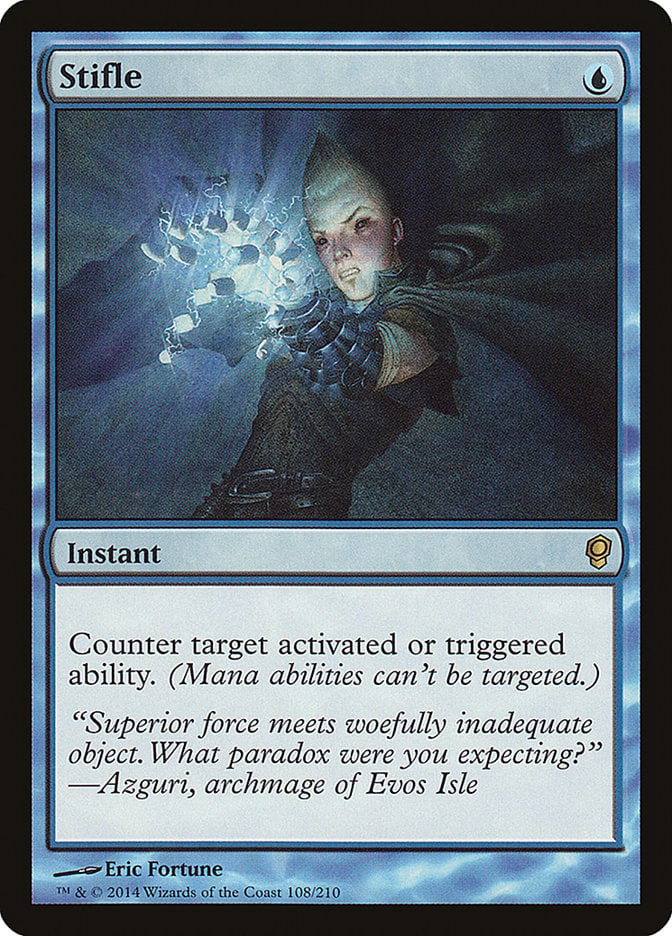
You can stifle a triggered ability like demonstrate to counter the demonstrate trigger, reducing the spell to just the original card on the stack. You can interact with both a demonstrate card and demonstrate copies by exiling the stack itself with cards like Time Stop.
What Happens When You Demonstrate a Permanent Spell?
When you demonstrate a permanent spell, you create a token copy of the permanent. The token has all the characteristics of the demonstrated permanent spell. It has the same color, mana value, stats, abilities, and triggers as the original. If the copied permanent spell had an X value or was kicked, the copy enters with the same X value or also kicked.
As the token copy resolves and enters the battlefield, it isn’t considered “created.” This means that it triggers ETB effects like Caretaker's Talent, but not token-created effects like Ojer Taq, Deepest Foundation.
Does Demonstrate Commit a Crime?
No, the demonstrate keyword itself doesn’t commit a crime. The keyword reads: “When you cast this spell, you may copy it. If you do, choose an opponent to also copy it.” Since you’re “choosing” an opponent and not “targeting” one, it’s not considered committing a crime.
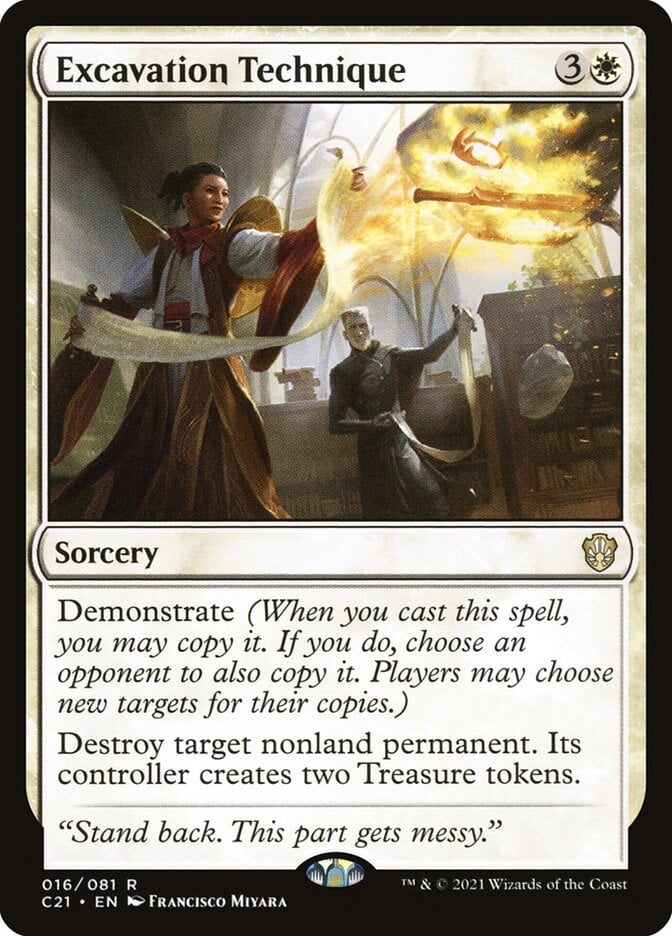
A card like Excavation Technique does commit a crime because it destroys target nonland permanent. This isn’t because of the demonstrate keyword but rather the target text of the spell.
Does Demonstrate Count as Casting a Spell?
No, it doesn’t. The demonstrate trigger can create a copy that’s immediately placed onto the stack. This doesn’t count as the casting of a spell. Sorry storm players, but this isn’t a way to increase the number of spells you’ve cast.
Gallery and List of Demonstrate Cards


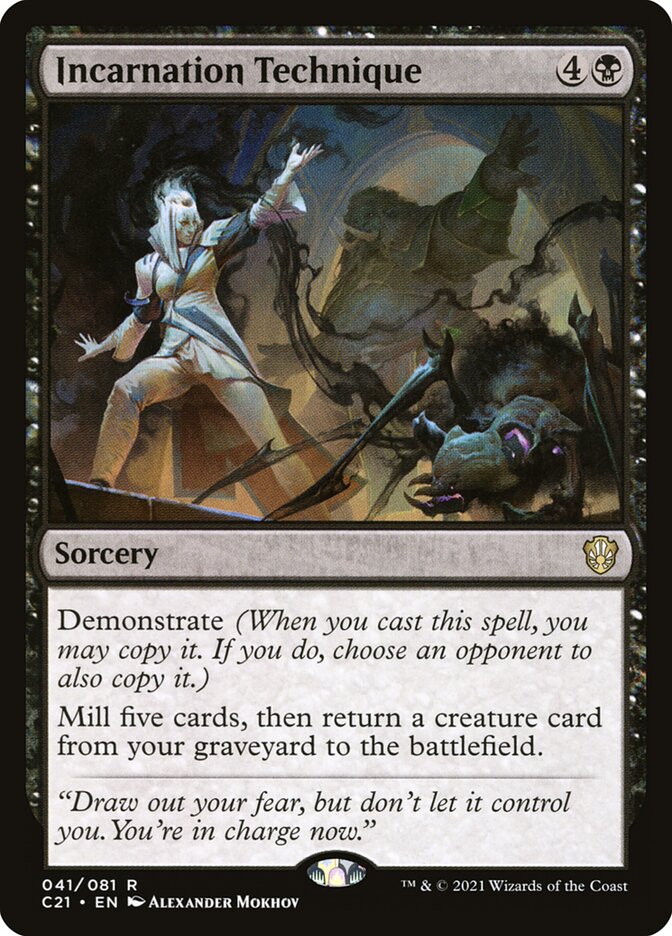


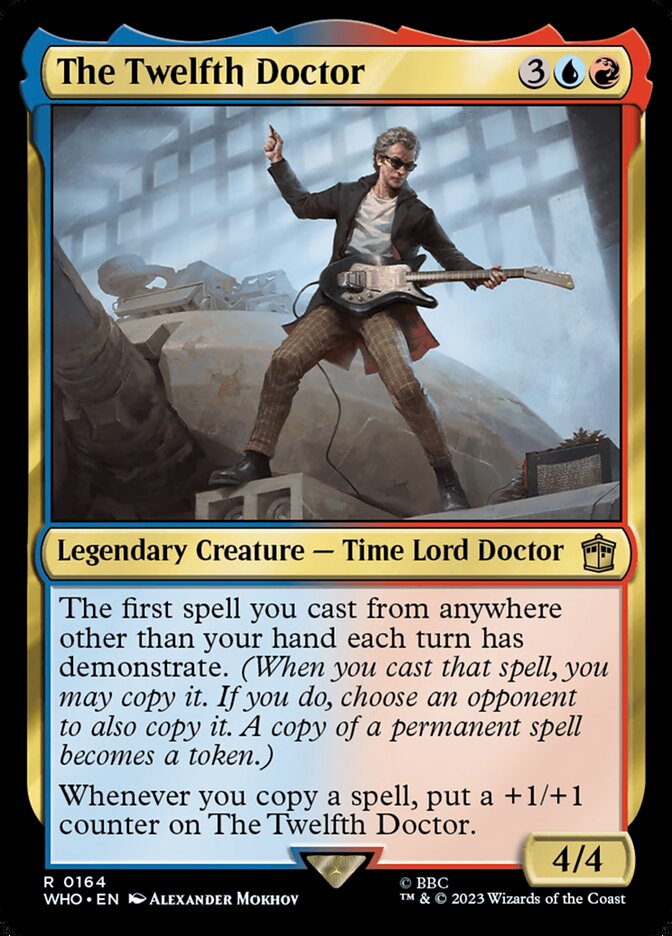

- Creative Technique
- Excavation Technique
- Healing Technique
- Incarnation Technique
- Replication Technique
- Silverquill Lecturer
- The Twelfth Doctor
- Transforming Flourish
Best Demonstrate Cards
#8. Transforming Flourish
Transforming Flourish can destroy artifacts or creatures, with the owner getting a free impulse play afterwards. I don’t like this trade-off as much as Creative Technique, and this card isn’t as good of a removal spell as Excavation Technique. You can’t even target your own artifacts for a cheap impulse cheat combo. I’m happy to see more demonstrate cards, but I’m quite underwhelmed by this one.
#7. Excavation Technique
Excavation Technique is one of the demonstrate cards I worry most about. The destruction of up to two nonland permanents is wonderful and can create some game-changing interactions. However, I don’t like giving my opponents the mana boost of two (or four) Treasure tokens and the possibility of my best nonland permanent being removed. This card has its advantages, but I’d use it with caution.
#6. Silverquill Lecturer
Silverquill Lecturer is an interesting card because it gives demonstrate directly to creatures. In theory, The Twelfth Doctor also could, but this card directly states that creatures have demonstrate. You can make a token copy of your beloved creatures while also giving an opponent a copy of them. Your 2:1 creature potential should still be advantageous. You can use a card like Kambal, Profiteering Mayor to mitigate the downsides of this demonstrate trigger.
#5. Healing Technique
Healing Technique is a decent way to respond to aggressive and removal-heavy decks. You can return two creatures to your hand from the graveyard and gain some life. This should hopefully give you some breathing room from early-game assaults. I do think this card is mana-intensive (having to recast the creatures from your hand), but it can have some value as a group hug piece.
#4. The Twelfth Doctor
The Twelfth Doctor is an Izzet commander () that fits well in a spell-copying deck. By giving spells that you cast from anywhere outside of your hand demonstrate, you can greatly increase the benefits of your spells by copying them. If you add a card like Melek, Izzet Paragon with this doctor, you should be overwhelming opponents in no time. The Twelfth Doctor is also the only legendary card that demonstrates spells right now.
#3. Creative Technique
Feeling truly impulsive? With the demonstrate trigger, Creative Technique can be a double impulse draw for you and a single one for an opponent. The sheer gamble of this card is what makes it exciting. The hope is that you can cast two bomb spells for free and the targeted opponent turns up a dud. Cross your fingers that your opponent doesn’t reveal a card like Omnath, Locus of Creation.
#2. Replication Technique
Similar to Incarnation Technique below, Replication Technique is all about making sure you have two better targets than an opponent’s single target. This card creates up to two tokens of one of your permanents. This could be an absolute killer copying a card like Rampaging Baloths. If you control the board, your two copies should be more advantageous than an opponent’s one.
#1. Incarnation Technique
Incarnation Technique is a wonderful reanimation spell that could return two bomb creatures from your graveyard. Five mana isn’t such a steep price when you assume your early turns will be about filling up your graveyard. If you can fill your graveyards with bomb creatures, you shouldn’t worry much about giving an opponent a reanimation spell. I’d 1000% let an opponent return a creature like Raffine, Scheming Seer so that I could return Archon of Cruelty and Valgavoth, Terror Eater.
Wrap Up

Healing Technique | Illustration by Michele Parisi
Demonstrate is a relatively unknown keyword that has some complicated but fascinating interactions and possibilities. I think this keyword has its merits and I’d be interested in seeing more cards with it. Hopefully, you’ve gotten some ideas on which builds you can use it in, as I have.
Thank you for reading! Leave a comment below with your favorite demonstrate cards and where you use them, then go check out all the other wonderful articles on Draftsim.com. For even more engagement, follow us on X and join the official Discord server.
Stay safe, and keep battling!
Follow Draftsim for awesome articles and set updates:










Add Comment