

Omniscience | Illustration by Jason Chan
Ever got mana screwed? Or suffered the wrath of its equally evil twin, land flood?
Well, Omniscience Draft is here to fix that! This Draft format gets rid of the whole “lands are resources” concept, and turns your hand into a Free All You Can Cast buffet.
Omniscience Draft is still a Draft format: You pick cards, build a 40-card deck, play matches. But during the games, you get an Omniscience emblem that lets you cast all the spells from your hand without paying their mana cost.
Fair warning: Not everybody likes this format, above all since it’s very swingy. But I personally enjoy it a lot, so in this article I’ll do my best to explain what it is, why you may like it (and why not!), and share tips to avoid the most common mistakes.
What Is Omniscience Draft?

Omniscience | Illustration by Alayna Danner
Omniscience Draft is a special draft format on MTG Arena where every player starts the game with an Omniscience emblem, which does two things:
- Lets you cast spells from your hand without paying their mana costs; both players basically have an uninteractable Omniscience in play all game
- Lets you activate it once per turn to add .
In other words: Every spell in your hand is free (with caveats), and the game becomes a sprint for card advantage. Since you can dump every card in your hand in a single turn, whoever can draw the most cards usually wins.
Not always, though!
Who Is Omniscience Draft For?
Let me be very clear about this: Omniscience Draft is not everybody’s cup of tea. It’s super high variance, and whoever goes first has a pretty big advantage… to the point that a well-built deck can very often win on the play, on turn one.
But, despite what detractors may say, it has its fair share of strategy, both when drafting and playing. At the very least, it’s a completely different experience from normal drafting. Games are very quick, very high-power (you get to play some of the most expensive spells, which is usually impossible in a real draft), and you need to approach it completely differently to understand what works and what wins.
And you tend to draw a lot of cards, of course. Which is the best thing in Magic!
Luckily for those among you that may be sitting on the fence, Omniscience Draft tends to show up as an event in MTG Arena’s Midweek Magic, which doesn’t have an entry fee, so you can try it risk-free.
Omniscience Draft Rules
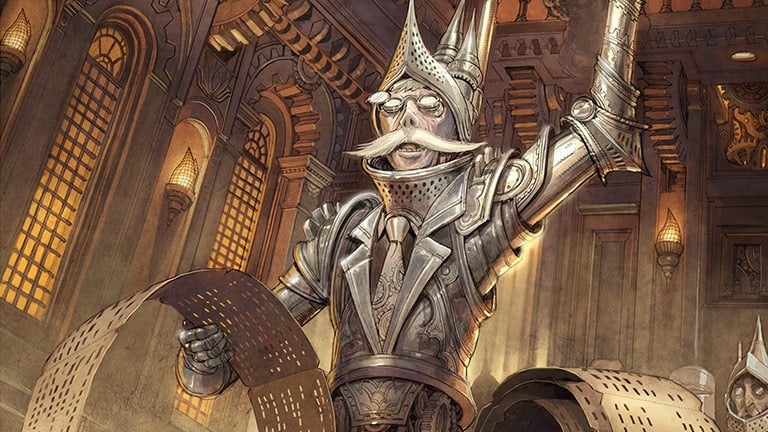
Rules Lawyer | Illustration by Sean Murray
The rules of the draft part are exactly the same as an Arena Quick Draft: You draft against bots (so you have all the time in the world to think through your picks), and then build a 40-card deck. The Omniscience twist is when playing the games:
- You start with three cards in hand instead of seven.
- You get an Omniscience emblem that:
- Lets you cast spells from your hand without paying mana costs, and
- Can be activated once per turn to add one mana of each color (WUBRG).
Since this Omniscience emblem changes everything about this format, let’s unpack what it does.
First, you still follow normal cast timings. Sorceries are still sorceries, you cast your creatures during your main phase, etc.

The emblem only makes spells free if you cast them from your hand. If a card says you can cast it from your graveyard or exile, you then have to pay those costs in full. Which is sometimes very relevant, as seen in one of the best cards in Final Fantasy Omniscience Draft, Dreams of Laguna. When you cast Dreams of Laguna from your hand, it’s free. But if you want to use flashback, you need to pay , which you can do by activating the emblem.
An important detail that’s easy to miss the first time you play: The emblem works once per turn, so you can use it on your turn and then in your opponent’s turn, too.
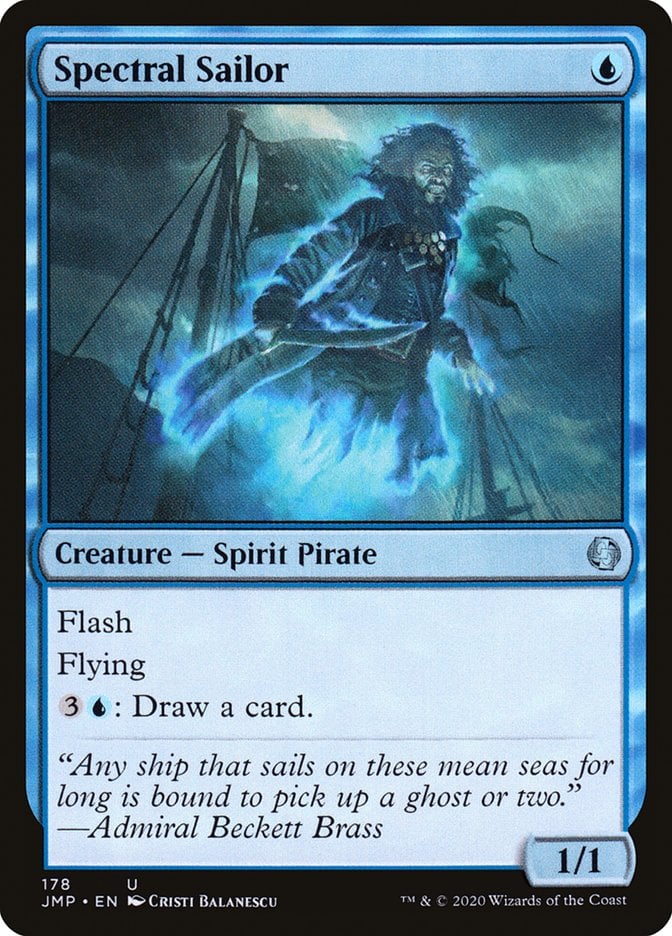
That’s also relevant for one of the best creatures if you’re playing Foundations Omniscience Draft, Spectral Sailor. You can cast this spirit pirate for free, but you have to pay for its activated ability. The emblem only makes casting free, not activated abilities (not even activated abilities from your hand, like a landcycler).
Technically speaking, the “without paying its mana cost” clause is an alternative casting cost. Which has an important corollary: It means X-spells are usually a trap. When you cast an X-cost spell “without paying its mana cost,” the rules force X=0. And, in general, when X is zero those spells are pretty worthless.
Additional costs still matter, though. Kicker, bargain, and similar “pay extra” mechanics don’t disappear just because the mana cost does. You still have to cover those additional costs.
Last but not least, notice the emblem generates exactly . So you can’t pay double-pip costs with it. You may be thinking: “Well, not too big of a deal; I’ll just add more lands of the double-pip color,” but… let’s just say maybe that’s not always a good idea.
Where Can You Play Omniscience Draft?
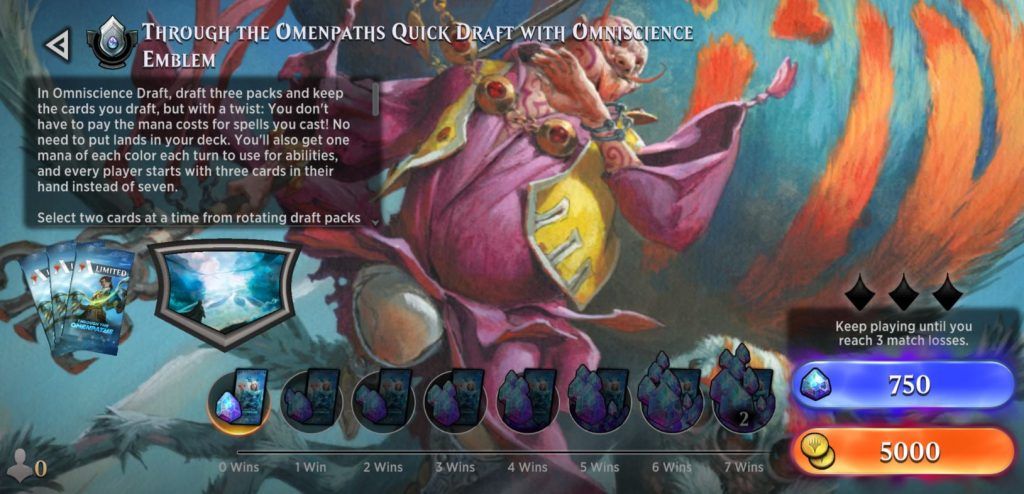
Omniscience Draft is primarily an MTG Arena event format. You can totally play it in paper if you want, since there’s nothing inherently digital about it. But unless I can convince not just you, but you and a bunch of your friends to give Omniscience Draft a try, MTG Arena is definitely your best bet.
The bad news is that there’s no clear schedule for when WotC will make the format available. They tend to use it as a bit of spicy filler, usually when the novelty of a given set is wearing off. But as a rule, Omniscience Draft shows up either as a Midweek Magic event, or as a stand-alone event that’s very similar to a Quick Draft.
Midweek Magic Omniscience Draft
Sometimes Omniscience Draft appears as a Midweek Magic event. Midweek Magic events have no entry fee, and you get two individual card rewards (ICRs) for participating.
When it’s a Midweek Magic event, Omniscience is run as a phantom draft, meaning the cards you draft are only for that event and don’t get added to your collection.
There’s no way of telling when the next Omniscience Draft will be featured in Midweek Magic, other than frequently checking the MTG Arena Announcements.
Omniscience Quick Draft

Clockspinning | Illustration by Zoltan Boros & Gabor Szikszai
From time to time, WotC has offered Omniscience Draft as a Quick Draft; when they did so, it was usually a couple of weeks before a new set arrived. For example, MTG Arena offered a Final Fantasy Quick Draft from July 18–22, 2025, a couple of weeks before launching Edge of Eternities.
Until now, these events have run pretty much like a normal Quick Draft:
- Same entry cost, that’s to say 5,000 gold or 750 gems.
- Same reward structure (including keeping all the cards you draft).
In a couple of cases they were even ranked, although apparently that was either a bug, or they backtracked on the idea. For Final Fantasy, the Omniscience Draft event was unranked.
Like Midweek Magic events, there’s no way of knowing when (or even if) they’ll offer the event next, and they sometimes skip a set. Duskmourn and Foundations had an Omniscience Draft event, they skipped it for Aetherdrift and Tarkir: Dragonstorm, and they brought it back for Final Fantasy and Through the Omenpaths.
Arena Decathlon
A couple of years ago, Omniscience Draft was one of the events of the The MTG Arena Decathlon, but that seems to have been a one-time thing.
How Much Does Omniscience Draft Cost?
As a general rule, Omniscience Drafts cost the same as the type of event you find them in. If it’s a Midweek Magic event, they cost nothing.
If it’s a Quick Draft event, they cost the same as a normal Quick Draft (5,000 gold or 750 gems). Notice that this could change without warning, so make sure to check before entering!
Omniscience Draft Rewards
Like the entry fee, the rewards for Omniscience Draft events are the same as the equivalent event.
Midweek Magic gives you a couple of Individual Card Rewards (ICRs), and it’s a phantom draft so you don’t keep the cards. You can play all you want while the event lasts.
In Quick Drafts you do keep all the cards you’ve drafted. Each run ends when you reach 7 wins or 3 losses, whichever happens first, and you get rewards for how well you do (at 7 wins you get 950 gems + 2 packs).
As with the entry fee, make sure you check the rewards structure since it may change without notice. For example, WotC may make the next Omniscience Draft a phantom event, with a different entry fee and/or reward structure.
Can You Play Lands in Omniscience Draft?
Yes, you can! The important question, though, is: Should you?
By and large, the answer is a big, resounding: No! Don’t! Do not put lands in your Omniscience Draft deck unless you have a very good reason for it!

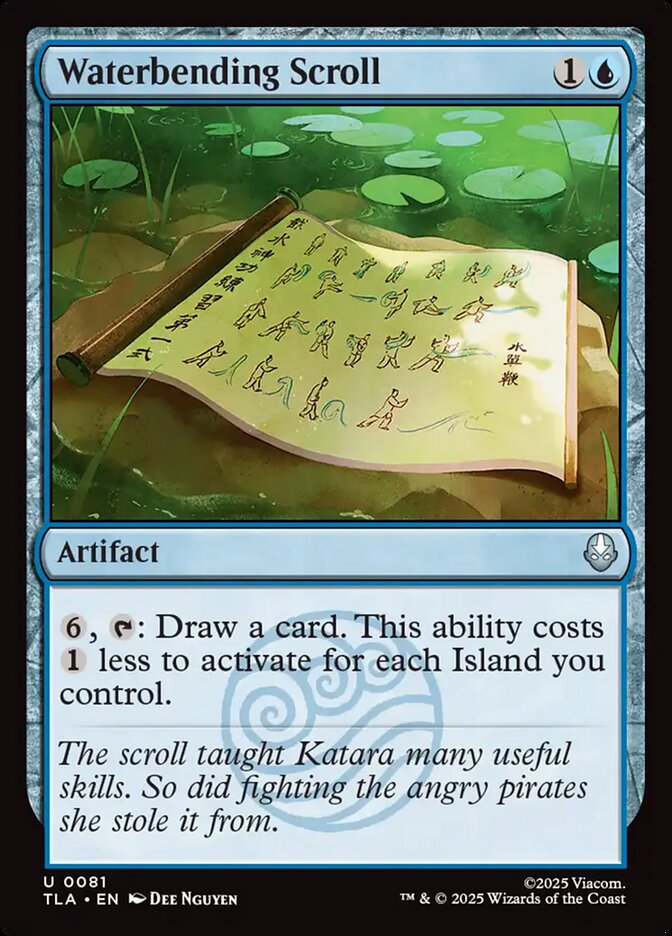
Omniscience Draft is above all about card draw, counterspells, and the biggest, baddest spells you can find. Unless they happen to have some awesome ability, lands are almost always useless. Once in a blue moon you could find a use for them, but unless you know exactly what you’re doing, don’t. Avatar: The Last Airbender presented quite a few reasons to want lands, like enabling earthbending cards, or running an Island to make Waterbending Scroll a busted card draw engine.
There are two exceptions, though. The first is that Play Boosters have 14 cards, and when drafting, sometimes the last couple of cards that the bots will pass you will be lands. Since you draft 42 cards altogether, if the last card of each pack is a land, you won’t have a choice and will have to put one in your deck.
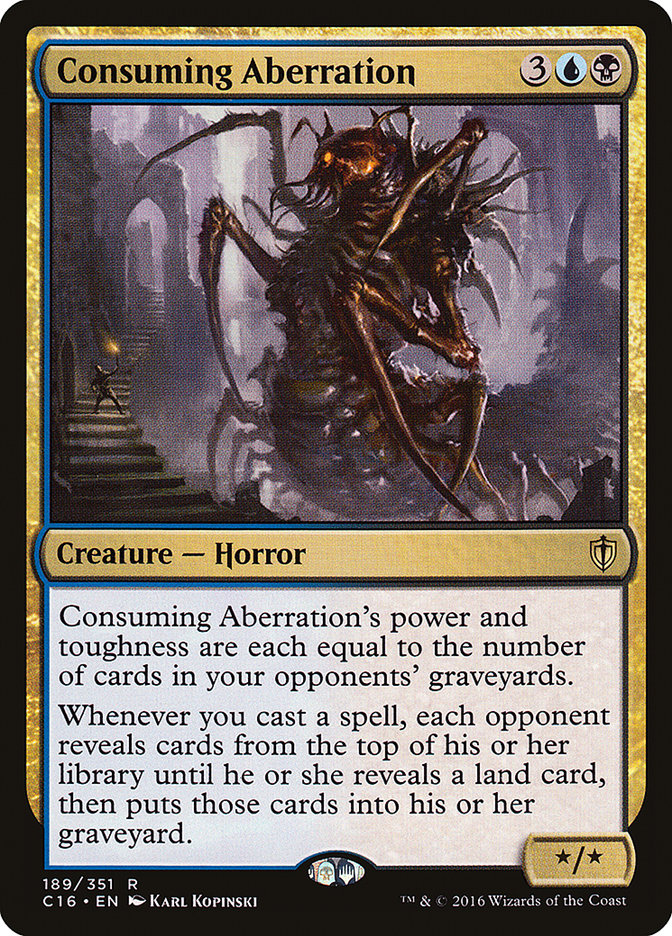
The other reason to play a couple of lands is this guy, from Foundations. No, don’t laugh. Yes, Consuming Aberration wins games in Omniscience Draft. A lot of games, in fact. Actually, it’s a slam-dunk pick if you see it, since it’s one of the top five best cards!
So, yeah, I wouldn’t go out of my way to put a land in my FDN Omniscience deck just in case I run into this cute fella, but it’s not a terribly bad idea either.
Omniscience Draft Tips and Tricks
Omniscience Draft in a nutshell looks like this:
- Draft card draw,
- Draft counterspells,
- Win the coin flip,
- ???
- Profit!!
The “???” part makes Omniscience Draft fun and skill-testing. But let’s go step by step.
Card Draw Is King, Queen, Jester, and The Whole Royal Court
If a card puts more cards in your hand or board, you draft it. Simple as that. Unless there’s something else in the pack that puts more cards into your hand.

I’m using “put cards into your hand” here for the rules lovers among you that will (correctly!) point out that Marina Vendrell's Grimoire draws you cards, while Marina Vendrell doesn’t. But for short, I’ll just say they both draw you lots of cards, so they are great (“great” as in literally the two best cards in Duskmourn Omniscience Draft, by the way).


Cantrips are great too; never pick them above cards that give you actual card advantage, but digging through your deck is also excellent. And even cards that combo with your card draw engine are excellent; two of the best creatures for DSK and FIN Omniscience Draft were Fear of Isolation and Ambrosia Whiteheart. They are great because some of the best card advantage engines in their formats are ETB permanents, and these two bouncers let you cast them again for more cards.
Counterspells: “Nice Card Draw Spell You’ve Got There…”
You win in Omniscience draft by chaining a lot of card draw spells, dumping a ton of threats on the board, and keeping a couple of counterspells in hand to negate your opponent’s card draw. Simple as that.
Counterspells are also what diminish the edge from going first. From the PoV of card advantage, going second is great: You draw an extra card, so you’re 33% more likely than the first player to find the card draw spell that lets you start the chain… as long as you stop the first player from hitting their card draw engine in their very first turn, of course!
Unless you’re really against the wall, never spend your counterspells on anything other than card draw spells, and the occasional discard effect.
The “???” Part
This is the part when Omniscience Draft gets interesting: Finding cool ways to win, both while drafting and playing, that are dependent on the set you’re drafting. It’s a big part of the fun of any form of drafting: Trying to solve the format, and finding what works.
Omniscience Draft detractors will probably say there’s no such thing here; that it’s just who wins the coin flip… and, yeah, winning the coin flip matters a lot in Omniscience, but I personally think there’s quite a bit more to it.
We’ve already seen one example, Consuming Aberration, that often wins you the game because lands are bad in Omniscience Draft, and your opponents will try not to have them in their deck. But there are subtle differences in how different sets play in Omniscience Draft, the same way different sets play differently in normal drafts.
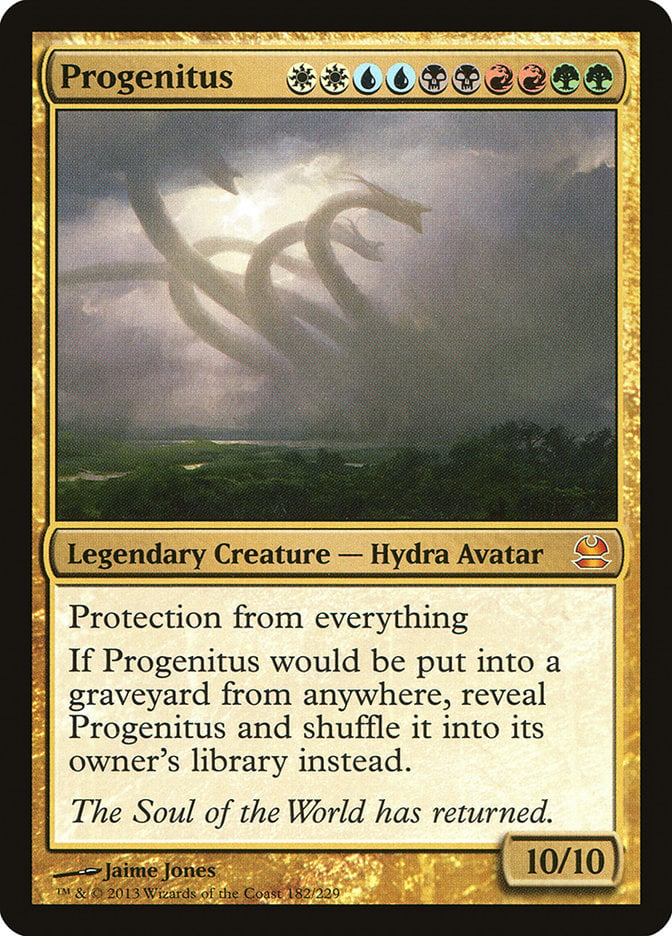
One example is Progenitus in FDN.
Big, dumb beatsticks tend to be just mediocre filler in this format. During my first Foundations Omniscience Draft, I would have always picked Arbiter of Woe over the big, dumb hydra, because the Arbiter draws you a card, forces your foe to discard, and is an evasive threat (and when you get your card draw engines going, sacrificing a creature is no big deal).
Turns out that the Arbiter is indeed one of the best cards in FDN Omni… but Progenitus is even better. I learned it the hard way, after a few opponents just grinded me to death with it; I then started picking it up highly and got rewarded for it. FDN doesn’t have too much card draw, so it’s much grinder than other sets; in my experience, it’s the one that gets closer to a normal draft (not too close, just closer!), and you can spend quite a few turns fighting on the board. Notably, almost all the top best cards are creatures.


On the other hand, you have sets like FIN: It has a ton of card draw, most of its best cards are noncreature spells, and one sorcery stands out. Circle of Power is both card draw and a win condition: There’s so much card draw that it’s very possible to ping your opponent to death… sometimes even in the very first turn! There’s so much card advantage and burn in FIN that big, dumb beatsticks aren’t too useful; one of the better creatures is Shinra Reinforcements because filling your graveyard and gaining life is better than big, dumb stats.
Other Omniscience Draft Tips
Forcing your opponent to discard can be really nasty on the play because starting hands are tiny. But if you’re on the draw, or at any time later in the game, discard can be dead because opponents often dump their hands fast. They are still useful against opponents holding a counterspell, though.

Cards that require you to discard as part of their cost (for example FIN’s Laughing Mad) are risky: If your opponent has a counterspell you’re pretty much done for, and if you’re in top-deck mode they’re clunky. For clarity, Laughing Mad is still one of the best cards in this format; just keep in mind it’s high risk, high reward.
Single-target removal isn’t too useful against a good Omniscience Draft deck: If your opponent chains their card draw and plays 10 threats in a turn, your one removal spell won’t save you. But when two mediocre decks bump into each other, or when a set is slow overall, games can get grindy and killing a big threat can be crucial (and that’s why Progenitus is great in FDN).
Damage-based removal is useless; real threats in Omniscience Draft are really, really big!
Bouncing your own permanents tends to be pretty good since there’s no penalty for doing so (you have practically infinite mana, so bouncing and recasting a big spell is usually a great idea!).
Last but not least, a refresher: Remember that there’s nothing truly and completely free in this world, and the Omniscience emblem comes with some small print:
- X spells default to X=0. If you cast an X-cost spell for “free”, you’re not paying mana into X, so X is 0. That makes cards like Syncopate basically unplayable. It doesn’t matter that the emblem lets you generate , an alternate cost won’t let you pay X,
- On the other hand, additional costs still matter. The emblem only covers the mana cost; everything else works normally. So you’ll need to activate the emblem and generate mana for Louisoix's Sacrifice if you don’t want to sac a legendary creature; and you’ll need to discard a card for Laughing Mad or Thrill of Possibility.
- You get one WUBRG burst each turn (yours and theirs). You can use that mana for casting from exile or graveyard, activating abilities, kicker, etc.
- Spells not cast from hand aren’t free. Flashback and anything else you cast from the graveyard, or spells you cast from exile, work normally: You’ll have to pay their full cost (usually with the once-per-turn you get from the emblem).
- Activated abilities aren’t free either. If something has “3U: Draw a card,” you have to pay for that (again, likely with the emblem mana).
Is Omniscience Draft Fun?
Yes, I very much think so, but there’s extremely strong evidence that some folks emphatically disagree.
I haven’t played much Yu-Gi-Oh!, but what little I’ve played kinda reminds me of Omniscience Draft: You’re often either trying to have a huge turn and get a massive advantage (if you go first), or hoping you have enough counterspells (if you go second) to break the first player’s momentum.
And to be fair, that’s not what a good chunk of Magic drafters are after. Normal drafts are probably the MTG format with the lowest power, where you need to be really unlucky to be dead before turn three… whereas it’s very common for Omniscience Draft matches to be pretty much decided by that point, or even sooner.
But if you enjoy formats that reward:
- Understanding a new environment, and what matters in it (card flow + interaction),
- Planning your sequencing,
- Doing broken stuff,
… and you don’t mind matches usually being brutal and short, I think Omniscience Draft is one of the most fun formats Arena has.
Wrap Up
Omniscience | Illustration by Justin Hernandez & Alexis Hernandez
Omniscience Draft is not a sensible, reasonable MTG format, and that’s the point. It’s Magic’s Fast and Furious, if you will. Many times it will be you losing the coin flip and watching your foe going furious and fast, so if that’s a deal-breaker, it may not be the format for you.
But games do get grindy, games often involve a bit of bluffing (is that card they didn’t play a counterspell? Do I cast my big draw spell?), and you get a fresh format to solve. If you want a Draft experience that rewards knowing what matters when mana stops mattering, Omniscience Draft is a blast.
I hope you’ve enjoyed this mechanical deep dive into Omniscience Drafts, and if you have comments or questions please drop something below, or stop by the Draftsim Discord for a chat.
And good luck out there!
Follow Draftsim for awesome articles and set updates:









Add Comment