
Last updated on April 15, 2026
Comparative Analysis | Illustration by Willian Murai
Believe it or not, there are two official ways to play Magic on the internet right now: Magic Online and MTG Arena. Yes, this is strange, and yes it kind of doesn’t make sense, but I’m here to give you a little background about why this is the case and which application best suits your needs.
Maybe you’re a newer player and know you want to play Magic online, but don’t know where to invest your time and money. Or perhaps you’re a returning MTG player from a long time ago and you have very bad memories of MTGO and are wondering, “Is it any better than it used to be?”
Do People Still Use MTGO?
Yes absolutely, there is a thriving community of players that use Magic Online. Several Legacy, Vintage and Pioneer players play older formats and with cards that are not available on Magic Arena.
Just so you know where I’m coming from, I’ve been playing Magic on and off for 25 years and have used both MTGA and Magic Online since their inception. I still remember sitting in my friend Erik’s basement doing Odyssey drafts together. Wow I’m old.
To add even more to my antiquated bona fides, I even still call Magic Online “MODO” (Magic Online with Digital Objects, the original title for MTGO).
But enough about my background – let’s discuss the difference between these two programs and which one I think you should choose to play Magic.
MTG Online vs Arena: Which is Right for Me?
If you’re a newer player, MTG Arena is definitely the right program for you, and the most popular option. If you’re an established player who loves and cherishes Commander, Modern, Legacy, or Vintage Cube, then MTGO is a suitable, and de facto, choice.
Quick Facts
| Program | Year Released | Cost | Primary Formats | Economy | Usability | Download Link |
|---|---|---|---|---|---|---|
| Magic: the Gathering Online | 2002 | $4.99 for a full account, plus cards + events | Modern Legacy Vintage Pauper Commander Limited | Trading and paper redemption | Poor | Download MTGO |
| Magic: the Gathering Arena | 2019 | Free | Standard Historic Brawl Pioneer Alchemy Limited | Crafting | Moderately Good | Download MTGA |
The Economy
A great deal of your experience with either game, and of course the most important driver in affordability, revolves around the economy of each. Both Magic Online and MTG Arena cater to different groups of people with different interests, so their economies are structured quite differently.
Needless to say, however, if you want to be competitive, and if you want to win, there is no way to avoid spending a decent amount of money on either program.
Magic Online
Magic Online’s economy revolves around event tickets, which are digital objects that cost 1 US Dollar each. An event may cost 15 tickets to enter, so you either have to pull out the old credit card to buy tickets for entry, sell some excess packs, or cards that you have left over from events. If it’s any comfort, extra tickets can later be sold on MTGO.
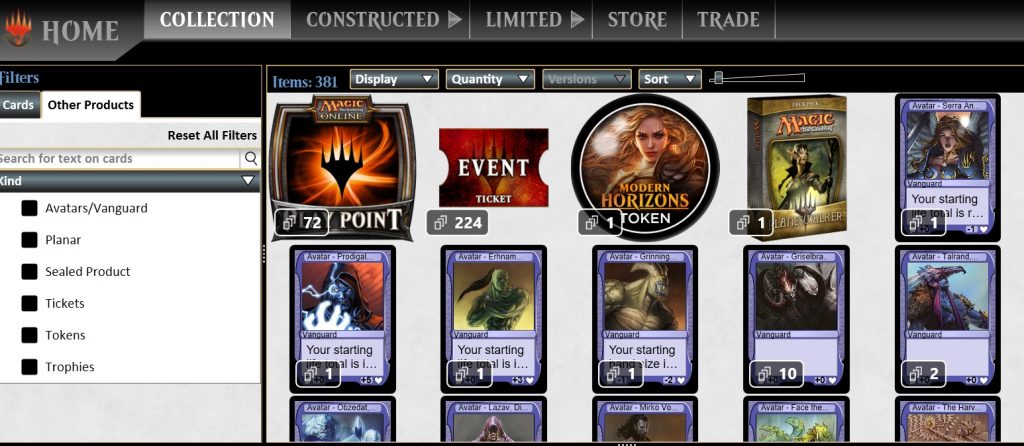
That’s right, you can sell cards and packs to other users on Magic Online. In reality, this involves trading them directly for event tickets. There are dozens of “bots” that you can utilize to dump items from your collection at a market price.
You actually own the “digital cards” on Magic Online, which is a stark difference from MTGA. This has a critical impact on the prices of the cards on the MTGO marketplace.
In fact, Standard sets are redeemable for a certain period of time, meaning that if you collect a complete set of digital cards, say one of each card in Avatar: The Last Airbender, you can deduct the cards from your account and Wizards will mail you a corresponding box with a complete set of honest to gosh cardboard cards.
Can You Play MTGO for Free?
While Magic Online is technically free, you need to invest at least $4.99 to fully access the game. I’ll describe this more in detail later in the article.
If this all sounds complicated, it very much is. And it’s an artifact of a business model that is now more than 20 years old. Enter MTG Arena.
MTG Arena
MTGA, on the other hand, revolves around gems, gold, and wildcards.
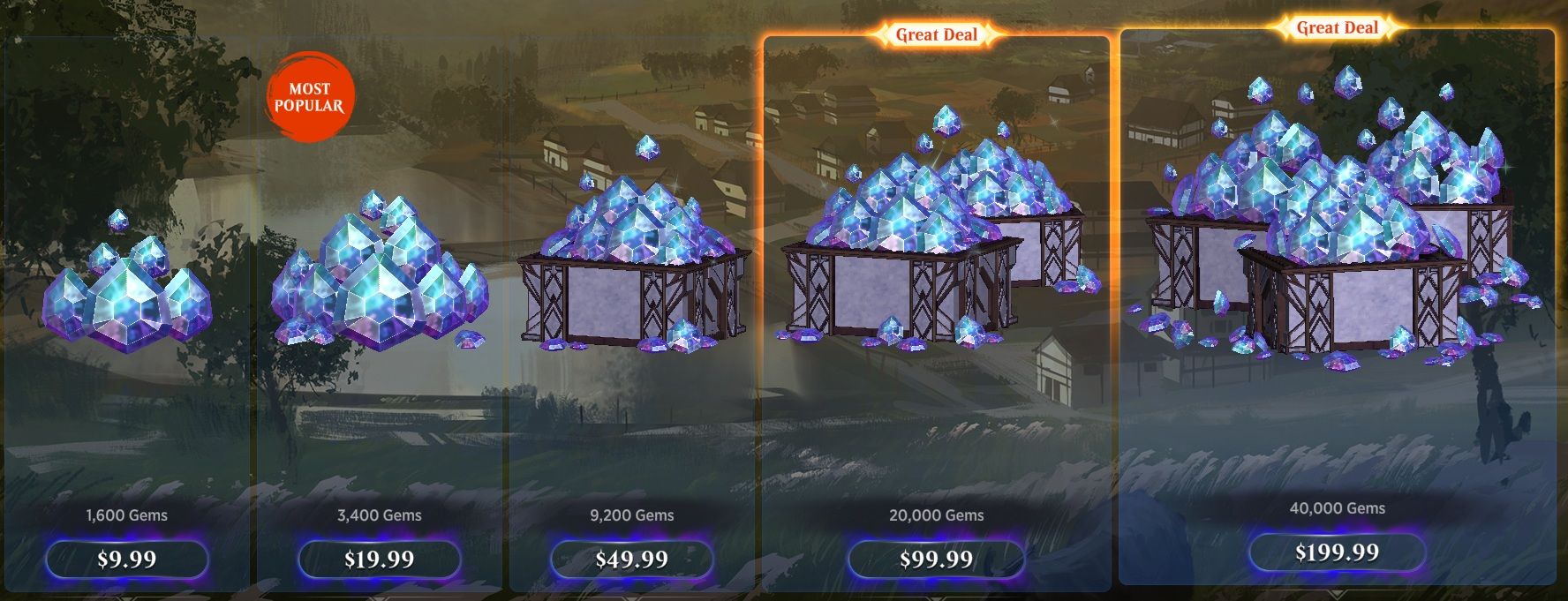
MTG Arena’s economy is essentially a F2P model. It is initially free to play, though realistically you might want to at least spend money on the welcome bundle when you get started. You also get very basic starter decks as part of the new player experience.
After that, you can play in the Standard, Historic, Pioneer, Timeless, and Brawl queues for free, but if you want to play Limited, you have to pony up. Just playing games will earn you daily XP and gold, which you can then use to either buy packs or enter events. Opening packs gets you cards and wildcards, along with progress on your vault. Then you can turn the wildcards into whatever cards you want and build decks.
This wildcard and crafting system means that MTG Arena has no trading. This is a key aspect of the entire economy.
Can You Play MTG Arena for Free?
MTGA is nominally free to play, but if you want to play a lot of different Standard decks, you’re going to have to put some money in. I personally only really play draft, and if my win rate at draft is high enough, I can realistically go infinite and not have to buy more gems. In fact, I haven’t had to in a long time. #nobigdeal
Suffice it to say, the more you want to play and/or the more different types of decks you want to have, then you’re more likely to need to take out your wallet. And if you want to buy cosmetics (a personalization option not available on Magic Online) Wizards will also happily take your money for that too.
Buying and Acquiring Decks
Though I might love limited more than anything (this is Draftsim, after all), I’ll be the first to admit that the reason the majority of people play Magic is to build decks and pit them against other players.
So let’s explore then: where is it cheaper to buy a deck? Where is it “easier?”
The Cost of a Deck
Uro, Titan of Nature's Wrath | Illustration by Vincent Proce
Let’s take a former Standard, for example. Here’s a Sultai Ramp list by Toru Saito.
Planeswalkers (8)
Narset, Parter of Veils x4
Nissa, Who Shakes the World x3
Tamiyo, Collector of Tales
Creatures (4)
Uro, Titan of Nature's Wrath x4
Instants (7)
Aether Gust x2
Eliminate x3
Heartless Act x2
Sorceries (10)
Agonizing Remorse x2
Casualties of War x2
Cultivate
Extinction Event x3
Thought Erasure x2
Enchantments (3)
Land (28)
Breeding Pool x4
Fabled Passage x4
Forest x2
Island x4
Overgrown Tomb x4
Swamp x2
Watery Grave x4
Zagoth Triome x4
Sideboard (15)
Disfigure x2
Elder Gargaroth x2
Eliminate
Heartless Act x2
Mystical Dispute x2
Negate x4
Noxious Grasp
Shark Typhoon
To get this deck on Magic Online, you’d have to buy all the cards (or rent them). According to MTG Goldfish, this deck would cost you 486.10 tickets. That means $486.10 in Good Old American Dollars. Whew. Those same cards would cost about $300 to buy the cards in paper.
By far the biggest driver of this cost are the Nissa, Who Shakes the World, Uro, Titan of Nature's Wrath and the multicolor land base with shock lands and triomes. Once sets are not being drafted, the supply of mythics gets very scarce in the client.
OK, so how do we look at this same deck in Arena then? You have to add up the wildcards, which Goldfish also conveniently does for us. It requires the following wildcards:
- 6 Mythic
- 33 Rare
- 21 Uncommon
- 15 Common
Most regular Standard players have little problem getting enough commons and uncommons for their decks. But the real problem here are the 6 mythics and 33 rares, which is a significant number.
With wildcard bundles at $20 for 4 mythics and $10 for 4 rares, you’d need about $130 to more than cover the rares and mythics.
So it’s potentially quite a bit cheaper to build the deck on MTGA, just be aware that this math is very approximate and depends on how you buy gems, what you open and when, and which play modes you choose.
If you draft on Arena or MTGO to build your collection, you can reduce this cost significantly.
Aesthetics and Graphics
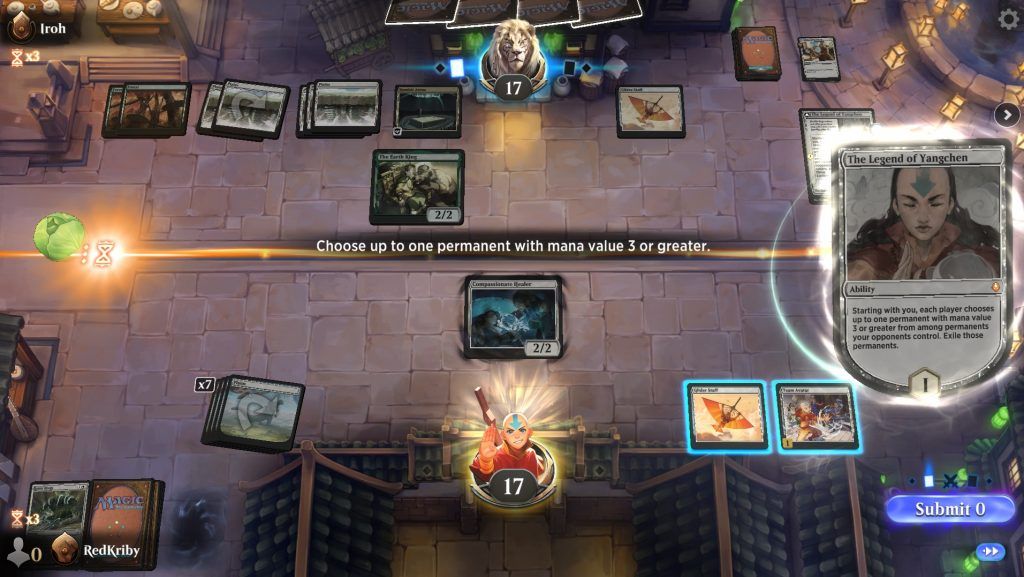
MTG Arena is the clear winner here if you care about this type of stuff. Mythic rares all have epic animations when they hit play, there are voice overs for planeswalkers, and the cards look and feel so much more alive when you mouse over them or put them into play.
When you damage your opponent, your creatures and spells hit and shake them. When you win, their head explodes. Cool.
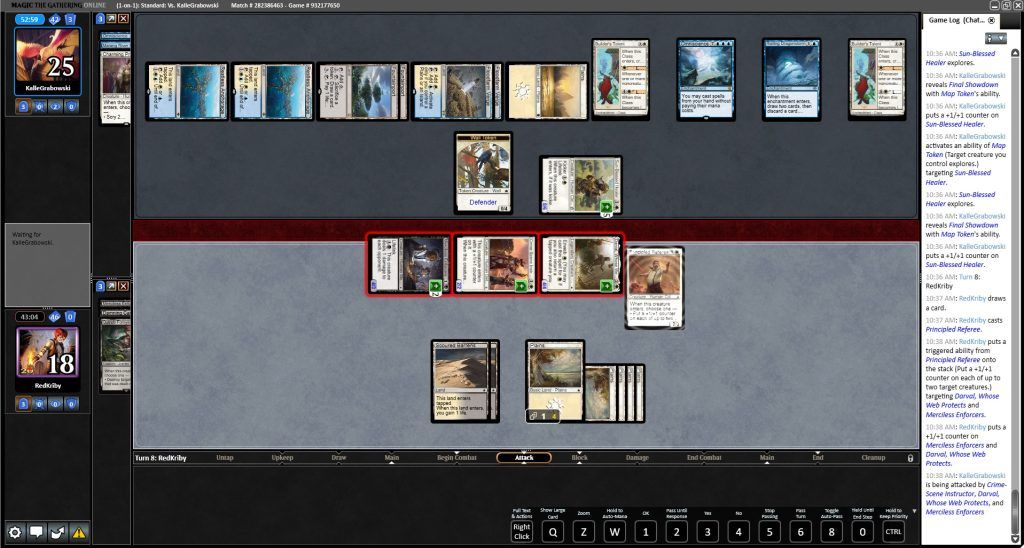
Alternately, there are no “visual effects” for MTGO. Playing the cards feels just like playing with inanimate cardboard objects. And the sounds… honestly remind me of when I played the card game Hearts on Windows 95.
Ease and Efficiency of Use
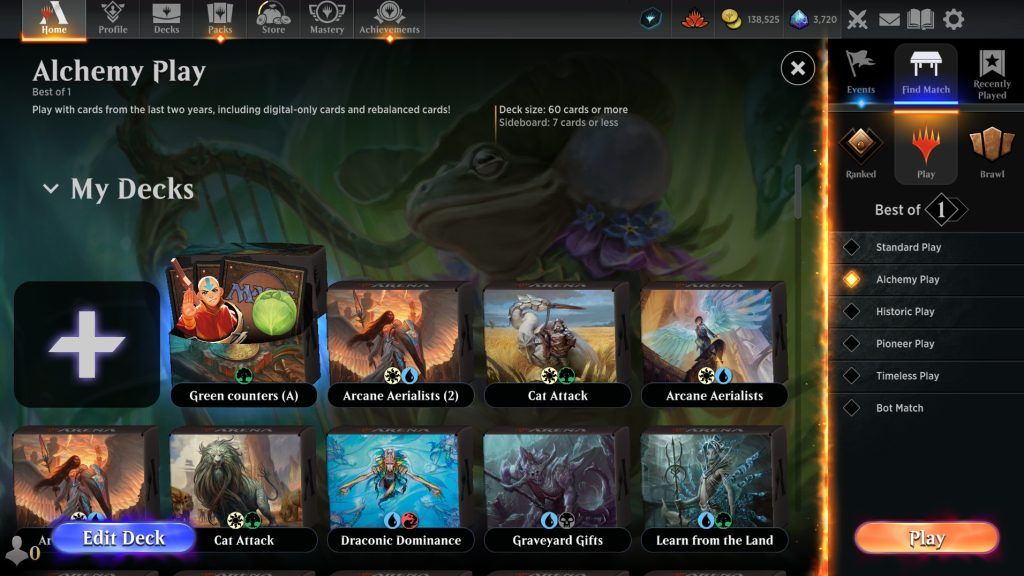
MTG Arena is the clear winner here. It’s fairly easy to choose game modes in the “Play blade”. It’s pretty intuitive to figure out what you’re supposed to be doing.
As for Magic Online, take a look at this and tell me if you know what to do:
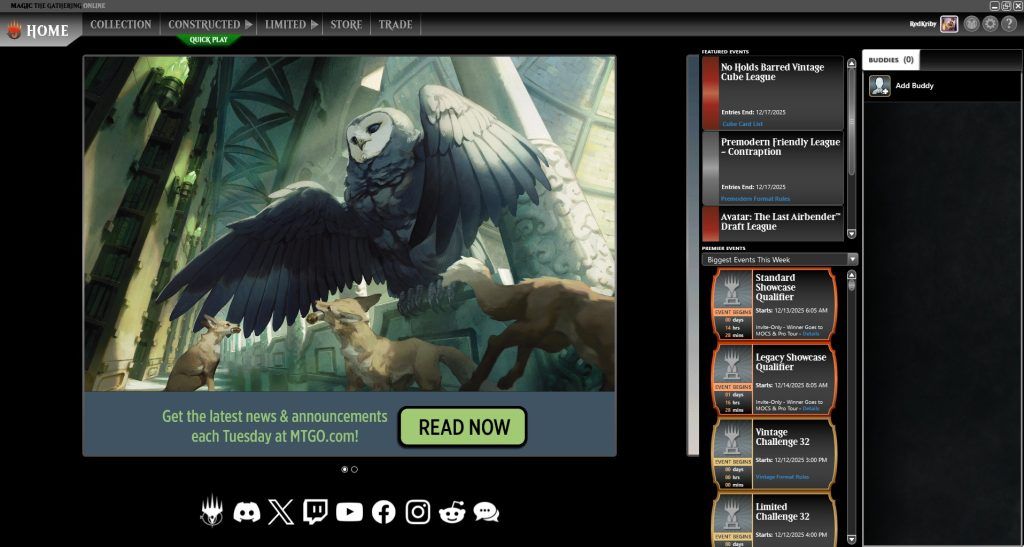
Yeah, it’s rough. And that “look and feel” carries through to the in-game UI too:
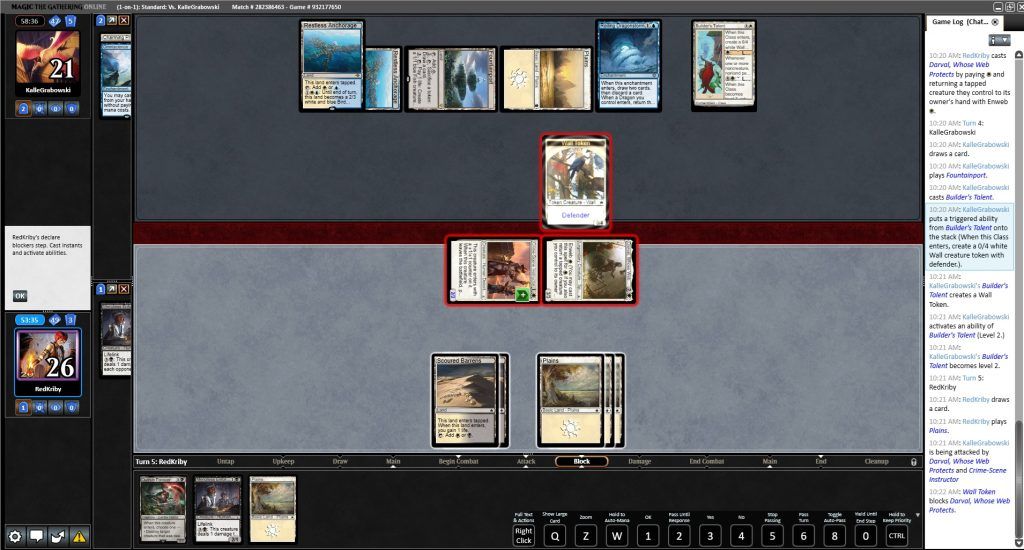
There are consistent updates and improvements(?), but the system is still very outdated looking.
Playing the games involves a whole lot of clicking, virtually manipulating the digital pieces of cardboard like you would in real life. There’s also a chess clock incessantly counting down your time available to make a move until you run out (and lose). It’s very intimidating for newer players.
MTGA, on the other hand, has maybe three major innovations that drastically change what it feels like to play Magic the Gathering digitally.
The first is clicking and dragging — many actions are sped up by directly clicking and dragging lands and spells into the play area. This feature partially exists in Magic Online, but not to the same extent.
Secondly, the autotapper. This saves an incredible amount of time over the course of the game. When you click and drag a card onto the battlefield, your lands just tap for you in a (mostly) appropriate fashion without you having to either figure out which to tap or having to click on each one individually. It’s an option that is wonderful.
Finally, the auto-passing of priority. In Magic Online, the default is to keep a lot of “stops” where each player has to manually click “ok” to progress the game. In Arena, if a player has no valid moves to make, the game zooms forward to the next point when a play can be made. Again, a huge time saver.
The end result of these changes is that the games go much, much faster. And the “rope” system in MTGA prevents stalling while not allowing 4-5 minute pauses like it can on MTGO.
If you play MTGA and are looking for ways to make your play experience even faster, check out our amazing articleon tips and tricks for Arena.
Grinding and Events
Since the games individually go faster, I think MTG Arena is way better for getting in a lot of games. Sometimes that’s all you need to either try a bunch of deck ideas, learn a draft format, or practice your deck.
While yes, MTGO has a greater variety of events and formats going at one time, you inevitably have to wait in between rounds to play. If you finish 20 minutes early, you have to wait 20 minutes until your next match. I think many gamers today find that unconscionable.
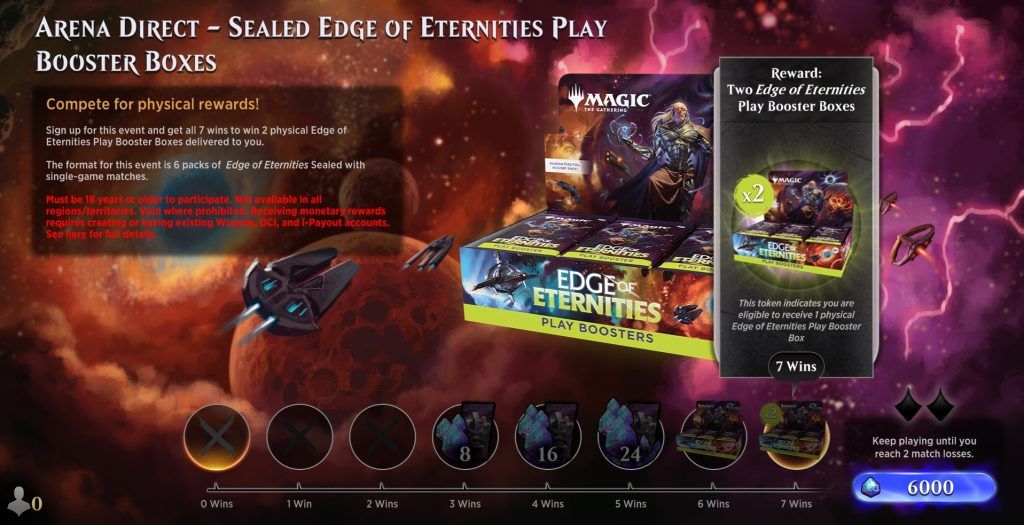
Conversely, MTGA leans toward an “on demand” big event structure. The Arena Directs allow you to play at your own speed. You can take breaks between rounds for as long as you want, just as long as you complete the requisite number of matches before the event ends.
And if you try to play a format on Magic Online that’s also on Arena… well you may just end up waiting for nothing.
Bugs and Issues
I wish I could definitively tell you that MTGA were a much more stable, dependable application than MTGO. But unfortunately that’s just not the case.
MTGO has had the reputation throughout the years of being a bug-ridden mess, and it certainly has been at times. It’s been a lot more stable the past couple of years, but there are still major issues. And bugs take forever to get addressed. In fact, when they’re fixed in a matter of weeks, they take a victory lap:
And while MTGO has the massive advantage of a number of different live events in different formats, sometimes the events just crash and no one is home to support them.
Beyond the incessant whining about the shuffler “bug”, there are also plenty of legitimate problems with MTG Arena. I even just sometimes get a random “Unity error” with an exclamation mark and the MTGA logo every couple weeks. Typically I’m able to log back in on time, but it’s scary!
Usually when a major update hits, you are just about guaranteed to get a huge bug, such as the infamous “black screen error,” that affects a large number of players. But hey, at least MTGA’s hotfixes only take a couple days to come out…
The Competition
If you’re looking for better competition (and not everyone is), then the place to go is Magic Online. By its nature, the program has attracted and retained the old guard of experienced Magic players. It is swimming with plenty of users who have played on the Pro Tour, long before it was ever a Players Tour, or a Mythic-whatever.
Before you yell at me and say, “hey what about the Mythic ladder on MTGA?”, yes the player skill there is also quite good in both Limited and Constructed. But if you want a high overall player quality in a random queue, MTGO is where it’s at. I’ve really seen this disparity in action in Arena’s Traditional Draft, for example.
Both Online and Arena have events that can qualify your for the highest levels of Magic. Although the competition is self-selecting, the average skill level of the players on MTGO is quite high.
The Pro Opinion
There’s generally acceptance among pros that competitive play lives on both MTGO and MTGA. Two-time World Champion Seth Manfield posted an undefeated run on the last Arena Open.
Other professionals have come around to Arena and use it regularly. Mike has come around and uses Arena now, but a handful of years ago, would have preferred MTGO:
The two main issues raised about MTGA were the economy and the tournament structures. While little has been innovated in the economy, the structure has come a long way and the Arena Limited Championship is a sign that there’s growth and attention on Arena. I’m pretty confident that MTG Arena is something WotC looks to iteratively improve upon, whereas MTGO is more or less hung out to dry.
Is Magic Arena the Same as the Card Game?
Yes, Magic Arena is more or less the same as the physical card game. MTGA has many of the same cards and rules, but fewer formats to play. The features of Magic Arena make the game snappier so it doesn’t have quite the same feel, but it is real Magic.
Are MTGO and MTGA the Same?
No, while both allow you to play Magic digitally, they are completely separate applications with different economies, playable platforms, formats, card pools, and player bases.
Where to Start
All right, so I’ve convinced you to go one way or the other. Now what?
MTG Arena
First, download the client and install it. You’ll need to sign up for an account, and then you get thrown into the new player experience.
You’re in luck, because this past year I’ve been having a ton of guides written for Draftsim geared towards newer MTGA players. You can find all those Arena guides and tutorials ready for reading now.
Other than getting up to speed with the guides, you should also download Arena Tutor:
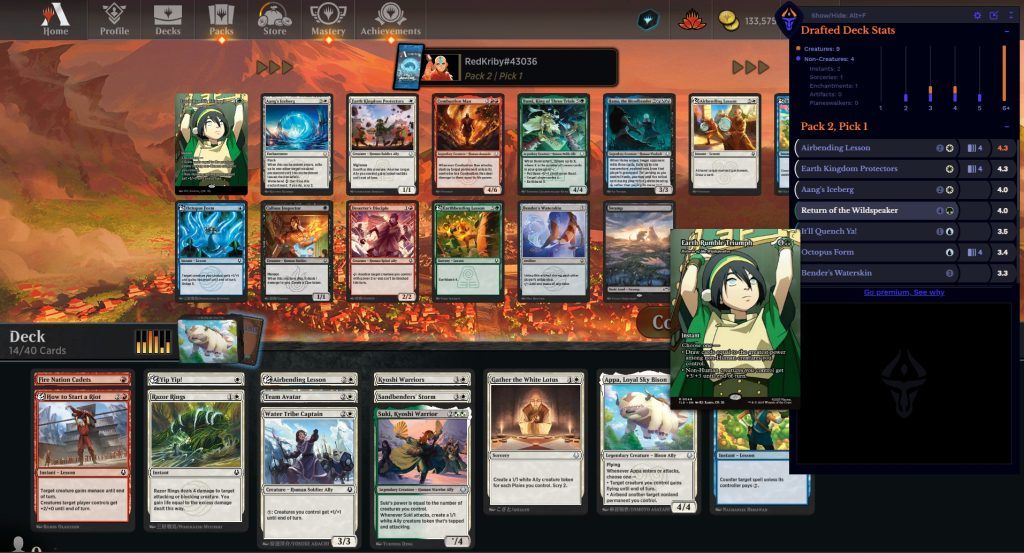
It’s a sweet and free app we’ve developed to help you track your games and give you AI recommendations while you play MTGA. It’s also incredibly easy to use and you’ll love Arena Tutor, trust me.
Magic Online
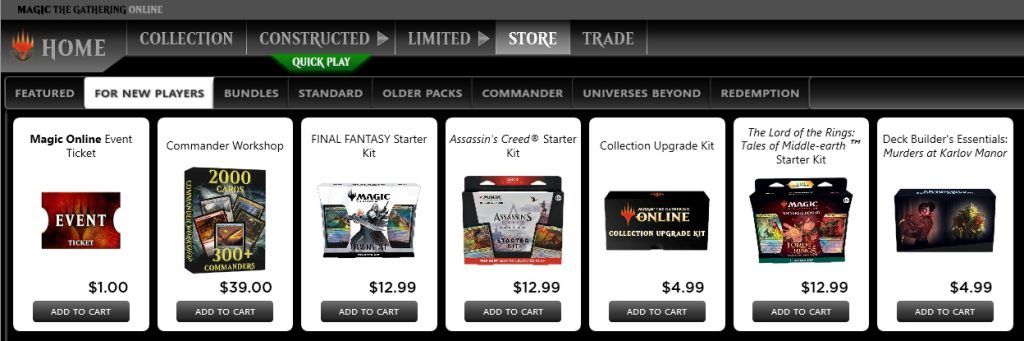
You won’t need that Collection Upgrade Kit since that is for accounts started before April 10, 2024, but the cost does match the full account cost.
Download the MTGO client, set up your account, and try it out. You’ll get what’s called a “basic account,” which is actually pretty cool because it includes 2 of every common and 1 of every uncommon in Standard.
Be forewarned, if you want to play the “full version” of MTGO, you have to pay $4.99 to get an Account Upgrade Kit. This gives you access to a Full User account. As a new player, you only have access to events you can play in with “new player points.” But if you try MTGO out and hate the client, there’s no commitment.
When you upgrade, you get another package of 2 commons and 1 uncommon of every card in Standard and 60 “Play Points” – which are actually worth $6 in play value.
The reality is that if you want to play real formats and events, you have to pay that upgrade cost. So I’m going to say that MTGO actually costs $4.99. There are ways to almost play MTGO for free.
If you want to get started playing constructed right away without trading or buying cards, sign up for Cardhoarder’s loan program. It changes MTGO from being a “pay to play” model to a subscription model.
Will Magic Arena Replace MTGO?

Giant Albatross | Illustration by David A. Cherry
Not anytime soon. I thought this was going to happen by now, but old man MODO is still alive and well, partially thanks to a revitalization and better management from its new caretaker Daybreak Games.
That said, it ain’t a pretty application. Non-MTGers are shocked when they see its old “Excel Simulator” style user interface. And what company wants to maintain two software applications that, in the end, do exactly the same thing: play Magic? Remember the video game Duels of the Planeswalkers?
In the medium term, I think you’re completely fine to start using Magic Online, as long as you don’t view it as a 10-year investment.
But as you saw with long campaign to get Pioneer onto MTGA via sets like Pioneer Masters, the plans are to get as many play modes as possible into MTG Arena, even at the expense of existing Magic Online formats.
So maybe dump that MODO stock while you still can…
Note: this post contains affiliate links. If you use these links to make a purchase, you’ll help Draftsim continue to provide awesome free articles and apps.
Follow Draftsim for awesome articles and set updates:









11 Comments
Any guess about being able to move cards from MTGO to MTGA?
I think this is extremely unlikely. It would take many, many years of work to make all of Magic’s card pool available on MTGA — and I’m not even sure if that’s the intent. Even if they did decide to transfer the cards that were actually there, it would mean the actual end of Magic Online. I still don’t see that happening any time soon (< 2 years).
super informative this article is amazing
I used to play magic years ago and I wanted to come back playing but I was unfamiliar with both the programs. This is exactly what i was looking for. It’s also good to see a veteran like you not standing for the older program, trying to give a good impartial description of both the options. Thanks for the article.
Awesome, so glad it helped!
Old at 25 years playing? The internet barely existed when we started, now i feel real old. Just putting in my vote for arena. Has already advanced since this writing.
I started magic 9 years ago when my friend invited to this wholesome area. Playing from tabletop with some snacks, one by one, was a great memory. And there, I meet MtgO. It was amazing experience to play that format even though I was beginner. After 4 years of rest from Mtg, I searched for Mtg to play some, Then mtga just showed up. This boy was amazing graphics, and made me more attracted to magic session again. But after playing arena, online one just became so old, nostalgic game to me. Still I miss the old time playing mtg with my friend.
cool, i loved
I believe you neglected far and away the most (only) reason a lot of players choose what you hilariously referred to as the “Excel Simulator” of MTGO- you have a far larger card pool for Commander than for Brawl.
I think you are wrong about the tix cost of sultai ramp.
MTG Goldfish says it would cost 50 dollars: https://www.mtggoldfish.com/deck/3306661#paper
Also, cardhoarder is showing Uro costing $3
I’m not sure where those numbers are coming from.
Hey Zach. The reason for that is after rotation, a bunch of cards plummeted in price, especially on MTGO. Now, that deck is only $50, but it’s not Standard Legal!
Add Comment