
Chakram Slinger | Illustration by Dmitry Burmak
A mulligan is Magic’s built-in “do-over” for opening hands. If you look at your starting hand and can’t help thinking, “Well, this sucks…,” you can throw away that hand and draw a fresh one.
With a cost, of course. Like everything in Magic. Or in life, for that matter!
In Commander, the cost of mulliganing a bad hand is smaller than in one-versus-one formats… but it’s still a cost, and you should treat it like one. So let’s check all the ins, outs, and corner cases of how to mulligan in Commander.
How Do Mulligans Work in Commander?

Brion Stoutarm | Illustration by Zoltan Boros & Gabor Szikszai
Commander uses the same core mulligan procedure as all other Magic formats: the London Mulligan (named that way because it was first tested in Mythic Championship II in London, in 2019).
- First, each player draws their starting hand (usually seven cards; some MTG formats have effects that can modify this number).
- Then, the starting player decalres whether or not they want to mulligan. Each other player does the same in turn order, and declares if they want to mulligan or keep their hand (the last player has the advantage of knowing how many other players will take a mulligan).
- If a player decides not to take a mulligan, they keep the cards they drew, which becomes their opening hand. They can’t take any more mulligans past this point.
- Players that take a mulligan put their hands back into their decks, shuffle, and draw a new hand equal to their starting hand size.
- Then the process is repeated until all players decide keep their hands.
At this point, players who took at least one mulligan choose a number of cards from their hand equal to the number of mulligans they have taken, and put those cards on the bottom of their library (in any order they choose).
The above process is similar for all Magic formats, but there are two caveats:
- In multiplayer games like Commander and Brawl, the first mulligan doesn’t count towards how many cards you have to put back into the deck after drawing a new hand.
- In multiplayer games, the first player draws a card at the start of their first turn (in 1-vs-1 formats, the first player skips their first draw step). Technically speaking, this is not part of the mulligan process, but it does affect the mulligan strategy. More about this in a bit!
In short: If you mulligan 3 times, you put back 2 cards if you’re playing multiplayer Commander (the first mulligan doesn’t count), and in 1v1 formats you put back 3 cards.
The mulligan rules have changed several times during Magic’s history. Magic’s original mulligan allowed you to draw a second hand if your first hand was all lands or no lands (and you could do this only once per game). Later it was switched to the Paris Mulligan: You could take as many mulligans as you wanted, but each time you drew one card less. The Vancouver mulligan allowed you to scry 1 if you took at least one mulligan.
Since July 2019, all Magic formats, including Commander, use the London Mulligan described above.
Is the First Mulligan Free in Commander?
Yes it is, as long as it’s multiplayer Commander.
That’s the only difference when it comes to rules: In multiplayer games (including Commander games with 3+ players), the first mulligan is free. The first mulligan you take doesn’t count toward how many cards you put on the bottom of your deck once you decide to keep your hand.
In Duel Commander, the first mulligan is not free, though! And since we’re at it: In Brawl the first mulligan is also free, even though it’s a 1v1 format.
How Many Times Can You Mulligan in Commander?
In multiplayer Commander, you can mulligan a maximum of eight times:
- The first mulligan is free.
- If you mulligan N times, you’ll have to put back (N-1) cards on the bottom of your deck; your starting hand is 7, so you can’t put back more than seven cards. In other words, if you mulligan 8 times you’ll have to put all cards you draw at the bottom of your library and start with zero cards in hand.
Which, in practice, pretty much means that you really can’t mulligan more than seven times in Commander (having one card in your starting hand is better than having zero cards, no matter how bad that one card is). But technically speaking, eight times is the max if you want to!
Are Commander Mulligans Different in 1v1 or Multiplayer?
Face to Face | Illustration by Randy Gallegos
Yes, they are different: In multiplayer formats the first mulligan is free.
Remember that there’s another important difference between multiplayer Commander and 1v1 MTG formats which, while technically not part of the mulligan, affects the mulligan strategy a lot: In a 2-player game, the player who plays first skips the draw step of their first turn. In multiplayer formats, the first player draws normally.
Therefore, if you’re going first in multiplayer Commander, you’re not as “down” as you’d be in 1v1, because you still draw on turn 1. That can make some sketchy hands (like “two lands + early play”) more keepable.
What Is Partial Paris?
Remember how one of the earlier mulligan rules was called the Paris Mulligan?
Partial Paris is an informal Commander mulligan process that many groups used before the London Mulligan became the standard. It’s not the default rules today, but you may still hear longtime Commander players reference it. While the details varied by group, the common process was:
- Draw 7 cards.
- Set aside (often face down) any number of cards you don’t want.
- Draw that many cards minus one.
- You could repeat, each time effectively shrinking your hand by 1.
- Then you’d shuffle the set-aside cards back into your library.
So for example, you could draw your first hand, keep four of those cards, set aside three, and draw two new cards. That’s the “partial” in the “Partial Paris”: Uou could keep the part of your first hand that you like, and toss aside the part you don’t.
Partial Paris usually leads to fewer unplayable hands (especially for newer players with jankier decks), with less feel-bad variance, which creates games where everyone “gets to do their thing” at least a little.
The con is that it allows for more hand sculpting, which gives combo decks (which are looking for their combo pieces) an advantage. This was in fact one important consideration when the mulligan rules were changed from the Vancouver to the London rules (with the Magic devs acknowledging that, “There’s also a risk that combo decks could abuse a very strong mulligan to much more reliably assemble a combo early in the game”) but, for jankier decks and casual groups, stronger mulligans are usually a positive by letting everybody play the game.
Can You “Friendly Mulligan” in Commander?
Truce | Illustration by Donato Giancola
In a competitive setting, no you can’t. Them’s the rules.
Then again, there’s also Rule 0! In friend groups, yeah, go with whatever you and your play group are okay with to ensure everyone starts with a reasonable hand.
Just don’t expect strangers, even in casual settings, to be okay with custom rules. In case of doubt, be sure to ask first (or follow the standard rules!).
When Should You Mulligan in Commander?
Mulligan decisions depend a lot on your deck, and at higher levels also on your opponents’ decks (your board wipes could be the best cards in your deck against a go-wide aggro deck, or a total brick against an instant-heavy deck), but the rule of thumb is: Your starting hand should allow you play the first 2-3 turns, no matter what you draw in those turns.
Generally speaking, ship hands when on of the following happens.
Your Starting Mana Just Doesn’t Let You Play Magic
Hands with one land are extremely sketchy in Commander; some decks with lots of cheap cantrips can make it work, but more often than not it’s not enough.
These 1-landers are often alluring because they do have six cards that you could play, so there will usually be a voice in your head saying: “Hey, if we draw just one more land we can play this, and this, and that, and then we draw into that other thing….”
Tell that voice, “The math ain’t mathing, mate.” There are 92 cards left in your library; odds are you’ve got less than 40 lands in there, so odds are you won’t draw a land next turn.
You Can’t Produce Your Colors
Similar to the previous point: Even if your starting hand can produce 2-4 mana, it doesn’t matter if it’s not in the colors you need.
Remember: Your starting hand should allow you to play the first 2, ideally 3 first turns without drawing anything else.
You Have No Early Game in a Deck That Needs It
Not every deck needs to curve out. But most decks need something early:
- A ramp spell
- A cheap draw/filter effect
- A tutor for your scary stuff
- Interaction that lets you stay alive
What you need also depends on your opponents’ decks (“Who’s the Beatdown” never gets old!). But even in a vacuum, some decks can afford to go a bit sluggish in the first couple of turns, while others always need to get things down ASAP. If your deck’s in the latter group, mulligan accordingly.
Your Hand Fights Your Commander’s Plan
Commander decks usually have a “default route” because your commander is always available.
Ask:
- Does this hand help cast my commander at a reasonable time?
- Does it do something useful if my commander gets removed or Counterspelled?
- Is it full of cards that only work after my commander is online?
A hand that’s all payoffs and no setup is how you end up staring at your own cards like they personally betrayed you. It’s tempting to keep all that payoff, because it’s usually the fun stuff you built your deck around… but if your deck needs your commander to do something, and then go for the flashy payoffs, make sure your starting hand helps you do something.
Mulligan Tips & Tricks
Hand That Feeds | Illustration by Loïc Canavaggia
According to Sun Tzu: “If you know your deck, and your opponents’ decks, you will always mulligan correctly.” Or in other words, ideally you want your starting hand to do something your deck wants you to do, and something your opponents’ decks don’t want.
The First Mulligan Is Free – Use It… But Don’t Be Too Greedy
In multiplayer Commander, your first mulligan costs you nothing. If it’s a sketchy hand, ship it; no second thoughts about it.
That said, “good enough” is actually very good here. If your first hand is playable, just keep it. Fortune does favor the bold, but has no love for the dumb: No need to throw away a good hand trying to get an excellent hand.
Mulligan Land-Light Hands
Most Commander decks are built to make land drops early. If your opener is light on lands, you’re asking Lady Luck to come to your rescue. As a rule of thumb:
- 2–4 lands with correct colors is the most common “functional” range.
- 2 lands is fine if your starting hand also has ramp or card draw (and a plan).
- 1 land is a keep only when you know your deck supports it (cheap draw, low curve, lots of 1–2 mana plays).
The reason one-landers are hard to throw away is that they are more likely to have the good stuff. It’s just basic probability: A starting hand with 1 land has 6 non-land cards; a starting hand with 4 lands has 3 non-land cards; if your deck has one Game Changer, then you’re more likely to see it among 6 non-land cards than among 3 non-land cards.
So, whenever you find yourself looking at a 1-land hand, you’re very likely to also be looking at some of the best cards in your deck, or at least looking at lots of cards you’d like to play. And it’s easy to imagine all you could do with all that stuff if you draw some lands…
… stop right there and just ship on that one-lander. Begone! Let’s see another hand!
Don’t Be Overly Tempted by Sol Ring
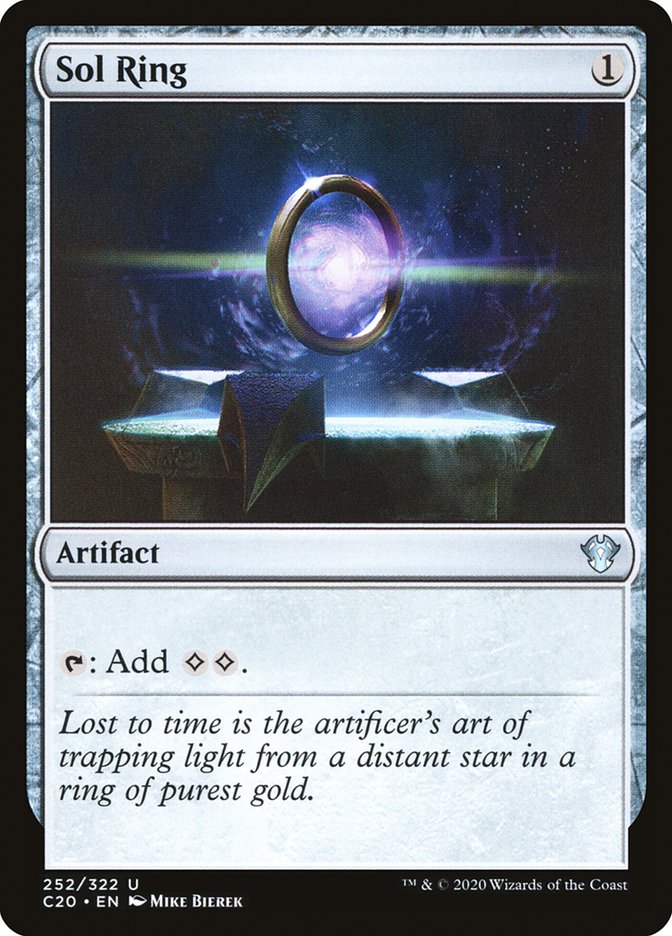
Speaking of good cards: Yes, Sol Ring is absurd. By Wizards of the Coast’s own admission, it’s so strong that it should be banned in Commander; they just allow it because, by now, Sol Ring is the card in Commander.
And it also makes mana. But, no, it doesn’t magically make a one-land hand a keep. If you have enough mana and gas in your starter to play turns 1-3 then yeah, keep it. But Sol Ring, a single land, and nothing in hand that costs less than 3 is not a hand you want to keep.
Prioritize “Function” Over “Power”
A hand with:
- lands that cast your spells,
- one early play,
- and a reasonable curve
… will beat a hand with three Game Changers you can’t cast.
Your starting hand is your runway, so to speak. You want to start your engines and get the plane in the air; there will be time to draw the Big Stuff, but your starting hand has to get things moving.
Help Your Deck Do What You Built It to Do
Every deck has something it wants to do (which, ideally, is what you want it to do!):
- Ramp decks want early ramp.
- Aggressive decks want early creatures.
- Control decks want early mana, removal, probably a counterspell or two.
- Combo decks want setup + selection.
A starting hand full of board wipes is probably a keep if you’re facing aggro decks, but won’t help you against a spell-heavy combo deck; in that case, mulligan the board wipes away and look for whatever your deck wants to do in that scenario (threats to kill the combo deck ASAP, or counterspells to counter their combo, etc.)
Mulligan with Your Commander in Mind
What we said for decks is also true for your commander: What does it want to do, and how can your starting hand help? Your commander is always available, so you can keep hands without a specific engine piece more often than in other formats.
But don’t keep hands that do literally nothing unless the commander sticks. Commander removal is plentiful, and you don’t want your entire game plan to be “please don’t have it.”
Don’t Let Mulligans Be an Excuse for Bad Deckbuilding
If you find yourself having to mulligan a ton with the same deck, that’s usually not bad luck. It’s often:
- too few lands,
- too many expensive spells,
- not enough early plays,
- greedy color requirements,
- or insufficient card draw/selection.
Card games are all about variance (else we’d be playing Chess or Go). Mulligans are about decreasing variance, allowing you to draw a fresh staring hand if you have really bad luck with the first.
But “That was unlucky, let’s mulligan this hand away,” is very different from “I need extremely good luck, every time, in order to play this deck.”
The latter is just a bad deck!
Wrap Up

Hundred-Handed One | Illustration by Brad Rigney
Mulligans are arguably one of Magic’s hardest skills to master, since it’s the very first game action: Everything that happens in a game happens after the mulligan, and while it’s a binary decision (mull or keep?), there’s a lot of nuance to it.
But, to keep things simple: A keepable hand is one that lets you play the first few turns.
When it comes to mulligans, Gordon Gekko was wrong. Do not be greedy. “Good enough” is actually great in this case: As long as your opening hand works, it’s a keep. And on the contrary, if it requires your next three draws to go perfect (like expecting to draw the lands you need to play the rest of your one-land hand…), then throw it away.
No regrets. And no mercy!
I hope you’ve enjoyed this mechanical deep dive into how Magic’s mulligan works in Commander, and if you have comments or questions please drop something below, or stop by the Draftsim Discord for a chat.
And good luck out there!
Follow Draftsim for awesome articles and set updates:









Add Comment