
Last updated on December 30, 2024

Cloudpost | Illustration by Martina Pilcerova
It’s no stretch to claim that lands make Magic the game we love. The land system is a fundamental part of how the game is balanced and how the color pie and cards are defined, and it’s central to many core strategies.
It’s no surprise that such an essential piece of the game can be easily broken. The simplest way to break lands is to make them tap for extra mana. That’s what distinguishes some of the best lands in the game, like Tolarian Academy and City of Traitors, from the rest.
Today topic is no exception: locus lands!
What Are Locus Lands in MTG?

Trenchpost | Illustration by Carlos Palma Cruchaga
The locus lands are colorless lands with the “locus” subtype. Three locus lands have been printed to date, as well as Planar Nexus, which counts as a locus in all zones.
Locus lands are tied to the plane of Mirrodin. They’re a type of land that get stronger together, as the locus lands care about how many different locus lands you control.
The History of Locus Lands in MTG
The first locus land, Cloudpost, was printed in the original Mirrodin set in 2003. It was the lone locus card in Magic for several years until Glimmerpost was printed in 2010 during the return to Mirrodin with Scars of Mirrodin.
These two lands have rarely gotten reprints. Glimmerpost’s only printing was in Scars, while Cloudpost got a few reprints in the Worlds Champ Decks 2004 and as an FNM promo in May 2010, a few months before Scars would release that October.
An additional locus was added to the game in 2024 as part Modern Horizons 3‘s Tricky Terrain precon. This one adds a mill win condition to decks focused on locus lands, but more importantly, ups the number of locus lands you can play for your Cloudposts. There’s also technically Planar Nexus, which counts as a locus, but doesn’t have the subtype printed on it.
Like any mechanic that lets you cheat on mana, the locus lands proved incredibly powerful, especially at the inception of Modern in 2011. When paired with cards like Vesuva that essentially gave you 12 locus lands, the deck ramped in explosive bursts even Tron couldn’t keep up with.
It would often be paired with Emrakul, the Aeons Torn, the best of the Eldrazi titans, as you can see in this BreachPost list Jesse Hampton piloted to a top eight in Pro Tour Philadelphia, 2011, shortly before Cloudpost was banned in Modern.
Creatures (20)
Emrakul, the Aeons Torn x4
Oracle of Mul Daya
Overgrown Battlement x4
Primeval Titan x4
Sakura-Tribe Elder
Terastodon
Ulamog, the Infinite Gyre
Wall of Roots x4
Instants (7)
Beast Within x3
Through the Breach x4
Sorceries (4)
Artifacts (4)
Gruul Signet x4
Lands (25)
Cloudpost x4
Dryad Arbor
Eye of Ugin
Forest x3
Glimmerpost x4
Grove of the Burnwillows x4
Misty Rainforest x2
Mountain
Stomping Ground
Vesuva x4
Sideboard (15)
Brooding Saurian
Chalice of the Void x3
Dismember x2
Firespout x3
Punishing Fire x3
Qasali Pridemage
Seal of Primordium x2
While Cloudpost is banned in Modern and Pauper due to its incredible mana production, you can still play 12-Post variants in Legacy, like with this list that finished top 8 during a recent Legacy preliminary on MTGO.
Creatures (13)
Elvish Reclaimer x4
Emrakul, the Aeons Torn
Endurance
Kozilek, the Great Distortion
Outland Liberator
Primeval Titan x3
Ramunap Excavator
Ulamog, the Ceaseless Hunger
Instants (8)
Crop Rotation x4
Once Upon a Time x4
Sorceries (4)
Artifacts (8)
Expedition Map x4
Pithing Needle x4
Lands (27)
Bojuka Bog
Boseiju, Who Endures
Cavern of Souls
Cloudpost x4
Dark Depths
Eye of Ugin
Forest x4
Glacial Chasm
Glimmerpost x4
Karakas
Maze of Ith
Thespian's Stage x2
Vesuva x2
Windswept Heath
Yavimaya, Cradle of Growth x2
Sideboard (15)
Carpet of Flowers x4
Collector Ouphe
Dismember x2
Endurance x3
Force of Vigor x4
Walking Ballista
You can even use these lands in EDH with plenty of ways to tutor them, like Crop Rotation and Sylvan Scrying, alongside ways to copy them like Vesuva, Thespian's Stage, and Orvar, the All-Form.
Best Locus Lands
#4. Planar Nexus
Planar Nexus is technically a locus, but not one you’re usually playing in Constructed, since it offers no utility outside of being locus #13 or so. It might have a short if Trenchpost wasn’t printed at the exact same time, but for now this one’s mostly here to keep the locus dream alive in Commander.
#3. Trenchpost
Trenchpost is the newest addition to the locus family, and is still fresh enough that it hasn’t quite stood out yet. It gives Cloudpost decks an alternate way to win the game, though the archetype doesn’t really need that when it’s effectively making 12+ mana in an average game. The life from Glimmerpost is still more important, though upping the locus count only presents more options.
#2. Glimmerpost
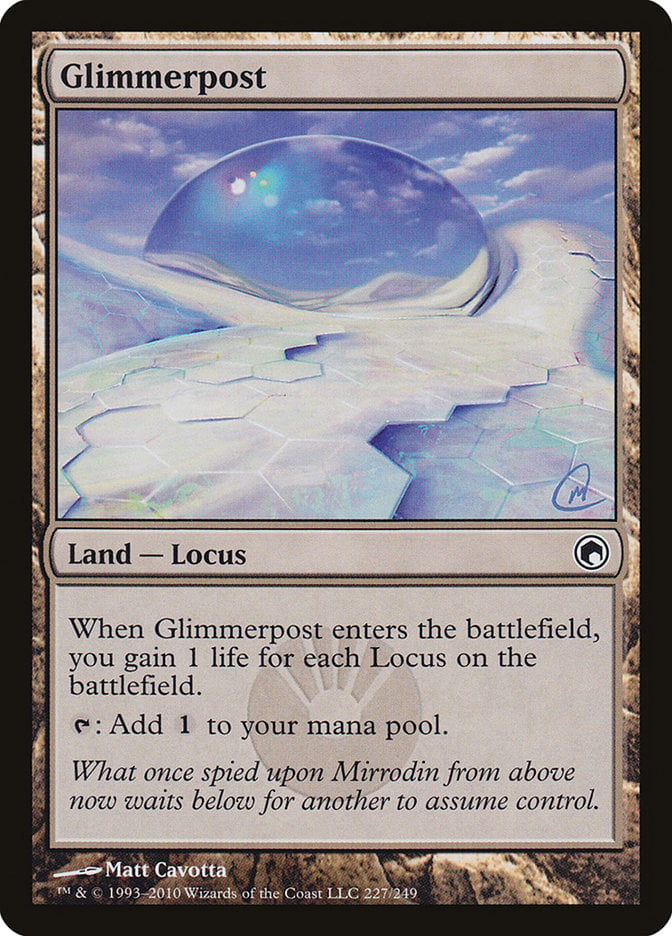
The second-best locus land has to be Glimmerpost. This isn’t directly responsible for the insane mana production but is still essential to the deck. Access to another four locus lands gives locus decks the consistency they desperately need. A hand with two Glimmerposts and a single Cloudpost still generates far more mana than a hand with only one locus.
The life gain tacked onto this land isn’t something to sneeze at. It adds up quickly in a deck dedicated to getting as many loci on the field as possible. These easily gain you four or five life in the later turns of the game, which is plenty to swing a match in your favor and buy your Emrakul the time it needs to close a game.
#1. Cloudpost
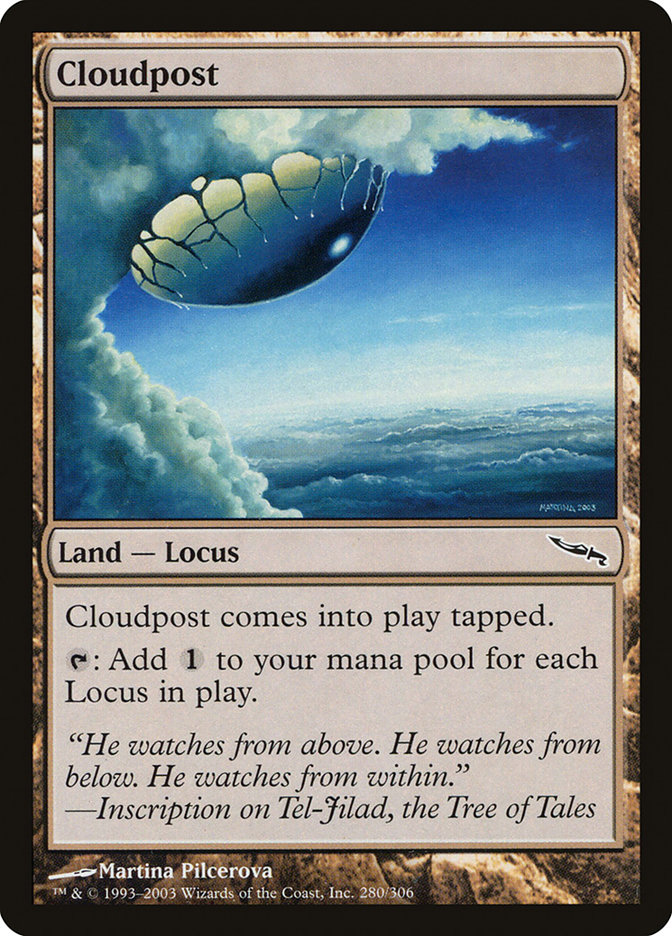
This locus is, of course, the broken one. Cloudpost is a devastatingly powerful land because of how hard it scales. One Cloudpost tapping for one mana doesn’t matter. Two of them tapping for 2 apiece is insane ramp, and if you can get three in play tapping for 3 apiece, you’ve developed a mana advantage that’s almost impossible to surmount.
That said, you don’t need to live the dream of having all your locus lands be Cloudpost. A singular Cloudpost with two Glimmerposts still taps for 5 colorless mana. Imagine a world where these lands were legal with Reality Smasher!
The secret to breaking these can be found in that BreachPost list. It didn’t need to hard-cast Emrakul. It just wanted to use two Cloudposts to play a turn-3 Through the Breach. In Legacy and Commander, you can use this colorless mana alongside things like Green Sun's Zenith and Sneak Attack for early bursts of pressure.
Alternate Options
Of course, the original locus lands are banned in most formats, so what are some of your other options?
The next best things are the Tron lands. Urza's Tower, Urza's Power Plant, and Urza's Mine have been a staple in Modern forever, thanks to their ability to let you curve out into a Karn Liberated on turn 3.
If you’re playing the Urza lands in Commander, you even get another option in Urza's Workshop, which does a good impression of Cloudpost with a different land type.
How to Turn Your Lands into Locus Land Effects
The best way to turn your lands into additional locus land effects is by copying the original locus lands. Thespian's Stage and Vesuva are the premiere way to copy locus land and other impactful lands. You can also use Mirage Mirror to get a temporary boost to mana that ramps you as long as your Cloudpost taps for 3 mana.
You can also look to copy other lands that tap for multiple mana to try and get a similar if weaker, effect. Vesuva copying an Ancient Tomb or Temple of the False God isn’t quite as strong as getting another Cloudpost, but certainly generates a ton of extra mana.
Wrap Up

Glimmerpost | Illustration by Matt Cavotta
Producing more mana than your opponents is the best way to get ahead in Magic. While you can do so with traditional ramp like Sol Ring and Rampant Growth, making your lands do the heavy lifting instead of your spells is a huge boon. Some iconic lands like Ancient Tomb and Serra's Sanctum tap for a lot of mana, but it’s hard to argue that the locus lands aren’t among the best lands to cheat on mana.
While their time in Modern was short-lived, they made a major impact on the burgeoning format by letting us dump an Emrakul, the Aeons Torn into play as soon as turn 3. This impact lives on in the various 12-Post lists you can find in Legacy.
Did you get to play with the locus lands in Modern or Pauper before the bannings? What are your favorite ways to copy the locus lands? Let me know in the comments or on the Draftsim Discord.
Stay healthy, and break your lands!
Follow Draftsim for awesome articles and set updates:










Add Comment