
Last updated on November 22, 2026
Seeker of Sunlight | Illustration by Randy Vargas
Explore is a mechanic that debuted in Ixalan, a set filled with adventure and exploration tropes. The Lost Caverns of Ixalan brought us back to that plane, and the explore theme returned, now in the underworld. Ixalan people have plenty of exploration on their hands, and so do we.
Today we’ll be quite literally exploring this fun mechanic and its rules intricacies. If you’re more interested in seeing a list of the best explore cards you could add to your deck, we’ve got them here instead.
How Does Explore Work?

Jadelight Ranger | Illustration by Jason Rainville
Explore is a keyword action. When a creature you control explores, you’ll look at the top card of your library. If it’s a land card, you put it in your hand. If it’s a nonland card, two things happen. First, you can either leave the revealed card on top of our library or put it into your graveyard. Second, you’ll put a +1/+1 counter on the creature that explored, regardless of what you did with the card.
There are many ways to explore. Typically, creatures explore when they enter the battlefield. Some enchantments and artifacts allow other creatures to explore, and now we have Map tokens, which make a creature explore when they’re sacrificed.
The History of Explore in MTG

Explore was introduced in 2017’s Ixalan set, and appeared in much smaller numbers in the follow-up Rivals of Ixalan. Between the two, there were 16 cards that either explored or caused another creature to explore, as well as three cards that trigger when your creatures explore.
Explore returned as a main-set mechanic in The Lost Caverns of Ixalan, where we were also introduced to Map tokens, which basically bottled up a one-use explore in artifact token form.
Explore is neither evergreen nor deciduous, but it appears on the occasional design in supplementary sets, and it made a cameo appearance in the Standard Star Trek set on Captain Kathryn Janeway.
What Is a Map Token?
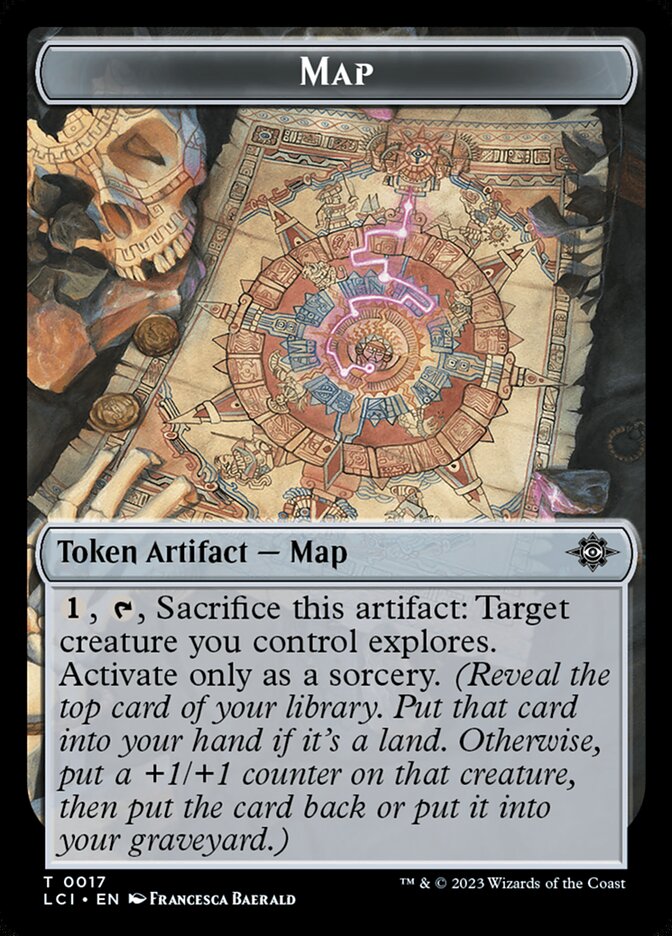
Map tokens are artifact tokens with a tap ability that costs and causes target creature you control to explore. You can only activate them at sorcery speed, and there must be a valid target in play to use them at all.
When You Explore, Do You Have to Reveal the Card You Draw?
Yes, you have to reveal the card you put into your hand while exploring to prove that it was a land.
Does Explore Count as Drawing a Card?
It doesn’t. If you reveal a land from the top of your library while exploring, you’ll put the card into your hand. That’s effectively the same as drawing a card, but MTG rules don’t consider that as drawing a card so it does not count towards card draw payoffs.
Is Explore Card Advantage?


Whether explore counts as card advantage or not depends on the card that produced the explore effect, and the result of exploring. Exploring a land into your hand will usually be card advantage, though not in the case where the explore effect isn’t attached to a permanent. A creature that enters, explores, and draws a land has produced a 2-for-1 in card advantage, but a spell like Enter the Unknown that draws a land has only created card parity (you spent one card and got one back). In the case of Enter the Unknown and similar effects, you might actually be at a card disadvantage if you don’t hit a land.
Explore also isn’t guaranteed to draw a land. Revealing anything other than a land gives you card selection, but you don’t recoup the card you spent to explore, so you’re likely just at card parity.
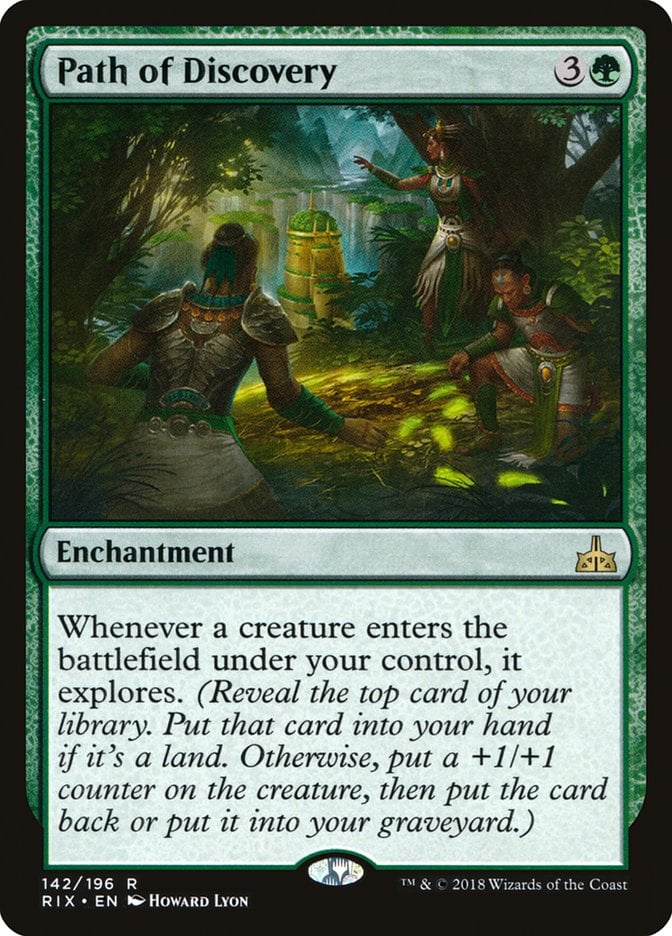
And in the case of mass explore effects like Path of Discovery and Hakbal of the Surging Soul, you might get a huge amount of card advantage if you end up drawing a bunch of lands off multiple targets exploring.
Can You Stack Multiple Explore Triggers?
You can. Let’s take Jadelight Ranger as an example, a card that lets you explore twice when it enters the battlefield. You’ll have two explore triggers, so each one is resolved separately. You can reveal a nonland card with the first explore trigger and leave it on the top of your library, so each trigger sees a nonland card and grants the Ranger two +1/+1 counters. You can also have two lands stacked on top of your library and get both with the explore triggers, and so on.
What If Multiple Creatures Explore at Once?
In most cases where multiple creatures are exploring, there will be a separate trigger for each one, and you simply order the triggers and resolve them one at a time. This can happen with a card like Path of Discovery on board and a bunch of creatures entering at the same time.
However, sometimes multiple creatures will explore as part of the same trigger, which is very common with Hakbal of the Surging Soul. There’s only one trigger that instructs all your merfolk to explore, and you have to “lock in” an order in which they explore before you actually start revealing cards. You can’t look at the top card and then assign which merfolk that explore is applied to; rather, you have to announce which merfolk is exploring and then reveal the top card, then repeat for each other merfolk until all of them have explored. This all takes place as the resolution of a single trigger, and players do not get priority to interact in between each explore.
Explore vs. Mill
When you mill, you simply put the top card of your library into your graveyard, which is one possible outcome of exploring, though there’s no alternative like looking at the top of your deck and possibly drawing a card. Exploring a card to the graveyard also does not count as milling.
Explore vs. Scry and Surveil
Scrying lets you look at the top of your library and put the card on top or bottom. At no point will it ever put an extra card in your hand or graveyard, and there’s no +1/+1 counter benefit from scry.
The effect of hitting a nonland with explore is essentially the same as surveil 1, though exploring is much more elaborate and doesn’t use the keyword action “surveil”, so it doesn’t interact with direct surveil payoffs.
Decklist: Yarok, the Desecrated Explore Deck in EDH

Yarok, the Desecrated | Illustration by Daarken
Commander (1)
Planeswalker (1)
Creature (33)
Aether Channeler
Armorcraft Judge
Avenger of Zendikar
Captain Kathryn Janeway
Cavalier of Thorns
Conclave Sledge-Captain
Dalek Drone
Deadeye Tracker
Deepfathom Echo
Eternal Witness
Evolution Witness
Francisco, Fowl Marauder
Hostage Taker
Jadelight Ranger
Jadelight Spelunker
Kami of Whispered Hopes
Legion Vanguard
Lieutenant Hikaru Sulu
Lurking Chupacabra
Merciless Executioner
Merfolk Branchwalker
Mulldrifter
Myr Battlesphere
Nicanzil, Current Conductor
Ravenous Chupacabra
Risen Reef
Roalesk, Apex Hybrid
Shriekmaw
Solemn Simulacrum
Spark Double
Tatyova, Benthic Druid
Tireless Tracker
Topography Tracker
Enchantment (5)
Extraordinary Journey
Omen of the Sea
Path of Discovery
Twists and Turns
Up the Beanstalk
Artifact (9)
Arcane Signet
Dimir Signet
Golgari Signet
Necklace of Girion
Panharmonicon
Simic Signet
Subterranean Schooner
Talisman of Resilience
Worldwalker Helm
Battle (5)
Invasion of Amonkhet
Invasion of Ikoria
Invasion of Ixalan
Invasion of Lorwyn
Invasion of Zendikar
Instant (5)
Doom Blade
Ghostly Flicker
Go for the Throat
Inspiring Call
Ripples of Potential
Sorcery (6)
Cultivate
Doomsday Confluence
Kodama's Reach
Tezzeret's Gambit
Torment of Hailfire
Villainous Wealth
Land (35)
Fetid Pools
Forest x9
Hedge Maze
Island x7
Karn's Bastion
Opulent Palace
Overgrown Tomb
Reliquary Tower
Swamp x5
Temple of Deceit
Temple of Malady
Turbulent Fen
Turbulent Wilderness
Undercity Sewers
Underground Mortuary
Watery Grave
Zagoth Triome
In my search for a commander who could embody the spirit of explore, I ended up with Yarok, the Desecrated. It allows you to play all the main explore colors, and most (not all) of the explore cards that trigger on ETB, so that’s double explore for you. There’s also the explore Simic () merfolk Commander precon led by Hakbal of the Surging Soul.
You appreciate the synergy between Path of Discovery and Avenger of Zendikar in this deck. I’ve added a few good ETB effects, good explore creatures, and some proliferate, since there’s a lot of +1/+1 counter synergies going on.
Wrap Up

Deepfathom Echo | Illustration by Matt Stewart
That’s all there is to explore here. The Lost Caverns of Ixalan expanded the possibilities of the explore mechanic by branching it heavily into other colors, and although explore isn’t an evergreen mechanic, it’s clearly still being used from time to time. It’s not tied thematically to any set and it’s an awesome fit in sets that have some graveyard or +1/+1 counter component.
What explore cards are you most willing to put in your decks? Which commanders are currently best at supporting an explore strategy? Let me know in the comments section below or over on Draftsim’s Discord. And check out The Daily Upkeep newsletter to stay up to date on all the latest MTG news.
Thanks for reading, and let’s keep exploring!
Follow Draftsim for awesome articles and set updates:










Add Comment