
Last updated on September 1, 2026

Commander's Sphere | Illustration by Ryan Alexander Lee
This may be a controversial opinion, but I strongly believe Commander is the best format to help teach Magic to new players. Thanks to being a multiplayer format, there are more players to give you advice, and they’re more likely to do so when you’re one of their three opponents instead of the only one. Commander games are also, theoretically at least, less competitive than most one-on-one formats.
If you’re looking to start playing Magic or want to introduce someone to the game through Commander, you need the right decks to do it with. Start with decks that are easy to understand but also have some hints of more complexity so they can work towards higher levels of play.
Budget is also a big concern when it comes to starting out. Nobody wants to throw down hundreds of dollars just to see if they like a game. When looking for the best entry-level decks, I chose ones that are as friendly to your budget as they are to your brain.
What Are Beginner Commander Decks in MTG?

Command Tower | Illustration by Ryan Yee
Beginner Commander decks are decks that are good for people who are just starting to learn the game. They should be easy to understand, cheap, and most importantly fun to play with. If someone starts playing Magic and their only experience is being mana screwed or not understanding how to play their complicated cards, they’ll probably decide the game isn’t for them. These decks are a good way to both learn the game and have fun doing it.
I also put an extra emphasis on decks that you can buy already made. When a new player can buy everything they need in a single box as opposed to having to chase down singles, it makes things a lot simpler.
Honorable Mention: Universes Beyond Commander Decks
Whatever your thoughts are on Universes Beyond products, it’s hard to deny that they’re a great way to introduce new players to the game. I know a lot of people who weren’t interested in Magic initially but were easily persuaded to buy some of the Lord of the Rings Commander decks because of their love for Tolkien. These decks range in how complicated and powerful they are, but I’ve found people are more willing to learn when they’re excited about playing as Frodo or Aragorn.
Between Warhammer 40,000, Final Fantasy, Doctor Who, and so much more, there are tons of products that can get new players excited about playing Magic thanks to their love for other IPs. Even if there isn’t one out now that you or your friends are into, stick around, because I’m sure one is on the way.
#10. Elenda, Saint of Dusk

Elenda, Saint of Dusk | Illustration by Chris Rahn
Commander (1)
Planeswalkers (1)
Creatures (26)
Ajani's Pridemate
Angel of Invention
Angel of Vitality
Arvad the Cursed
Defiant Bloodlord
Elenda's Hierophant
Essence Channeler
Exemplar of Light
Fiendish Panda
Healer's Hawk
High Priest of Penance
Indulgent Tormentor
Inspiring Overseer
Midnight Snack
Kunoros, Hound of Athreos
Lyra Dawnbringer
Marauding Blight-Priest
Mikaeus, the Lunarch
Noxious Gearhulk
Nullpriest of Oblivion
Oasis Gardener
Pontiff of Blight
Rune-Scarred Demon
Solemn Simulacrum
Sorin of House Markov
Twinblade Paladin
Sorceries (7)
Akroma's Vengeance
Death Grasp
Debt to the Deathless
Diabolic Tutor
Exsanguinate
Restart Sequence
Zombify
Instants (9)
Give In to Violence
Breathe Your Last
Moment of Craving
Utter End
Deadly Riposte
Devouring Light
Hero's Downfall
Murder
Valorous Stance
Artifacts (12)
Celestial Armor
Cosmos Elixir
Charcoal Diamond
Fellwar Stone
Marble Diamond
Lotus Blossom
Orzhov Signet
Pristine Talisman
Sol Ring
Swiftfoot Boots
Trading Post
Wayfarer's Bauble
Enchantments (11)
Angelic Destiny
Darksteel Mutation
Dawn of Hope
Glasswing Grace / Age-Graced Chapel
Grasp of Fate
Leyline of Hope
Parasitic Impetus
Phyrexian Arena
Polluted Bonds
Prayer of Binding
Sigarda's Splendor
Lands (33)
Command Tower
Restless Fortress
Plains x14
Rogue's Passage
Scoured Barrens
Shineshadow Snarl
Swamp x13
Temple of Silence
Elenda, Saint of Dusk has a lot of text and a well-supported creature subtype, and it's all good. No drawback to mitigate, no graveyard shenanigans to navigate. Elenda benefits from conditional hexproof against instants which make up much of the best targeted removal in Commander, and with white and black's ability to stall and gain life, the bonus of evasion and a potential 10/10 commander is real and relevant.
Young pilots for this deck enjoy the pivot from a lifegain and value strategy to a win-by-commander damage strategy if the opening presents itself. This has some recursion to help it recover with Fiendish Panda and Zombify and outlast opponents. Elenda calls upon one half of a Sanguine Bond combo in Defiant Bloodlord but uses it more as a burn accelerant to go along with a Midnight Snack to help reach an opponent's life total rather than an infinite combo.
#9. Draconic Destruction Starter Commander Deck

Atarka, World Render | Illustration by Camille Alquier
Commander (1)
Planeswalker (1)
Creature (28)
Akoum Hellkite
Demanding Dragon
Draconic Disciple
Dragon Mage
Dragonkin Berserker
Dragonlord's Servant
Dragonmaster Outcast
Dragonspeaker Shaman
Drakuseth, Maw of Flames
Dream Pillager
Drumhunter
Flameblast Dragon
Foe-Razer Regent
Furnace Whelp
Harbinger of the Hunt
Hoard-Smelter Dragon
Loaming Shaman
Mordant Dragon
Rapacious Dragon
Runehorn Hellkite
Sakura-Tribe Elder
Savage Ventmaw
Scourge of Valkas
Steel Hellkite
Thunderbreak Regent
Thundermaw Hellkite
Tyrant's Familiar
Verix Bladewing
Instant (8)
Beast Within
Blossoming Defense
Hunter's Insight
Magmaquake
Provoke the Trolls
Return to Nature
Spit Flame
Unleash Fury
Sorcery (9)
Chain Reaction
Clan Defiance
Cultivate
Harmonize
Hunter's Prowess
Primal Might
Shamanic Revelation
Sweltering Suns
Vandalblast
Enchantment (6)
Crucible of Fire
Dragon Tempest
Elemental Bond
Fires of Yavimaya
Frontier Siege
Garruk's Uprising
Artifact (7)
Arcane Signet
Atarka Monument
Commander's Sphere
Dragon's Hoard
Sol Ring
Swiftfoot Boots
Talisman of Impulse
Land (40)
Cinder Glade
Command Tower
Forest x12
Game Trail
Haven of the Spirit Dragon
Kazandu Refuge
Mountain x18
Path of Ancestry
Rugged Highlands
Shivan Oasis
Temple of Abandon
Timber Gorge
I think all of the Starter Commander decks are pretty solid entry points for players. They were intentionally designed to be pretty straight-forward, and they’re a lower price point than some of the other preconstructed decks. Draconic Destruction is the one that I thought was the strongest right out of the box.
It has some solid dragons like Steel Hellkite and Tyrant's Familiar. There are also typical dragon support cards like Dragonspeaker Shaman and Dragon Tempest. These cards aren’t only good pieces for this deck, they’re good inclusions for any dragon deck, so if you want to update this deck you already have a good start.
Cards like Vandalblast and Cultivate are also general format staples, so if you’re looking to start a collection, you’ll have some cards here you can pull out and put into other decks.
#8. Grave Danger Starter Commander Deck

Gisa and Geralf | Illustration by Karla Ortiz
Commander (1)
Planeswalker (1)
Creature (29)
Cemetery Reaper
Champion of the Perished
Diregraf Captain
Eternal Skylord
Fleshbag Marauder
Geralf's Mindcrusher
Gleaming Overseer
Gravespawn Sovereign
Gray Merchant of Asphodel
Havengul Lich
Josu Vess, Lich Knight
Laboratory Drudge
Lazotep Reaver
Liliana's Devotee
Liliana's Standard Bearer
Lord of the Accursed
Lotleth Giant
Loyal Subordinate
Midnight Reaper
Mire Triton
Overseer of the Damned
Scourge of Nel Toth
Spark Reaper
Unbreathing Horde
Undead Augur
Vela the Night-Clad
Vengeful Dead
Vizier of the Scorpion
Withered Wretch
Instant (5)
Cruel Revival
Lazotep Plating
Murder
Sinister Sabotage
Undermine
Sorcery (12)
Army of the Damned
Crippling Fear
Deep Analysis
Distant Melody
Enter the God-Eternals
Feed the Swarm
Necromantic Selection
Necrotic Hex
Pilfered Plans
Syphon Flesh
Victimize
Zombie Apocalypse
Enchantment (4)
Curse of Disturbance
Liliana's Mastery
Open the Graves
Vampiric Rites
Artifact (9)
Arcane Signet
Commander's Sphere
Dimir Signet
Grimoire of the Dead
Heraldic Banner
Sol Ring
Talisman of Dominance
Unstable Obelisk
Wayfarer's Bauble
Land (39)
Choked Estuary
Command Tower
Dismal Backwater
Island x13
Jwar Isle Refuge
Salt Marsh
Submerged Boneyard
Sunken Hollow
Swamp x18
Temple of Deceit
While Draconic Destruction is probably the most powerful Starter Commander deck, I think that Grave Danger is a lot more fun. It’s a zombie reanimator deck built around Gisa and Geralf and has several other ways to put creatures into your own graveyard like Liliana, Untouched by Death. This deck is a great way to get someone used to seeing the graveyard as a resource and self-mill as an opportunity.
This deck has some solid cards like Cemetery Reaper and Gray Merchant of Asphodel. It also has Feed the Swarm, a card any player who wants to build a mono-black deck probably has a use for.
The strategy for this one is a little more complicated than some of the other Starter Commander decks, which I actually see as a huge positive for beginners. Even if you aren’t winning, you’ll feel like you’re doing a lot, and you’ll start to get the hang of how cards interact with one another. It’s a good way to bypass thinking Magic only has to be about playing the biggest creatures out there.
#7. Madame Null, Power Broker

Madame Null, Power Broker | Illustration by Irina Nordsol
Commander (1)
Creature (35)
Baleful Ammit
Child of Night
Crystalline Giant
Deep-Cavern Bat
Defiant Bloodlord
Defiling Daemogoth
Elegy Acolyte
Eradicator Valkyrie
Flayed One
Ghastly Gloomhunter
Gifted Aetherborn
Gollum, Obsessed Stalker
Gray Merchant of Asphodel
Grimdancer
Gumdrop Poisoner // Tempt with Treats
Hagra Constrictor
Morlun, Devourer of Spiders
Moseo, Vein's New Dean
Murderous Rider // Swift End
Necropolis Regent
Nighthawk Scavenger
Nullpriest of Oblivion
Phyrexian Fleshgorger
Preacher of the Schism
Qarsi Revenant
Scheming Silvertongue // Sign in Blood
South Wind Avatar
Super-Adaptoid
Taborax, Hope's Demise
The Haunt of Hightower
Tivash, Gloom Summoner
Urborg Scavengers
Vadmir, New Blood
Vampire Nighthawk
Vault Skirge
Instant (7)
Archenemy's Charm
Armor of Shadows
Bitter Triumph
Consuming Corruption
Defile
Doom Blade
Undying Evil
Sorcery (8)
Decorum Dissertation
Desperate Plea
Dirge of Dread
Essence Harvest
Feed the Swarm
Night's Whisper
Sign in Blood
Unearth
Enchantment (3)
Call of the Ring
Font of Agonies
Retribution of the Ancients
Artifact (8)
Arcane Signet
Charcoal Diamond
Everflowing Chalice
Fellwar Stone
Heraldic Banner
Mind Stone
Sol Ring
Thought Vessel
Land (38)
Swamp x38
Black aggro decks from decades ago used cards like Carnophage that were over-statted but cost you life. These decks bet on your creatures killing your opponent faster than you, and Madame Null, Power Broker gives you that strategy in Commander.
The deck leans heavily into lifelink creatures like Vampire Nighthawk and The Haunt of Hightower that get very large and dangerous when Madame Null stacks counters on them, gambling that you can gain huge chunks of life back faster than your opponents can kill you. After all, it’s pretty hard to race a large lifelink creature generating 8-point life swings.
The deck also leans into a little synergy. Since you have so many lifelinkers, there’s room to employ lifegain payoffs like Defiant Bloodlord and South Wind Avatar. Black even rewards you for paying life with cards like Font of Agonies. Round that out with classic black card draw and removal like Night's Whisper and Bitter Triumph, and your opponents will be bleeding.
#6. Krenko Goblins
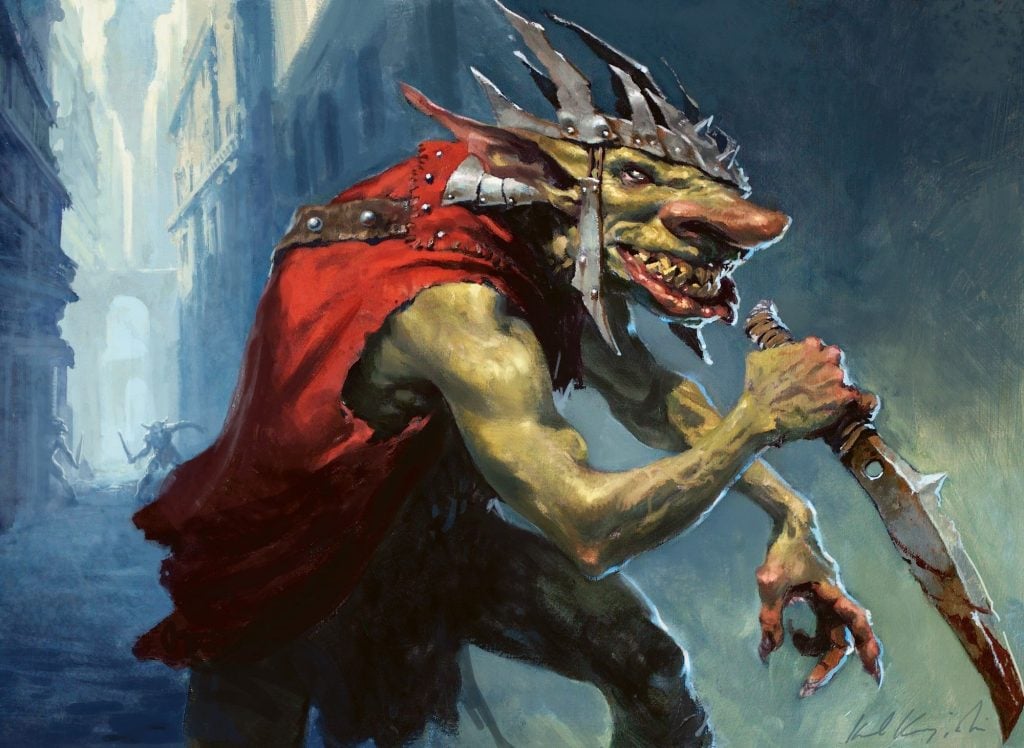
Krenko, Mob Boss | Illustration by Karl Kopinski
Commander (1)
Creature (50)
Battle Squadron
Beetleback Chief
Bloodcrazed Goblin
Bloodstone Goblin
Boggart Brute
Boggart Forager
Clamor Shaman
Foundry Street Denizen
Frenzied Goblin
Goblin Arsonist
Goblin Assassin
Goblin Assault Team
Goblin Banneret
Goblin Bird-Grabber
Goblin Champion
Goblin Chieftain
Goblin Cohort
Goblin Cratermaker
Goblin Instigator
Goblin King
Goblin Lookout
Goblin Matron
Goblin Motivator
Goblin Ringleader
Goblin Shortcutter
Goblin Smuggler
Goblin Taskmaster
Goblin Trailblazer
Goblin Trashmaster
Goblin Warchief
Goblin Wardriver
Hobgoblin Bandit Lord
Keldon Overseer
Krenko, Tin Street Kingpin
Magmaw
Mogg Flunkies
Mudbutton Clanger
Ogre Battledriver
Pashalik Mons
Siege-Gang Commander
Skinbrand Goblin
Skirk Prospector
Skirk Shaman
Squee, the Immortal
Subterranean Scout
Teeterpeak Ambusher
Tuktuk Rubblefort
Volley Veteran
Weaselback Redcap
Zada's Commando
Instant (3)
Battle Hymn
Bombard
Brightstone Ritual
Sorcery (8)
Burn at the Stake
Direct Current
Dragon Fodder
Empty the Warrens
Goblin Grenade
Goblin Rally
Goblin War Party
Krenko's Command
Enchantment (4)
Boggart Shenanigans
Quest for the Goblin Lord
Warstorm Surge
Goblin Bombardment
Land (34)
Mountain x34
Krenko, Mob Boss is the kind of commander that’s easy to understand. You want to play a lot of goblins so you can make a lot of goblins. While there are plenty of Krenko decks out there, this one's very beginner-friendly for a few reasons.
First off, it’s very creature heavy. Creatures are some of the simpler cards to understand in the game and don’t require as much of an understanding of sequencing as something like a spellslinger deck. New players also want to feel productive, and being able to cast a creature or attack on your turns is a good way to stay engaged.
Because the land base is all Mountains, it’s very easy for new players to manage their mana base. It also means less chance of frustration over being mana screwed, which can happen when you start dipping into multicolor decks or include a lot of colorless utility lands.
This deck is also very budget friendly. Many of these cards cost less than a dollar, meaning it won’t be much more expensive to buy this than some preconstructed decks. It also has room to grow, meaning that if a new player wants to try their hand at deckbuilding, they can start by upgrading this one.
#5. Ghalta, Primal Hunger

Ghalta, Primal Hunger | Illustration by Kemonomichi
Commander (1)
Planeswalker (1)
Creature (31)
Agonasaur Rex
Cavalier of Thorns
Dawnglade Regent
Elder Gargaroth
Elvish Mystic
Forgotten Ancient
Garruk's Packleader
Goreclaw, Terror of Qal Sisma
Hulking Raptor
Jubilation
Karametra's Acolyte
Kogla, the Titan Ape
Llanowar Elves
Llanowar Tribe
Managorger Hydra
Paradise Druid
Pugnacious Hammerskull
Rampaging Baloths
Reclamation Sage
Slumbering Trudge
Steel Leaf Champion
Surrak, Elusive Hunter
Sylvan Caryatid
Tender Wildguide
Terastodon
The Tarrasque
Thrashing Brontodon
Tireless Tracker
Undermountain Adventurer
Verdant Sun's Avatar
Yorvo, Lord of Garenbrig
Instant (8)
Beast Within
Bite Down
Boon of Boseiju
Ram Through
Return of the Wildspeaker
Tail Swipe
Tifa's Limit Break
Tyvar's Stand
Sorcery (10)
Bushwhack
Cultivate
Explore
Farseek
Harmonize
Kodama's Reach
Majestic Genesis
Prey Upon
Rampant Growth
Shared Roots
Enchantment (6)
Colossal Majesty
Court of Bounty
Garruk's Uprising
Kenrith's Transformation
Monstrous Vortex
Wild Growth
Artifact (1)
Land (42)
Green always feels like a great choice to start with in part because it’s simple and in part because who doesn’t like throwing dinosaurs at people? This deck leans on Ghalta, Primal Hunger, perhaps the Timmiest card to ever Timmy, as the leader of a green stompy deck.
This list leans into what green does best: ramp and big creatures. Ramp spells dominate the cheaper side of the curve, with cards like Llanowar Elves and Rampant Growth to lead you to the big, exciting cards like Jubilation and Dawnglade Regent.
Most green things are stapled to creatures, which this deck exhibits. The removal? Either fight spells like Prey Upon or creatures like Kogla, the Titan Ape. Card draw often correlates with your creatures’ power, as seen with Garruk, Primal Hunter and Colossal Majesty’s rewards for controlling the biggest and best permanents (like Ghalta!). The deck’s very straightforward and surprisingly fun.
#4. Oloro, Ageless Ascetic

Oloro, Ageless Ascetic | Illustration by Eric Deschamps
Commander (1)
Planeswalker (1)
Creature (10)
Archon of Absolution
Baird, Steward of Argive
Eidolon of Rhetoric
Hushbringer
Lavinia, Azorius Renegade
Silent Arbiter
Spelltithe Enforcer
Teferi, Mage of Zhalfir
Thopter Assembly
Realm-Cloaked Giant
Instant (16)
Blink of an Eye
Crush Contraband
Epiphany at the Drownyard
Fact or Fiction
Forsake the Worldly
Frantic Search
Into the Roil
Mana Leak
Miscalculation
Negate
Neutralize
Oblation
Opportunity
Precognitive Perception
Rain of Revelation
Read the Runes
Sorcery (9)
Approach of the Second Sun
Debt to the Deathless
Diabolic Tutor
Kaya's Wrath
Phyrexian Rebirth
Razaketh's Rite
Read the Bones
Rout
Time Wipe
Enchantment (12)
Arcane Laboratory
Aura of Silence
Blind Obedience
Curse of Exhaustion
Frozen Aether
Ghostly Prison
Kismet
Monastery Siege
Propaganda
Rule of Law
Sphere of Safety
Telepathy
Artifact (15)
Azorius Locket
Azorius Signet
Bloodthirsty Blade
Damping Sphere
Dimir Locket
God-Pharaoh's Statue
Knowledge Pool
Orzhov Locket
Orzhov Signet
Prismatic Lens
Sphere of the Suns
Star Compass
Talisman of Hierarchy
Time Sieve
Wayfarer's Bauble
Land (36)
Command Tower
Dimir Guildgate
Dismal Backwater
Evolving Wilds
Exotic Orchard
Forsaken Sanctuary
Island x7
Jwar Isle Refuge
Myriad Landscape
Orzhov Guildgate
Plains x12
Salt Marsh
Scoured Barrens
Submerged Boneyard
Swamp x4
Terramorphic Expanse
Oloro, Ageless Ascetic is a great commander for learning to play a control deck. Its abilities alone show players that they don’t need to necessarily just rely on attacking to get ahead of their opponents. Like Oloro, sometimes the best strategy is to sit back and wait for your moment.
This Oloro build shows players how powerful seemingly small tax effects on cards like Archon of Absolution can be, especially once you start to use them together. It also gives players a strong understanding of why they need to diversify their tactics in the game. If you watch a card like Hushbringer absolutely dismantle an opponent’s game plan, you’ll understand the need for removal and interaction.
Approach of the Second Sun illustrates the payoff of playing a control deck like this. It very much encapsulates the idea of keeping threats away until you’re ready for your game-winning play. It’s also just kind of exciting for a new player to see a spell that says “you win the game.”
There are two downsides to this deck that I feel are important to mention. One is that it won’t be very fun to play against. If you’re a new player who’s starting up a playgroup among friends, you probably don’t want a deck that’s going to make people less excited about playing. A lot of the cards in this deck are also big targets for removal, and it can be kind of a bummer to feel targeted when you’re first starting to play.
#3. Sythis, Harvest’s Hand

Sythis, Harvest's Hand | Illustration by Ryan Yee
Commander (1)
Creature (29)
Yavimaya Enchantress
Transcendent Envoy
Sun Titan
Starnheim Courser
Starfield Mystic
Siona, Captain of the Pyleas
Setessan Champion
Satyr Enchanter
Renata, Called to the Hunt
Nyx-Fleece Ram
Nessian Wanderer
Monk Idealist
Mesa Enchantress
Llanowar Elves
Herald of the Pantheon
Heliod's Pilgrim
Fyndhorn Elves
Elvish Mystic
Eidolon of Blossoms
Destiny Spinner
Daxos, Blessed by the Sun
Celestial Ancient
Avacyn's Pilgrim
Auramancer
Archon of Sun's Grace
Arbor Elf
Arasta of the Endless Web
Alseid of Life's Bounty
Ajani's Chosen
Instant (1)
Sorcery (8)
Winds of Rath
Rampant Growth
Regrowth
Plea for Guidance
Open the Armory
Kruphix's Insight
Cultivate
Approach of the Second Sun
Enchantment (24)
Wild Growth
Whip Silk
Wolfwillow Haven
Squirrel Nest
Spirit Mantle
Solitary Confinement
Sigil of the Empty Throne
Seal of Primordium
Rancor
Overgrowth
Omen of the Hunt
Mana Bloom
Kenrith's Transformation
Ground Seal
Font of Fertility
Fertile Ground
Felidar Retreat
Ethereal Armor
Enchantress's Presence
Elspeth Conquers Death
Darksteel Mutation
Banishing Light
Abundant Growth
Abundance
Artifact (2)
Land (35)
Tranquil Thicket
Temple of Plenty
Terramorphic Expanse
Sungrass Prairie
Selesnya Sanctuary
Secluded Steppe
Plains x10
Myriad Landscape
Krosan Verge
Graypelt Refuge
Forest x11
Exotic Orchard
Evolving Wilds
Command Tower
Blossoming Sands
Ash Barrens
Sythis, Harvest's Hand is a very beginner-friendly Selesnya commander. It has a low casting cost, meaning you can rely on having it on the field early and benefit from its ability. Sythis is both a Selesnya enchantment and an enchantress, and the extra value it provides helps keep your game more consistent while also teaching a valuable lesson about building a deck around a specific theme or card type.
Many of the cards in this deck are very cheap, and you could easily pick this up for less than $50. There are some easy next steps here, like grabbing a copy of Sterling Grove. This gives you the opportunity to either upgrade the deck or just try out Magic and not spend too much money if you don’t enjoy it.
#2. Quandrix Unlimited Precon

Zimone, Infinite Analyst | Illustration by Carly Milligan
Commander (1)
Creature (27)
Altered Ego
Benevolent Hydra
Deekah, Fractal Theorist
Elusive Otter // Grove's Bounty
Forgotten Ancient
Goldvein Hydra
Guardian Augmenter
Hangarback Walker
Hydroid Krasis
Ingenious Prodigy
Kami of Whispered Hopes
Kinetic Ooze
Lifeblood Hydra
Nev, the Practical Dean
Owlin Spiralmancer
Primo, the Unbounded
Primordial Hydra
Quandrix Apprentice
Steelbane Hydra
Stonecoil Serpent
Striding Shotcaller // Run the Play
Tanazir Quandrix
The Goose Mother
Troyan, Gutsy Explorer
Yavimaya Bloomsage // Channel
Zimone, All-Questioning
Zimone, Quandrix Prodigy
Instant (15)
Beast Within
Biomass Mutation
Commander's Insight
Decisive Denial
Eureka Moment
Nexus Mentality
Perplexing Test
Pull from Tomorrow
Quandrix Charm
Quandrix Command
Rapid Hybridization
Silkguard
Stroke of Genius
Tyvar's Stand
Zimone's Hypothesis
Sorcery (9)
Animist's Awakening
Curse of the Swine
Entrancing Melody
Expansion Algorithm
Nature's Lore
Open the Way
Oversimplify
Primal Might
Three Visits
Enchantment (4)
Hardened Scales
Lattice Library
Mana Bloom
Unbound Flourishing
Artifact (7)
Arcane Signet
Astral Cornucopia
Brass Infiniscope
Elementalist's Palette
Fractal Harness
Ozolith, the Shattered Spire
Sol Ring
Land (37)
Alchemist's Refuge
Command Tower
Exotic Orchard
Fabled Passage
Flooded Grove
Forest x6
Hinterland Harbor
Island x7
Opal Palace
Oran-Rief, the Vastwood
Overflowing Basin
Paradox Gardens
Path of Ancestry
Quandrix Campus
Rain-Slicked Copse
Reliquary Tower
Rogue's Passage
Sodden Verdure
Study Hall
Tangled Islet
Temple of Mystery
Temple of the False God
Terramorphic Expanse
Turbulent Wilderness
Vineglimmer Snarl
Yavimaya Coast
The Quandrix Unlimited precon from Secrets of Strixhaven is an amazing beginner deck because green ramp into big spells is a simple enough plan to follow that you can do it while learning the ropes of the game. Since the deck generally taps out for one big spell after the first few turns, you can spend more thought on the nuances of combat and understanding what your opponents are doing.
It’s also a good starting point for an X-spell deck as it has many of the most important pieces, like Unbound Flourishing and Lattice Library. While there are plenty of ways to upgrade, you get a solid core to start with.
It’s also just fun to mess around with big creatures. But if big creatures aren’t your thing and you want to upgrade towards something more controlling, there are ample draw spells and counterspells to upgrade Quandrix Unlimited with.
#1. Marwyn, the Nurturer

Marwyn, the Nurturer – Illustration by Chris Rahn
Commander (1)
Creature (37)
Cantankerous Keepers
Regal Force
Woodland Bellower
Soul of the Harvest
Primordial Sage
Voice of the Woods
Yeva, Nature's Herald
Wirewood Channeler
Temur Sabertooth
Skyshroud Poacher
Nullmage Shepherd
Lys Alana Huntmaster
Karametra's Acolyte
Ivy Lane Denizen
Immaculate Magistrate
Heedless One
Dwynen, Gilt-Leaf Daen
Wood Elves
Timberwatch Elf
Rishkar, Peema Renegade
Jagged-Scar Archers
Imperious Perfect
Elvish Archdruid
Sylvan Ranger
Scryb Ranger
Frontier Guide
Elvish Visionary
Elvish Vanguard
Duskwatch Recruiter
Wirewood Symbiote
Nettle Sentinel
Llanowar Elves
Joraga Treespeaker
Elvish Mystic
Birchlore Rangers
Arbor Elf
Woodland Weavemaster
Instant (3)
Naturalize
Nature's Claim
Natural State
Sorcery (15)
Seasons Past
Rishkar's Expertise
Collective Unconscious
Shamanic Revelation
Skyshroud Claim
Harmonize
Explosive Vegetation
Nissa's Pilgrimage
Kodama's Reach
Cultivate
Rampant Growth
Nature's Lore
Broken Bond
Wildest Dreams
Animist's Awakening
Enchantment (6)
Rites of Flourishing
Tranquil Grove
Ground Seal
Durable Handicraft
Path of Discovery
Vernal Bloom
Artifact (4)
Lifecrafter's Bestiary
Prism Ring
Elixir of Immortality
Sword of the Animist
Land (34)
“Elfball” decks like this Marwyn, the Nurturer build can be very exciting for new players. Even if you don’t win, you get to do awesome things like snipe a big creature with Jagged-Scar Archers or tap Elvish Archdruid multiple times thanks to Wirewood Lodge to play your entire hand.
Even if you don’t use this exact Marwyn build, I think it’s one of the best starter commanders, and it's definitely one of the best commanders in green. It’s strong, it helps keep you on track with mana, and Marwyn can also be very budget friendly. While this build is a little more expensive, I’ve seen some Marwyn decks that are under $30.
Commanding Conclusion

Sol Ring | Illustration by Mike Bierek
While these aren’t the only beginner-friendly decks out there, these are ones that I think strike the perfect balance between power level, price, and ease of play. They are also all decks that I think show hints at more complex gameplay or that could be upgraded if players are ready for tips on building Commander to delve deeper into the game.
What was your first Commander deck? Did you start with a precon or build your own? Was Commander your first format? Let me know in the comments or in Draftsim’s Discord. And check out The Daily Upkeep newsletter to stay up to date on all the latest MTG news.
Thank you for reading and see you next time!
Follow Draftsim for awesome articles and set updates:










3 Comments
I mostly played precons at first, my first build was a Zegana, Utopian Speaker +1/+1 counter build.
Been out of the game for 15+ years and I feel like I’m relearning everything now that commander has taken over. Thanks for this.
No prob, glad it helps!
Add Comment