
Last updated on December 6, 2025

Bag of Holding | Illustration by Dmitry Burmak
A few days ago, I stumbled across old Magic cards I hadn’t touched in almost a decade. As much as it pains me to admit it, they’ve just been sitting there, collecting dust. That got me thinking: Would it be worth selling my precious dual lands? And if I did, would I even get a fair price for them?
So, I dug in and did some research. Today, I’m sharing the best option—and a few great alternatives—for selling your vintage Magic cards and entire collections while getting the most value out of them. Intrigued? Let’s dive in.
Criteria for Selling

Renari, Merchant of Marvels | Illustration by Filip Burburan
For this guide, I chose the options below based on a few key factors: ease of use, fair prices, and a solid reputation. Each pick is broken down into three parts: a quick intro, what’s required to sell through them, and their main limitations. This way, you’ll know exactly what to expect from each option and can decide which one best fits your selling style and goals.
#1. Top Pick: AncestralMTG

AncestralMTG is a high-end Magic: The Gathering dealer that specializes in rare and vintage collectibles. They’re known for handling some of the most exclusive pieces in the game — think test prints, Power 9 cards, uncut sheets, and other one-of-a-kind items. If you’re looking to sell or trade top-tier old-school Magic cards, this boutique buyer has a strong reputation for premium collectibles and serious expertise.
If your collection is very high value, or contains high value cards such as Power 9, dual lands, Reserved List cards, serialized cards, etc., you should contact a vendor such as AncestralMTG that specializes in high end cards and collections.
Why Selling to Them Is Great
AncestralMTG has built a strong reputation as one of the most trustworthy and seller-friendly places for high-end Magic cards. Collectors praise them for offering some of the fairest and most competitive payouts on rare or vintage items, often exceeding what other buyers offer. Their process feels professional yet personal — you’ll be dealing with experts who genuinely know the market. More importantly, they’re transparent and fair in every step, ensuring you always walk away feeling confident about your sale.
It’s also worth noting that AncestralMTG has the capital to purchase large collections and can offer you higher prices on your high end cards.
Requirements
Here are the key steps and details you’ll need to know when selling to AncestralMTG:
- First off, you’ll need to contact them via their website or email with details about the cards you’re looking to sell. They don’t have an automated online buylist system.
- Be prepared to send an inventory list or a detailed description of the high-value pieces you have, so they can make an initial offer.
- Since they focus on premium items, your condition descriptions must be accurate — they care about quality.
- For large or especially valuable collections, they’ll often provide a prepaid, insured FedEx shipping label and packing instructions so you can send the cards safely.
- They explicitly state they aim for competitive offers on vintage or rare cards, and if they can’t make a strong offer on certain cards, they’ll refer you to other reputable dealers rather than lowball you.
- Payment is handled via secure methods, which may include check, PayPal, or even crypto.
Limitations
- AncestralMTG specializes in high-end and vintage Magic cards, so they aren’t the best option if your collection is mostly bulk or modern commons.
- Because their process involves personal communication and careful appraisal, it can take longer than an automated buylist.
- While they’ll help you get top value for your rare cards, they might not purchase everything in a mixed lot.
#2. Card Kingdom

Card Kingdom is one of the biggest and most trusted places to sell Magic cards. Their online buylist is simple to use—you can check prices, submit your order, and know exactly what you’ll get before shipping anything. They pay quickly, grade fairly, and even offer a 30% bonus if you choose store credit. They also buy sealed products, so whether you’re selling a few singles or an entire collection, the process is smooth and reliable.
Requirements
Selling to Card Kingdom is straightforward and follows a clear process. You start by creating a sell order on their website by adding your cards—or sealed products—to an online Sell Cart. Their buylist only includes specific, in-demand cards, so you need to check which ones they’re currently buying.
Once you finish your order, you need to ship your cards within seven days to lock in the prices they quoted. Cards should be unsleeved, sorted to match your order, and packaged securely before shipping. After Card Kingdom receives them, they’ll grade your cards—usually within a few business days—and then send payment by check, PayPal, or store credit. If your cards are in slightly lower condition than expected, the payout adjusts based on their grading scale, but you can request to be contacted before they finalize any changes.
Limitations
- Card Kingdom’s buylist is geared toward quality, not quantity, so they don’t take bulk commons, uncommons, or unsorted collections.
- You’ll need to cover shipping costs unless your sale is large enough for them to offer a credit or shipping kit. The 30% bonus for store credit is awesome if you plan to spend it there, but if you’re just after cash, you’ll only get the regular payout.
- Since Card Kingdom is a large retailer, their buy prices can be slightly lower than smaller dealers who specialize in certain cards.
Lastly, at the time of this writing, Card Kingdom has paused collection purchases. They’re still buying singles through their buylist, and although they say this service will resume as soon as possible, it’s worth noting that it may not always be available
#3. TCGplayer Marketplace

TCGplayer is the biggest online marketplace for trading card games in the U.S. Think of it like eBay, but built specifically for cards. Instead of selling to a store, you list your cards directly to players and collectors. Because of that, you can usually earn closer to full retail value, especially on expensive singles or sealed products. TCGplayer is one of the most-visited sites for Magic cards, so your listings get a lot of attention. Their mobile app lets you scan cards and build your inventory fast, and if you become a high-volume seller, you can join TCGplayer Direct to make shipping and order management even easier.
Requirements
Selling on TCGplayer starts with creating a seller account. Once registered, you’ll add your cards to your inventory by searching for each card, selecting the right version and condition, and setting a price (you can match the market price or undercut it for faster sales). For large collections, this process can take time since each card or product usually needs its own listing. As orders come in, you’ll package and ship cards directly to buyers. If you sell a lot of small orders, that means sending many separate packages. Orders over $50 require tracking, and accuracy is key for maintaining your seller rating. TCGplayer takes care of payments, deducting around 12–13% in total fees (covering platform and payment processing), and sends the rest to your bank or PayPal once you confirm shipment.
Limitations
- The biggest downside to selling on TCGplayer is the time investment. Listing and managing a whole collection can take weeks or even months, especially if you’re grading, pricing, and packaging each card individually.
- You’ll handle customer service if buyers have issues with orders.
- Between fees, shipping supplies, and postage, about 20% of your profits might go toward costs.
- The platform isn’t designed for selling bulk lots or massive unsorted collections—buyers are usually looking for specific singles, not entire binders. So while TCGplayer offers the best potential return on valuable cards, it’s not a fast or hands-free way to sell everything at once.
#4. Card Conduit
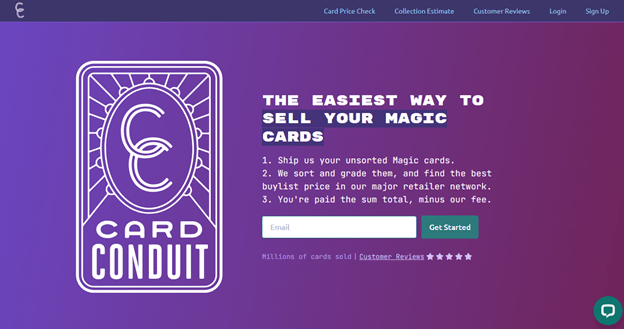
Card Conduit is a super easy way to sell your whole Magic collection without doing all the sorting and listing yourself. Instead of sending cards to different stores, you ship everything to them once, and their team handles grading, pricing, and finding the best offers across multiple vendors. This saves you time and usually gets you close to the same payout you’d earn selling cards on your own. They consolidate everything, reduce shipping costs, and keep the process stress-free. It’s a trusted option in the MTG community and perfect if you want a simple, hands-off way to turn a big collection into cash.
Requirements
Getting started is simple. You create an order on Card Conduit’s website, ship your collection to their U.S. facility, and they take it from there. You don’t need to sort or sleeve anything—just pack your cards securely. They accept collections of almost any size, though the service is most efficient for large lots. Once your cards arrive, Card Conduit processes them, sends you a full report with an itemized breakdown, and gives you a final offer. Their standard service fee is 10% of the sale total plus $0.03 per card processed, which is deducted from your payout after the sale. Processing time varies based on collection size but usually takes a couple of weeks for bigger shipments.
Limitations
- Card Conduit’s 10% fee plus the per-card charge can add up, especially if your collection contains mostly bulk or low-value cards. In some cases, those cards might not even cover the processing cost. You’re essentially paying for convenience—less profit, but far less work.
- You need to be comfortable shipping your entire collection and waiting while they evaluate it. While Card Conduit focuses solely on Magic cards and won’t handle other games or accessories, they will exclude valueless bulk and may offer to return or donate it.
#5. Star City Games (SCG)

Star City Games, or SCG, is one of the most well-established Magic: The Gathering retailers in the U.S., known for their huge online store, SCG Con events, and decades of experience buying collections. They make selling easy with their online Sell List, where you can lock in prices, or their Ship + Sell program, which lets you send your whole collection and have their team sort and grade it for you. They process orders in a few days and pay by check, PayPal, or store credit, and they also buy in person at major events. Their offers are fair—usually around 50–80% of market value—and they sometimes run promotions that boost store credit even higher, making SCG a reliable and flexible option for collections of any size.
Requirements
To sell online, you’ll need to create a Star City Games account and submit your list through their Sell List cart system. Once you finalize your order, you must ship it within two business days to keep the quoted prices—late shipments can be repriced. Cards should be unsleeved, sorted, and packed carefully before sending. If you’re using the Ship + Sell option, all you have to do is fill out a short form and send in your cards unsorted; SCG’s team will handle the rest and send you an offer once they’ve reviewed and graded everything. For in-person sales, you can visit their store (appointments are required for large collections) or meet them at major events like SCG Con. You’ll need a photo ID if you want payment by check, and for security, in-store cash payments are capped at $200, with larger amounts paid by check. Sellers usually cover shipping costs unless the sale is done in person.
Limitations
- SCG doesn’t buy absolutely everything. They don’t take foreign-language bulk, excessively played cards, or stacks of duplicates in bulk submissions.
- Prices are not always the highest—smaller specialty buyers might offer slightly better rates on specific cards.
- You’ll need to pay for shipping to their warehouse. If you use Ship + Sell, you won’t know your exact payout until after they’ve appraised everything, so it requires some trust in their grading.
- Additionally, SCG doesn’t always offer a standing store credit bonus; those usually come through limited-time promotions.
#6. eBay

eBay is one of the most popular places to sell Magic cards and full collections, even though it isn’t dedicated to MTG. You can reach buyers worldwide and sell anything from single high-value cards to sealed boxes or mixed lots. The best part is control—you set the price, choose auctions or Buy It Now, and decide how your cards are listed. Because you’re selling directly to players and collectors, you can often earn close to full retail value, especially for rare or in-demand items. It’s also flexible enough to handle things most buylists won’t take, giving you plenty of options based on how much time you want to put in.
Requirements
Selling on eBay starts with creating a seller account and listing your cards or collection. You’ll need to write clear titles and descriptions, upload good-quality photos, and specify key details like card condition, set, and language. You can sell cards individually, in small bundles, or as one big lot—whatever fits your goal.
When an item sells, you’re responsible for packaging it safely and shipping it quickly, with tracking for higher-value sales. eBay charges around 12–13% in fees, which are automatically deducted before you receive payment (deposited directly to your bank). You’ll also handle buyer communication and any issues that come up, so being honest and accurate in your listings helps protect your reputation. Overall, eBay requires some time and effort, but it offers powerful tools and massive reach if you want to manage your own sales.
Limitations
- Listing lots of individual cards can be tedious, and shipping dozens of small orders adds up in both cost and time.
- You’ll pay roughly 10–15% in combined fees, which eats into your profits.
- Another challenge is dealing with buyer disputes—if someone claims a card didn’t arrive or wasn’t as described, eBay tends to side with the buyer.
- Selling entire collections in one go tends to bring in less than selling pieces separately, since bulk lots attract resellers hunting for bargains. For example, a big 10,000-card listing might only sell for a few cents per card unless you clearly show valuable inclusions.
- eBay isn’t ideal for dumping bulk or trying to cash out quickly. It rewards effort and presentation—if you’re patient and organized, it can yield some of the best returns available.
#7. Local Game Stores & In-Person (Conventions)
Selling your Magic cards in person—whether to a local game store (LGS) or at major events like MagicFests or CommandFests—is the most direct and immediate way to cash out your collection. Many stores and convention vendors buy cards for their own inventory, and you can often just walk in with your binders and boxes.
The best part? You usually get paid right then and there, no shipping or waiting required. It’s quick, simple, and face-to-face. You can negotiate on the spot, compare offers between vendors, or sell parts of your collection like bulk rares or commons that online platforms might not take. For many players, it’s also a great way to support their local community while keeping things hassle-free.
Requirements
If you’re selling a huge collection, it’s smart to contact the store ahead of time—walking in with thousands of cards unannounced can be overwhelming for smaller shops. For smaller sales or high-value singles, you can usually just stop by during regular business hours. Most stores prefer that your cards are unsleeved and at least loosely sorted, with bulk separated from the more valuable pieces. Bring a valid ID, since many shops need to record seller information for larger transactions, especially if they’re paying by check.
At conventions, expect to fill out a short form, possibly wait in line, and spend some time while the buyer reviews everything. Having a rough idea of what you’re selling can help you negotiate better, but it’s not required—these transactions are usually casual and quick.
Limitations
- Local stores and event vendors typically pay less than online buyers—often around 50% of market value, sometimes lower. They need to make a profit reselling the cards, so you’re paying for the convenience of instant payment.
- Smaller stores might also be selective, taking only cards they know will sell and passing on bulk or heavily played cards.
- Conventions offer more competition between buyers, but not everyone there buys bulk, and the lines can be long.
- If you live far from an event or big store, travel costs can add up, too. For safety, always meet in public spaces if selling locally through classifieds or meetups.
When Should You Sell an MTG Collection?

Smothering Tithe | Illustration by Mark Behm
The best time to sell your Magic: The Gathering collection really depends on your situation. Maybe you’ve been crushing it at events and now have more prizes than you know what to do with—uncut sheets, sealed boxes, full sets, and piles of booster packs stacking up everywhere. At some point, your space just can’t keep up, and it makes sense to start selling the stuff you’re not using before it turns into clutter.
On the other hand, if you’re like me and mostly play digitally these days, with no plans to return to in-person events, selling off your physical cards can be a smart move too. It frees up space and gives you extra cash for things you’ll actually use.
Of course, you’ve probably heard those legendary stories of players selling old collections and walking away with enough to buy a house. While that’s not common, it’s not a myth either—some cards really do hold incredible value over time.
And finally, there’s the more difficult but very real reason: Sometimes you simply need the money. Whether it’s to pay off a debt or cover unexpected expenses, selling part of your collection can be the right choice. It’s not ideal, but it’s a practical way to turn your cards into something that helps you in the moment.
Should You Sell Your Entire Collection Online or at an LGS?
That really depends on what matters most to you—time or money. Selling online usually gets the highest payouts, especially for valuable singles, sealed products, or rare collectibles. Platforms like TCGplayer, eBay, or services such as Card Conduit let you reach thousands of buyers, and you’ll often earn close to full market value. The trade-off is effort: You’ll need to list, pack, ship, and sometimes deal with buyer questions or fees. It’s the best route if you’re patient and want to maximize profit.
Of course, selling online comes with its own risks. There’s always the fear of sending your collection and never hearing back, or dealing with shady buyers who claim something went wrong. That’s why it’s crucial to stick with trusted and reputable platforms—companies like AncestralMTG have strong track records and secure processes that protect both sellers and buyers.
Selling to a local game store (LGS), however, is much faster and simpler. You bring your collection in, they look it over, and you can walk out with cash or store credit the same day. The downside is that LGS offers are lower—usually around 50–70% of market value—because they need room to resell for profit. Still, if you value convenience or just want everything gone in one go, it’s a solid choice.
How Much Should You Expect for a Collection?
What you’ll earn for your Magic collection depends on where and how you sell it. In general, expect to get less than full market value when selling to retailers or local stores since they need to make a profit on resale.
If you decide to sell directly to players—through online marketplaces, social media, or forums—you can sometimes get closer to retail value, but it usually takes more time and effort. Plus, those methods often come with listing fees or potential scams if you’re not careful.
Wrap Up

Trading Post | Illustration by Adam Paquette
Deciding to sell a big Magic: The Gathering collection can stir up a lot of emotions. Whether you’re doing it to clear space, shift focus, or handle something more personal, it isn’t always an easy call. My biggest takeaway? Know exactly what you have and what it’s worth before you make any moves. Once you have a fair estimate of your collection’s total value, expect to earn about 70% of that amount.
That said, some items can break the rule. Products that are rarer or harder to find—like certain Secret Lair drops or limited-edition promos—can fetch higher-than-expected prices, especially if they’re in pristine condition. So take your time, do your research, and don’t undersell yourself.
Thanks for reading, and if you enjoyed this breakdown, remember to follow us on social media so you never miss new MTG content.
Take care, and we’ll meet again in the next article!
Note: this post contains affiliate links. If you use these links to make a purchase, you’ll help Draftsim continue to provide awesome free articles and apps.
Follow Draftsim for awesome articles and set updates:










Add Comment