
Last updated on November 28, 2025

Unexpected Windfall | Illustration by Alayna Danner
Selling cards doesn’t always mean liquidating an entire collection. Sometimes you just need a quick buck, or you opened the new chase card from a set that you have no intentions of using. Or you’re just trying to work your way towards something pricey, and, much like my middle-aged belly, you’ve got bulk to spare. And sure, sometimes you want to liquidate a whole collection.
There are myriad ways to sell your Magic cards, many of which are trusty, household names in the MTG community. Others might be a little more obscure, or less MTG-focused, but either way there are plenty of avenues to turn your cards into cash.
Guide: How I Ranked the Ways to Sell

Decision Paralysis | Illustration by Vincent Proce
Accessibility, familiarity, and personal recommendation all factor into the entries I’d be comfortable suggesting to someone looking to sell cards.
Accessibility means there shouldn’t be too many obstacles between the cards you want to sell and the cash you want instead. You might have to order through a website and ship something out, or actually drive somewhere, but it should at least be a straightforward process.
Familiarity means I’m just more likely to recommend places with a proven track record in the MTG community. I’m aiming for well-known brands and names here, things most Magic players will recognize, since they have trustworthy reputations.
And I’ve included just one or two personal recommendations that I can back because I’ve used them myself and believe they’re great alternatives to some of the more widely known methods of selling cards.
Honorable Mention: Card Router

Card Router isn’t a site you sell directly to, but rather an optimization service that links you to the best places to sell your cards to. It essentially lets you create a list that’s then compared across the buylists of multiple big-name retailers, and it suggests where you might want to direct your attention.
This can be a handy tool if you don’t yet have a preferred place that you like to sell to, and it’s great for cross-comparing prices across multiple different sites at once.
#13. Whatnot

Whatnot is a little bit different than most platforms, and I’ve never engaged with it myself, so I’m a little wary to give it a full recommendation. The basic idea is that people record the items they’re looking to get rid of, and the audience can bid on what they want to buy. I’ve heard the resulting process described as “degenerate gambling” before, though that’s obviously on the buyer’s end more than the seller.
This is also a much more involved process, requiring a recording set-up and a volume of product worth displaying in this way. It’s better used for consistent sellers who are trying to offload the leftovers from box openings or have a constant stream of incoming cards that they’re then looking to flip for a profit.
#12. Local Game Stores
If you want Magic to thrive, you should support your local game stores. These are the places where Magic actually gets played, and buying from/selling to stores helps them thrive and keep a community for the game going.
Of course, every game store has its own established parameters on how to purchase your Magic cards. Many of them will offer cash upfront, usually based on market prices from sites like TCGplayer, though you’ll only be getting between 50-80% of a card’s actual worth this way. That’s to be expected—remember, they’re a business that needs to make a profit off what you’re selling them. Also, many stores will offer bonus store credit if you’re looking to just move cards into other product.
#11. MagicCons and Other Conventions
Selling cards in person is a great way to offload what you need without the hassle of packaging and shipping. Of course, you need to find people who are interested in what you have to sell, and your LGS isn’t always going to want those boxes of bulk you have lying around.
Finding vendors at large-scale Magic tournaments can be a great way to sell off large quantities of cards. Events like MagicCons and CommandFests have multiple vendors looking to buy and sell cards. They’ll often have rates for cards by rarity, so you could sell large quantities of bulk rares or mythics for a set price. Some larger vendors will even buy excess bulk by the box (something along the lines of $3 per 1,000 commons), though you might need to contact the vendor before you try to sell them an enormous quantity of cards.
#10. Journey’s End Game Video Selling

Draftsim writer Bryan Hohns recently reviewed a video selling option from Journey’s End Games, a game store located in Moscow, Idaho. The process involves setting up a date and time and joining a video call where you show a store representative what you intend to sell. It has all the benefits of talking directly with a vendor, which can be great for bargaining and asking questions, and lets you do so from the comfort of your own home.
However, it also requires at least a rudimentary webcam set-up, since you’ll need to show the physical product you intend to sell. It also requires direct contact with other humans, which can be a deal-breaker for people who prefer the comfort of automation instead. Video selling is a fairly underexplored way to exchange MTG cards, so try this out if you have a lot of product lying around, and check out Bryan’s review of the process.
#9. eBay

Selling on eBay can be a bit daunting. It’s not that far off from Amazon and a little more official than selling through something like Facebook Marketplace. You’re working directly with individual buyers here, though there’s no in-person meet-up required. You can also set whatever prices you’d like for the items you’re selling, though you’ll want to remain within reason and base your prices at least somewhat on general market prices.
eBay can also be a solid option for selling small collections, lots, or bulk. If you have a box of commons and uncommons lying around, throw it up on eBay for $10-20 and see if anything sticks. If you have individual high-dollar cards to sell instead, you can make individual listings and see who’s interested. One of the advantages of selling in this manner is that you’ll often get the full value of a card, as opposed to taking around a 25% hit on market value by selling to a business that needs to make a profit off your sale. That said, there are shipping and eBay fees to consider, so make sure what you’re selling is worth it in the end.
#8. Amazon
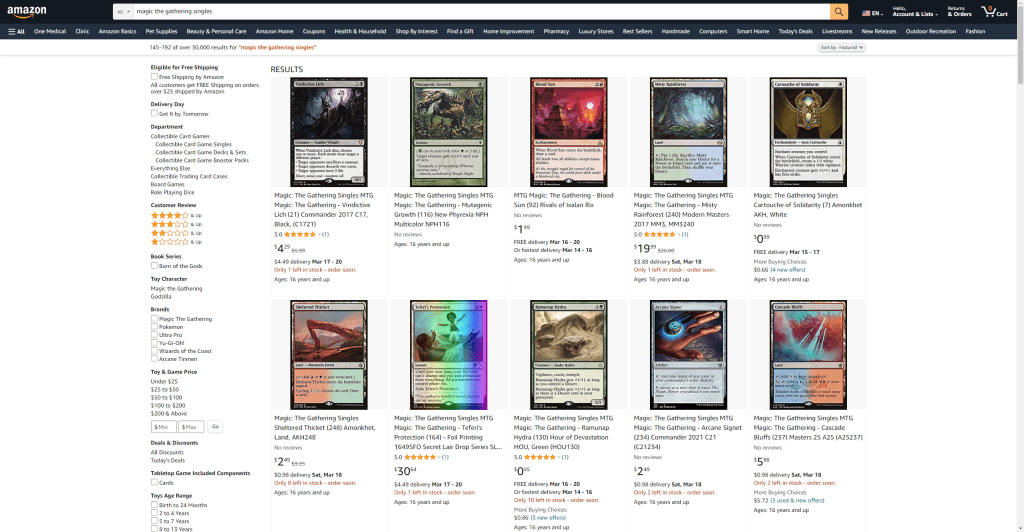
It’s Amazon. You know it, you don’t love it, but you use it anyway. If you want to fill your and Bezos’s wallet at the same time, feel free to browse your seller options on Amazon. It’s better suited for selling high-price, in-demand items, like Standard or Modern all-stars, or sealed product like Secret Lairs, Commander precons, or booster boxes. It’s not worth trying to sell $1 cards and the like here, so save those for larger lots or retailers interested in buying chunks of cards at a time.
#7. Facebook Marketplace
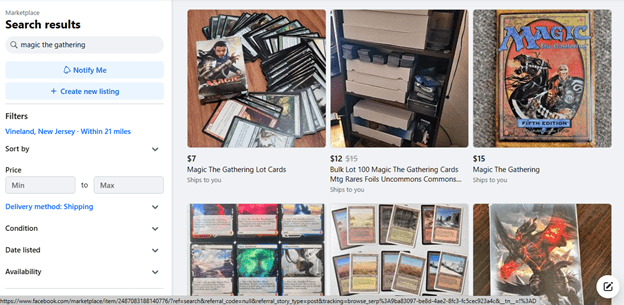
Full disclosure about Facebook Marketplace: You’re dealing with completely random people here, and you often have to complete a transaction face-to-face, so be smart, always schedule sales in public places, and feel free to haggle a little bit. If you’re able to weed out the occasional strange message or people randomly ghosting you after you answer a simple question, then you might just find success here. It also happens to be decent for buying Magic cards, too.
When listing on FB Marketplace, you should be as precise as possible about what you’re selling, how much you’re asking for, and what condition your cards are in. Obviously if you’re selling large bulk boxes full of cards, you don’t need to list everything that’s up for grabs, but people should have a basic understanding of what they’re getting if you sell them something.
I recommend Facebook Marketplace as a starting point before transitioning to something a little more… concrete. I’ve managed to sell tons of unopened Secret Lairs, as well as random things like stacks of foil lands, full-arts, etc. You’d be surprised how often people are interested in the cards you have to sell.
#6. Cardsphere
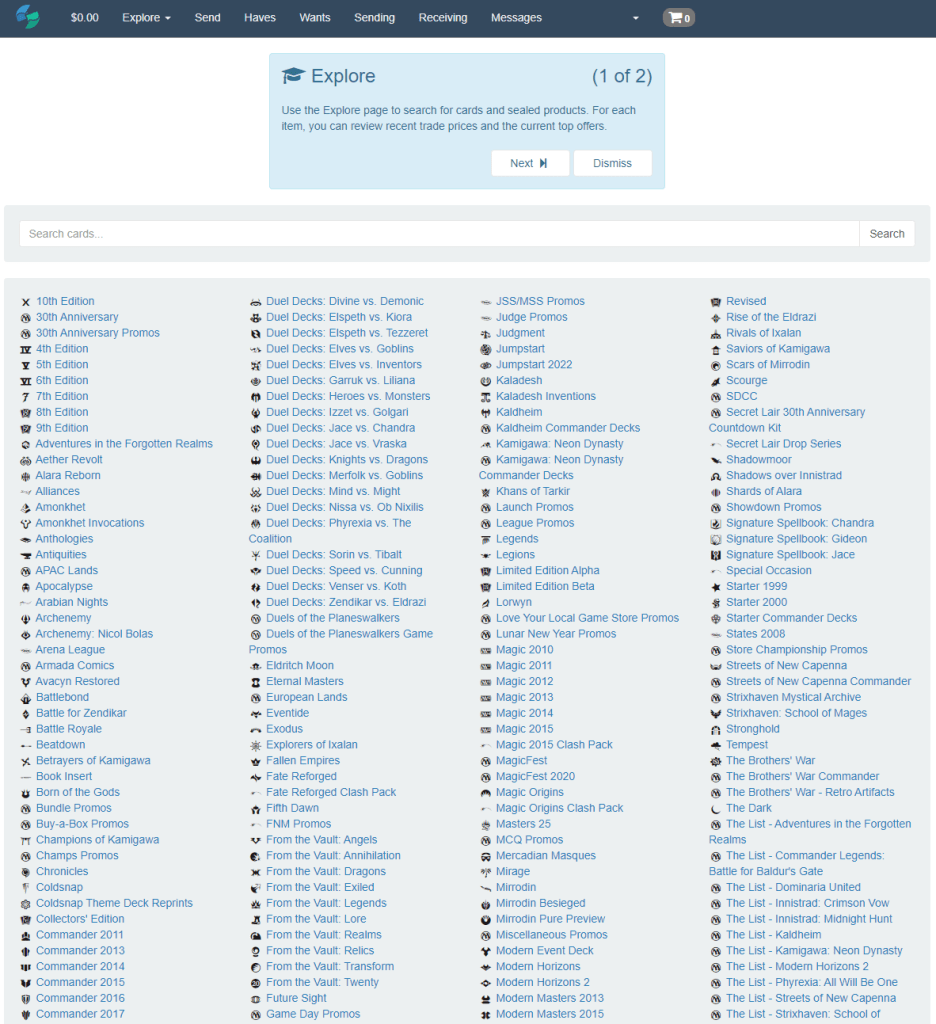
Cardsphere would’ve been one of my personal recommendations, even before reviewing the site for Draftsim. I’ve used this P2P site as a means of offloading cards ever since PucaTrade shut down. It’s not exactly aimed at selling cards, but that’s an option.
Normally, Cardsphere users send their unwanted cards to other users, which accumulates a sort of bank roll that’s then available to other players to send cards to you from a curated wants list. However, you can opt out of the receiving end of the site and just use it as a means to send cards to others, then cash out whenever you want to.
It’s not my first choice for straight-up selling cards, since Cardsphere’s economy usually revolves around buying and selling cards at lower than market price (you can trade people cards for 50% of their value, but you also receive cards at a discounted rate, for example). It also involves mailing to a bunch of individuals, which is extra time and money. It’s more of a back-pocket option for selling cards, though I do highly recommend it if your goal is to trade towards other MTG cards.
#5. Star City Games

The final stretch of entries here includes the big-name Magic retailers that you’re probably aware of if you’ve been playing Magic for any length of time. I’m not a huge fan of buying from Star City Games, but selling to them is always an option.
It’s much the same process with sites like Star City Games, TCGplayer, Card Kingdom, etc., and a lot of the differences come down to the exact seller fees, the buylists each individual site has, and how you need to ship your cards. In Star City’s case, they’re buying directly from you, rather than serving as an intermediary between you and a customer, so you can ship single packages full of cards to one location. They’re also a trustworthy name in the business, and you’ll often find them at conventions, or even spearheading their own SCG Con tournaments, which can be a great opportunity to sell in person.
#4. Cardmarket

I’ll shout out Cardmarket for our European friends who don’t necessarily want their cards shipped to them overseas. If you’re not in Europe and still want to order from Cardmarket, just be aware that you don’t receive anything directly from the website. It’s composed of private sellers, and there are fees involved with overseas shipping, so this isn’t the best place to shop if you’re in the States, Canada, etc.
One thing I’ve learned after tracking tons of Magic card prices is that the American and European MTG markets are completely out of synch. You can find cards that have spiked to $10 in the United States still hovering in the 1€ range on Cardmarket. That’s great news for the European market, even if it doesn’t help those of us over in the US.
#3. Card Kingdom
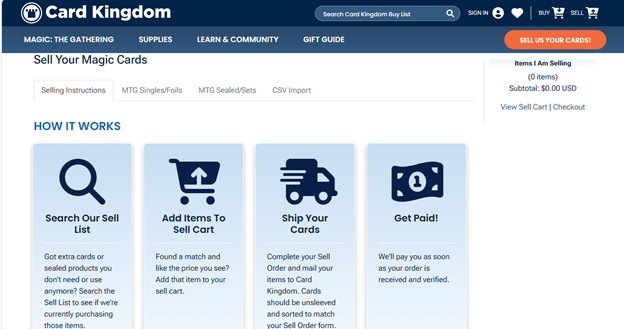
Card Kingdom is an MTG juggernaut that specializes in Magic: The Gathering. It’s a great website for selling singles or sealed product, though note that they’ve paused buying collections or bulk for the time being.
Card Kingdom also has an excellent buylist, and it’s a great tool to browse through and see what you could send their way without having to list everything you own first. Of course, this list usually contains high-demand cards that the site always tries to keep in stock, making them a great first stop for any chase cards you’ve recently opened that you don’t plan on keeping.
#2. TCGplayer

As the most trusted site for tracking accurate card prices, TCGplayer’s also unsurprisingly one of the best places you can sell your cards to. There are fees involved as you might expect, and you’ll have to ship out everything you sell. If you’ve ever purchased a stack of cards from TCGplayer, you probably know how many envelopes you could end up getting, so expect the reverse of that when selling cards too. But TCGplayer exposes your inventory to a massive net of potential buyers, making it an exception platform for selling sealed product or high-end collectibles.
TCGplayer also has a mobile app that makes uploading a collection easier, though it’s probably not the best for inventorying large amounts of bulk, since you need to individually scan cards.
#1. AncestralMTG

AncestralMTG is a very unique Magic store. They deal in the utmost high end of Magic cards: everything from test print Black Lotuses to uncut sheets and more. That makes them our number one pick when it comes to selling your Magic cards, especially if you’re looking to offload some premium vintage or incredibly rare cards.
Their customer service is top-notch. Their goal is to get you the highest price for your valuable cards. That means that if they can’t make you a strong offer, they’ll refer you to the stores that can so that you can make an informed decision, rather than trying to lowball you in hopes that you’ll cave.
How To Sell Your Cards in Person
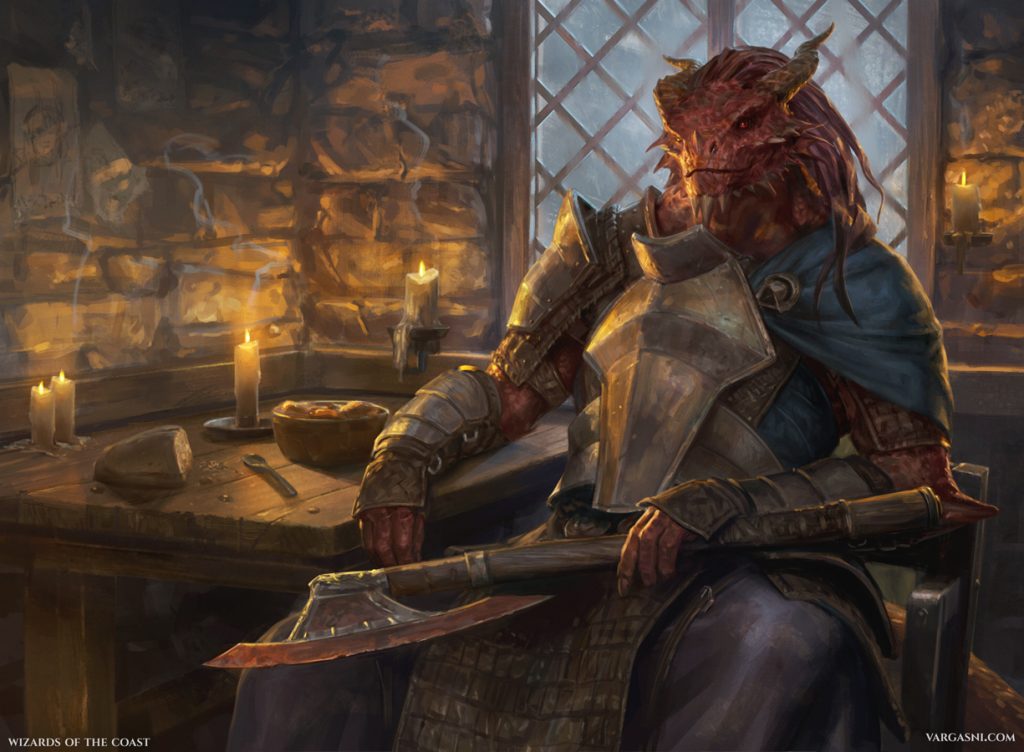
Jaded Sell-Sword | Illustration by Randy Vargas
You give them your cards, they (hopefully) give you money. Ok, it’s a little more nuanced than that.
There’s a stark difference between selling through a platform like Facebook Marketplace and meeting a stranger in person, or going to a local game store or convention and selling to a professional.
Selling to an LGS is usually pretty easy: Just go to a store near you and ask what their policy on buying cards is. In many cases, they’ll be willing to look through a small collection or stack of cards and give you a price on the spot, though at a discounted rate from the total expected market price. The same goes for selling at a convention, though there can be wait times depending on when you go and how much you have for someone to look through.
Where Can You Sell Your Entire Collection?
You’ll want to go to one of the big-name Magic retailers to sell a full collection, likely Star City Games or Card Kingdom. These sites have features that’ll price out an entire collection once you’ve uploaded what you have, and you can make a decision about whether you’re getting as much as you’d like in return.
I don’t recommend trying to sell a large collection in person unless you’ve contacted the seller already. You don’t want to barge into the LGS during FNM with 4,000 loose cards and seven binders for them to rummage through, so try to contact them first and see when you can drop a collection by for an estimate.
Sites like eBay and Amazon aren’t ideal for selling collections either, and are more suited to single-card purchases.
When Should You Sell Your MTG Collection?
Everyone knows that person who “had three Black Lotuses and a playset of every Dual Land” and got rid of them back during the Bush Administration. Sucks for them, but sometimes it’s just right to sell off your cards.
The most common case is that you just don’t play the game anymore and have no real intentions of coming back to it. If you tried it out for a year and it didn’t stick, or you’re just not enjoying Magic, selling what you have to invest into a different hobby is always fine. Just be sure you’re not going to come back in a year before you liquidate everything.
And in some cases, you just need some quick money, and you might have to part ways with some of your collection to tend to more pressing matters. I’m thankful I’ve never been in this position, but I know at least two people who have funded major emergencies in their lives by offloading Magic cards. Magic’s like a mini-investment of sorts, and sometimes you need to cash out.
Are Commons Worth Selling?
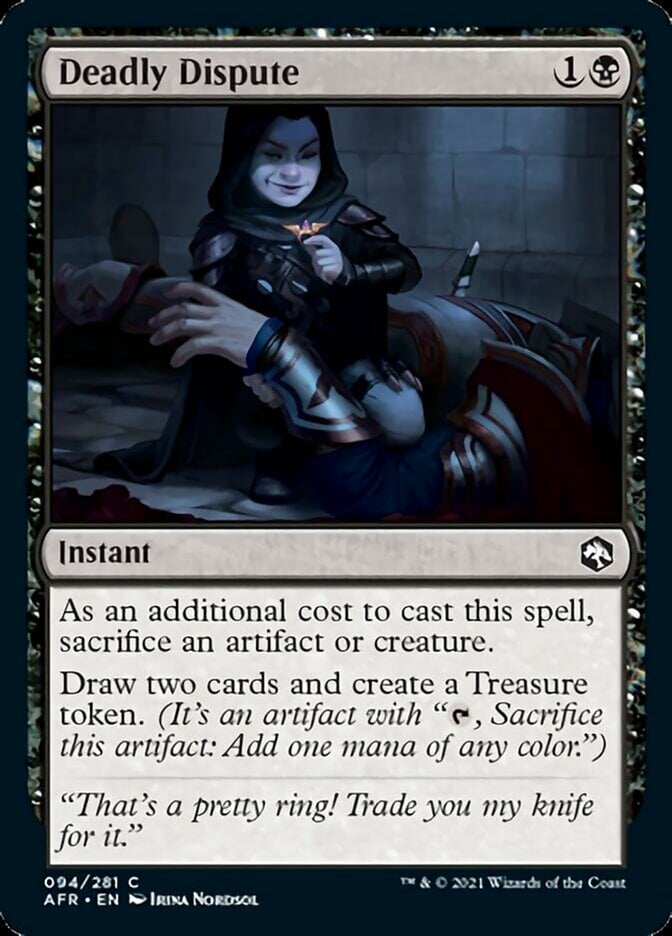
Some commons are worth money, especially specific foils or older cards that get played in formats like Pauper. However, the vast majority of commons aren’t worth trying to sell on an individual basis. People won’t generally be buying them, and the price of a common usually doesn’t justify the cost of the stamp you’d have to use just to mail it to someone.
That said, you can sometimes sell large amounts of commons at one time. Many game stores are known to buy boxed bulk for a certain amount per 1,000 cards, and you could even try to sell a huge collection of commons as a lot on somewhere like Facebook Marketplace. Just be forthcoming about what you’re selling, and don’t try to trick people by acting like it’s anything other than a big box of commons.
Can You Sell Cards on MTG Online?
It can be a slightly convoluted process, but it is possible to sell cards from your Magic Online collection. One way is to simply sell to bots on the digital platform and turn your cards into tickets, which can then be used to participate in events or buy other products.
The other method involves using sites like Manatraders or Cardhoarder and following their guidelines for selling MTGO cards. This usually involves sending them an itemized list of what you want to sell, engaging with one of their MTGO bots to actually send them the cards, and having them send you your payment through PayPal or some digital wallet. I recommend reading about this process more in depth here, especially if you’re looking to sell out of MTGO.
Sold Out
Currency Converter | Illustration by Sean Murray
There you go, a few thousand words smarter and hopefully a decent chunk of Magic cards lighter. Selling Magic cards doesn’t always have to be as tragic as falling out with the game and pawning off an entire collection; sometimes you just have spare cards you don’t need and you want to turn them into cash! Which, of course, you’ll spend on booster packs to get more spare cards you don’t need. The Circle of Magic.
Did any of these entries help you find a new way to sell cards? What’s your preferred method of getting cash for your cards, whether one at a time or in larger collections? Let me know in the comments below or over in the Draftsim Discord.
Thank you for making Draftsim your #1 stop for all things Magic!
Note: this post contains affiliate links. If you use these links to make a purchase, you’ll help Draftsim continue to provide awesome free articles and apps.
Follow Draftsim for awesome articles and set updates:










Add Comment