

Chronomancer | Illustration by Alexey Kruglov
Cube is unequivocally the best way to play Magic: The Gathering. I’m a Limited nut myself, so I’m already bias towards that mentality, but Cube weeds out all the worst parts of normal retail Limited sets and leaves you with the best. And there’s so much innovation with Cube, especially since it’s sort of exploded over the last few years.
Behind every great cube is a cube curator who’s worked hard to compile the cards in their list, sleeve up 500+ Magic cards, and get enough people together to actually enjoy some free Limited Magic. Cube construction is an art, and it can be intimidating trying to get started with your first cube. I’ll put my nearly 10 years of Cube experience to good use here and give you all the tools you need to get started. All you’ll need to do is get the cards.
What Is a Cube in MTG?

Clue Token (Doctor Who) | Illustration by Greg Opalinski
Cube is an MTG format in which individuals create their own Limited environment by curating a list of cards and drafting it with others. It’s a fully customizable experience, allowing the cube curator to choose whatever cards and themes they want for their environment. The intent is to create a repeatable, draftable set of cards that the curator can adjust as they see fit. It’s literally like designing your dream Limited set.
Cubes are almost always Singleton in nature, meaning there’s only one copy of each card outside of basic lands. You won’t be hunted down if you play multiple copies of cards, but the expectation going into a cube is that it’s Singleton unless otherwise stated by the cube designer.
Cube drafting works like normal draft, and there are tons of variants out there, from normal cubes approximating someone’s favorite Limited set to a cube where the only creatures are literally 100 Ornithopters.
Cube Sizing
If you’re looking to get started with your first cube, there are some logistical questions you need to answer first. To start with, how big do you want your cube to be? Here are the typical sizes you’ll see for most cubes:
- 360 cards: Enough for 8 players to draft 3 packs of 15 cards each. If you draft with 8 players, all 360 cards will be opened.
- 450 cards: Same intent as 360, except with more variance since 20% of the cube won’t be opened in an 8-player draft. 450 also accommodates 10 players with three 15-card packs each.
- 540 cards: Perfect for adding tons of variance from draft to draft, and can accommodate pods of most sizes. You’ll see this a lot with digital cubes like MTGO’s Vintage Cube or Arena’s cubes, since they have tons of replayability to them and the larger cube size keeps repeat drafts feeling fresh.
- 180 cards: Often called a “Twobert” (coined by Ryan Overturf), this is a mini-cube intended for 2-4 players.
I’m a 360 believer myself, since I like knowing that every card in the cube will be present in the draft, or in a fellow drafter’s deck/sideboard somewhere. But there’s merit to all sorts of cube sizes, and you can play as many cards as you want. The more cards you have, the more variance you’ll see from draft to draft with a typical 8-player group. I’ll be using 360-card cubes for most of the following recommendations, though you can always scale up to larger cube sizes.
Remember that you have to provide basic lands for your drafters, ideally enough for multiple people to comfortably draft the same colors, and the number of basics you’ll need increases with your cube size.
Cube Legality and Rarity Restrictions
All restrictions on Cube are self-imposed. You don’t have to adhere to any banlists when you’re the one in control of what’s being played.
There are some expectations though. “Pauper Cubes” and “Peasant Cubes” are quite common (pun intended), and impose rarity restrictions on the cards that are playable within those cubes, just like the Constructed formats of the same names. A Pauper Cube can only run cards that have been printed at common rarity, and Peasant Cubes (my favorite) include uncommons. These are the preferred cubes of choice for people who aren’t keen on explosive rares and game-warping cards.
Cube Themes

Bootleggers' Stash | Illustration by Dominik Mayer
Most cube curators have some sort of overarching theme to their cube. That can be something broad like Pauper/Peasant or high-power Vintage cubes only interested in playing the best of the best. You’ll also discover more granular themes, like cubes built around a single card, or a plane in the Magic multiverse, or a particular format. Here are some of the most common themes you’ll encounter:
- Plane Cubes: Cubes built around a particular setting, flavor, or grouping of MTG sets. For example, you might see an “Innistrad Cube” that only includes cards originally printed in Innistrad sets, or cards that match the flavor of Innistrad.
- Set Cubes: Cubes trying to capture specific Limited environments or blocks by recreating the original set(s). The idea is to rebuild a set or sets someone really liked and offer a way to repeatedly draft them. These could also be “remixed” versions of a set that remove some of the problematic cards from the original, or look to bolster existing strategies in some way.
- Standard / Modern Cubes: Cubes using the cardpool from their associated Constructed format, often adhering to the format’s banlist.
- Legacy / Vintage Cubes: Cubes that are open to cards across all of Magic’s history, including cards printed outside of Standard sets (Commander decks, for example).
- Powered Cubes: Generally refers to Vintage Cubes that include copies of The Power Nine, as well as ultra-powerful cards like Time Vault.
- Peasant / Artisan Cubes: Cubes that only use commons and uncommons. Artisan is the Arena-specific name for Peasant. Pauper Cubes similarly only use commons.
- General Cubes: Cubes that aren’t really purposefully thematic, and instead focus on macro-archetypes like supporting aggro, control, midrange, etc. These are highly focused on good gameplay rather than a quippy theme.
- Novelty Cubes: Cubes centered around a specific gimmick or drafting gameplay trick. Desert Cube is a great example, as a Cube variant in which you must draft all lands you intend to play.
Selecting Archetypes
Here’s the tricky part of crafting your cube. You know how large you want the cube to be, and you know what category it fits in (360 Pauper Cube, for example), but what cards should you actually play? What archetypes should you support? What should each of the color pairs do?
The answer really comes down to what you want to play. If you built a cube because you really wanted to play with a bunch of your favorite +1/+1 counter cards, you can support that in the appropriate sections. If you love playing artifacts and you want them to be represented in your cube, there’s tons of artifact support across nearly all color pairs in Magic.
Even if you begin cube-building with some preconceived notions of how you want each color pair to play out, there are some general guidelines worth considering.
- Avoid parasitism, and look for ways to cross-synergize your archetypes. The more the different strategies bleed into one another, the more flexibility drafters have, and the more unique decks you’ll see.
- If you’re struggling to think of what a color pair should be doing, just ask yourself what it generally does in most Magic sets. Izzet () is always the spells color pair, Orzhov () usually deals with tokens/sacrifice, Simic () ramps and draws cards. Lean into the identity of the color pairs and you’ll find there’s tons of support for each one.
- It’s a bit advanced, but you might want to approach these as “emergent archetypes”. That means building out the mono-colored sections of your cube first, then seeing how the individual colors fit together to see what the 2c decks might look like.
Color Distribution

The Prismatic Bridge | Illustration by Johannes Voss
I’m going to give you a skeleton you can follow to equalize the different sections of a new cube, but I want to stress that these are not hard and fast rules. There’s nothing saying you must have the same number of cards in each colored or multicolor section, and you have complete freedom to adjust these numbers as you wish.
That said, I’d urge beginner Cube creators to aim for equal sections as a starting point, and make adjustments once you know how the cube plays.
Here’s a general distribution of cards you might see in a 360-card Cube:
- 50 White cards
- 50 Blue cards
- 50 Black cards
- 50 Red cards
- 50 Green cards
- 40 Lands (4 dual lands per color combination)
- 40 Multicolor cards (4 cards per color combination)
- 30 Colorless cards (including artifacts and colorless utility lands)
Again, there’s no rule saying this is what a Cube needs to look like, but it’s a great starting place. You might decide you want fewer gold cards and more cards in each mono-colored section, and that’s fine. Many people actually prefer the opposite and want to play with more gold cards, which is also fine (just don’t make your environment too on-rails). You also don’t have to play any set number of colorless cards/artifacts. They’re useful, but they’re not mandatory. Don’t play mediocre colorless cards just to fill out the section.
The one place I highly recommend not cutting from is the section of lands. In general, cubes play better when players have ample mana fixing to choose from, and a high land count can help you with that.
Cube Products
Starter Cubes
There have been various admiral attempts by high-profile MTG names to create “Starter Cubes” that people can buy as the framework for a cube, which they can then tweak as they see fit. Some examples include the Card Kingdom Starter Cubes, as well as Tolarian Community College’s “Foundations” Starter Cube, which combined cards from the Foundations set and the Foundations Starter Collection. These are usually in the $100-200 range and give new Cube creators a great starting point. Only problem is… they’re kind of not available anymore.
That said, you could always peruse eBay and Amazon for people selling custom-made starter cubes, though I’d make sure there’s a card list I could check before buying them. I found a 360-card Starter Cube on eBay for $99.99, but the contents weren’t listed, which is a no-go for me.
Sleeves

Unless you really, truly don’t care about the condition of your cards, sleeves are a must, especially with how many double-faced cards they print these days. And remember, you’ll need sleeves not only for the cards in the cube, but also the basic lands you’ll need pre-sleeved for your players. If you’re compiling a 360-card cube with 30 of each basic land, that’s 510 total sleeves you’ll need, and even more for a 450+ card cube.
I personally like to double-sleeve my cubes, and recommend others do the same, with a normal card sleeve and an inner sleeve facing the opposite direction. This keeps the cards in a sort of air-tight package that prevents them from getting dusty as your cube sits in a drawer waiting for you to find seven other people to draft it.
I personally like UltraPRO's Penny Sleeves as a clear, inner sleeve, as well as matte Dragon Shields for the outer sleeve. You can go with whatever sleeves you like, but I’d avoid anything too cheap; you don’t want sleeves splitting on people constantly, and you want something with a good shuffle feel.
- Play with peace of mind knowing your cards are safeguarded by Dragon Shield sleeves
- Made from high quality material
- Perfect for organizing your cards
- Experience the silky-smooth shuffle feel of Dragon Shield sleeves
Cube Storage

I’ll be honest, I keep my cubes in old Fat Pack boxes, and my main cube in a Battle for Zendikar Gift Box. These… aren’t ideal storages, but they do the trick. If you’re going to be moving your cube around a lot, or maybe you’re packing it up and heading to CubeCon next year, I recommend getting something a little nicer.
One recommendation I’ve heard a lot is the Dex Protection Supreme Game Chest, which you can find on Amazon in the $60-70 range. Again, another pricey purchase, but something that’ll go a long way if you plan on playing your cube a lot. Alternatively, just use one of those long white storage boxes that people use for bulk, and make sure your cards are sleeved. It’ll do fine, especially if you Sharpee your name on the top for authenticity.
- ULTIMATE GAME STORAGE – The Supreme Game Chest features two deck storage rows. The larger lower row can house 550+ double (650+ single) sleeved cards and the smaller upper row can store 300+ double (360 single) sleeved cards.
- DUAL ACCESSORY COMPARTMENTS – Store dice, character figures, token markets and more with the dual accessory storage compartment on either side of the small deck row. Keep your decks and accessories together with one simple storage solution.
- CRAFTED FOR LUXURY – Our wood base construction, lined with a suede interior and smooth matte finish exterior provides an elevated sense of luxury. Safely store your decks in our trusted line of Deck Boxes.
- SECURE CLOSURE – Seal away your desks for travel or storage with confidence. The sewn-in Velcro closure strip spans the full width of the fold over lid, securely closing the Supreme Game Chest until the next adventure arises.
- CREATED BY THE COMMUNITY - Our design and innovations come from die hard gamers and collectors that know what the community is looking for in their accessories.
Proxy Websites
You can create a cube entirely out of proxies, and there are tons of proxy websites that can help with that. Printing Proxies, for example, sells cards at $0.75 per card on orders of 200 cards or more, so if you’re printing out a 360-card cube, that’s $270 for the whole thing. And that’s assuming the need all 360 cards proxied; you probably own some amount of the cube, or individual cards might be less than $0.75 to begin with.
Nearly $300 for a Cube sounds like a lot, but that’s actually pretty cheap when you consider how much real versions of all those cards might cost, as well as how much replayability you’ll get out of that initial payment. I’m not a proxy cuber myself (no shade), but if I was, I’d want my proxies to at least look good.
Cube-Building Tips and Tricks

Doc Ock's Tentacles (Giantcraft Helm) | Illustration by Claudio Pozas
The art of Cube-building can be tricky, but here are some lessons I’ve learned from my own experiences designing and playing cubes.
Avoid Power Outliers
Unless you’re intentionally trying to plant super-powerful cards in a cube of normal-powered stuff, you should avoid power outliers on both ends. That means cards that are clearly too weak compared to the average power level, as well as cards that are significantly above the average.
Some cubes operate under the premise that they’re playing the best cards no matter what, and that’s a feature of those specific environments. But if you’re looking for a more even experience where any new drafter could sit down and have a shot with any archetype, you should identify consistent overperformers and underperformers and consider whether those cards need to be axed.
Proxy Expensive Cards
Cards are expensive! But if you want to cube in paper, you need cards, don’t you? Well, there’s this little thing called proxying where you can just print out your cube and play that way. You can do this the simple way and print from home, or visit one of many proxy sites, some of which will let you print large batches of cards at discounted prices.
My experience is that most people don’t mind proxied cubes, but they still enjoy playing with something that feels and looks like a Magic card, so you’ll want nice proxies if you do take this route. The whole point is not to feel obligated to shill out hundreds of dollars to get your cube off the ground.
Seek Feedback from Your Best Players
This one might sound a bit harsh, but I’ve learned that the loudest voices in the room often come from the least skilled players. That’s not a knock against people who aren’t professional-level MTG players, but complaints like “this card is too good” or “there’s too much removal” will come from people who aren’t evaluating the game quite as intently as a more skilled player. That’s not to say you shouldn’t listen to them period, but if I’m seeking advice on what’s working or not working in my Cube, I’m going to solicit that advice from the best players.
This also means you don’t have to adjust your cube the second someone voices a negative opinion. Evaluate all feedback, but don’t feel obligated to make changes every time there’s a complaint.
The TONC Method
This isn’t really a real thing, but it’s something I say a lot in my community and on my Cube-related podcast. TONC means “Try Out the New Card”, and it’s a phrase I say to convince Cube designers to test out new cards.
Sometimes it’s very clear that a card or grouping of cards you’re considering isn’t quite as good as something you already play, but you can Try Out the New Card and give your players something new to experiment with anyway. The reverse is true, as well. You might be looking at cards from a new set, and you’re not actually sure if they’re good or not. TONC, baby! You can have all the suspicions in the world, but how will you really know unless you test it out?
It really doesn’t hurt you either. The glory of Cube is that you can just change anything that’s not working out. Worst case scenario, you TONC something and it falls flat, and you just remove it right away. Best case, you and your players fall in love with the card, and you’ve got a new lifelong Cube staple.
Keeping Cubes fresh and periodically updating is a great way to make sure players keep coming back for more.
Where to Get Help with Cube-Building

Helping Hand | Illustration by Aldo Dominguez
There are tons of great ways to watch Cube content, but Cube design is a more narrow topic. I recommend the following resources if you want more info about making cubes beyond what I can offer here.
Lucky Paper Radio

These guys are awesome, and some of the leading voices in the Cube community. If you’re going to poke around in the Cube space, you’ll hear people talk about Lucky Paper, and you can listen to their podcast for yourself to brush up on Cube design tips.
Cube Cobra
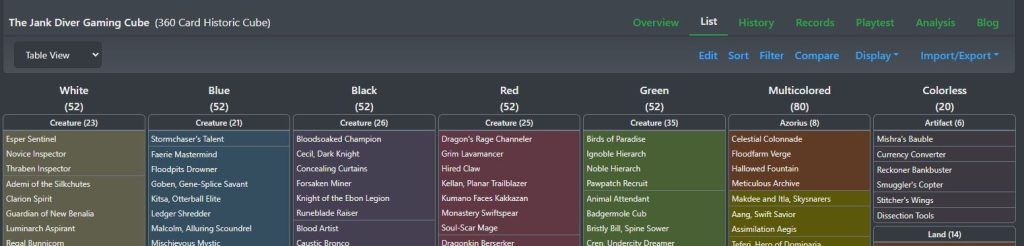
Cubecobra.com is a quintessential Cube-building tool. It’s the best place to manage a cube, it’s up to date with almost all Magic cards and all art variants, and it has great supplementary tools like a playtest feature, tagging and sorting, and even analytics data. I highly recommend tracking your cube(s) on Cube Cobra, even if you’re maintaining an in-person paper cube.
Jank Diver Gaming

Yes, I’m biased; I co-created Jank Diver Gaming, and I’m the community manager of this Discord-based Cube group. JDG focuses on digital cubing through MTG Arena, but our community is full of excellent players, designers, and over 1,000 awesome members to chat with. The JDG Discord server is our main hub for conversation, and we’re always happy to answer questions about new cubes, especially if they’re Arena-friendly!
Wrap Up
Doubling Cube | Illustration by Mark Tedin
Yeah, a little bit of unabashed self-promotion there at the end, but my community really is great, and I’m very proud of having built it. JDG has a lot to offer aspiring Cube-builders, but there are an incredible number of resources out there, and tons of Cubes to be built.
I think it was Michelangelo (not the turtle) who said he “saw the angel in the marble” and just had to set him free by carving the statue. That’s how it feels to create a Cube sometimes. Sure, it’s a bit of a monolithic comparison, but sometimes you have a vision for what you want a new Cube to look like, and you just need to piece together the cards for it.
Anyway, enough waxing poetic about Cube design, get out there and actually try it out. And share a Cube Cobra list while you’re at it! Let us know how your experience creating your first cube went in the comments below or over in the Draftsim Discord.
Thank you for making Draftsim your #1 stop for all things Magic!
Note: this post contains affiliate links. If you use these links to make a purchase, you’ll help Draftsim continue to provide awesome free articles and apps.
Follow Draftsim for awesome articles and set updates:










Add Comment