
Myth Realized | Illustration by Jason Rainville
Value Vintage, like Commander, Tiny Leaders, Cube, and many other formats, is a community created MTG Constructed variant. Value Vintage is a 60-card 1v1 format in which you can play whatever you want, as long as your whole deck costs less than $30. This format aims to bring fresh air to the Constructed scene for players often priced out of normal Vintage. Today, let’s learn everything about Value Vintage and its growing community.
What Is Value Vintage?

Balance | Illustration by Kev Walker
Value Vintage is a community-built Constructed format that started in Cincinatti, Ohio, with its origins tracing back to 2016. In this format, you can play every card that’s legal in the Vintage format, except that your deck, including the mainboard and sideboard, can’t cost more than $30.
You also need to follow the Vintage Restricted list, so you can’t play four Channels even though the card fits the format budget. It’s basically a format filled with wildly different Constructed decks that look like they came from someone’s alternative Cube. Value Vintage offers a format where you can play rares, mythics, dual lands, sweepers, planeswalkers, and more, as long as they fit into your budget. And when you can spend an average of $0.40 per card, every penny counts.
Who Is Value Vintage For?
First and foremost, Value Vintage is a format that helps players who want to get into Constructed without spending a lot of money on a single deck. It’s an Eternal format, so decks should be viable for a while, and you can adapt old decks from formats like Modern and Pioneer.
Pauper, a Constructed format where you can only play commons, used to fill this hyper-budget space since it started as a cheap Constructed format with a slowly-changing metagame. That said, some cards are really expensive as they have been printed just once—Pauper had an Oubliette problem for a long time. Also, the power level of common cards has erupted in more recent years. As a result, Value Vintage decks are cheaper than Pauper decks, which often cost $50-100. Another small advantage of Value Vintage is that you can play with cards that don’t exist in Pauper, like planeswalkers and sweepers.
The $30 cap is a brewer’s paradise because it incentivizes you to try and build different decks, experimenting with new cards instead of the tried-and-true staples. As much as I like the idea of Premodern, some old cards are expensive and hard to acquire. Some Vintage Value decks are amalgams of Standard and Pioneer decks, while others look like a 2014-2017 Modern deck. And the meta-warping cards that plague most Constructed formats are often priced out of Value Vintage. Sure, you can play four copies of Stormchaser's Talent, but that’s almost your whole budget for a playset of one card.
Value Vintage-Legal Sets
All sets in MTG are legal in Value Vintage. But what about those Commander sets and Conspiracy sets, you might ask? They’re also legal. Outside of the banned list and the restricted list, all cards are legal.
Value Vintage Rules
Value Vintage has the same rules as the Vintage 60-card constructed format. Aside from the budget restriction, it’s the same: You have a 60-card deck and a 15-card sideboard, and between the two, you can’t have more than 4 copies of the same card. Furthermore, there’s the Vintage restricted list, and you can’t play more than one copy of each of those cards. Players start at 20 life, draw 7 cards, mulligan rules are the classic 1v1 rules… you get the idea.
Does the $30 Limit Apply to the Sideboard?
It does. The $30 limit applies to your main deck and sideboard altogether.
What About Cards That Have Cheap and Expensive Versions?
The value of the card is determined by the “Current cheapest, English language, tournament legal printing of the cards contained in a player’s deck, according to those cards’ current TCGplayer market price.” You can put your $50 version of a card in your deck, as long as the cheapest English version fits within your budget. If a card like Demonic Tutor has a version that’s listed as $0.10 online, which is clearly a mistake, then common sense is applied.
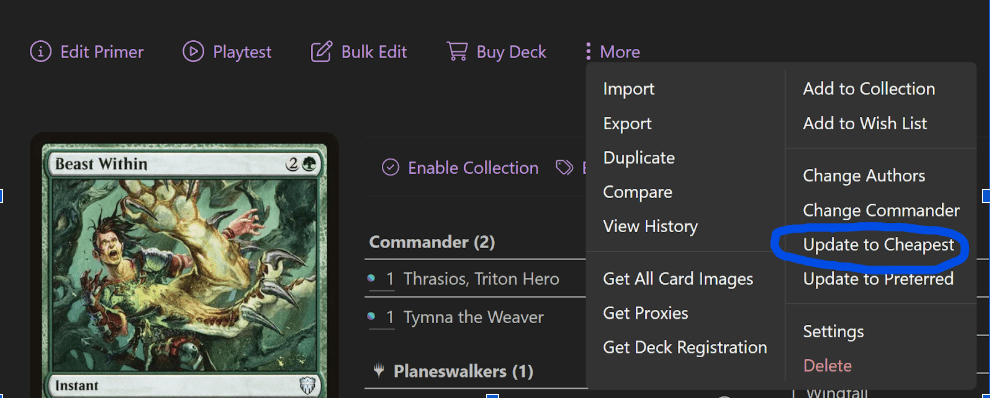
Here’s a quick tip from the Value Vintage community: You can create a decklist on moxfield.com and update all versions to the cheapest available:
Value Vintage Restricted List
First, we have to differentiate between restricted and banned. Banned means you can’t play the card at all. Restricted means that you can play one copy of the card. Vintage is famous for having no banned cards (except for structurally banned cards like ante), just a restricted list to keep the format from getting too crazy.
- Ancestral Recall
- Balance
- Black Lotus
- Brainstorm
- Chalice of the Void
- Channel
- Demonic Consultation
- Demonic Tutor
- Dig Through Time
- Flash
- Gitaxian Probe
- Golgari Grave-Troll
- Gush
- Imperial Seal
- Karn, the Great Creator
- Library of Alexandria
- Lion's Eye Diamond
- Lodestone Golem
- Lotus Petal
- Mana Crypt
- Mana Vault
- Memory Jar
- Mental Misstep
- Merchant Scroll
- Mind's Desire
- Monastery Mentor
- Mox Emerald
- Mox Jet
- Mox Pearl
- Mox Ruby
- Mox Sapphire
- Mystic Forge
- Mystical Tutor
- Narset, Parter of Veils
- Necropotence
- Sol Ring
- Strip Mine
- Thorn of Amethyst
- Time Vault
- Time Walk
- Timetwister
- Tinker
- Tolarian Academy
- Treasure Cruise
- Trinisphere
- Urza's Saga
- Vampiric Tutor
- Vexing Bauble
- Wheel of Fortune
- Windfall
- Yawgmoth's Will
Cards That Are Banned in Value Vintage
- 46 Cards that reference “Stickers“
- 28 Cards that reference “Attraction“
- 25 Cards with the Card type “Conspiracy”
- 9 Cards that reference “Playing for Ante”
- Cards whose art, text, name, or combination thereof are racially or culturally offensive are banned in all formats.
- Chaos Orb
- Falling Star
- Shahrazad
Where to Play Value Vintage
Value Vintage can be played on MTGO and in real life. It doesn’t make any sense on MTG Arena because the economy works differently there, plus a large portion of the card pool simply doesn’t exist there. That said, people organize to play Pauper on MTGA, so I wouldn’t count Arena out.
Value Vintage Decks
Now that we’ve covered the format, let’s talk about some of the decks we can play. These decklists came from Value Vintage events, so they’re at least competitive.
Red Cycling Aggro (Hollow One)

Hollow One | Illustration by Anthony Palumbo
Creature (29)
Anger
Hobgoblin, Mantled Marauder x3
Detective's Phoenix x4
Flameblade Adept x4
Hollow One x4
Ivora, Insatiable Heir x2
Marauding Mako x4
Ox of Agonas x3
Street Wraith x4
Instant (3)
Fireblast x3
Sorcery (11)
Burning Inquiry x3
Control of the Court x4
Faithless Looting x4
Land (17)
Mountain x17
Sideboard (15)
Damping Sphere x4
Harsh Mentor x4
Leyline of the Void x4
Lightning Axe x3
Almost every format has explored Hollow One; you can often cast this 4/4 for or even .
This is a very linear deck centered on discarding for value. Cards like Marauding Mako, Flameblade Adept, and Hobgoblin, Mantled Marauder benefit from discard, while Ox of Agonas and Detective's Phoenix recur themselves. Street Wraith can be discarded for 0 mana. The reprint of the obscure Portal Three Kingdoms card Control of the Court makes this an interesting and valid inclusion in the deck.
Mono-Black Initiative

Vicious Battlerager | Illustration by Cristi Balanescu
Creature (23)
Caustic Bronco x4
Deep-Cavern Bat x2
Emperor of Bones x2
Evolved Sleeper
Faerie Dreamthief x2
Passageway Seer x4
Ravenloft Adventurer x3
Sunset Saboteur x2
Vicious Battlerager x3
Artifact (1)
Instant (8)
Power Word Kill x3
Archenemy's Charm x2
Dark Ritual x3
Sorcery (8)
Hymn to Tourach x4
Inquisition of Kozilek x4
Land (20)
Mishra's Factory x2
Swamp x18
Sideboard (15)
Break the Ice x4
Duress x2
Game Over x2
Necromentia x2
Ravenous Trap x3
Sudden Edict x2
This black deck uses efficient creatures like Deep-Cavern Bat and Caustic Bronco to apply early pressure backed by good interaction. Hymn to Tourach is a strong discard card, and in the 4-drop slot, four cards grant us the initiative, a broken mechanic for 1v1 games. The deck also plays accelerants like Sol Ring and Dark Ritual to get to the initiative as quickly as possible.
Blue-Green Nadu

Nadu, Winged Wisdom | Illustration by Daren Bader
Creature (23)
Cephalid Illusionist x4
Daring Waverider
Gene Pollinator x3
Gilded Goose x2
Laboratory Maniac
Loaming Shaman
Nadu, Winged Wisdom x4
Narcomoeba x2
Nomads en-Kor x4
Omni-Changeling
Enchantment (1)
Artifact (5)
Sorcery (8)
Dread Return
Step Through x2
Malevolent Rumble x4
Sevinne's Reclamation
Land (23)
Waterlogged Grove x3
Yavimaya Coast x4
Mishra's Factory
Island x2
Forest x4
Adarkar Wastes
Aether Hub x4
Brushland x4
Sideboard (15)
Burrenton Forge-Tender x2
Deep Analysis x2
Dryad Militant
Invasive Surgery
Memory's Journey
Mistcaller
Spell Pierce x4
Step Through
String of Disappearances
Wastescape Battlemage
Yes, Nadu, Winged Wisdom is back, with the same Shuko interaction that made the card be banned in the first place. The core of this deck is to have Nadu in play so that you can target your own creatures with Shuko, a free-to-equip equipment. For each viable target, you’ll draw two cards and put extra lands into play. One way this deck wins is by milling yourself with Cephalid Illusionist and having Laboratory Maniac in play. These are both wizards, so you can tutor them via wizardscycling on Step Through.
Blue-Red Spellslinger
Bedlam Reveler | Illustration by Jama Jurabaev
Creature (13)
Thing in the Ice // Awoken Horror x4
Tolarian Terror x4
Bedlam Reveler x2
Sailors' Bane x3
Instant (21)
Mission Briefing x2
Counterspell x3
Consider x4
Spell Pierce x4
Otherworldly Gaze x4
Lightning Bolt x4
Sorcery (8)
Artful Dodge x2
Maximize Velocity x2
Preordain x4
Land (18)
Sulfur Falls x4
Shivan Reef x4
Mountain x2
Island x8
Sideboard (15)
Tormod's Crypt x2
Surgical Extraction x2
Smash to Smithereens x2
Skin Invasion x2
Meltdown x2
Dispel x3
Anger of the Gods x2
This is your typical UR Tolarian Terror + Bedlam Reveler deck with a cardpool close to what you’d expect in formats like Standard or Pioneer. What caught my attention was Sailors' Bane, a Commander Masters card that maybe some Peasant cubers have played once or twice. It’s basically a slightly larger and harder-to-deal with Tolarian Terror. Thing in the Ice also makes an appearance alongside many 1-mana cantrips to fuel the graveyard interactions.
WU Standstill Control

Standstill | Illustration by Heather Hudson
Creature (6)
Prairie Dog x2
Timeless Dragon x4
Enchantment (9)
Shark Typhoon x4
Myth Realized x2
Standstill x3
Instant (18)
Swords to Plowshares x3
Silundi Vision
Condemn x2
Lose Focus x4
Memory Lapse x2
No More Lies x3
Razorgrass Ambush // Razorgrass Field x2
Dig Through Time
Sorcery (5)
Depopulate x3
Treasure Cruise
Balance
Land (21)
Celestial Colonnade x2
Glacial Fortress x4
Island x4
Plains x7
Prairie Stream x4
Sideboard (15)
The Filigree Sylex x2
Test of Talents x3
Spectral Sailor
Soul-Guide Lantern x2
Echoing Truth x2
Damping Sphere x2
Annul x3
Just so I cover all sides of the archetype spectrum, here’s WU Standstill. It’s a control deck that casts Standstill to force your opponents to stop playing cards unless they want to refill your hand. This deck usually wins via win conditions that don’t need to be cast. For example, cycling Shark Typhoon or eternalizing Timeless Dragon don’t break your Standstill. The same goes for a large Myth Realized attacking as a creature. Another interesting inclusion in this deck is Prairie Dog, a card that benefits from having your namesake enchantment in play because you’re not playing spells, growing the squirrel.
Other Decklists
There are many other viable decks I haven’t even touched on. Graveyard decks with Hogaak, Arisen Necropolis, Izzet Arclight Phoenix, Death and Taxes, Boros energy decks with Modern Horizons 3 cards, black sacrifice aristocrats decks, and much more. Right now, the format is ripe for testing, and the metagame keeps evolving.
Getting Started with Value Vintage
The best way to get started with Value Vintage is to see decks that are performing well in the format and trying them out in the queues. An interesting suggestion is the WU spirits deck that sees some play in Pioneer, as it’s very similar to a good Value Vintage deck. These cards got much cheaper after Innistrad Remastered reprinted the most expensive ones.
Many format staples are playable because they have been banned everywhere else, including Dig Through Time, Fury (which used to be a $30+ card before bannings), and Hymn to Tourach. Cards that were big in their Standard formats but didn’t make the jump into other formats, like Evolved Sleeper and Brazen Borrower, are also cheap and playable. You can check the whole list of format staples and their card prices here.
Plus, here’s a schedule for upcoming events. If there’s something near you, you might as well check that out. MTGO Value Vintage events are always a good option to test the waters.
Value Vintage Communities
The main website for Value Vintage is VVMTG.com, which is the place to get all the information on the format, the metagame, next events, the banned and restricted list, and more.
This is the $30 Value Vintage Discord Server where people can discuss the format, decklists, metagame, and how to grow the Value Vintage scene.
The subreddit r/valuevintage has lots of specific information on the format. It’s a small subreddit, so the main MTG subreddit r/magicTCG ends up receiving format-specific discussion, too.
Specific YouTubers like @forkpapi and @kindamtg are often playing or discussing the format.
Wrap Up

Prairie Dog | Illustration by Kevin Sidharta
I didn’t know what Value Vintage was until recently, but now I’m interested. MTG formats are at their best when they first start growing, or when WotC doesn’t ruin them with power creep cards or Masters/Horizons. Having formats that we can construct cheap decks for is always good, and when even Pauper decks can reach $70-100 consistently, it’s nice to have another budget format. And if your Eternal staples get banned and their price tanks as a result, they might become viable in Value Vintage.
What do you think about the format? Did anything catch your interest? Let me know in the comments section below, or lets discuss this over in the Draftsim Discord. Check out The Daily Upkeep newsletter for all the latest MTG news.
Thanks for reading, and see you guys around!
Follow Draftsim for awesome articles and set updates:











Add Comment