
Graceblade Artisan | Illustration by Magali Villeneuve
Star Wars: Unlimited, or SWU, is a Star Wars thematic card game still in its early days. When I see SWU, I see more Lightning Bolts and Serra Angels and less Ninja Turtles or cards like Questing Beast, where you don’t even remember the card denies damage prevention.
It’s a simpler, more straight-to-the-point card game, and of course, if you like Star Wars and MTG, you have to give this one a chance. Let’s dive in and see what makes this card game tick.
What Is the Star Wars: Unlimited Trading Card Game?
Fiendslayer Paladin | Illustration by Wesley Burt
The Star Wars: Unlimited Trading Card Game, or SWU, is a relatively new TCG based on the Star Wars IP from Fantasy Flight Games. Star Wars had other TCGs before, and the Star Wars Trading Card Game was even created by Richard Garfield in 2002 and produced by Wizards of the Coast. In fact, SWU draws some characteristics from that now out-of-print game. Spark of Rebellion debuted as the first set in 2024, and they’ve just released their 8th set, Ashes of the Empire, as of July 2026. Making an analogy to MTG, they’re in The Dark/Homelands age, but of course, in the 90s there was no such thing as a TCG, so SWU designers know what they’re doing.
SWU has been releasing expansions regularly, once every three months, and their Standard format just rotated for the first time. Having played MTG and Hearthstone before, SWU isn’t hard to grasp. It’s like MTG with a Hearthstone-style combat system, but SWU still distinguishes itself from both of them, and the Force is definitely strong with it (the “force” of one of the world’s most popular IPs for a game).
How Do You Play the Star Wars: Unlimited TCG?
Let’s briefly cover what makes this game so great.
Aspects
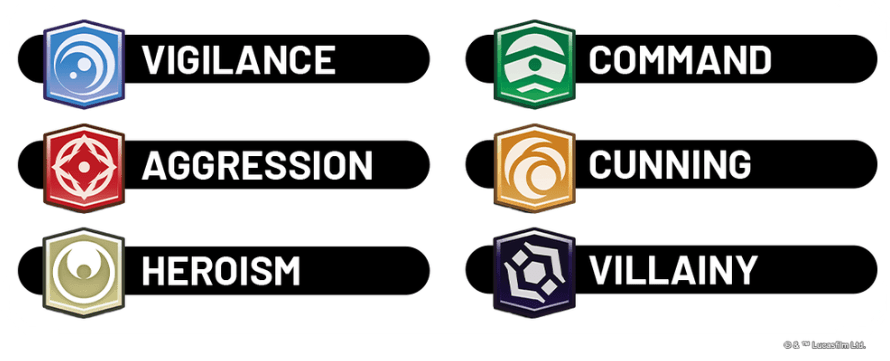
There are 6 aspects in SWU (like the colors in MTG). The four main aspects are: vigilance, command, aggression, and cunning. Heroism (the light side) and villainy (the dark side) are secondary aspects. A card can be blue, blue-white, or blue-black, but there’s not a blue, white, and black card. White and black don’t mix together in this game, although there are tricky exceptions.
SWU has a color pie like MTG, and here are some examples:
- Blue is a very controlling color with removal and big creatures
- Yellow is more on the tempo side with bounce effects
- Red is aggressive, with cards that deal direct damage to bases and saboteur/ambush mechanics
- Green is the color of units, allowing us to go wide or ramp into big 7/7 and 9/9 trample creatures.
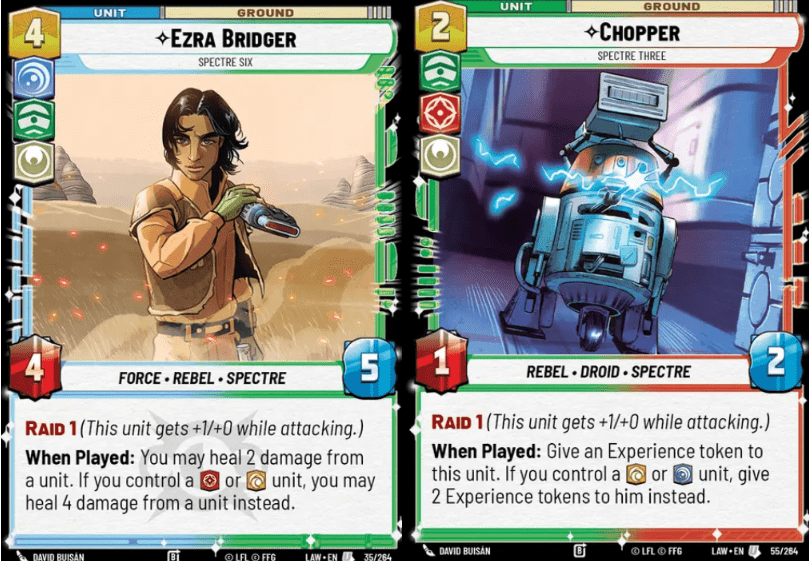
Multi-aspect cards were introduced very recently and are functionally gold cards. In SWU, a card being blue and white, or blue and black is the norm, but a card that’s red, green, and white, or red, green, and black is considered a gold card. For example, Ezra Bridger could be green/white, or blue/white card, but since it combines blue and green aspects in a single card, it’s considered a multi-aspect card.
Resources
SWU uses a 50-card deck, and there’s no specific “land card”. Every turn, you may put a card face-down as a resource, a resource system other TCGs have employed. Your land drop is guaranteed every turn, but later in the game you’ll often prefer to keep your cards. Some mechanics like smuggle let you play the card you’ve resourced at a later stage. As a first action, you’ll put two cards face-down as resources, so you start the game with two lands. All cards in SWU require a given amount of colorless resources. A typical deck mostly runs cards that cost 2-4 with a few 6-9 drops, except the most aggressive ones, which keep costs low.
Bases
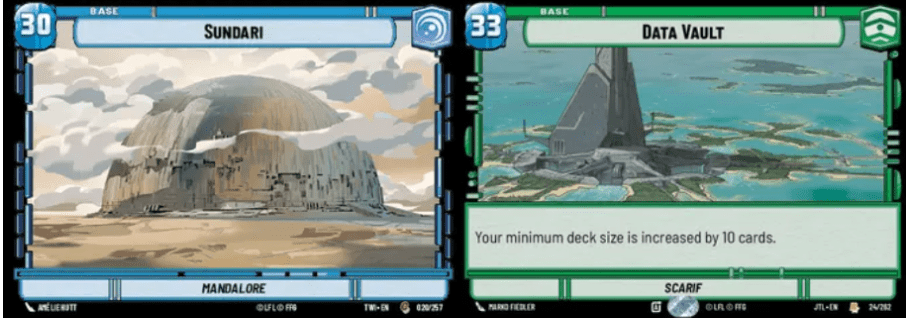
Each player starts with a base and a leader in play, and these colors dictate what aspects you can play without any penalties. In this game, your base is attacked, so that’s your starting life total, and the max life you’ll have in a game.
Sundari is a vanilla blue base with 30 HP, while Data Vault gives you more hit points at the expense of a small penalty. Other bases have fewer hit points but with a small advantage. MTG’s done something similar before with Vanguard. It’s interesting because if the meta is aggressive, players will opt for the higher hitpoint bases, but if the meta is midrangy or controlling, you can play 26 hitpoint bases to accrue small advantages.
Leaders and Deploy
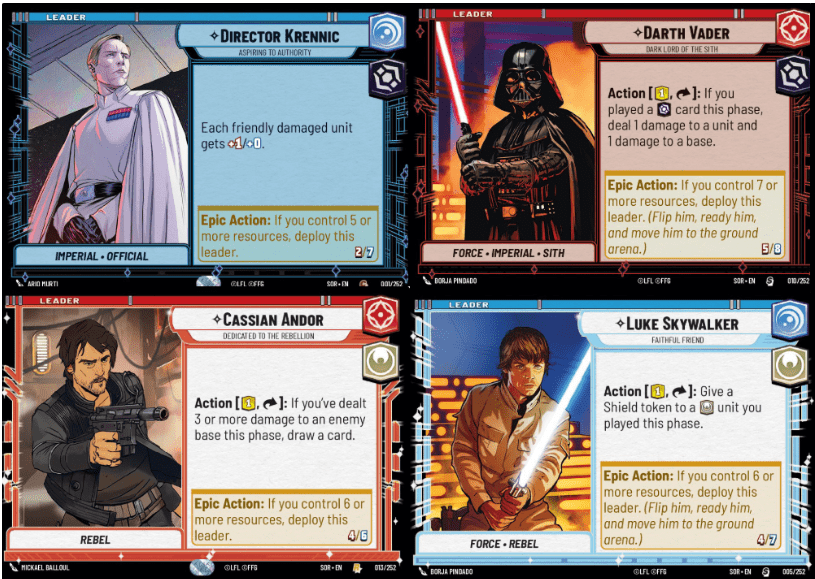
Each deck has its leader on the battlefield, similar to a commander, but it’s not a creature (think Theros gods). When they aren’t creatures, you can only use their abilities. Later, when you have a appropriate amount of resources, you can deploy your leader, and you can do that only once in the game as an “epic action”. At that point, your leader becomes a powerful creature that can attack and be attacked. For example, Darth Vader becomes a 5/8 creature when you have 7 resources to deploy it, and Luke Skywalker is a 4/7 that needs 6 resources. When your leader dies, it returns to the battlefield as a non-creature and can’t be deployed again. Like bases, leaders define your deck’s aspects.
Parts of the Turn
The first thing you do in SWU is to draw your 7-card hand and put two resources face down. The first player has the initiative token. In SWU, you only do one action, and then you pass. Possible actions include:
- Play a card from your hand
- Attack with a unit
- Activate an ability from your unit or your leader.
- Special Action: Take the initiative, which ensures you play first on the next turn.
In MTG terms, that would be similar to “I play a creature, you play a creature”. “I use my 3/3 to attack you, you use your 3/4 to attack my 3/3”, and so on.
The turn ends when both players can’t or won’t take a game action. Then, each player draws two cards, can put up to one card from their hand face-down as a resource, and the player with the initiative goes first. This unique turn structure is very similar to how many board games play out.
Arenas
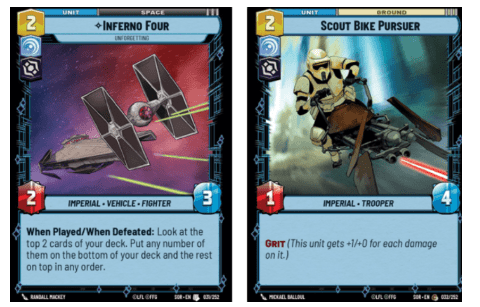
SWU has two arenas: the ground arena and the space arena. The card art helps illustrate if it’s a ground or space unit, but the indication also appears above the card’s name. Ground units, like storm troopers and AT-STs, go to the ground arena, while space units, like X-Wings and TIE-fighters, go to the space arena. The most interesting aspect of these arenas is that a ground unit can’t attack a space unit, and vice versa. Any unit can attack an opponent’s base. In MTG, this would be similar to shadow. Many cards refer to their arena, like “this unit gets +2/+2 if you control more units in its arena.”
Upgrades
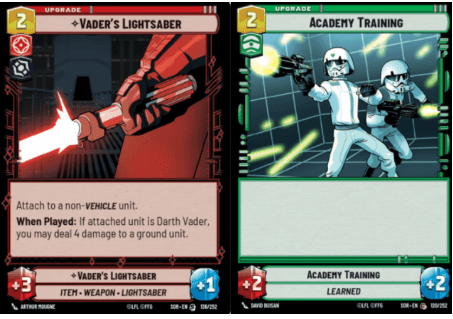
SWU has upgrades, the equivalent of auras. These can go into units, leaders, and bases. Some upgrades are your typical +2/+2 aura, while others can be negative (-2/-2). One minor difference from MTG is that playing an upgrade isn’t an action, so you can upgrade a unit and attack with the same action.
Events
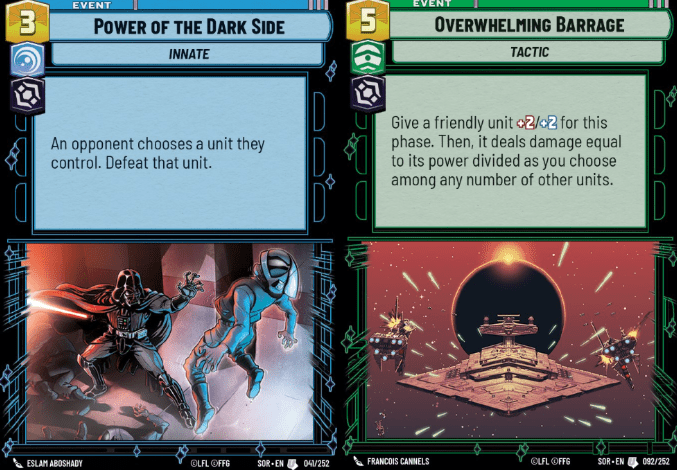
Events are the analogue to sorceries. Some events kill creatures, others draw cards, and there are sweepers, too. There aren’t any instant cards in the game. Power of the Dark Side is your “edict” effect, while Overwhelming Barrage is a sweeper if you have a big unit.
Tokens
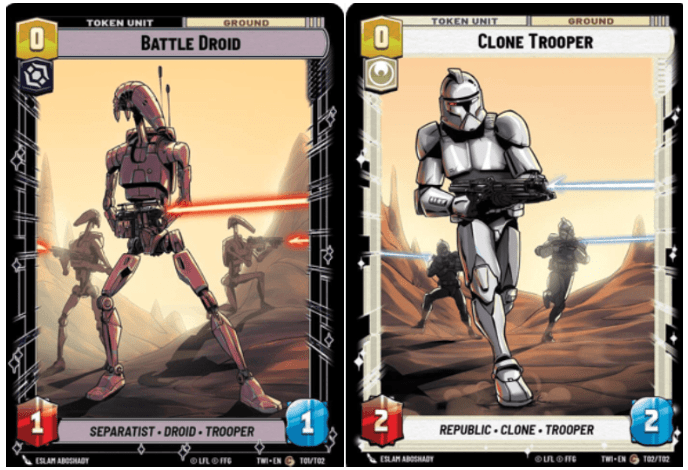
SWU has a small number of different tokens. There are shield tokens, which are equivalent to MTG’s shield counters, upgrade tokens (equivalent to +1/+1 counters), and creature tokens, like a 1/1 Battle Droid or a 2/2 Clone Trooper. They recently created a credits token, which is analogous to MTG’s treasure token.
How Are Magic and SWU the Same?
I’m sure SWU designers and developers played a lot of MTG in their lifetime, and probably come from a competitive background. MTG and SWU are very similar games, and MTG players can learn the game very quickly.
General Similarities
This is essentially a game in which you tap your resources to play spells, and you tap your units to attack opposing bases. Each turn you untap all your cards so you can use them again. When their base has 0 HP or less, you win. So, you’re making “land drops”, playing your cards, creating a board that’s stronger than your opponent’s, and getting their life totals to zero before they do the same to yours.
Units
Units have power and toughness like MTG, and many of the combat abilities are functionally identical. Ambush is haste, overwhelm is trample, restore is lifegain. As in MTG, the creature’s stats and abilities grow comparative to their costs.
Building Around a Leader
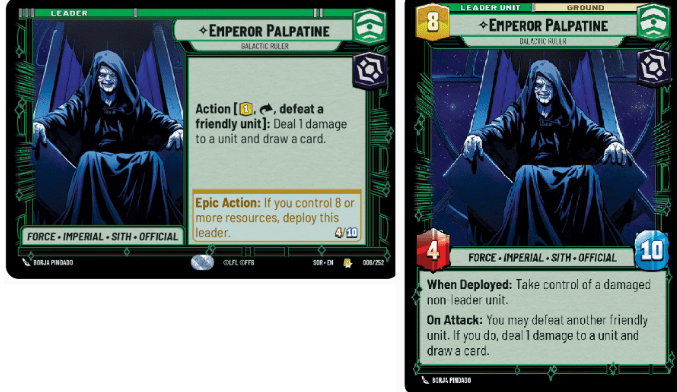
This is courtesy of the Commander format. Each deck has a leader and a base, and the colors of these two cards dictate what you can play. As you can see, Emperor Palpatine is a black and green card, so you can play those aspects, and he has an ability where you can sacrifice your creatures to draw cards, so an “aristocrats leader” of sorts. When he becomes a creature, you get to steal damaged creatures. You’ll build around this card with some disposable fodder and cards with good effects when they die.
Formats
SWU has Premier (Standard), three-pack Draft, six-pack Sealed, Eternal (all cards allowed), and Twin Suns, which is similar to Commander. Since you don’t need to play land cards, the minimum number of cards required for a deck in Limited is 30, 50 for Premier/Eternal, and 80 for Twin Suns. Twin Suns is a singleton format, and you play with two leaders instead of one (like partner). In 50-card formats, you can have up to 3 copies of the same card. In Limited, like MTG, there’s no limit to how many copies of the same card you can play as long as you got all the copies in your pool.
How Are Magic and Star Wars: Unlimited Different?
Resource System
There are no land cards or mana screw in SWU. That said, the decision of what card to resource is an integral part of the game’s skill and strategy.
Alternate Action
This is by far the biggest difference and the biggest selling point. There’s no my turn and your turn. The game is always played in a sequence of alternate actions, until a player passes, and no other player wants to take an action, which marks the beginning of a new round. Some mechanics like ambush (haste) are very powerful because they let you play a unit and attack in the same action.
Two Different Arenas
In MTG, you can use fliers to block non-flyers, but SWU is a bit different. This game replaces flying with “shadow” entirely.
Attack Units and Permanent Damage
In SWU, you can use a unit to attack a base or an opponent’s unit, like the fight mechanic. The damage is permanent (like Hearthstone). If you use a 2/1 to attack into their 4/4, your 2/1 dies, and their 4/4 has 2 damage on the card, which can be healed later with some effects. Like Hearthstone, if they have a sentinel unit (taunt), you must attack that sentinel unit first.
This game encourages you to align your units with theirs; they play a 2/2, you use a 2/3 to take out their 2/2. Next turn, if they play another 2/2, you get a two-for-one trade using your 2/3 again.
Leader and Base System
Leaders are an integral part of the TCG for all formats, including Standard and this game’s “Commander” variant. Your base card is part of your deck since it lets you play cards from a different color. You can play a blue/white leader and a red base, gaining access to all three aspects.
No Instants
Since SWU has an alternating play system, there are no instants or the stack. So, when your opponent uses an action to play a creature, you have your action to think about how to neutralize it, be it attacking with your unit or using a removal spell right away. The game doesn’t need instant-speed spells.
Banlists
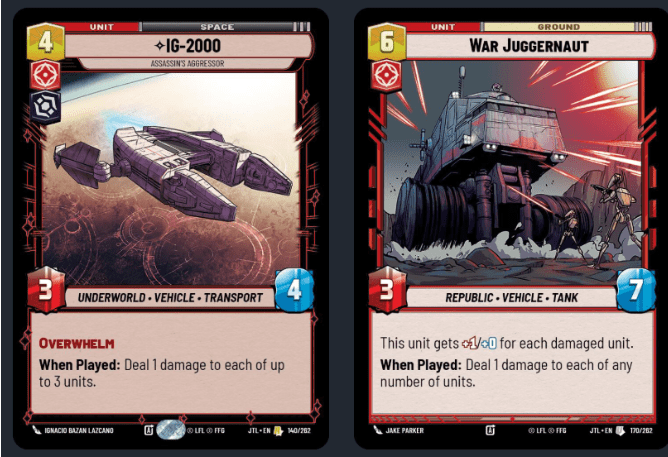
SWU has a “suspended” list with just a couple cards since the game’s in its infancy. Plus, the whole game has only a few sets—there are fewer cards in SWU Eternal formats than in MTG’s current Standard format. Five cards were suspended in Premier, but these rotated, so the Premier suspended list is now empty. Two cards are currently suspended in Eternal as of August 2026.
Are Magic: The Gathering or Star Wars: Unlimited Cards More Expensive?
The comparison isn’t fair at all. A Premier SWU deck costs between $50-120. Older sets have entire boxes that range from $30-50. Twin Suns decks can be much cheaper since you can’t play multiples of the more expensive cards. Here are some expectations based on Amazon prices in mid-2026:
- Standard Booster Box with 24 boosters: $120 or less depending on the set.
- Carbonite Booster Display with 12 boosters: $269. These are the Collector Booster equivalent.
- Spotlight Series Deck: Both Luke and Palpatine spotlight decks playable in Premier go for $25.
- A box with four Twin Suns Precon Decks: Between $120-160.
How Do These Games Handle Reprints?
SWU is just starting, and the oldest set,Spark of Rebellion, was released in 2024. This set needs a reprint the most because of its Eternal and Twin Suns staples; some of them are approaching the $20-40 range, which is absurd for a card game where most rares don’t even cost $1.
They’ll release an Icons collection in late 2026, with a concept very similar to MTG’s Core Sets: Reprint many commons, uncommons, and rares, while designing new simple cards that appeal to beginners. Where MTG’s Core Sets would design a red mythic dragon to catch the players’ attention, SWU will design a new Anakin Skywalker or Leia Organa card that’s simple but impactful.
Do You Have to Know Star Wars to Enjoy SWU?
I’m a little bit suspect because I enjoy Star Wars and TCGs, so it’s a perfect fit. Being a fan of Star Wars will help; it’s desirable for the flavor, and it’s the game’s biggest selling point, but not needed to understand the game and the mechanics in general. Think about Universes Beyond in MTG: if you’re a fan of Doctor Who or Marvel Super Heroes, those card designs will click, but at the end of the day it’s just MTG.
At the same time, this game covers a lot of Star Wars aspects and eras, including the old and new trilogy, The Clone Wars, and stuff that’s in the books or in the new TV series. So if you’re a Star Wars fan that just watched all the movies, you’ll still see a lot of unknown characters in the cards.
Verdict: Which Game Should You Play?
I think SWU is a great game that’s still in its earlier days, so there’s a lot to explore, and many of MTG’s worse aspects aren’t there: The price is ok, the release pipeline is good, there’s no giant power creep between sets, and so on. The game is quite solid, and if you’re a Star Wars fan, or if you have players willing to get into the game, it’s an excellent choice.
But at the end of the day, SWU is another TCG in the market that’s being fought over by physical and digital card games. MTG’s greatest strengths are its longevity and gameplay, and what usually draws people to TCGs is having friends that you can play with. Another huge strength of MTG that SWU doesn’t have yet is an online client like MTG Arena or MTGO, so you can enjoy the game even if your local scene isn’t that strong.
Wrap Up
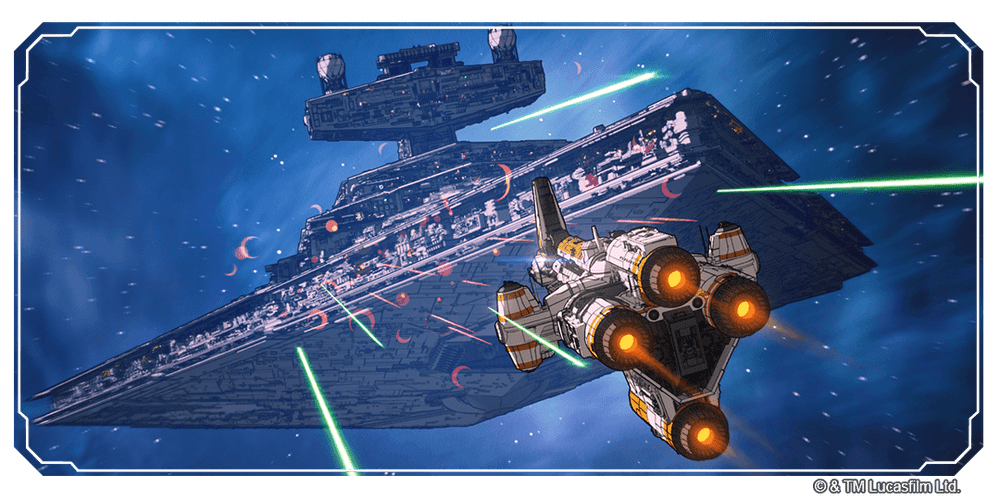
Star Wars Unlimited Art | Illustration by Stephen Zavala
And that’s about it for Star Wars: Unlimited. I’m trying to convince veteran MTG players like me that this game can also be very fun and challenging to play, and that it tries to solve some of MTG’s problems while not reinventing the wheel entirely. We can see it draws heavily from MTG: The Limited aspect is similar, the Commander philosophy is ingrained into the game, while not having a Reserved List or 32 different products each year.
Have you ever played SWU? Are you eager to play? Let me know in the comments section below, and let’s discuss it over in the Draftsim Discord as well.
Thanks for reading, and until the next time.
Follow Draftsim for awesome articles and set updates:










Add Comment