
Last updated on April 29, 2026
Colossus of the Blood Age | Illustration by Leon Tukker
Secrets of Strixhaven has been out on Arena for a week now, and the early meta has begun to take shape. There is a healthy spread of decks, but it also seems like some strategies and colors might be a little too good compared to the others. This article will dive into the meta to see what’s working and what isn’t after week one.
The Fast Decks
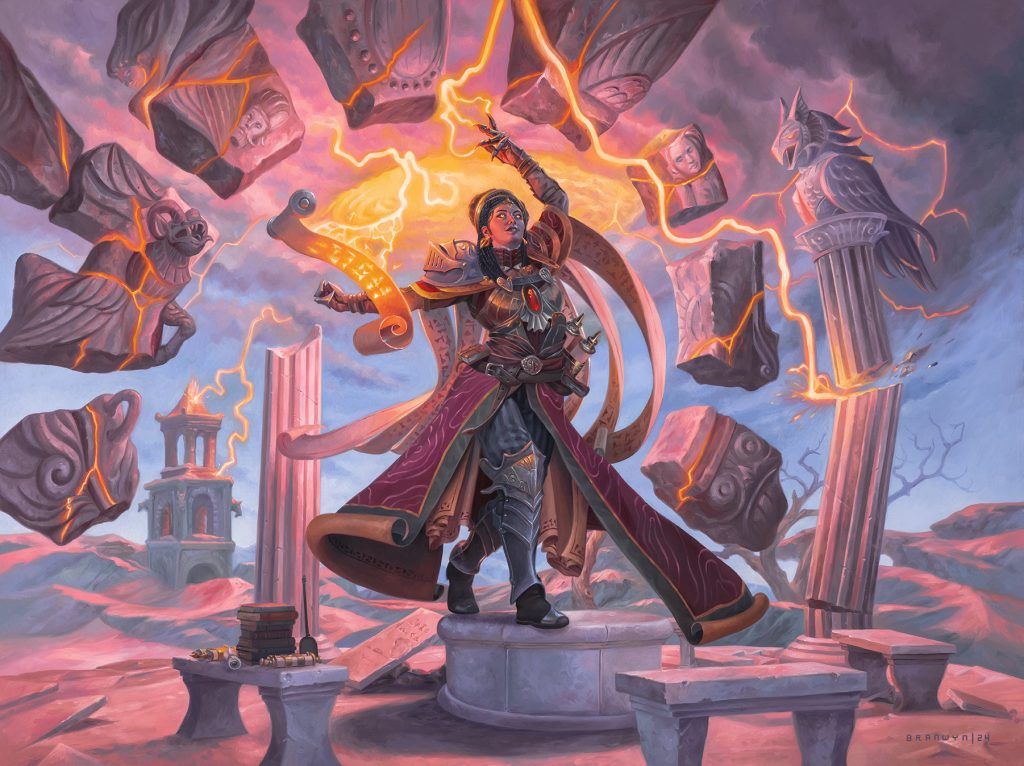
Emeritus of Conflict | Illustration by Alix Branwyn
Both Silverquill and Lorehold have continued to be good so far. There are a few reasons for this. One is that their shared color, white, is just generally good. It has some incredible bombs in Stirring Hopesinger, Practiced Offense, and Antiquities on the Loose, which stand far above other monocolored bombs.
White is also not lacking in powerful lower rarity cards, such as Elite Interceptor or Quill-Blade Laureate. While some of these cards might be better in one deck or another, they are all still generally good in any two color white deck.


Aside from that, Lorehold and Silverquill decks both heavily reward you for synergy. One of the best synergy enablers in the red white deck is Rubble Rouser, which allow for you to consistently and repeatedly trigger all of your graveyard effects like Spirit Mascot or Garrison Excavator. In Silverquill, repartee is a mechanic that rewards you for drafting a good deck with lots of removal and interaction, and it allows for some of the most aggressive starts with cards like Graduation Day, Lecturing Scornmage, or Dig Site Inventory.


Overall, these decks have overall high card quality and a generally aggressive game plan that has put up good results early in the format. In fact, early on white seems like it may be a little too good, as cards like Practiced Offense or Antiquities on the loose can feel oppressively good.
The Slow Decks

Sanar, Unfinished Genius | Illustration by Justin Gerard
Prismari is in a very interesting space, as I think it’s a very difficult deck to play and draft, yet it also can get amazing results. More than anything, base red blue decks function as controlling late game decks, but can often include combo or combo adjacent gameplans. Cards like Mathemagics or Crackle with Power are single card win conditions that you can ramp into with Sanar, Unfinished Genius, Resonating Lute, Hydro-Channeler or any other of the handful of mana accelerators available to red blue decks. There are also other cards that function as win conditions, although they do need a bit more set up. Colorstorm Stallion can win a game on its own if you ever untap with it, as can Prismari, the Inspiration. Even lower rarity cards like Visionary's Dance are able to achieve wins when you have multiple copies or are able to recur it with Flashback or Divergent Equation. Even Exhibition Tidecaller can be good in these decks, as it’s able to mill out your opponent surpisingly quickly. The good Prismari decks feel like they are working around these individual win conditions, setting up the rest of the game around them, so keep an eye out for these cards when drafting and if you do get them, think about how best to support them.


The other slow deck is soup. There’s more than one way to build soup, as it’s really just anything that’s four or five colors, but usually in this format it will be based in blue green and splashing the rest. One card to keep in mind when building a soupy deck is Potioner's Trove. This card plays better than it looks, and life gain is often relevant over the course of a longer game. Your average soup deck will function similarly to the Prismari decks, just with more colors allowing you to splash more easily, although the line between these decks is often blurred, and the main difference will be how much value you are getting out of converge spells. Snarl Song, Together as One, Arcane Omens, Transcendent Archaic, and Sundering Archaic are all very good when you are consistently able to get the mana for them, and a good soup deck will be defined by the converge cards you are able to get for it.


Wrap Up

Transcendent Archaic | Illustration by Chris Rahn
This is a highly complex format with a lot of fun gameplay. Early on, it does feel like Lorehold is the big winner, with Silverquill closely behind, although it’s only the first week. It may be the case that throughout the whole ten weeks of the format that it stays the best deck, but it’s more often the case that the meta shifts and changes as players familiarize themselves with the set and get a better understanding of which cards are worth prioritizing. Until then, it’s still incredibly fun and the decks are varied, all signs of a healthy format.
Follow Draftsim for awesome articles and set updates:










Add Comment