
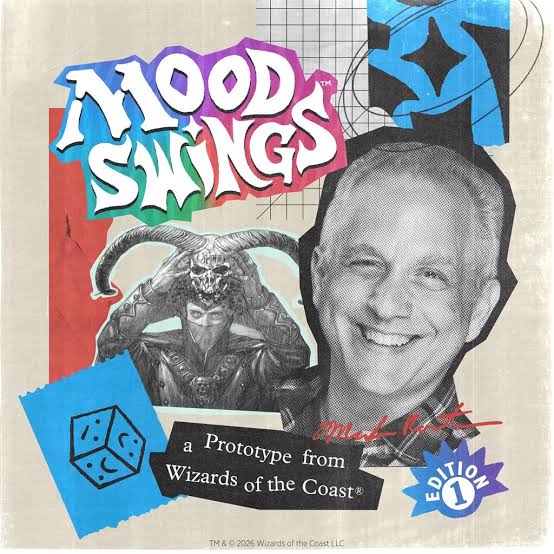
Mood Swings is an all new TCG developed by none other than Mark Rosewater, Head Designer of Magic: The Gathering, and distributed by Wizards of the Coast. Rosewater has been in game design leadership positions for over 30 years, and his breadth of MTG knowledge runs deep. The game is in its infancy and exists only as a prototype right now, so it will likely undergo changes and iterations for future releases.
But… does that mean that you should snag a copy of Mood Swings? How do you even play the game? If you love Magic, will you be in the mood for this game too?
I’ll answer all those questions for you here. Let’s dive in.
How to Play Mood Swings
Source: theteabeard on Instagram
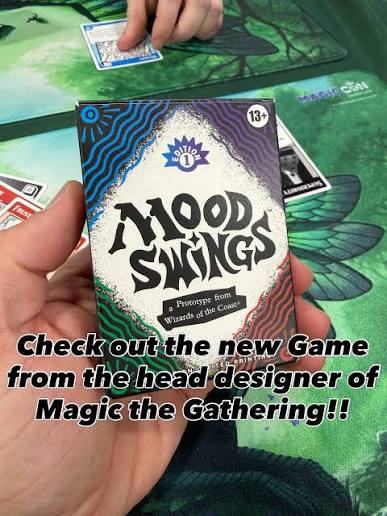
Each pack of Mood Swings costs $25 with tax and shipping from the Secret Lair website. Each pack comes with 45 randomized cards: 30 commons, 10 uncommons, 3 rares, 2 mythics, and two rules instruction cards. Each pack comes ready to play, no deckbuilding necessary.
Cards in Mood Swings are themed around emotions, and use some MTG art as a cool little bonus.
Both players share the deck and discard pile. To start the game, one player shuffles the deck, then reveals the bottom card. Whoever felt the emotion on the card most recently plays first.
At the beginning of the game, each players draws 5 cards from the deck. Each game is comprised of 3 rounds. Each round, each player may play 1 card, unless instructed otherwise by the effect of another mood. When you play a card, it becomes a mood. This is similar to to the way cards are cast, then become spells, which then become permanents or whatever else in MTG.
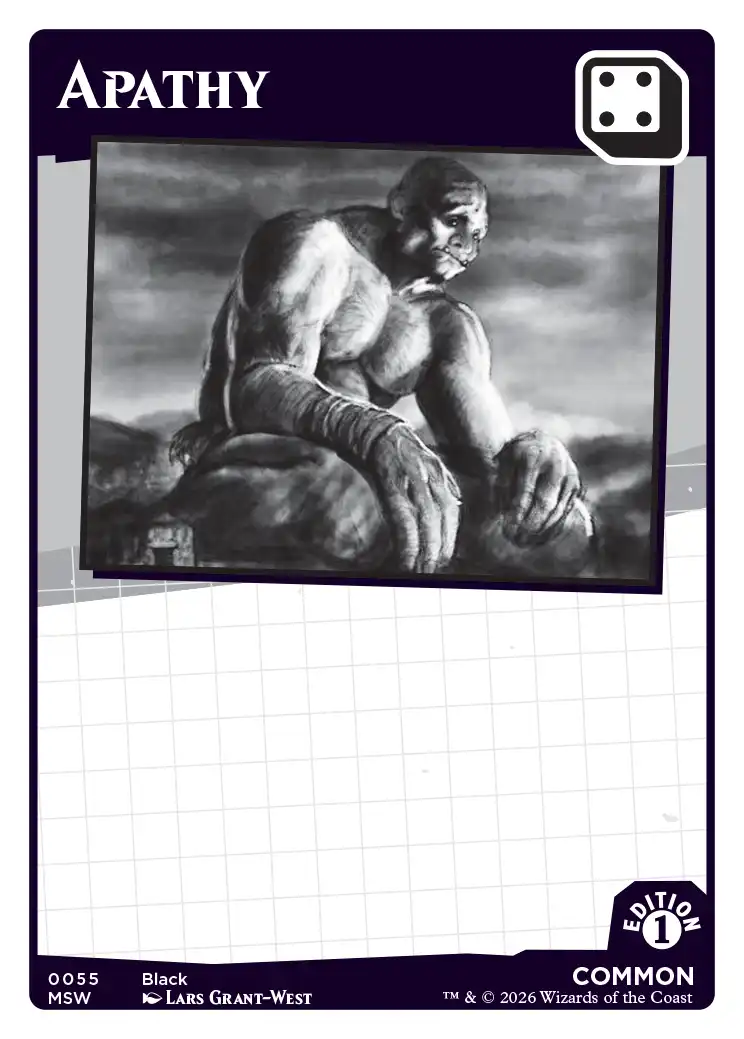
Each card has a die value in the upper right hand corner. This is to determine its value, not its cost.
In a 2-player game, the first player may play a card, then the second player plays a card. At the end of each round, we get to scoring. To score, look at the dice values on all of your moods. The player with the higher total value wins that round. If you tie, the player who played first wins the round. The player who won the first round plays first for the second round. The losing player draws a card, which is a huge advantage.
This cycle continues until a player has won three rounds, at which point they win the match.
Important Mechanics
Things are significantly simpler in Mood Swings than they are in Magic, but there are still a few key elements to commit to memory.
Firstly, cards have colors just like in Magic, and they use the same color pie consisting of white, blue, black, red, and green cards.
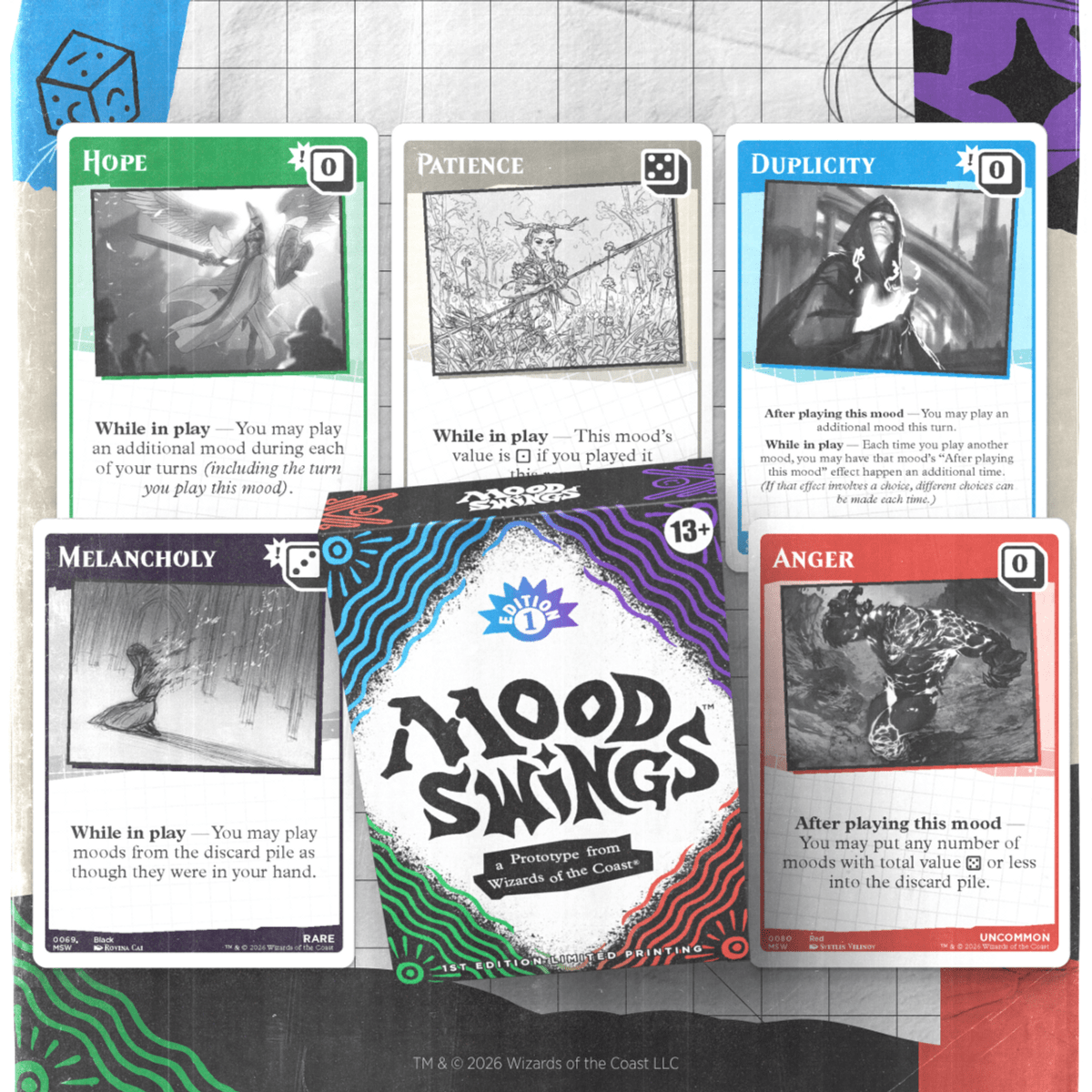
Many cards have black dice in their lower left-hand corners. These cards usually flip into higher values when certain conditions are met.
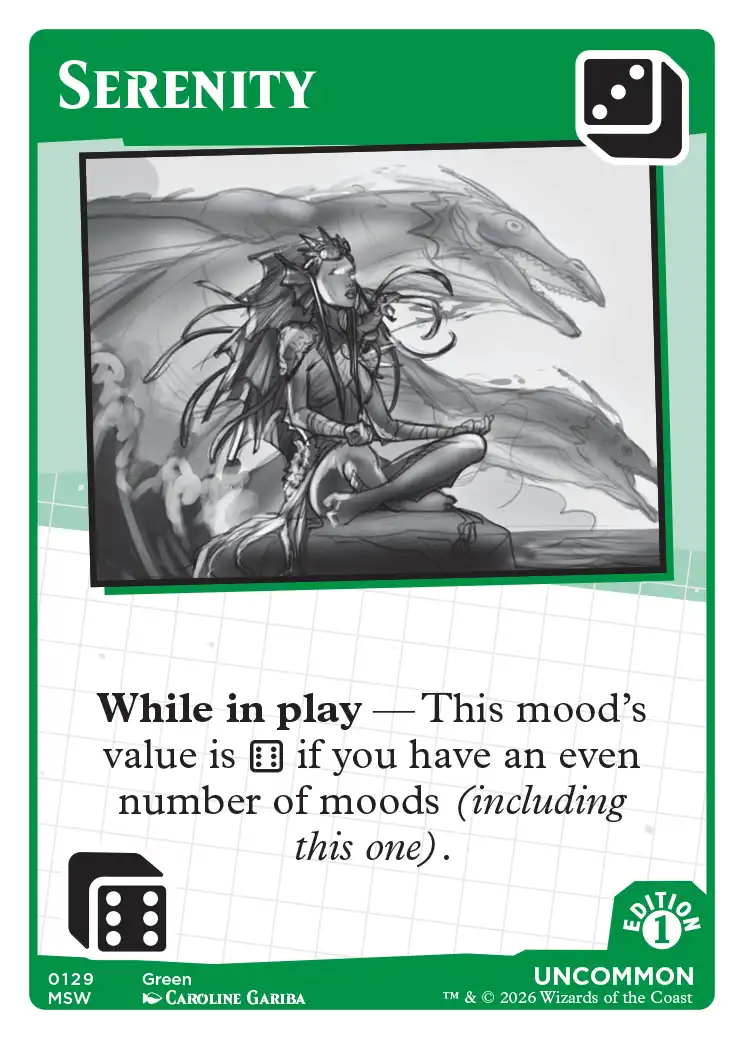
For example, Serenity says: “While in play – This mood’s value is 6 if you have an even number of moods.”
Normally, Serenity’s value is 3, but it becomes 6 if you control an even number of moods. It usually won’t score that high in round 1, but it definitely hits way harder in round 2 and later. These black dice cards can change at any moment.
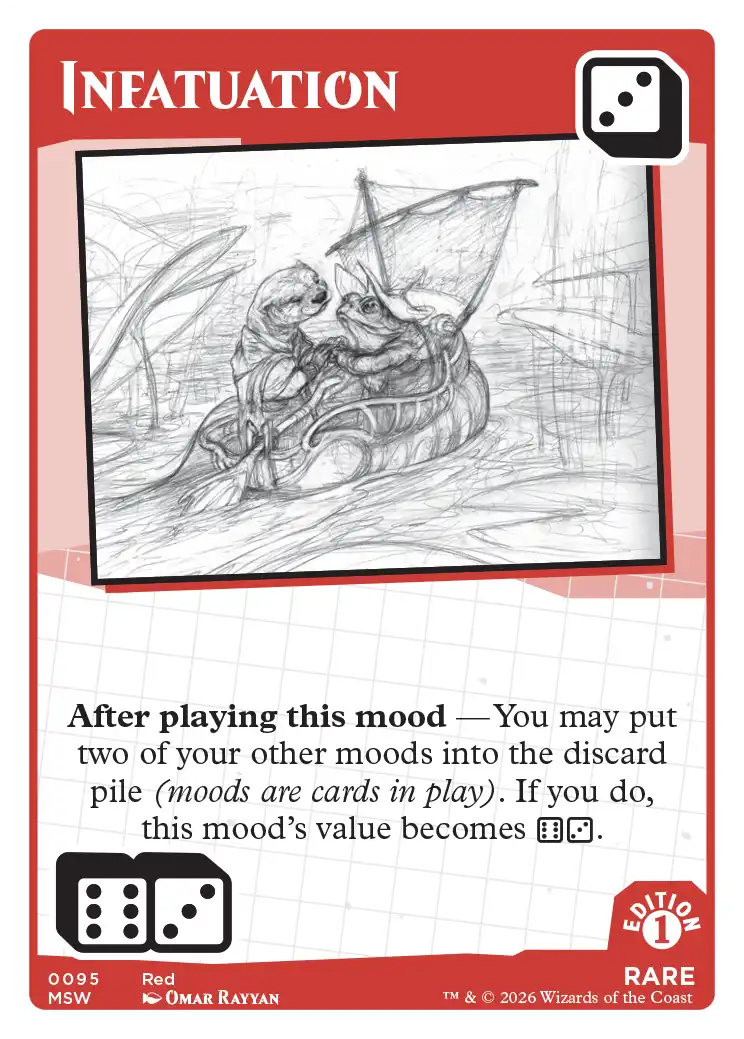
Certain cards have white dice in their left-hand corners. These permanently switch values when you fulfill a certain condition: Infatuation permanently becomes a 9-value card if you discard two moods after you play it. You represent the fact that a mood’s left-hand die condition has been met by rotating it 180º.
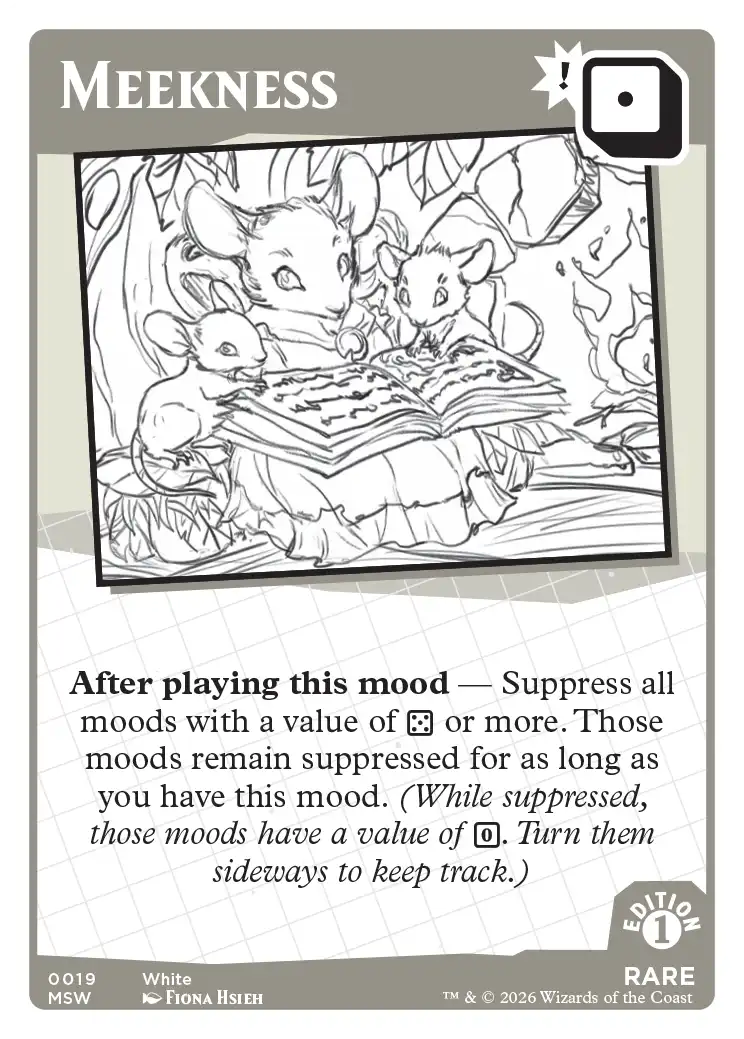
Certain cards will instruct you to suppress a mood. When a mood is suppressed, rotate it horizontally just like you would when you tap a land. While suppressed, a mood’s value is 0.
In a 3+ player game, the Hurt Feelings mechanic is introduced. During a round, the player with the lowest score gets Hurt Feelings and may play an additional card during the following round.
Mood Swings Review
So far, I’ve been having a lot of fun with Mood Swings. I’ve been an avid Magic player for about five years now, and I can confidently say that Mood Swings is an excellent miniature version of Magic.
Not having to worry about lands to take actions makes gameplay smoother. Cards and effects are far simpler and are more conducive to new players. I’ve been trying to get my partner to play Magic with me forever, and she’s simply too intimidated by the sheer number of rules you need to understand to really have fun with it.
She just beat me 3 times in a row at Mood Swings.
The game is much more about luck than Magic is, for better or for worse. It creates a more even playing field for all players, but also more or less does away with the thrill of sculpting a great hand. Since each pack is randomized, redundancy can be an issue, certain packs are definitely more fun to play than others.
Certain games just stall out, and skill sometimes doesn’t even feel like a factor, which is my biggest qualm with the game. Despite this, rounds move quick, and variance is good enough that I never feel too upset by RNG screw.
I’d say that this game doesn’t particularly appeal to expert Magic players. If you’re a cEDH grinder, I don’t know that I’d recommend Mood Swings. There’s no 10-card stack battles, there’s virtually no “instant speed” action. There’s definitely room for splashy plays, and I do find myself sometimes contemplating moves for minutes, just like in Magic.
It certainly scratches a tactical itch, but not in the same way that Magic does. In terms of complexity, I’d say it’s much simpler than Magic, and only a bit more difficult to understand than something like Uno.
Certain mechanics definitely feel as though they’d work much better in a 4-person game. One of the packs my partner and I played only had one or two cards with discard synergies, which altogether feel like they’d be more fun with a more stacked discard pile.
Mood Swings Variations
Duel Play
Duel Play is essentially a Constructed version of Mood Swings where players bring their own deck to face off against another instead of sharing a deck. This is divided into “Structural Duels”, where you face off a 45-card deck against an opponent’s 45-card deck, plus “Power Duel”, which pits two rarity-restricted 15-card decks against one another.
Mood Swings Draft
No surprises coming from a game created by Mark Rosewater, but Mood Swings does have a draft component. Quick Draft will result in two players each creating minimum 12-card decks out of a total pool of 48 cards. Winston Draft uses a 45-card pile and also results in 12+ card decks for two players, and operates similar to Winston Drafting for MTG.
Team Play
Mood Swings also supports multiplayer. Open Team play is the equivalent of Two-Headed Giant, where you and a partner face off against another team of two players. Closed Team is similar, but you sit across from your partner instead of next to them and you don’t have information about your partners’ hand the same way you would in Open Team play.
Wrap Up
Mood Swings feels like the perfect way to kill a half hour between other tasks. Regardless of any value in the cards, I don’t really see myself ever really collecting the game. It’s the kind of thing you’d grab once at Target and keep in the good ol’ game cabinet for when you need it.
Magic can feel all-consuming. I usually won’t plan a session unless I can commit four or more uninterrupted hours, and that can sometimes only yield two games of Commander. Mood Swings feels like a much smaller commitment. Something fun to do before you sit down for dinner, between classes, or if you’re meeting a friend somewhere for a bite.
While I do have some qualms with the randomness of the game, it definitely is playable with a single pack. Both packs I ended up with have yielded 10+ dynamic games each so far.
Do you love playing Commander below Bracket 3? Do you love the chaotic luck of Limited formats in MTG? Then I’m willing to bet you’ll enjoy Mood Swings. Let me know your thoughts and experiences with Mood Swings in the comments below, or what you’d like to see if it continues to develop. For more from Draftsim, check out our newsletter, The Daily Upkeep.
Until next time, go out there, have fun, and try something new!
Follow Draftsim for awesome articles and set updates:









Add Comment