
Last updated on September 18, 2026
Jace's Machinations | Illustration by Serena Malyon
Magic has always been better at geography than history. Cards are fantastic at giving us glimpses of other worlds: Their landscapes and creatures; their cities (sometimes thriving, sometimes just old ruins); their inhabitants with their food, clothes, customs. The art and flavor text are great for showing us what ordinary people there look like… and the dangers, monsters, and occasional world-ending monstrosities they face.
Cards are much worse at telling a story in the classic sense, though: explaining what happened first, what happened next, why that changed a character, and why something that somebody may have done three sets ago matters now.
In other words, Magic cards are great at places, but not so much at plot. And, a bit ironically, Universes Beyond sets may understand that better than Magic’s in-universe sets.
What Kind of Tale Can a Card Tell?
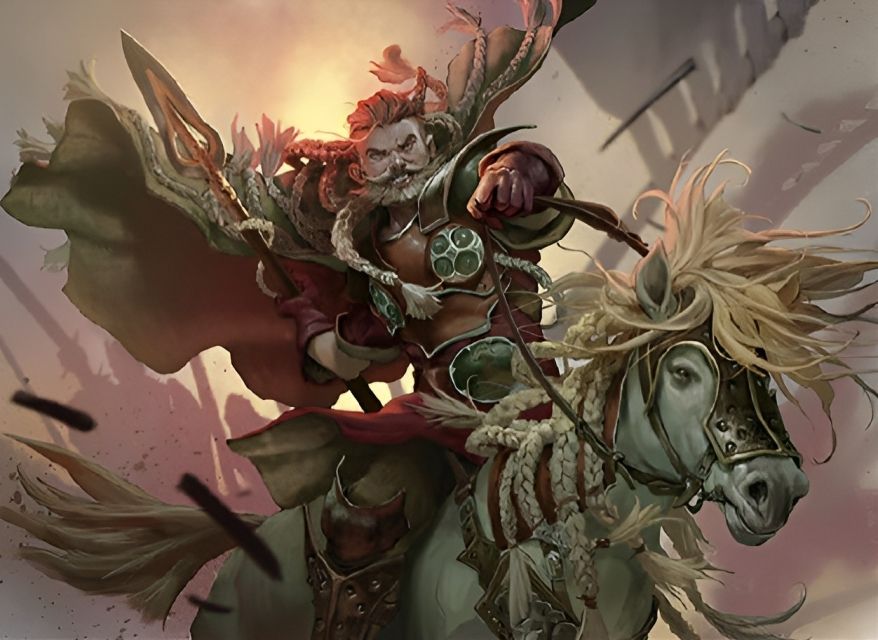
Éomer, Marshal of Rohan | Illustration by Jesper Ejsing
I’m not saying that Magic’s original worlds shouldn’t have stories. Stories give worlds context, texture, and coherence. Characters in those worlds give us somebody to care about: either somebody we’d like to be… or somebody we’d like to obliterate to save the day.
But there’s a difference between Magic’s worlds having a story behind them, and Magic cards being a good medium for telling one.
A novel is sequential by nature. Page 73 comes after page 72. A television series gets Episode 4 after Episode 3. The author controls when we learn something, when a character changes, and when a mystery finally pays off. And sequencing matters a lot for good storytelling. If we learn that Darth Vader is Luke’s father before we actually meet Vader, we’ve basically received the same facts, but definitely not the same story!
Magic cards don’t work like that, at all. There’s no way to control which cards you’ll see first, or even which cards you’ll see at all because the cards you’ll want to play depend a lot on the format.
One of my personal favorites is Éomer of the Riddermark, because I loved the character in the books and won a lot of games with it in Magic, sometimes rescuing victory from the jaws of defeat…
… but that’s because I loved drafting LotR, and Éomer happened to be great there. The set was never legal in Standard, and Éomer of the Riddermark never made a dent in any other format outside drafting, so I doubt non-drafters even know the card exists.
And, worse, that’s the only Éomer-like thing Éomer does in those drafts, while you can make him do a lot of out-of-character stuff. You can kill Frodo, Gandalf, or Aragorn with Éomer. Or you can have him stand steadfast with Sauron and Saruman.
That’s how a Magic game goes. It’s not trying to tell a story; in that sense, cards are just game pieces. Your deck (hopefully!) has some coherent strategy to win; it absolutely does not need to bother with a coherent story.
Magic Is Better at Geography Than History
Archaeomancer's Map | Illustration by Ovidio Cartagena
Early Magic wasn’t about players following the adventures of a cast of protagonists. The players themselves were immensely powerful mages traveling a Multiverse while summoning creatures from those worlds. In Garfield’s vision, we were the planeswakers. Early Magic cards were giving us pieces of distant worlds we could travel to, and summon creatures from.
And that’s something Magic does very well today. Bloomburrow is probably the best recent example: Bloomburrow cards tell you a lot about the plane’s inhabitants and their communities, homes, food, professions, predators, traditions, seasons, and the enormous Calamity Beasts looming above them. The set doesn’t need to spell out that there are no humans in this plane; it’s something you realize just by noting that, hey, they are all rabbits and otters and frogs, and none of them is human.
Yes, it’s still connected to the main storyline. Ral shows up and does… something? I’m not being vague on purpose here, I honestly don’t remember what he does, even if I’ve certainly played the card. But that’s the thing: Bloomburrow works because Bloomburrow is somewhere I’d like to planeswalk to, even if I really don’t know it ties into the main storyline.
Universes Beyond Already Figured This Out

Cloud, Midgar Mercenary | Illustration by Kazto Furuya
Universes Beyond is frequently (and rather ardently…) accused of ruining Magic’s identity, but some of the best UB sets, in my opinion, demonstrate what Magic’s best at.
I’ll go with Lord of the Rings again. There’s definitely a story there (I mean, it’s one of the most influential stories of the past century!), but Magic didn’t have to bother telling us that story; good ol’ Tolkien already did a pretty good job at that.
Which, in turn, allowed Magic do what it does best: let us visit Middle-earth. Of course it all makes even more sense if you are familiar with the LotR IP, but even if you never read the books or saw the movies, you can still catch a very good glimpse of that world.
In a way, Universes Beyond makes storytelling a bit of a team effort: The original IP has the story covered and has done all the heavy lifting in that regard; now Magic has to let us (re)visit the world.
That’s perhaps why, right after Alpha and Beta, Magic went with a proto-UB product, set in an already existing universe: Arabian Nights!
To be clear, I’m not saying that any sufficiently famous IP is a good fit for Magic. Quite the contrary: If places are Magic’s strength, then the place has to be interesting.
Final Fantasy’s Midgar is the sort of city that, all by itself, makes for a killer setting.
Spider-Man’s New York… maybe not so much.
You can have a great story in a pretty boring setting; you just need great characters. But I think that doesn’t translate well to Magic: Any good MTG set needs above all somewhere worth going. It doesn’t even need to be super original. Innistrad is basically Magic taking all the European gothic horror tropes and merging them together: gloomy villages, old churches, vampires in castles, werewolves in forests, shambling corpses, ghosts… none of those ingredients were new when Innistrad used them, and that was the point. What makes Innistrad great is its coherence. You can look at a handful of unrelated Innistrad cards and start imagining what life there must be like.
Fracturing Under Heavy Lifting
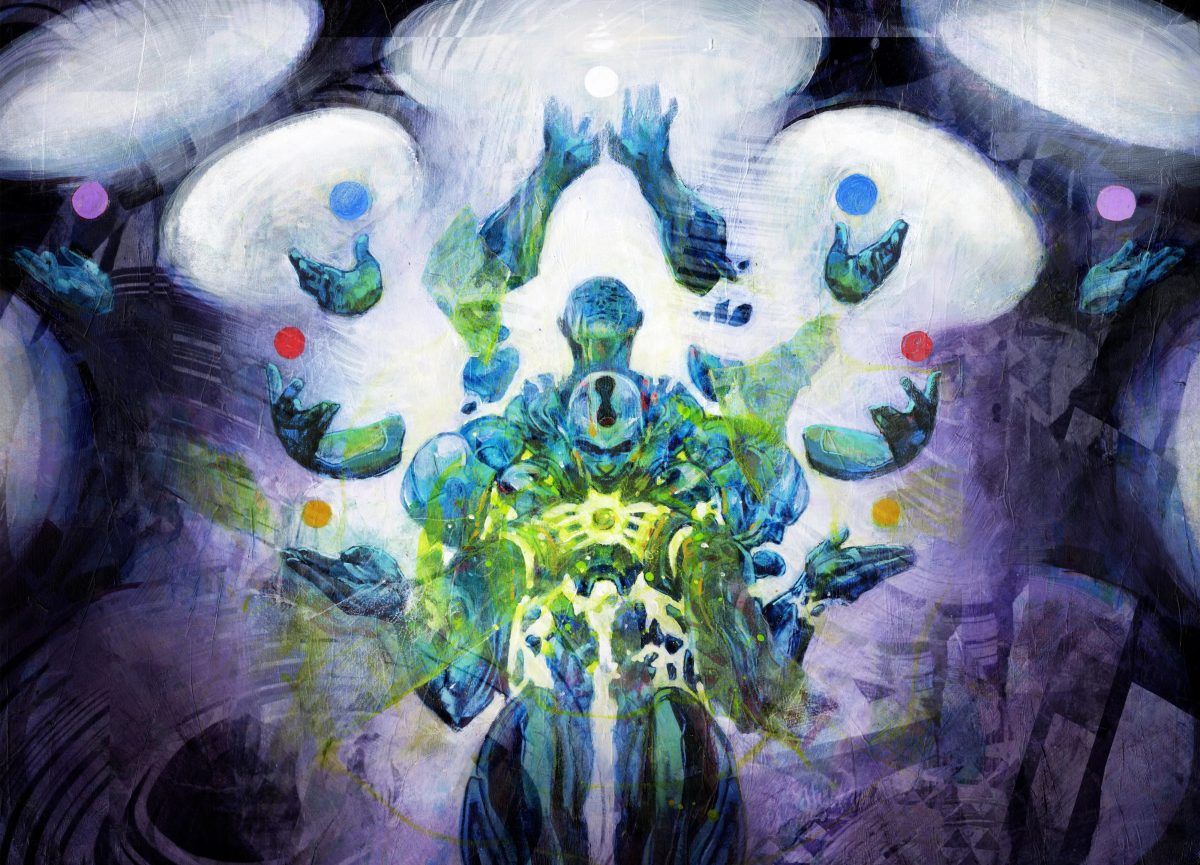
Avatar of Burgeoning Echoes | Illustration by Eli Minaya
Reality Fracture is a good example of the opposite: What happens when WotC asks a set to do everything, from showing us a cool new place to wrapping up an epic storyline. Reality Fracture has to introduce us to Hexhaven and the Echoverse, show us warped versions of people and places we already know, wrap up Jace’s arc…
… even free Emrakul and make her be a sort of saves-the-day heroine for once!
It’s just too much.
That’s another advantage Universes Beyond sets have: their worlds don’t have to lead anywhere else. Avatar doesn’t need Aang to discover an Omenpath at the end so he can turn up on Zhalfir three years from now. Frodo doesn’t need to meet Jace, and Middle-earth doesn’t have to contain some mysterious object that will become important in the next big crossover event.
UB worlds are allowed to be about themselves (there may even be very strict contractual clauses that prohibit WotC from mixing things up too much!). Ironically, that’s some creative freedom that original Magic worlds don’t always get: they can’t just be about themselves, they always have to also be about some overarching narrative.
Where To Next?

The Seriema | Illustration by Sergey Glushakov
Magic can definitely have its own original worlds, and its own cool characters. And WotC certainly shouldn’t stop publishing fiction!
But I think that perhaps the priority is backwards. Instead of building worlds to advance Magic’s story, WotC should build great worlds and use stories to help us experience them. And perhaps also stop trying to connect those worlds with an overarching, “The Whole Multiverse Is At Risk!” storyline.
Just let Bloomburrow be about Bloomburrow, and let Tarkir be about Tarkir. They are cool enough to stand out on their own. And, by all means, those worlds can have victories, tragedies, rivalries, and adventures that make those places feel alive, with characters worth caring about. The Multiverse can still connect everything without everything needing to advance the plot, though. An infinite multiverse feels less infinite and multiverse-y when the same half a dozen heroes keep showing up to save the day.
Magic cards were made for planeswalking. For arriving somewhere strange, seeing things you’ve never imagined. I mean, that’s why we travel to other places, right? We want to get to know the place, even if there’s no world in urgent need of saving from some unimaginably evil Big Bad?
Magic’s stories should serve its worlds, rather than forcing every world to serve one enormous story. A Magic set can communicate the where in a way almost no other medium can. Hundreds of tiny windows into somewhere we’d much love to planeswalk to.
Magic cards may never be the best medium for telling us exactly what happened next… But when it comes to showing us where we could go next, few things do it better.
Follow Draftsim for awesome articles and set updates:









Add Comment